Hepatobilliary System: Source of Bile, composition and its functions
1.
BILE SOURCE ,
COMPOSITION&
FUNCTION
Presented by –
SNEHASIS ADHIKARY
BACHELOR OF SCIENCE IN PHYSICIAN ASSISTANT
DEPARTMENT OF ALLIED HEALTH SCIENCE
2.
INTRODUCTION OF BILE
Bileis secreated from the liver. Human
liver secreates about 0.5 to 1 liter of bile
per day. Secreation of bile is important
for digestion and absorption of fat.
Bile stored in gallbladder.
It released from gallbladder into the
intestine whenever it is required.
3.
FUNCTIONAL ANATOMY
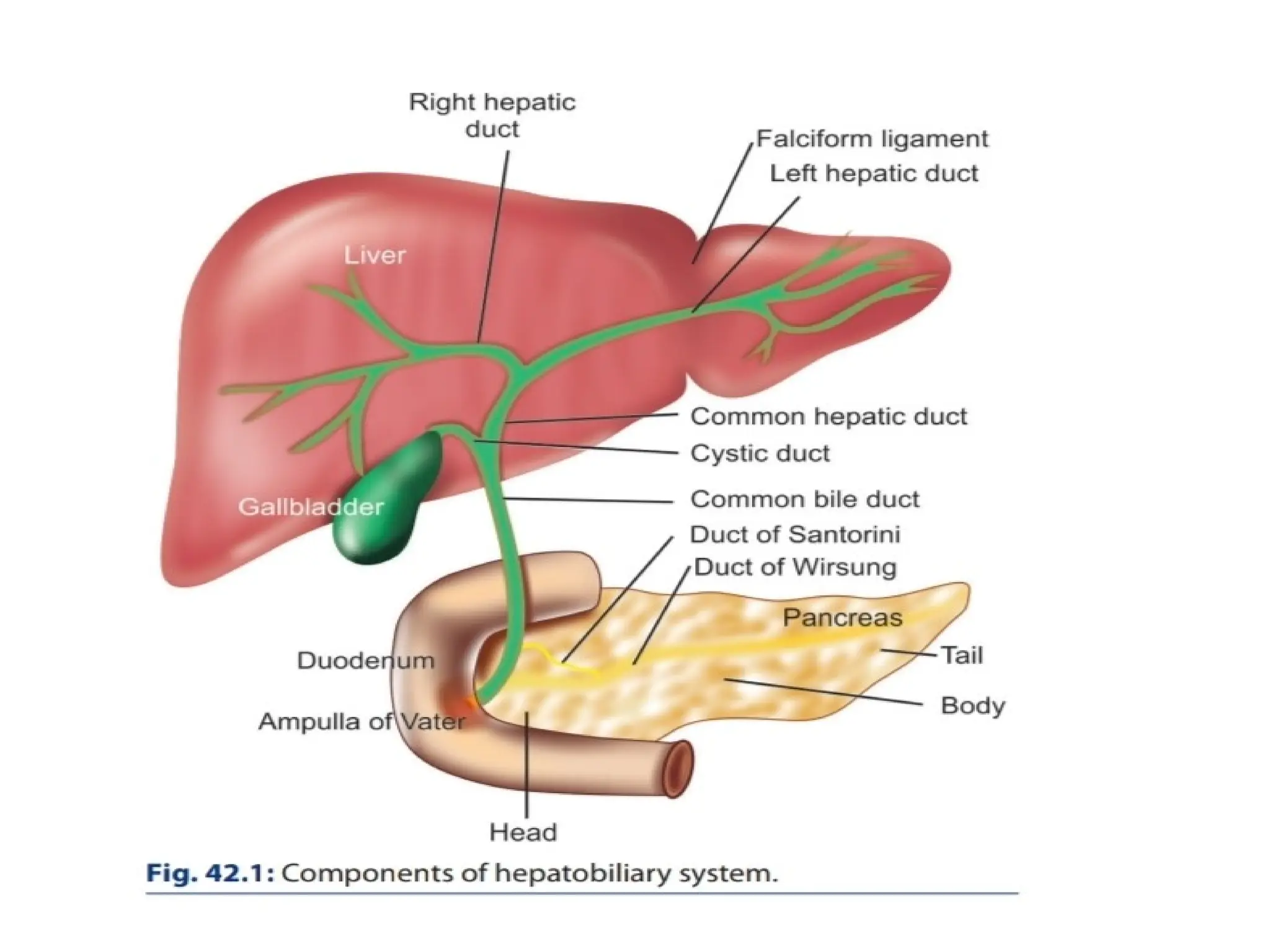
Bileis formed in the liver and is excreadted through the bile
ductules. The bile ductules along with the branches of portal
vein and hepatic artery from the portal triad. The portal triad
opens into the hepatic sinusoids. The sinusoidds are
surrounded by hepatocytes. The hepatocytes are in intimate
contact with the sinusoidal blood. The bile canaliculi start at
the space between two hepatocytes, which opens into bile
ductules. Bile ductules then form the bile duct which leads to
hepatic duct. The right and left hepatic ducts join to form
common hepatic duct. The cystic duct from gallblader
combines with hepatic duct to form common bile duct.
Common ble duct combines with pancreatic duct and opens
to second part of duodenum through sphincter of Oddi.
5.
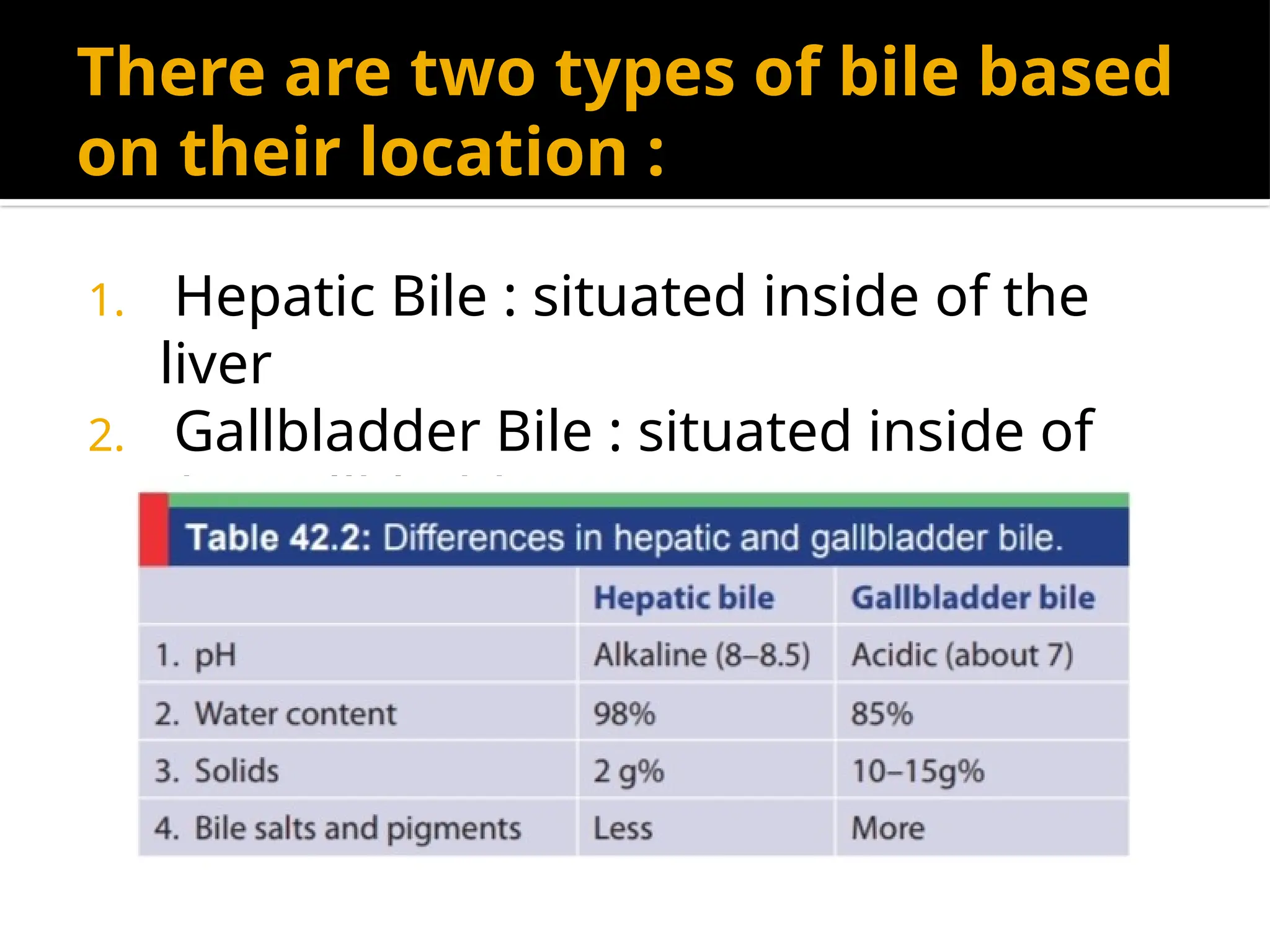
There are twotypes of bile based
on their location :
1. Hepatic Bile : situated inside of the
liver
2. Gallbladder Bile : situated inside of
the gallbladder
6.
COMPOSITION OF BILE
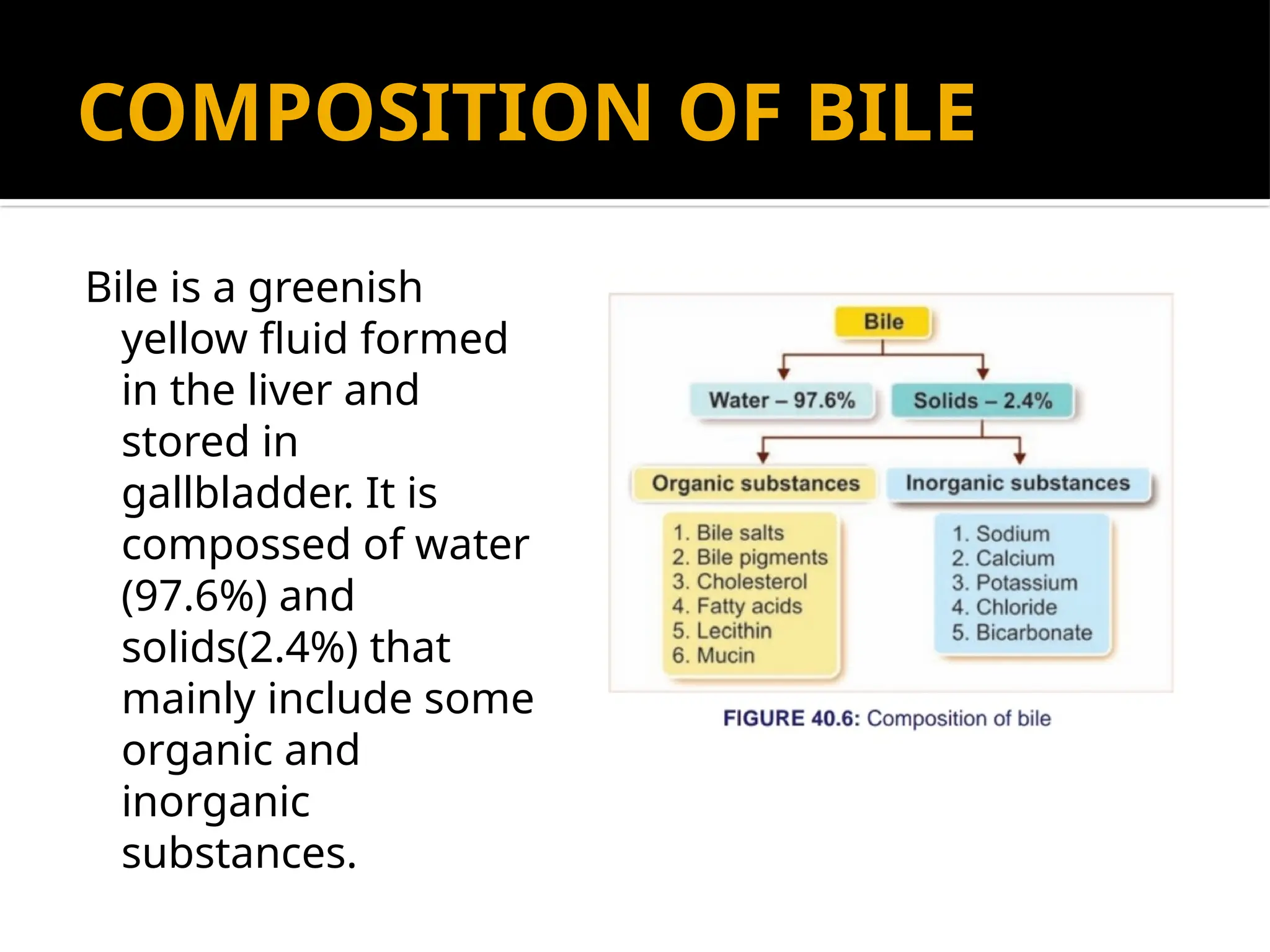
Bileis a greenish
yellow fluid formed
in the liver and
stored in
gallbladder. It is
compossed of water
(97.6%) and
solids(2.4%) that
mainly include some
organic and
inorganic
substances.
7.
BILE ACIDS &BILE SALTS
BILE ACIDS
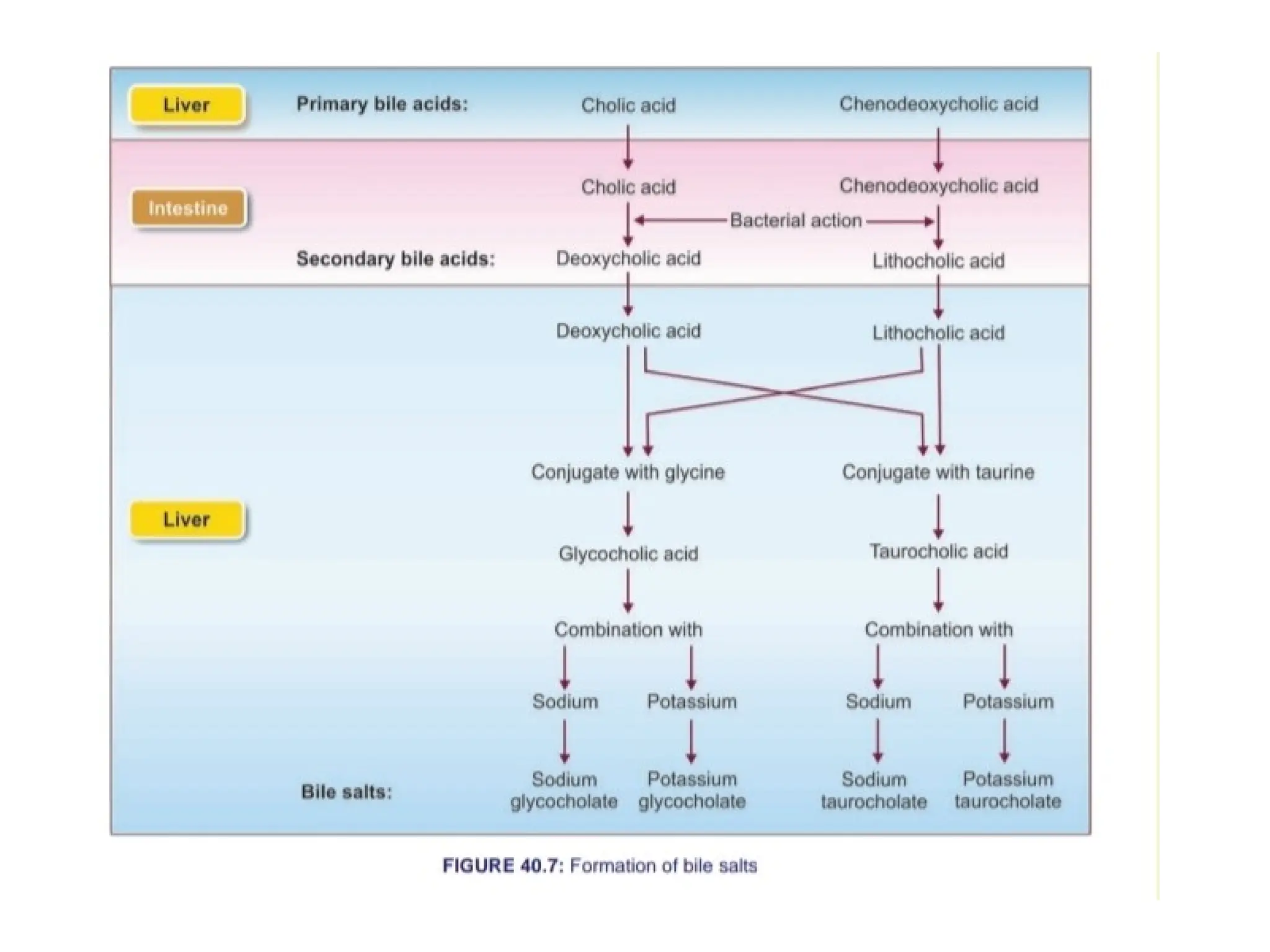
1. The primary bile acids are
cholic acid and
chenodeoxycholic acid. The
primary bile acids are
formed in the hepatocytes
from cholesterol.
2. Secondary bile acids are
deoxycholic acid and
lithocholic acid. The
secondary bile acids are
produced in the intestine
where intestinal bacteria
convert primary bile acidds
into secondary bile acids.
BILE SALTS
Bile ssalts are Na+ and K+
salts of bile acid. Bile acids
are conjugated with
taurine or glycine to form
taurocholic acid or
glycocholic acid. These
acids then combine with
sodium and potassium
salts to form Na+ -
taurocholate, Na+ -
glycocholate, K+ -
taurocholate and K+ -
glycocholate respectively.
9.
FUNCTION OF BILESALT
Absorption of Fat : This depends on formation
of micelles by bile salts in the intestine. Lipids
are transported in micelles from the lumen to
membrane of intestinal mucosal epithelial cells
where micelle dissociates and lipids are
absorbed.
Emulsification of Fat : Bile salts are surface
tension reducing agents. Along with
phopholipids and monoglycerides, they cause
emulsification of fat, which is essential for
digestion and absorption of fat.
10.
FUNCTION OF BILESALT
Source of bile acid : Bile salts are
converted to bile acids in the intestine,
which are then absorbed into portal
blood.
Bile secretion : Bile salts are important
choleretics. They are constituent of bile
and also they stimulate bile secretion.
Activation of pancreatic enzymes :
Bile salts activate pancreatic lipase.
11.
FUNCTION OF BILESALT
Absorption of fat-soluble vitamins : Bile salts
facilitate absoption of fat soluble vitamins (vitamins
A,D,E & K).
Prevention of gallstone formation : Bile ssalts
along with lecithin solubilize cholesterol. Thus ,
they prevent formation of stones in the gallbladder.
Prevention of bacterial growth : Bile maintains
pH of intestinal content and prevent overgrowth of
bacteria in intestine.
Stool color : Bile salts add natural brownish color
to the stool.
12.
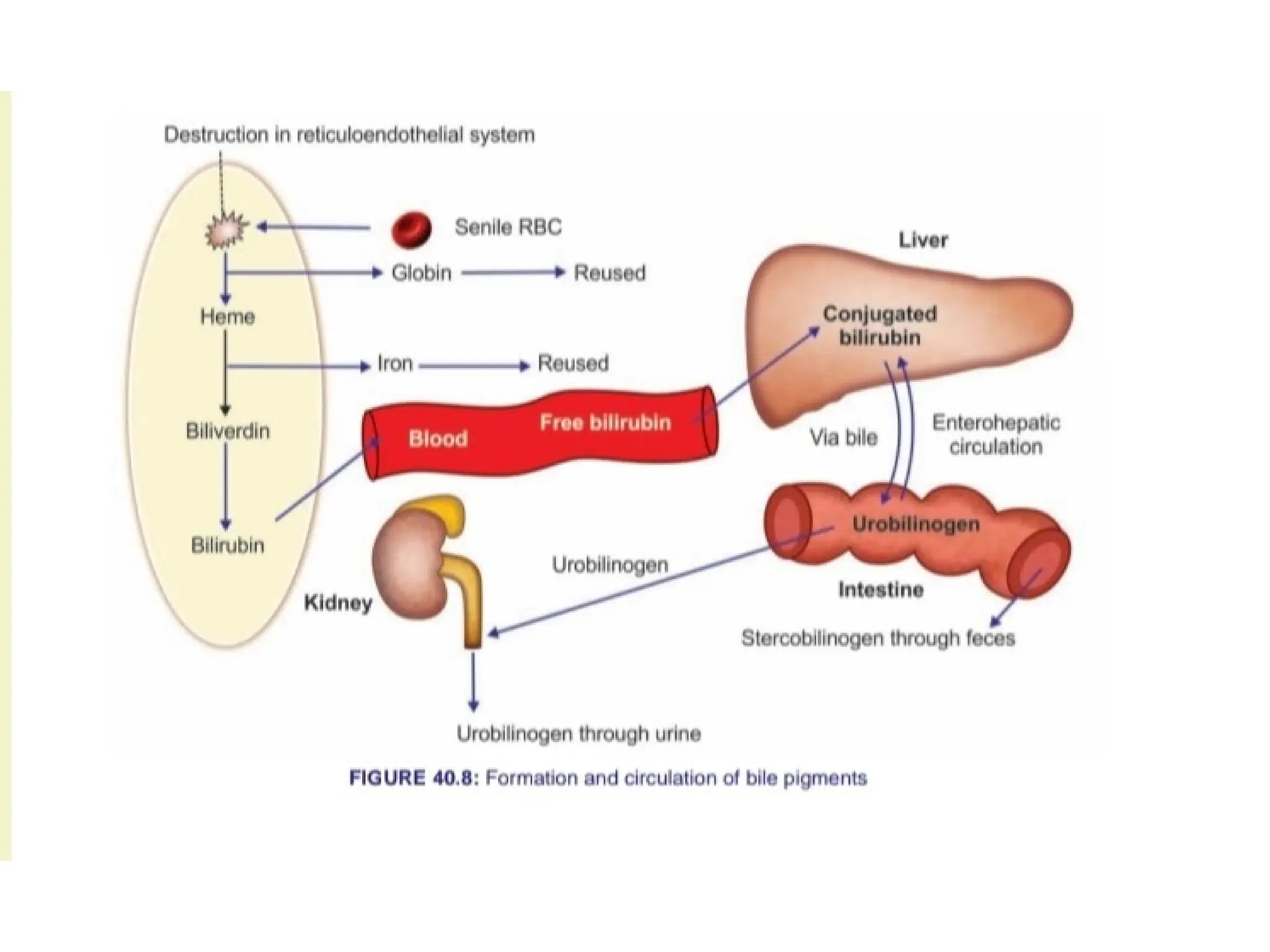
BILE PIGMENT
Bile pigmentsare the excretory products
in bile. Biliverdin and bilirubin are the
two bile pigments and bilirubin is the
major bile pigment in human beings.
Bile pigments are formed during
breakdown of hemoglobin, which is
released from the destroyed RBCs in
the reticuloendothelial system.
14.
FUNCTION OF BILE
1.Bile helps in absorption of lipid from
intestine by forming micelles.
2. Bile salts in bile are important
choleretics(increase bile secretion).
3. Bile promotes absorption of fat soluble
vitamins (A,D,E,K).
4. Bile ssalts activate pancreatic lipase.
5. Bile pigments (bilirubin & biliverdin) are
responsible for greenish-yellow coloration of
gallbladder that helps to identify the organ
especially in small animals.
15.
REFERENCE
1. Essentials ofMEDICAL PHYSIOLOGY by
K Sembulingam & Prema
Sembulingam (Sixth Edition)
2. Comprehensive Textbook of MEDICAL
PHYSIOLOGY by G K Pal , Pravati Pal &
Nivedita Nanda (First Edition)