Fuzzy C-Means Clustering
Protocol For Wireless Sensor
Networks
By Group:
K.Mourya
Manoj
Lahari
• Clustering technique is utilized as an energy
efficient routing in Wireless Sensor Networks.
• Many routing protocols have been proposed
to obtain energy efficient communication for
the WSNs for recent years.
• Routing techniques are classified into three
categories based on their network structure
• They are:
1. Flat routing protocol
2. Hierarchical routing protocol
3. Location-based routing protocol
• Among these routing protocols, hierarchical
or cluster based protocols are well known
techniques with special advantages related
to scalability and efficient communication.
• In hierarchical routing method their are
usually two types of sensor nodes:
1. Clustering head nodes(CH)
2. Non-CH nodes
• Non-Ch nodes mainly carry out sensing task
and send information to the CH,while CH
collect data and send to the end users.
LEACH
• LEACH stands for Low Energy Adaptive
Clustering Hierarchy.
• It is a cluster-based protocol using a
distributed clustering formation algorithm.
• It uses a predetermined probability for
selecting the CH nodes.
MINIMUM TRANSMISSION
ENERGY
• MTE protocol route messages from a node
through its nearest neighbor toward the BS, in
this case, nodes nearer to the BS have to relay
a huge amount of data.
• Thus, they ran out of energy before other
nodes.
K-Means
• Clustering is the process of partitioning a group of
data points into a small number of clusters. For
instance, the items in a supermarket are clustered in
categories (butter, cheese and milk are grouped in
dairy products). Of course this is a qualitative kind of
partitioning. A quantitative approach would be to
measure certain features of the products, say
percentage of milk and others, and products with
high percentage of milk would be grouped together.
In general, we have n data points xi,i=1...n that have
to be partitioned in k clusters.
• The goal is to assign a cluster to each data point. K-
means is a clustering method that aims to find the
positions μi,i=1...k of the clusters that minimize
the distance from the data points to the cluster. K-
means clustering solves
• Argminc ∑i=1k∑x cid(x,μi)=argminc∈
∑i=1k∑x ci x−μi 22∈ ∥ ∥
• where ci is the set of points that belong to cluster i.
The K-means clustering uses the square of the
Euclidean distance d(x,μi)= x−μi 22. This problem is∥ ∥
not trivial (in fact it is NP-hard), so the K-means
algorithm only hopes to find the global minimum,
possibly getting stuck in a different solution.
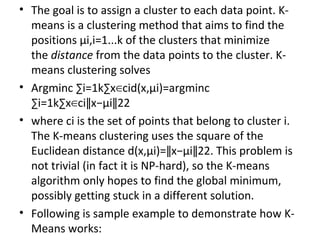
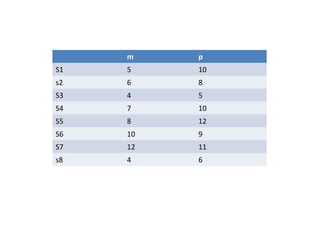
• Following is sample example to demonstrate how K-
Means works:
m p
S1 5 10
s2 6 8
S3 4 5
S4 7 10
S5 8 12
S6 10 9
S7 12 11
s8 4 6
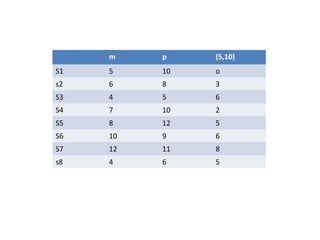
m p (5,10)
S1 5 10 o
s2 6 8 3
S3 4 5 6
S4 7 10 2
S5 8 12 5
S6 10 9 6
S7 12 11 8
s8 4 6 5
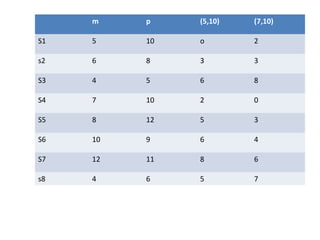
m p (5,10) (7,10)
S1 5 10 o 2
s2 6 8 3 3
S3 4 5 6 8
S4 7 10 2 0
S5 8 12 5 3
S6 10 9 6 4
S7 12 11 8 6
s8 4 6 5 7
m p (5,10) (7,10) (12,11)
S1 5 10 o 2 8
s2 6 8 3 3 9
S3 4 5 6 8 14
S4 7 10 2 0 6
S5 8 12 5 3 5
S6 10 9 6 4 4
S7 12 11 8 6 0
s8 4 6 5 7 13
m p (5,10) (7,10) (12,11)
S1 5 10 o 2 8 1
s2 6 8 3 3 9 1
S3 4 5 6 8 14 1
S4 7 10 2 0 6 2
S5 8 12 5 3 5 2
S6 10 9 6 4 4 3
S7 12 11 8 6 0 3
s8 4 6 5 7 13 1
where
‘||xi 
- vj
||’ is the Euclidean distance between xi
 and vj.
‘ci
’ is the number of data points in ith
 cluster. 
‘c’ is the number of cluster centers.
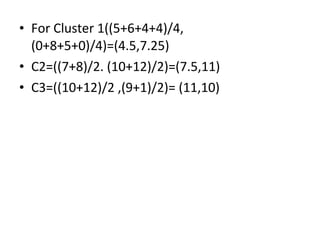
• For Cluster 1((5+6+4+4)/4,
(0+8+5+0)/4)=(4.5,7.25)
• C2=((7+8)/2. (10+12)/2)=(7.5,11)
• C3=((10+12)/2 ,(9+1)/2)= (11,10)
WIRELESS SENSOR NETWORKS
• Wireless Sensor Networks(WSN) consists of 
hundreds to thousands of tiny sensor nodes 
equipped with sensing, data processing, and 
communication units.
• They are used to collect information about the 
ambient environment like temperature, 
humidity, vibration, light, etc.
• The measured data is pre-processed and sent to the 
Base Station(BS).
• Due to these capabilities WSN are used in wide 
variety of fields like target tracking, surveillance, 
Healthcare monitoring, habitat monitoring, etc.
• However they are equipped with only a limited 
energy so energy conservation is the key challenge in
the connectivity of the network.
• And communication takes most of the energy 
compared to other tasks.
• So routing algorithms are used to make it energy 
efficient.
FUZZY C-MEANS
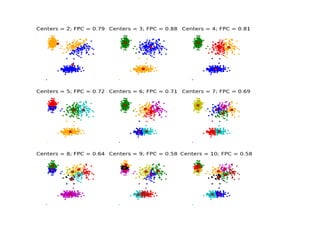
• Fuzzy c-means (FCM) is a data clustering technique in
which a dataset is grouped into n clusters with every
datapoint in the dataset belonging to every cluster to
a certain degree. For example, a certain datapoint
that lies close to the center of a cluster will have a
high degree of belonging or membership to that
cluster and another datapoint that lies far away from
the center of a cluster will have a low degree of
belonging or membership to that cluste
CONCLUSION
• Fuzzy-C Means Algorithm in slower than K-
means Algorithm in efficiency but gives better
results in cases where data is incomplete or
uncertain and has wider appicability.

Fuzzy c means clustering protocol for wireless sensor networks

  • 1.
    Fuzzy C-Means Clustering ProtocolFor Wireless Sensor Networks By Group: K.Mourya Manoj Lahari
  • 3.
    • Clustering techniqueis utilized as an energy efficient routing in Wireless Sensor Networks.
  • 4.
    • Many routingprotocols have been proposed to obtain energy efficient communication for the WSNs for recent years. • Routing techniques are classified into three categories based on their network structure • They are: 1. Flat routing protocol 2. Hierarchical routing protocol 3. Location-based routing protocol
  • 5.
    • Among theserouting protocols, hierarchical or cluster based protocols are well known techniques with special advantages related to scalability and efficient communication. • In hierarchical routing method their are usually two types of sensor nodes: 1. Clustering head nodes(CH) 2. Non-CH nodes • Non-Ch nodes mainly carry out sensing task and send information to the CH,while CH collect data and send to the end users.
  • 6.
    LEACH • LEACH standsfor Low Energy Adaptive Clustering Hierarchy. • It is a cluster-based protocol using a distributed clustering formation algorithm. • It uses a predetermined probability for selecting the CH nodes.
  • 7.
    MINIMUM TRANSMISSION ENERGY • MTEprotocol route messages from a node through its nearest neighbor toward the BS, in this case, nodes nearer to the BS have to relay a huge amount of data. • Thus, they ran out of energy before other nodes.
  • 8.
    K-Means • Clustering isthe process of partitioning a group of data points into a small number of clusters. For instance, the items in a supermarket are clustered in categories (butter, cheese and milk are grouped in dairy products). Of course this is a qualitative kind of partitioning. A quantitative approach would be to measure certain features of the products, say percentage of milk and others, and products with high percentage of milk would be grouped together. In general, we have n data points xi,i=1...n that have to be partitioned in k clusters.
  • 9.
    • The goalis to assign a cluster to each data point. K- means is a clustering method that aims to find the positions μi,i=1...k of the clusters that minimize the distance from the data points to the cluster. K- means clustering solves • Argminc ∑i=1k∑x cid(x,μi)=argminc∈ ∑i=1k∑x ci x−μi 22∈ ∥ ∥ • where ci is the set of points that belong to cluster i. The K-means clustering uses the square of the Euclidean distance d(x,μi)= x−μi 22. This problem is∥ ∥ not trivial (in fact it is NP-hard), so the K-means algorithm only hopes to find the global minimum, possibly getting stuck in a different solution. • Following is sample example to demonstrate how K- Means works:
  • 10.
    m p S1 510 s2 6 8 S3 4 5 S4 7 10 S5 8 12 S6 10 9 S7 12 11 s8 4 6
  • 11.
    m p (5,10) S15 10 o s2 6 8 3 S3 4 5 6 S4 7 10 2 S5 8 12 5 S6 10 9 6 S7 12 11 8 s8 4 6 5
  • 12.
    m p (5,10)(7,10) S1 5 10 o 2 s2 6 8 3 3 S3 4 5 6 8 S4 7 10 2 0 S5 8 12 5 3 S6 10 9 6 4 S7 12 11 8 6 s8 4 6 5 7
  • 13.
    m p (5,10)(7,10) (12,11) S1 5 10 o 2 8 s2 6 8 3 3 9 S3 4 5 6 8 14 S4 7 10 2 0 6 S5 8 12 5 3 5 S6 10 9 6 4 4 S7 12 11 8 6 0 s8 4 6 5 7 13
  • 14.
    m p (5,10)(7,10) (12,11) S1 5 10 o 2 8 1 s2 6 8 3 3 9 1 S3 4 5 6 8 14 1 S4 7 10 2 0 6 2 S5 8 12 5 3 5 2 S6 10 9 6 4 4 3 S7 12 11 8 6 0 3 s8 4 6 5 7 13 1 where ‘||xi  - vj ||’ is the Euclidean distance between xi  and vj. ‘ci ’ is the number of data points in ith  cluster.  ‘c’ is the number of cluster centers.
  • 15.
  • 16.
  • 18.
    • The measured data is pre-processed and sent to the  Base Station(BS). • Due to these capabilities WSN are used in wide  variety of fields like target tracking, surveillance,  Healthcare monitoring, habitat monitoring, etc. •However they are equipped with only a limited  energy so energy conservation is the key challenge in the connectivity of the network. • And communication takes most of the energy  compared to other tasks. • So routing algorithms are used to make it energy  efficient.
  • 19.
    FUZZY C-MEANS • Fuzzyc-means (FCM) is a data clustering technique in which a dataset is grouped into n clusters with every datapoint in the dataset belonging to every cluster to a certain degree. For example, a certain datapoint that lies close to the center of a cluster will have a high degree of belonging or membership to that cluster and another datapoint that lies far away from the center of a cluster will have a low degree of belonging or membership to that cluste
  • 21.
    CONCLUSION • Fuzzy-C MeansAlgorithm in slower than K- means Algorithm in efficiency but gives better results in cases where data is incomplete or uncertain and has wider appicability.