Downloaded 27 times
![IOSR Journal of Computer Engineering (IOSRJCE)
ISSN: 2278-0661 Volume 4, Issue 6 (Sep-Oct. 2012), PP 23-30
www.iosrjournals.org
www.iosrjournals.org 23 | Page
A Comprehensive Overview of Clustering Algorithms in Pattern
Recognition
Namratha M
1
, Prajwala T R
2
1, 2
(Dept. of information science, PESIT/visvesvaraya technological university, India)
Abstract: Machine learning is a branch of artificial intelligence which recognizes complex patterns for
making intelligent decisions based on input data values. In machine learning, pattern recognition assigns
input value to given set of data labels.
Based on the learning method used to generate the output we have the following classification, supervised and
unsupervised learning. Unsupervised learning involves clustering and blind signal separation. Supervised
learning is also known as classification.
This paper mainly focuses on clustering techniques such as K-means clustering, hierarchical
clustering which in turn involves agglomerative and divisive clustering techniques.
This paper deals with introduction to machine learning, pattern recognition, clustering
techniques. We present steps involved in each of these clustering techniques along with an example and the
necessary formula used. The paper discusses the advantages and disadvantages of each of these techniques
and in turn we make a comparison of K-means and hierarchical clustering techniques. Based on
these comparisons we suggest the best suited clustering technique for the specified application.
Keywords: Agglomerative, Clustering, Divisive, K-means, Machine learning, Pattern recognition
I. Introudction
Machine learning is the field of research devoted to study of learning systems. Machine learning
refers to changes in the systems that perform tasks associated with artificial intelligence like recognition,
diagnosis, prediction and so on.
In machine learning[1], pattern recognition is assignment of label to given input value.
A pattern is an entity like fingerprint image, handwritten word or human face that could be given a
name. Recognition is an act of associating a classification with a label.
Pattern recognition[2] is the science of making inferences based on data. It’s objective is to assign
an object or event to one of a number of categories based on features derived to emphasize commonalities.
Figure 1: Design cycle for patter recognition
Pattern recognition involves three types of learning:
1. Unsupervised learning
2. Supervised learning
3. Semisupervised learning
In unsupervised learning[2] also known as cluster analysis, the basic task is to develop
classification labels. It’s task is to arrive at some grouping of data. The training set consists of labeled data.
Two types of unsupervised learning are:
a. Clustering
b. Blind signal separation
In supervised learning[2], classes are predetermined. The classes are seen as a finite set of data. A
certain segment of data will be labeled with these classification. The task is to search for patterns and
construct mathematical models. The training set consists of unlabeled data.](https://image.slidesharecdn.com/d0462330-131001012502-phpapp01/85/A-Comprehensive-Overview-of-Clustering-Algorithms-in-Pattern-Recognition-1-320.jpg)
![IOSR Journal of Computer Engineering (IOSRJCE)
ISSN: 2278-0661 Volume 4, Issue 6 (Sep-Oct. 2012), PP 23-30
www.iosrjournals.org
www.iosrjournals.org 23 | Page
A Comprehensive Overview of Clustering Algorithms in Pattern
Recognition
Namratha M
1
, Prajwala T R
2
1, 2
(Dept. of information science, PESIT/visvesvaraya technological university, India)
Abstract: Machine learning is a branch of artificial intelligence which recognizes complex patterns for
making intelligent decisions based on input data values. In machine learning, pattern recognition assigns
input value to given set of data labels.
Based on the learning method used to generate the output we have the following classification, supervised and
unsupervised learning. Unsupervised learning involves clustering and blind signal separation. Supervised
learning is also known as classification.
This paper mainly focuses on clustering techniques such as K-means clustering, hierarchical
clustering which in turn involves agglomerative and divisive clustering techniques.
This paper deals with introduction to machine learning, pattern recognition, clustering
techniques. We present steps involved in each of these clustering techniques along with an example and the
necessary formula used. The paper discusses the advantages and disadvantages of each of these techniques
and in turn we make a comparison of K-means and hierarchical clustering techniques. Based on
these comparisons we suggest the best suited clustering technique for the specified application.
Keywords: Agglomerative, Clustering, Divisive, K-means, Machine learning, Pattern recognition
I. Introudction
Machine learning is the field of research devoted to study of learning systems. Machine learning
refers to changes in the systems that perform tasks associated with artificial intelligence like recognition,
diagnosis, prediction and so on.
In machine learning[1], pattern recognition is assignment of label to given input value.
A pattern is an entity like fingerprint image, handwritten word or human face that could be given a
name. Recognition is an act of associating a classification with a label.
Pattern recognition[2] is the science of making inferences based on data. It’s objective is to assign
an object or event to one of a number of categories based on features derived to emphasize commonalities.
Figure 1: Design cycle for patter recognition
Pattern recognition involves three types of learning:
1. Unsupervised learning
2. Supervised learning
3. Semisupervised learning
In unsupervised learning[2] also known as cluster analysis, the basic task is to develop
classification labels. It’s task is to arrive at some grouping of data. The training set consists of labeled data.
Two types of unsupervised learning are:
a. Clustering
b. Blind signal separation
In supervised learning[2], classes are predetermined. The classes are seen as a finite set of data. A
certain segment of data will be labeled with these classification. The task is to search for patterns and
construct mathematical models. The training set consists of unlabeled data.](https://image.slidesharecdn.com/d0462330-131001012502-phpapp01/75/A-Comprehensive-Overview-of-Clustering-Algorithms-in-Pattern-Recognition-1-2048.jpg)
![AComprehensive Overview Of Clustering Algorithms In Pattern Recognition
www.iosrjournals.org 24 | Page
Two types of supervised learning are:
a. Classification
b. Ensemble learning
Semisupervised learning deals with methods for exploiting unlabeled data and labeled data
automatically to improve learning performance without human intervention.
Four types of semisupervised learning are:
a. Deep learning
b. Low density separation
c. Graph based methods
d. Heuristic approach
Clustering is a form of unsupervised learning which involves the task of finding groups of objects
which are similar to one another and different from the objects in another group. The goal is to minimize
intracluster distances and maximize intercluster distances[3].
Figure 2: Graphical representation of clustering
II. K-Means Clustering
K-means is one of the simplest unsupervised learning algorithm that is used to generate specific
number of disjoint and non-hierarchical clusters based on attributes[4]. It is a numerical, non-
deterministic and iterative method to find the clusters. The purpose is to classify data.
Steps in K-means clustering:
Step 1: Consider K points to be clustered x1,…, xK. These are represented in a space in which objects are being
clustered. These points represent initial centroids.
Step 2: Each object is assigned to the group that has closest centroid[5].
Step 3: The positions of K centroids are recalculated after all objects have been assigned. C(i) denotes cluster
number for the ith observation[5]
Step 4: Reiterate steps 2 and 3 until no other distinguished centroid can be found. Hence, K clusters whose
intracluster distance is minimized and intercluster distance is maximized[5].
where
mk is the mean vector of the kth cluster
.,,1,
)(:
Kk
N
x
m
k
kiCi
i
k
NimxiC
Kk
ki ,,1,minarg)(
1
2
K
k kiC
kik
K
k kiC kjC
ji mxNxxCW
1 )(
2
1 )( )(
2
2
1
)(](https://image.slidesharecdn.com/d0462330-131001012502-phpapp01/85/A-Comprehensive-Overview-of-Clustering-Algorithms-in-Pattern-Recognition-2-320.jpg)
![AComprehensive Overview Of Clustering Algorithms In Pattern Recognition
www.iosrjournals.org 25 | Page
Nk is the number of observations in k
th
cluster
The choice of initial cluster can greatly affect the final clusters in terms of intracluster
distance, intercluster distance and cohesion.
The sum of squares of distance between object and corresponding cluster centroid is minimum in the
final cluster.
Figure 3: Flowchart to represent steps in K-means clustering
Advantages:
1. K-means is computationally fast.
2. It is a simple and understandable unsupervised learning algorithm
Disadvantages:
1. Difficult to identify the initial clusters.
2. Prediction of value of K is difficult because the number of clusters is fixed at the beginning.
3. The final cluster patterns is dependent on the initial patterns.
Example: Problem:
To find the cluster of 5 points: (2,3),(4,6),(7,3),(1,2),(8,6).
Solution:
The initial clusters are (4,6) and (2,3) Iteration 1:
(4,6) (2,3) Cluster
(2,3) 5 0 2
(1,2) 7 2 2
(4,6) 0 5 1
(8,6) 4 9 1
(7,3) 6 5 2
The cluster column is calculated by finding the shortest distance between the points[6]. The new values
of centroid are (6,6) and (10/3,8/3).
Iteration 2:
Repeat the above steps to find the new values of centroids. Since the values converge, we do not
proceed to next iteration. Hence the final clusters are :
Cluster 1: (4,6) and (8,6) Cluster 2:(2,3) , (1,2) and (7,3) Applications[7]:
Used in segementation and retreival of grey level images[6].
Applied for spatial and temporal datasets in the field of geostatics.
Used to analyze the listed enterprises in financial organizations[4].
Also used in the fields of astronomy and agriculture.](https://image.slidesharecdn.com/d0462330-131001012502-phpapp01/85/A-Comprehensive-Overview-of-Clustering-Algorithms-in-Pattern-Recognition-3-320.jpg)
![AComprehensive Overview Of Clustering Algorithms In Pattern Recognition
www.iosrjournals.org 26 | Page
III. Hierarchical Clustering
It is an unsupervised learning technique that outputs a hierarchical structure which does not require to
prespecify the nuimber of clusters. It is a deteministic algorithm[3].
There are two kinds of hierarchical clustering:
1. Agglomerative clustering
2. Divisive clusttering
Agglomerative clustering:
It is a bottom up approach with n singleton clusters initially where each cluster has subclusters which in
turn have subclusters and so on[9].
Steps in agglomerative clustering:
Step 1: Each singleton group is assigned with unique data points.
Step 2: Merge the two adjacent groups iteratvely repeat this step. Calculate the Euclidian distance using the
formula given below[8],
Where a(x1,y1) and b(x2,y2) represent the coordinates of the clusters . Mean distance dmean(Di,Dj)=||xi-xj||
Where Di and Dj represent the clusters i and j respectively
Xi and xj are the means of clusters i and j respectively
Step 3: Repeat until a single cluster is obtained.
Figure 4: Flowchart for steps in agglomerative clustering
Advantages:
1. It ranks the objects for easier data display.
2. Small clusters are obtained which is easier to analyze and understand.
3. Number of clusters is not fixed at the beginning. Hence, user has the flexibility of choosing the clusters
dynamically.
Disadvantages:
1. If objects are grouped incorrectly at the initial stages , they cannot be relocated at later stages.](https://image.slidesharecdn.com/d0462330-131001012502-phpapp01/85/A-Comprehensive-Overview-of-Clustering-Algorithms-in-Pattern-Recognition-4-320.jpg)
![AComprehensive Overview Of Clustering Algorithms In Pattern Recognition
www.iosrjournals.org 27 | Page
2. The results vary based on the distance metrics used.
Example: Problem:
To find the cluster of 5 points: A(2,3),B(4,6),C(7,3),D(1,2),E(8,6).
Solution:
Iteration 1:
Calculate the Euclidian distance between two points. Euclidian distance between two points are:
A(2,3) and B(1,2)=sqrt(2)=1.41
A(2,3) and C(4,6)=sqrt(13)=3.6
A(2,3) and D(8,6)=sqrt(25)=5
A(2,3) and E(7,3)= sqrt(25)=5
The two adjacent clusters are A(2,3) and B(1,2). Merge these two clusters. The new centroid is F(1.5,2.5).
Iteration 2:
Repeat the above step and merge adjacent clusters as above.
The two adjacent clusters are C(4,6) and D(8,6). Merge these two clusters. The new centroid is G(6,6).
Iteration 3:
Repeat the above step and merge adjacent clusters as above.
The two adjacent clusters are G(6,6) and E(7,3). Merge these two clusters. The new centroid is H(6.5,4.5).
Iteration 4:
Repeat the above step and merge adjacent clusters as above.
The two adjacent clusters are H(1.5,2.5) and F(6.5,4.5). Merge these two clusters. Finally we get the resultant
single cluster R.
Figure 5: Diagrammatic representation of agglomerative clustering for the above example
Applications:
1. Used in search engine query logs for knowledge discovery.
2. Used in image classification systems to merge logically adjacent pixel values.
3. Used in automatic document classification.
4. Used in web document categorization.
Divisive clustering:
It is a top-down clustering method which works in a similar way to agglomerative clustering
but in the opposite direction. This method starts with a single cluster containing all objects and then
successively splits resulting clusters until only clusters of individual objects remain[10].
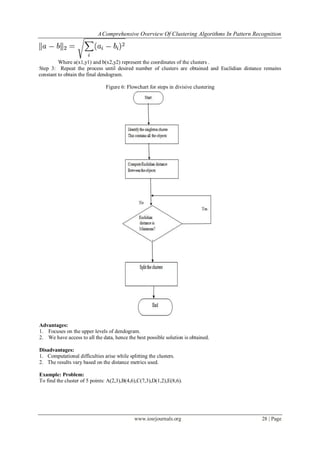
Steps in divisive clustering:
Step 1: Initially consider a singleton cluster.
Step 2: Iteratively divide the clusters into smaller clusters based on the Euclidian distance. Objects with least
Euclidian distance are grouped into a single cluster[8].](https://image.slidesharecdn.com/d0462330-131001012502-phpapp01/85/A-Comprehensive-Overview-of-Clustering-Algorithms-in-Pattern-Recognition-5-320.jpg)
![AComprehensive Overview Of Clustering Algorithms In Pattern Recognition
www.iosrjournals.org 29 | Page
Solution:
Iteration 1: Calculate the Euclidian distance between two points. Euclidian distance between two points are:
A(2,3) B(4,6) C(7,3) D(1,2) E(8,6)
A(2,3) Sqrt(13) Sqrt(25) Sqrt(2) Sqrt(45)
B(4,6) Sqrt(18) Sqrt(25) Sqrt(16)
C(7,3) Sqrt(37) Sqrt(10)
D(1,2) Sqrt(65)
E(8,6)
Since sqrt(2) is the least Euclidian distance merge the point sA(2,3) and D(1,2)
The new centroid is F(1.5,2.5). Iteration 2:
Repeat the above step and merge adjacent clusters with least Euclidian distance as above. The two
adjacent clusters are C(7,3) and E(8,6). Merge these two clusters.
The new centroid is G(7.5,4.5). Iteration 3:
Repeat the above step and merge adjacent clusters with least Euclidian distance as above.
The two adjacent clusters are B(4,6) and G(7.5,4.5). Merge these two clusters.
Figure 7: The resulting dendogram for the above example[11].
Applications:
1. Used in medical imaging for PET scans.
2. Used in world Wide Web in social networking analysis and slippy map optimization.
3. Used in market research for grouping shopping items.
4. Used in crime analysis to find hot spots where crime has occurred.
5. Also used in mathematical chemistry and petroleum geology.
Agglomerative versus divisive clustering:
Table 1:Comparison of hierarchical clustering techniques
Agglomerative Divisive
1. Bottom-up approach Top-down approach
2. Faster to compute Slower to compute
3. More ration al to global structure of data. Less blind to global structure of data
4. Best possible merge is obtained Best possible split is obtained
5. Access to individual objects Access to all data
IV. K-Means versus Hierarchical Clustering
Table 2:Comparison of clustering techniques
Hierarchical K means
Sequential partitioning process Iterative partitioning process
Results in nested cluster structure Results in Flat mutually exclusive structure
Membership of an object or cluster in fixed Membership of an object or cluster could be
constantly changed.
Prior knowledge of the number of clusters is not
needed.
Prior knowledge of the number of clusters is
needed in advance.
Generic clustering technique irrespective of the
data types.
Data are Summarized by representative entities.
Run time is slow. Run time Faster than Hierarchical.
Hierarchical clustering requires only a similarity
measure.
K-means clustering requires stronger
assumptions such as number of clusters and the
initial centers.](https://image.slidesharecdn.com/d0462330-131001012502-phpapp01/85/A-Comprehensive-Overview-of-Clustering-Algorithms-in-Pattern-Recognition-7-320.jpg)
![AComprehensive Overview Of Clustering Algorithms In Pattern Recognition
www.iosrjournals.org 30 | Page
V. Conclusion
This paper discusses the clustering techniques along with an illustrative example. By comparing
the advantages and disadvantages of each of these techniques we made a list of the applications
where the techniques could be used. Whenever we require a sequential partitioning and time is not a constraint
hierarchical clustering can be used. Contradictorily when prior knowledge of clusters is available and mutually
exclusive structure is used as training data we use K-means clustering. Each of the techniques described in
this paper has it’s own advantages and disadvantages. To overcome these disadvantages optimization
techniques can be used for better performance.
References
[1] Tom Mitchell: "Machine Learning", McGraw Hill, 1997.
[2] http://www.springer.com/computer/image+processing/book/978-0-387-31073-2
[3] Data Clustering: A Review A.K. JAIN Michigan State University M.N. MURTY Indian Institute of Science AND P.J. FLYNN
The Ohio State University
[4] http://books.ithunder.org/NLP/%E6%90%9C%E7%B4%A2%E8%B5%84%E6%96%99/%E6%96%87%E6%9C%AC%E8%81%
9A%E7%B1%BB/k-means/kmeans11.pdf
[5] http://gecco.org.chemie.uni-frankfurt.de/hkmeans/H-k-means.pdf
[6] http://home.dei.polimi.it/matteucc/Clustering/tutorial_html/kmeans.html#macqueen
[7] http://delivery.acm.org/10.1145/2350000/2345414/p106
mishra.pdf?ip=119.82.126.162&acc=ACTIVE%20SERVICE&CFID=109187129&CFTOKEN=83079467& a cm
=1346224103_195980e7451e402acb712a927456104d
[8] http://www.cs.princeton.edu/courses/archive/spr07/cos424/papers/bishop-regression.pdf
[9] http://delivery.acm.org/10.1145/2010000/2003657/p34-
spiegel.pdf?ip=119.82.126.162&acc=ACTIVE%20SERVICE&CFID=109187129&CFTOKEN=83079467& acm
[10] =1346223866_ec4f1d23636d3f275175a2f7bc11c432
[11] http://www.frontiersinai.com/ecai/ecai2004/ecai04/pdf/p0435.pdf
[12] http://delivery.acm.org/10.1145/950000/944973/3-1265-
dhillon.pdf?ip=119.82.126.162&acc=PUBLIC&CFID=109187129&CFTOKEN=83079467& acm =1346223975
[13] _b9279bd748e1660bad277d28c67683cc](https://image.slidesharecdn.com/d0462330-131001012502-phpapp01/85/A-Comprehensive-Overview-of-Clustering-Algorithms-in-Pattern-Recognition-8-320.jpg)

This document provides an overview of clustering algorithms used in pattern recognition, including K-means clustering and hierarchical clustering (agglomerative and divisive). It describes the basic steps of each algorithm, provides examples, and compares their advantages and disadvantages. K-means clustering partitions data into K groups based on feature similarity, while hierarchical clustering creates nested clusters based on distance metrics. The document concludes that the appropriate technique depends on factors like prior knowledge of clusters and whether a sequential or flat structure is needed.


![Chapter#04[Part#01]K-Means Clusterig.pdf](https://cdn.slidesharecdn.com/ss_thumbnails/chapter04part01k-meansclusterig-250525201708-2d369307-thumbnail.jpg?width=640&height=640&fit=bounds)


