Introduction to
Web Technology
DR. PALLAWI BULAKH
MSc(CS), M.Phil, NET(JRF), Ph.D
pallawi@moderncollegegk.org
Introduction
 The Internet and the World Wide Web
 History of the Internet and the WWW Transmission
Across the Internet
 TCP/IP and Domain Names
 Basic Services from FTP to the WWW
 Uniform Resource Locators (URLs) – Intranets and
Extranets
Introdcution
 The Internet is a global network of networks that
enables computers of all kinds to directly and
transparently communicate and share services
throughout the world.
 The InterNet is short for….
INTERconnected NETwork
The Internet
 The Internet is a giant network of networks
 A network may include PCs, and other devices like
servers or printers
 A network is connected through a communication
channel
 Early research was performed by the US Department
of Defense in 1962. This research group established
ARPAnet (Advanced Research Project Agency) in order
to connect the US Defense Department network 1
What did the Internet come
from?
 Original aim was to create a network that would allow
users of a research computer at one university to be
able to ‘talk to’ research computers at other
universities.
 A side benefit of ARPAnet’s design was that, because
messages could be routed or rerouted in more than
one direction, the network could continue to function
even if parts of it were destroyed in the event of a
military attack or other disaster.
 The users of the Internet took a direction of their own
History of the Internet
 The first long distance communication took place in
1965 between a computer in MIT and California.
 In 1969, four computers clients were connected
together via ARPAnet. – How old is the Internet?
 Leonard Kleinrock is accredited with the idea of packet
switching, which describes how data can be sent
across a network
History of the Internet
 The ethernet was developed by Xerox during this
period. This was inspired by Robert Metcalfe’s PhD on
‘packet networks’.
 An ethernet is a protocol for describing how
computers can be connected in a LAN (Local Area
Network)
 Through the use of Ethernet and ARPAnet the US were
able to develop a working network
 In the late 1970s and early 1980s other networks were
developed, e.g. CSNET, USNET and BITNET
History of the Internet
 In 1973 Vint Cerf and Bob Kahn created the TCP/IP
communication protocols
 TCP/IP: Transfer Control Protocol/Internet Protocol is
a set of rules that describe how computers can
communicate over a network
 To send information over the Internet, a computer
packs data into Internet Protocol (IP) packets and
labels them with the correct address. They are then
sent across a packet switched interconnected network
How do we use the Internet?
 Email
 WWW
 Hypertext
 browsers
 RSS
 FTP,
 P2P 
 file distribution
 Mobile Internet
 IM,
 IRC,
 Skype
 Blogging,
 microblogging
 Gaming
 Learning
 Video Conferencing
 Remote Backup
 Streaming video and audio
 Collaboration-Participation
 (Wiki)
 Collaborative tagging
 Software over the web
 Rich User Experiences
 Social networks • Business and
finance
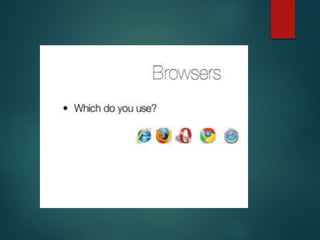
Browsers
 An application that provides a way to look at and
interact with the information on the World Wide Web
 It retrieves, presents, and traverses information
resources
 These include web pages, images, video, and other
multimedia content
World Wide Web (WWW)
 The World Wide Web allows computer users to locate and view
multimedia-based documents (i.e., documents with text, graphics,
animations, audios or videos) on almost any subject.
 Even though the Internet was developed more than three decades
ago, the introduction of the World Wide Web is a relatively recent
event. In 1990, Tim Berners-Lee of CERN (the European
 Laboratory for Particle Physics) developed the World Wide Web and
several communication protocols that form the backbone of the
Web.
 The Internet and the World Wide Web surely will be listed among
the most important and profound creations of humankind.
 In the past, most computer applications executed on “stand-alone”
computers (i.e., computers that were not connected to one another).
 The W3C is also a standardization organization
Web Contents
 Web content is the textual, visual or aural content that
is encountered as part of the user experience on
websites.
 It may include, among other things: text, images,
sounds, videos and animations
HTML web content
 Even though we may embed various protocols within web pages,
the "web page" composed of "html" (or some variation) content
is still the dominant way whereby we share content. And while
there are many web pages with localized proprietary structure
(most usually, business websites), many millions of websites
abound that are structured according to a common core idea.
 A web search engine is designed to search for information on
the World Wide Web.
 The search results are generally presented in a list of results and
are often called hits
 The information may consist of web pages, images, information
and other types of files. Some search engines also mine data
available in databases or open directories.
 Unlike Web directories, which are maintained by human editors,
search engines operate algorithmically or are a mixture of
algorithmic and human input.
Types of Website Content
 Static Web Site
 Dynamic Web Site
Static Web Site
 A static web page (sometimes called a flat page) is a web
page that is delivered to the user exactly as stored.
 Dynamic web pages which are generated by a web
application
 Consequently a static web page displays the same
information for all users, from all contexts, subject to
modern capabilities of a web server to negotiate content-
type or language of the document where such versions
are available and the server is configured to do so.
 Static web pages are often HTML documents stored as
files in the file system and made available by the web
server over HTTP.
Static Web Site
 However, loose interpretations of the term could
include web pages stored in a database, and could
even include pages formatted using a template and
served through an application server, as long as the
page served is unchanging and presented essentially
as stored.
 Static Web pages are very simple in layout and
informative in context. Creation of static website
content requires great level of technical expertise and
if a site owner is intended to create static
 web pages, they must be very clear with their ideas of
creating such pages since they need to hire a web
designer.
Advantages
 No programming skills are required to create a static
page.
 Inherently publicly cacheable (i.e. a cached copy can be
shown to anyone).
 No particular hosting requirements are necessary.
 Can be viewed directly by a web browser without
needing a web server or application server, for
example directly from a CDROM or USB Drive.
Disadvantages
 Any personalization or interactivity has to run client-
side (ie. In the browser), which is restricting.
 Maintaining large numbers of static pages as files can
be impractical without automated tools .
Application areas of Static
Website:
 Need of Static web pages arise in the following cases.
 Changes to web content is infrequent
 List of products / services offered is limited Simple e-
mail based ordering system should suffice
 No advanced online ordering facility is required
 Features like order tracking, verifying availability of
stock, online credit card transactions, are not needed
 Web site not required to be connected to back-end
system

Introduction to web technology

  • 1.
    Introduction to Web Technology DR.PALLAWI BULAKH MSc(CS), M.Phil, NET(JRF), Ph.D pallawi@moderncollegegk.org
  • 2.
    Introduction  The Internetand the World Wide Web  History of the Internet and the WWW Transmission Across the Internet  TCP/IP and Domain Names  Basic Services from FTP to the WWW  Uniform Resource Locators (URLs) – Intranets and Extranets
  • 3.
    Introdcution  The Internetis a global network of networks that enables computers of all kinds to directly and transparently communicate and share services throughout the world.  The InterNet is short for…. INTERconnected NETwork
  • 4.
    The Internet  TheInternet is a giant network of networks  A network may include PCs, and other devices like servers or printers  A network is connected through a communication channel  Early research was performed by the US Department of Defense in 1962. This research group established ARPAnet (Advanced Research Project Agency) in order to connect the US Defense Department network 1
  • 5.
    What did theInternet come from?  Original aim was to create a network that would allow users of a research computer at one university to be able to ‘talk to’ research computers at other universities.  A side benefit of ARPAnet’s design was that, because messages could be routed or rerouted in more than one direction, the network could continue to function even if parts of it were destroyed in the event of a military attack or other disaster.  The users of the Internet took a direction of their own
  • 6.
    History of theInternet  The first long distance communication took place in 1965 between a computer in MIT and California.  In 1969, four computers clients were connected together via ARPAnet. – How old is the Internet?  Leonard Kleinrock is accredited with the idea of packet switching, which describes how data can be sent across a network
  • 7.
    History of theInternet  The ethernet was developed by Xerox during this period. This was inspired by Robert Metcalfe’s PhD on ‘packet networks’.  An ethernet is a protocol for describing how computers can be connected in a LAN (Local Area Network)  Through the use of Ethernet and ARPAnet the US were able to develop a working network  In the late 1970s and early 1980s other networks were developed, e.g. CSNET, USNET and BITNET
  • 8.
    History of theInternet  In 1973 Vint Cerf and Bob Kahn created the TCP/IP communication protocols  TCP/IP: Transfer Control Protocol/Internet Protocol is a set of rules that describe how computers can communicate over a network  To send information over the Internet, a computer packs data into Internet Protocol (IP) packets and labels them with the correct address. They are then sent across a packet switched interconnected network
  • 9.
    How do weuse the Internet?  Email  WWW  Hypertext  browsers  RSS  FTP,  P2P  file distribution  Mobile Internet  IM,  IRC,  Skype  Blogging,  microblogging  Gaming  Learning  Video Conferencing  Remote Backup  Streaming video and audio  Collaboration-Participation  (Wiki)  Collaborative tagging  Software over the web  Rich User Experiences  Social networks • Business and finance
  • 10.
    Browsers  An applicationthat provides a way to look at and interact with the information on the World Wide Web  It retrieves, presents, and traverses information resources  These include web pages, images, video, and other multimedia content
  • 13.
    World Wide Web(WWW)  The World Wide Web allows computer users to locate and view multimedia-based documents (i.e., documents with text, graphics, animations, audios or videos) on almost any subject.  Even though the Internet was developed more than three decades ago, the introduction of the World Wide Web is a relatively recent event. In 1990, Tim Berners-Lee of CERN (the European  Laboratory for Particle Physics) developed the World Wide Web and several communication protocols that form the backbone of the Web.  The Internet and the World Wide Web surely will be listed among the most important and profound creations of humankind.  In the past, most computer applications executed on “stand-alone” computers (i.e., computers that were not connected to one another).  The W3C is also a standardization organization
  • 14.
    Web Contents  Webcontent is the textual, visual or aural content that is encountered as part of the user experience on websites.  It may include, among other things: text, images, sounds, videos and animations
  • 15.
    HTML web content Even though we may embed various protocols within web pages, the "web page" composed of "html" (or some variation) content is still the dominant way whereby we share content. And while there are many web pages with localized proprietary structure (most usually, business websites), many millions of websites abound that are structured according to a common core idea.  A web search engine is designed to search for information on the World Wide Web.  The search results are generally presented in a list of results and are often called hits  The information may consist of web pages, images, information and other types of files. Some search engines also mine data available in databases or open directories.  Unlike Web directories, which are maintained by human editors, search engines operate algorithmically or are a mixture of algorithmic and human input.
  • 16.
    Types of WebsiteContent  Static Web Site  Dynamic Web Site
  • 17.
    Static Web Site A static web page (sometimes called a flat page) is a web page that is delivered to the user exactly as stored.  Dynamic web pages which are generated by a web application  Consequently a static web page displays the same information for all users, from all contexts, subject to modern capabilities of a web server to negotiate content- type or language of the document where such versions are available and the server is configured to do so.  Static web pages are often HTML documents stored as files in the file system and made available by the web server over HTTP.
  • 18.
    Static Web Site However, loose interpretations of the term could include web pages stored in a database, and could even include pages formatted using a template and served through an application server, as long as the page served is unchanging and presented essentially as stored.  Static Web pages are very simple in layout and informative in context. Creation of static website content requires great level of technical expertise and if a site owner is intended to create static  web pages, they must be very clear with their ideas of creating such pages since they need to hire a web designer.
  • 19.
    Advantages  No programmingskills are required to create a static page.  Inherently publicly cacheable (i.e. a cached copy can be shown to anyone).  No particular hosting requirements are necessary.  Can be viewed directly by a web browser without needing a web server or application server, for example directly from a CDROM or USB Drive.
  • 20.
    Disadvantages  Any personalizationor interactivity has to run client- side (ie. In the browser), which is restricting.  Maintaining large numbers of static pages as files can be impractical without automated tools .
  • 21.
    Application areas ofStatic Website:  Need of Static web pages arise in the following cases.  Changes to web content is infrequent  List of products / services offered is limited Simple e- mail based ordering system should suffice  No advanced online ordering facility is required  Features like order tracking, verifying availability of stock, online credit card transactions, are not needed  Web site not required to be connected to back-end system