Presented to –                     Presented by-
Mr. Shreyaskar Gaur                Pallavi Srivastava
Assistant Professor                B.Tech(C.S.E)
Department of Computer Science &   Semester-6
Technology
                                   Roll no.- 0928210035
JPIET
Contents


           W3C

       Semantic web

   Semantic web themes

      Technology map

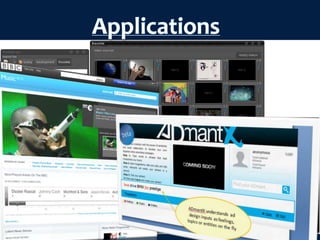
        Applications

Advantages and disadvantages

        Future scope

     Imaginative aspect
W3C
International consortium directed by Tim Berners-Lee
Mission: “Lead the Web to its full potential”
Hosts: MIT, ERCIM, Keio University
Defines Web Standards
   HTML, CSS, XML, Security
   Web Accessibility Initiative (WAI)
   Web Services (SOAP, WSDL, etc.)
   Semantic Web
Method
 Technical specifications developed with Working Groups and
  extensive public review
 Advanced Development to chart long term architectural
  directions
W3C track record: building infrastructure to address
technical and social needs of the Web
Need of semantic web
Semantic web
   “The Semantic Web is a major research initiative of the World Wide
Web Consortium (W3C) to create a metadata-rich Web of resources
that can describe themselves not only by how they should be
displayed (HTML) or syntactically (XML), but also by the meaning of the
metadata.”
                        From W3C Semantic Web Activity Page


    “The Semantic Web is an extension of the current web in which
information is given well-defined meaning, better enabling computers
and people to work in cooperation.”

                         Tim Berners-Lee, James Hendler, Ora Lassila,
                         The Semantic Web, Scientific American, May 2001
Semantic Web

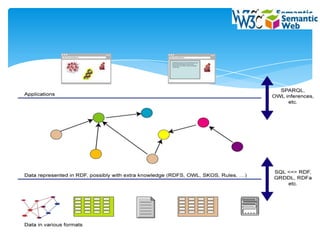
Data Integration at Web Scale
Web of data
  framework for integrating multiple sources
  to draw new conclusions
  architecture for describing all kinds of things
  (items, collections, services, processes, etc.)
Increase the utility of information by
connecting it to its definitions and its
context
  effective management and reuse of data at
  various scales (personal, group, enterprise,
  community, web
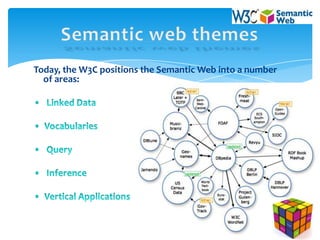
Today, the W3C positions the Semantic Web into a number
  of areas:
Semantic web themes
Linked data
 Data on the Web should be available in a standard format.
 Relationships among data should be made available, too, to create a Web of Data .
 Collection of interrelated datasets on the Web.
Vocabulary-
 Concepts and relationships (also referred to as “terms”) used to describe and
 represent an area of concern.
 Used to-
    Classify the terms that can be used in a particular application.
    Characterize possible relationships.
    Define possible constraints on using those terms.
 The role are to help data integration.
 E.g. a:author same as f:auteur
Query
 Programmatic mechanisms to retrieve all the data.
Semantic web themes
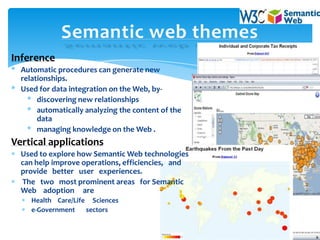
Inference
* Automatic procedures can generate new
  relationships.
* Used for data integration on the Web, by-
    * discovering new relationships
    * automatically analyzing the content of the
       data
    * managing knowledge on the Web .
Vertical applications
  Used to explore how Semantic Web technologies
  can help improve operations, efficiencies, and
  provide better user experiences.
  The two most prominent areas for Semantic
  Web adoption are
     Health Care/Life Sciences
     e-Government    sectors
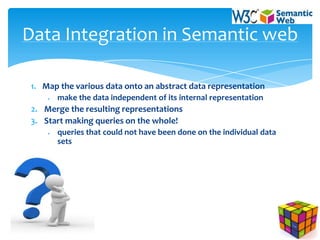
Data Integration in Semantic web

 1. Map the various data onto an abstract data representation
       make the data independent of its internal representation
 2. Merge the resulting representations
 3. Start making queries on the whole!
       queries that could not have been done on the individual data
       sets
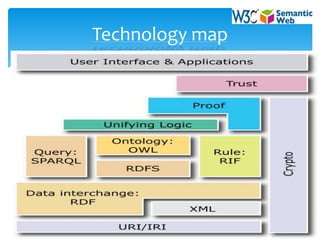
Technology map
RDF
 RDF(Resource Description Framework) is the first and the fundamental technology of
 semantic web.
 It describes Resources through a series of Statements.
 RDF has following important concepts
•    Resource : The resources being described by RDF are anything that can be named via a
     URI.
•    Property : A property is also a resource that has a name, for instance Author or Title.
•    Statement : A statement consists of the combination of a Resource, a Property, and
     an associated value.
 Each statement is a Property and Value that is about a Resource.
  An RDF Triple (s,p,o) is such that:
  “s”, “p” are URI-s, ie, resources on the Web; “o” is a URI or a literal
  “s”, “p”, and “o” stand for “subject”, “property”, and “object
Resources can use any URI, e.g.:
   http://www.example.org/file.xml#element(home)
   http://www.example.org/file2.xml#xpath1(//q[@a=b])
URI-s can also denote non Web entities:
 http://www.ivan-herman.net/me is me
 not my home page, not my publication list, but me
RDF & RDFS
    Another significant part of RDF is it’s
    Schema language. RDF Schema allows for
    greater specification of semantics for
    information models.
    RDFS defines resources and classes:
      everything in RDF is a “resource”
         “classes” are also resources, but…
         …they are also a collection of possible
         resources (i.e., “individuals”)
              “fiction”, “novel”
    Relationships are defined among classes             <rdf:Description
     and resources:                                      rdf:about="http://…/isbn/202038
                                                         6682">
         “typing”: an individual belongs to a specific       <f:titre xml:lang="fr">Le
         class                                           palais des mirroirs</f:titre>
              “«The Glass Palace» is a novel”                <f:original
              to be more precise:                        rdf:resource="http://…/isbn/000
              “«http://.../000651409X» is a novel”       651409X"/>
         “sub classing”: all instances of one are also   </rdf:Description>
         the instances of the other (“every novel is a
         fiction”)
            RDFS formalizes these notions in RDF
RDF example

                             Has road
                                        Garden st.     In Suburb
              Intersection


In location                  Has road
                                                     Central
                                                      ave
                                                               In Suburb
   Traffic                         Sydney
  accident                                                          Eveleigh

                                          In city
OWL

 Declarative knowledge representation
language for the Semantic Web with
formally defined meaning for creating
ontologies.
It is a ‘Monotonic’ language.
Collection of basic “pieces of knowledge.”
 Statements that are made in an ontology are
called axioms in OWL.
 The ontology asserts that its axioms are true.
 OWL denotes:
• objects as individuals,
• categories as classes, and
• relations as properties.
SPARQL

SPARQL query language and the accompanying
semantics and protocols makes possible to send                PREFIX ns: <http://road.com/>
queries and receive results .                                    SELECT ?name
                                                                 WHERE
SPARQL queries are similar in syntax to SQL
                                                                 {
   based on the RDF triple models                                  ?road ns:inSuburb “Eveleigh”
   provide patterns against such relationships in which       .
   some resource references are variables.
                                                                   ?road ns:hasName ?name .
A SPARQL engine would return the resources that                  }
match these patterns for all triples.
Under current development          are a                      The results would be:
   SPARQL Update language                                         Name
   SPARQL HTTP bindings                                           “Garden St”
   discovery mechanism for describing the capabilities of a       “Central Ave”
   SPARQL endpoint.
GRDDL & POWDER
GRDDL
* GRDDL is a mechanism for Gleaning Resource Descriptions from Dialects of Languages.
* introduces markup based on existing standards for:
   *   declaring that an XML document includes data compatible with the RDF
   *   linking to algorithms (typically represented in XSLT),
   *   extracting this data from the document.

POWDER ( Protocol for Web Description Resources )
  Supports
       the provision of description resources
       way to apply them to groups of online resources
       the authentication   of those descriptions .
  There are two versions of POWDER:
       one simple version expressed in XML.
       the other that harnesses the Semantic         Web    languages (POWDER-S).

SKOS
  An area of work developing specifications and standards to support the use of knowledge
  organization systems (KOS) such as thesauri, classification schemes, subject heading lists and
  taxonomies within the framework of the Semantic Web
Rule Interchange Format

 Family of specifications which focuses on exchange rather
  than a single one-fits-all rule language but even rule
  exchange alone is a complex and daunting area.
 Rule systems fall into three categories;
   first-order
   logic-programming
   action rules
 Family of languages, called dialects.
 Core idea : Different rule systems will provide syntactic
  mappings from their native languages to RIF dialects and back.
 Mappings are required to be preserve their original
  semantics
Tools

                 Categories
                                            The following Semantic Web tools
                                              have been recently released:
                 Inference
Triple Stores                  Converters      AceWiki (Version 0.5.3, 19
                  engines
                                              January 2012)
                                              LDIF (Version 0.4, 16 January
  Search                                      2012)
                Middleware       CMS
  engines                                     AllegroGraph (Version 4.4.0.1, 12
                                              January 2012)
 Semantic                                      Semantic MediaWiki (Version
                Development    Semantic       1.7.0.1, 9 January 2012)
   Web
                environments     Wikis
 browsers                                      Bigdata (Version 1.1.0, 20
                                              December 2011)
Advantages
Disadvantages
Current news
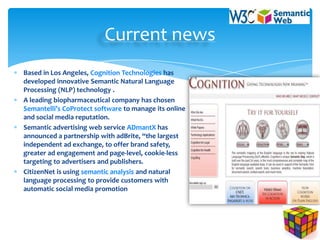
Based in Los Angeles, Cognition Technologies has
developed innovative Semantic Natural Language
Processing (NLP) technology .
A leading biopharmaceutical company has chosen
Semantelli’s CoProtect software to manage its online
and social media reputation.
Semantic advertising web service ADmantX has
announced a partnership with adBrite, “the largest
independent ad exchange, to offer brand safety,
greater ad engagement and page-level, cookie-less
targeting to advertisers and publishers.
CitizenNet is using semantic analysis and natural
language processing to provide customers with
automatic social media promotion
Future Aspect
The semantic web is driving the evolution of current web by
enabling users to find ,share & combine information more easily.
The US government has propelled the adoption of semantic web
in governmental agencies.
More than 2,70,000 data sets are available for public viewing with
the help of Data Gov project.
At present , semantic web witnesses funding inflow for product
development.
In future, the investments are likely to be made in projects where
focus is on enhancing the existing ecosystems on internet
especially in :
    Social computing
    Search engines enhancements
    Advertising
    Analytical tools
Semantic innovations relevant to thriving ecosystems such as
Facebook & twitter stand better chance of attracting funds from
venture capalists & other funding agencies.
Clarabridge,which delivers highly customized enterprise
processing solutions had acquired $4.33 million for marketing &
sales expansion.
Semantic web is about an individual.
Searches: With semantic search engines we can receive
right information/content at the right time from
anywhere.
Once the Semantic Web exists, it can provide the ability
to tag all content on the Web, describe what each piece
of information is about and give semantic meaning to
the content item.
Thus, search engines become more effective than they
are now, and users can find the precise information
they are hunting.
E-commerce : “We believe this is what you are looking”
Online ad: “Personalized ad display based on user
preferences, community and other characteristics”.
References:

www.w3.org>W3C
www.readwriteweb.com
Semantic Web - Wikipedia, the free encyclopedia
en.wikipedia.org/wiki/Semantic Web
Tutorial ppt W3C
http://www.w3.org/2001/sw/grddl-wg/
Queries…
Semantic web

Semantic web

  • 2.
    Presented to – Presented by- Mr. Shreyaskar Gaur Pallavi Srivastava Assistant Professor B.Tech(C.S.E) Department of Computer Science & Semester-6 Technology Roll no.- 0928210035 JPIET
  • 3.
    Contents W3C Semantic web Semantic web themes Technology map Applications Advantages and disadvantages Future scope Imaginative aspect
  • 4.
    W3C International consortium directedby Tim Berners-Lee Mission: “Lead the Web to its full potential” Hosts: MIT, ERCIM, Keio University Defines Web Standards  HTML, CSS, XML, Security  Web Accessibility Initiative (WAI)  Web Services (SOAP, WSDL, etc.)  Semantic Web Method  Technical specifications developed with Working Groups and extensive public review  Advanced Development to chart long term architectural directions W3C track record: building infrastructure to address technical and social needs of the Web
  • 5.
  • 6.
    Semantic web “The Semantic Web is a major research initiative of the World Wide Web Consortium (W3C) to create a metadata-rich Web of resources that can describe themselves not only by how they should be displayed (HTML) or syntactically (XML), but also by the meaning of the metadata.” From W3C Semantic Web Activity Page “The Semantic Web is an extension of the current web in which information is given well-defined meaning, better enabling computers and people to work in cooperation.” Tim Berners-Lee, James Hendler, Ora Lassila, The Semantic Web, Scientific American, May 2001
  • 7.
    Semantic Web Data Integrationat Web Scale Web of data framework for integrating multiple sources to draw new conclusions architecture for describing all kinds of things (items, collections, services, processes, etc.) Increase the utility of information by connecting it to its definitions and its context effective management and reuse of data at various scales (personal, group, enterprise, community, web
  • 8.
    Today, the W3Cpositions the Semantic Web into a number of areas:
  • 9.
    Semantic web themes Linkeddata Data on the Web should be available in a standard format. Relationships among data should be made available, too, to create a Web of Data . Collection of interrelated datasets on the Web. Vocabulary- Concepts and relationships (also referred to as “terms”) used to describe and represent an area of concern. Used to- Classify the terms that can be used in a particular application. Characterize possible relationships. Define possible constraints on using those terms. The role are to help data integration. E.g. a:author same as f:auteur Query Programmatic mechanisms to retrieve all the data.
  • 10.
    Semantic web themes Inference *Automatic procedures can generate new relationships. * Used for data integration on the Web, by- * discovering new relationships * automatically analyzing the content of the data * managing knowledge on the Web . Vertical applications Used to explore how Semantic Web technologies can help improve operations, efficiencies, and provide better user experiences. The two most prominent areas for Semantic Web adoption are Health Care/Life Sciences e-Government sectors
  • 11.
    Data Integration inSemantic web 1. Map the various data onto an abstract data representation make the data independent of its internal representation 2. Merge the resulting representations 3. Start making queries on the whole! queries that could not have been done on the individual data sets
  • 14.
  • 15.
    RDF RDF(Resource DescriptionFramework) is the first and the fundamental technology of semantic web. It describes Resources through a series of Statements. RDF has following important concepts • Resource : The resources being described by RDF are anything that can be named via a URI. • Property : A property is also a resource that has a name, for instance Author or Title. • Statement : A statement consists of the combination of a Resource, a Property, and an associated value. Each statement is a Property and Value that is about a Resource. An RDF Triple (s,p,o) is such that: “s”, “p” are URI-s, ie, resources on the Web; “o” is a URI or a literal “s”, “p”, and “o” stand for “subject”, “property”, and “object Resources can use any URI, e.g.: http://www.example.org/file.xml#element(home) http://www.example.org/file2.xml#xpath1(//q[@a=b]) URI-s can also denote non Web entities: http://www.ivan-herman.net/me is me not my home page, not my publication list, but me
  • 16.
    RDF & RDFS Another significant part of RDF is it’s Schema language. RDF Schema allows for greater specification of semantics for information models. RDFS defines resources and classes:  everything in RDF is a “resource” “classes” are also resources, but… …they are also a collection of possible resources (i.e., “individuals”) “fiction”, “novel”  Relationships are defined among classes <rdf:Description and resources: rdf:about="http://…/isbn/202038 6682"> “typing”: an individual belongs to a specific <f:titre xml:lang="fr">Le class palais des mirroirs</f:titre> “«The Glass Palace» is a novel” <f:original to be more precise: rdf:resource="http://…/isbn/000 “«http://.../000651409X» is a novel” 651409X"/> “sub classing”: all instances of one are also </rdf:Description> the instances of the other (“every novel is a fiction”) RDFS formalizes these notions in RDF
  • 17.
    RDF example Has road Garden st. In Suburb Intersection In location Has road Central ave In Suburb Traffic Sydney accident Eveleigh In city
  • 18.
    OWL Declarative knowledgerepresentation language for the Semantic Web with formally defined meaning for creating ontologies. It is a ‘Monotonic’ language. Collection of basic “pieces of knowledge.” Statements that are made in an ontology are called axioms in OWL. The ontology asserts that its axioms are true. OWL denotes: • objects as individuals, • categories as classes, and • relations as properties.
  • 19.
    SPARQL SPARQL query languageand the accompanying semantics and protocols makes possible to send PREFIX ns: <http://road.com/> queries and receive results . SELECT ?name WHERE SPARQL queries are similar in syntax to SQL { based on the RDF triple models ?road ns:inSuburb “Eveleigh” provide patterns against such relationships in which . some resource references are variables. ?road ns:hasName ?name . A SPARQL engine would return the resources that } match these patterns for all triples. Under current development are a The results would be: SPARQL Update language Name SPARQL HTTP bindings “Garden St” discovery mechanism for describing the capabilities of a “Central Ave” SPARQL endpoint.
  • 20.
    GRDDL & POWDER GRDDL *GRDDL is a mechanism for Gleaning Resource Descriptions from Dialects of Languages. * introduces markup based on existing standards for: * declaring that an XML document includes data compatible with the RDF * linking to algorithms (typically represented in XSLT), * extracting this data from the document. POWDER ( Protocol for Web Description Resources ) Supports the provision of description resources way to apply them to groups of online resources the authentication of those descriptions . There are two versions of POWDER: one simple version expressed in XML. the other that harnesses the Semantic Web languages (POWDER-S). SKOS An area of work developing specifications and standards to support the use of knowledge organization systems (KOS) such as thesauri, classification schemes, subject heading lists and taxonomies within the framework of the Semantic Web
  • 22.
    Rule Interchange Format Family of specifications which focuses on exchange rather than a single one-fits-all rule language but even rule exchange alone is a complex and daunting area.  Rule systems fall into three categories;  first-order  logic-programming  action rules  Family of languages, called dialects.  Core idea : Different rule systems will provide syntactic mappings from their native languages to RIF dialects and back.  Mappings are required to be preserve their original semantics
  • 23.
    Tools Categories The following Semantic Web tools have been recently released: Inference Triple Stores Converters AceWiki (Version 0.5.3, 19 engines January 2012) LDIF (Version 0.4, 16 January Search 2012) Middleware CMS engines AllegroGraph (Version 4.4.0.1, 12 January 2012) Semantic Semantic MediaWiki (Version Development Semantic 1.7.0.1, 9 January 2012) Web environments Wikis browsers Bigdata (Version 1.1.0, 20 December 2011)
  • 28.
  • 29.
  • 30.
    Current news Based inLos Angeles, Cognition Technologies has developed innovative Semantic Natural Language Processing (NLP) technology . A leading biopharmaceutical company has chosen Semantelli’s CoProtect software to manage its online and social media reputation. Semantic advertising web service ADmantX has announced a partnership with adBrite, “the largest independent ad exchange, to offer brand safety, greater ad engagement and page-level, cookie-less targeting to advertisers and publishers. CitizenNet is using semantic analysis and natural language processing to provide customers with automatic social media promotion
  • 31.
    Future Aspect The semanticweb is driving the evolution of current web by enabling users to find ,share & combine information more easily. The US government has propelled the adoption of semantic web in governmental agencies. More than 2,70,000 data sets are available for public viewing with the help of Data Gov project. At present , semantic web witnesses funding inflow for product development. In future, the investments are likely to be made in projects where focus is on enhancing the existing ecosystems on internet especially in : Social computing Search engines enhancements Advertising Analytical tools Semantic innovations relevant to thriving ecosystems such as Facebook & twitter stand better chance of attracting funds from venture capalists & other funding agencies. Clarabridge,which delivers highly customized enterprise processing solutions had acquired $4.33 million for marketing & sales expansion.
  • 32.
    Semantic web isabout an individual. Searches: With semantic search engines we can receive right information/content at the right time from anywhere. Once the Semantic Web exists, it can provide the ability to tag all content on the Web, describe what each piece of information is about and give semantic meaning to the content item. Thus, search engines become more effective than they are now, and users can find the precise information they are hunting. E-commerce : “We believe this is what you are looking” Online ad: “Personalized ad display based on user preferences, community and other characteristics”.
  • 33.
    References: www.w3.org>W3C www.readwriteweb.com Semantic Web -Wikipedia, the free encyclopedia en.wikipedia.org/wiki/Semantic Web Tutorial ppt W3C http://www.w3.org/2001/sw/grddl-wg/
  • 34.

Editor's Notes

  • #20 PREFIX ns: &lt;http://road.com/&gt; SELECT ?name WHERE { ?road ns:inSuburb “Eveleigh” . ?road ns:hasName ?name . } The results would be: “Garden St” “Central Ave”