

Future Directions in
Electronic Computing and
Information Processing
Submitted by:
Yatish Bathla
Hamzeh Khalili
Why we need this Step?
 Early Failure of Moore’s Law
Negative Result:
o IBM has recently given up its PC market.
o doubts about the validity of the “law” can
negatively influence share prices of
Processor firms
 some exotic new technologies such as nano
electronics or quantum computing would be
able to save us from this slowdown
Moore’s Law
 The law is named after Intel co-founder
Gordon E. Moore
 Number of transistors that can be placed
inexpensively on an integrated circuit
doubles approximately every two years
 The capabilities of many digital electronic
devices are strongly linked to Moore's law:
 processing speed
 memory capacity
 sensors
 number and size of pixels in digital
cameras
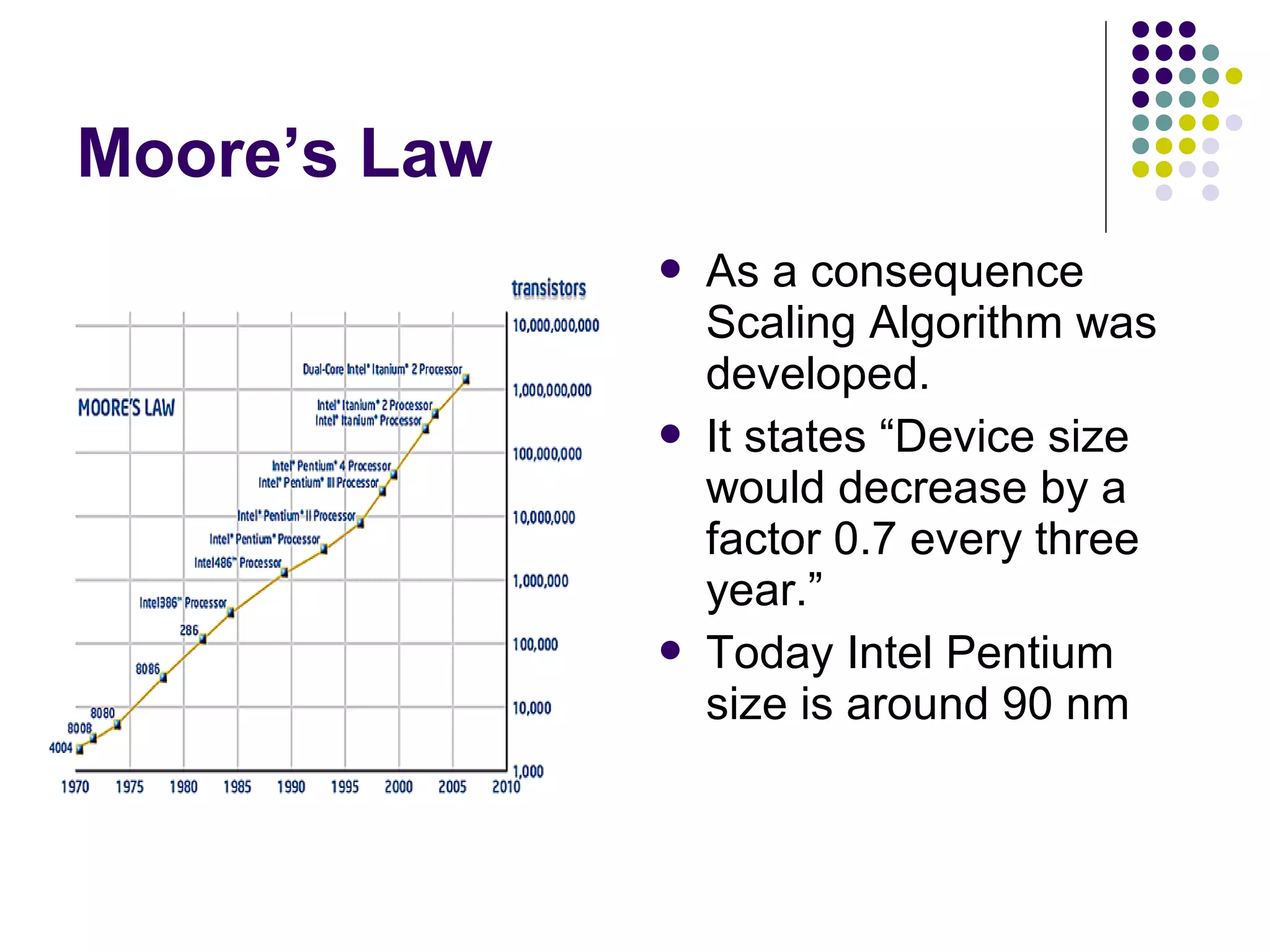
Moore’s Law
 As a consequence
Scaling Algorithm was
developed.
 It states “Device size
would decrease by a
factor 0.7 every three
year.”
 Today Intel Pentium
size is around 90 nm
Moore’s Law
 exponential improvement has dramatically
enhanced the impact of digital electronics in
nearly every segment of the world economy
 Moore's law describes a driving force of
technological and social change in the late
20th and early 21st centuries
 Moore’s second law: Capital cost of a
semiconductor fabrication also increases
exponentially over time
Failure Of Moore’s Law
 Failure took place much earlier in 2004 when
intel’s failed to move from 90 nm to 60 nm
 Reason:
 Decreasing bits-per-joule energy efficiency
due to the leakage current
 synergic effects of the increasing thermal
noise, heat dissipation and bandwidth during
miniaturization would manifest themselves in
either a high bit-error rate or chip overheating
Potential ways of improvements
by classical information
Parallel Processing
 it cannot save Moore’s law because the law is
meant for a single chip. Even if we disregard
Moore’s law, we are facing serious problems with
the more than 100 W of today’s microprocessors.
 Parallel processing is useful, but the help it can
offer is limited by the total energy dissipation of
the computer.
Single-Electron Technology
Ray to Save Moore Law
 To reduce processor size, it must need to
reach a reasonable bit-error rate at room
temperature, the quantum-dot size had to be
kept at or below 1 nm
 But VLSI chips with I nm size are not feasible
and next to impossible
Quantum Computing
 Device for computation that makes direct
use of quantum mechanical phenomena,
such as superposition and entanglement,
to perform operations on data
 Use qubits and represent the state of an n-
qubit system on a classical computer would
require the storage of 2n complex
coefficients
 Large-scale quantum computers could be
able to solve certain problems much faster
than any classical computer
Advantage: Quantum
Computing
• Quantum Fourier transform algorithm to find the period
of a function that is known in advance to be periodic,
exponentially faster than with a classical algorithm
• Shor's algorithm or the simulation of quantum many-
body systems calculate almost 20 times faster integer
factorization as Classical computers
• provide a polynomial speedup over a classical algorithm,
example: “quantum search” algorithm discovered. This
would allow one to locate a particular
• item in a “database” of N entries with only of the order of
under root N queries, as opposed to the typical order of
queries N/2 one expects when dealing with classical
computers
Disadvantage: Quantum
Computing
 De-coherence: when a measurement of any type is
made to a quantum system, decoherence breaks
down and the wave function collapses into a single
state
 qubits are not digital bits of data thus they cannot
use as conventional error correction
 “quantum CPU” will have efficiency and heating
problems of their own
 minimum energy requirement for the quantum
logical operations is five times than classical
computer
Conclusion
 The exponential evolution of hardware performance
has ended
 space for evolution is basically in the potential
improvement of the efficiency of the software
 Currently there is no new technology on the horizon
to improve this efficiency.
 In Future near-to-distant future, more sophisticated,
custom-made parallel-processing clusters, as well
as conventional analog, optical, and quantum
computers will arise
Gracious

Computing and Information Processing

  • 1.
    Future Directions in ElectronicComputing and Information Processing Submitted by: Yatish Bathla Hamzeh Khalili
  • 2.
    Why we needthis Step?  Early Failure of Moore’s Law Negative Result: o IBM has recently given up its PC market. o doubts about the validity of the “law” can negatively influence share prices of Processor firms  some exotic new technologies such as nano electronics or quantum computing would be able to save us from this slowdown
  • 3.
    Moore’s Law  Thelaw is named after Intel co-founder Gordon E. Moore  Number of transistors that can be placed inexpensively on an integrated circuit doubles approximately every two years  The capabilities of many digital electronic devices are strongly linked to Moore's law:  processing speed  memory capacity  sensors  number and size of pixels in digital cameras
  • 4.
    Moore’s Law  Asa consequence Scaling Algorithm was developed.  It states “Device size would decrease by a factor 0.7 every three year.”  Today Intel Pentium size is around 90 nm
  • 5.
    Moore’s Law  exponentialimprovement has dramatically enhanced the impact of digital electronics in nearly every segment of the world economy  Moore's law describes a driving force of technological and social change in the late 20th and early 21st centuries  Moore’s second law: Capital cost of a semiconductor fabrication also increases exponentially over time
  • 6.
    Failure Of Moore’sLaw  Failure took place much earlier in 2004 when intel’s failed to move from 90 nm to 60 nm  Reason:  Decreasing bits-per-joule energy efficiency due to the leakage current  synergic effects of the increasing thermal noise, heat dissipation and bandwidth during miniaturization would manifest themselves in either a high bit-error rate or chip overheating
  • 7.
    Potential ways ofimprovements by classical information Parallel Processing  it cannot save Moore’s law because the law is meant for a single chip. Even if we disregard Moore’s law, we are facing serious problems with the more than 100 W of today’s microprocessors.  Parallel processing is useful, but the help it can offer is limited by the total energy dissipation of the computer.
  • 8.
    Single-Electron Technology Ray toSave Moore Law  To reduce processor size, it must need to reach a reasonable bit-error rate at room temperature, the quantum-dot size had to be kept at or below 1 nm  But VLSI chips with I nm size are not feasible and next to impossible
  • 9.
    Quantum Computing  Devicefor computation that makes direct use of quantum mechanical phenomena, such as superposition and entanglement, to perform operations on data  Use qubits and represent the state of an n- qubit system on a classical computer would require the storage of 2n complex coefficients  Large-scale quantum computers could be able to solve certain problems much faster than any classical computer
  • 10.
    Advantage: Quantum Computing • QuantumFourier transform algorithm to find the period of a function that is known in advance to be periodic, exponentially faster than with a classical algorithm • Shor's algorithm or the simulation of quantum many- body systems calculate almost 20 times faster integer factorization as Classical computers • provide a polynomial speedup over a classical algorithm, example: “quantum search” algorithm discovered. This would allow one to locate a particular • item in a “database” of N entries with only of the order of under root N queries, as opposed to the typical order of queries N/2 one expects when dealing with classical computers
  • 11.
    Disadvantage: Quantum Computing  De-coherence:when a measurement of any type is made to a quantum system, decoherence breaks down and the wave function collapses into a single state  qubits are not digital bits of data thus they cannot use as conventional error correction  “quantum CPU” will have efficiency and heating problems of their own  minimum energy requirement for the quantum logical operations is five times than classical computer
  • 12.
    Conclusion  The exponentialevolution of hardware performance has ended  space for evolution is basically in the potential improvement of the efficiency of the software  Currently there is no new technology on the horizon to improve this efficiency.  In Future near-to-distant future, more sophisticated, custom-made parallel-processing clusters, as well as conventional analog, optical, and quantum computers will arise
  • 13.