“SMART DUST” 
Sensing the Future… 
- Sucheta Mandal
Presentation Profile 
1.Introduction 
2.History 
3.Technology 
4.Mote Design
Introducing Smart dust 
• It is mainly Micro-Electro-Mechanical System. 
• It combines sensing, robotics, computing that 
can sense light, temperature ,vibration , 
magnetism or chemicals. 
• They are usually networked wirelessly and are 
distributed over some area to perform tasks, 
usually sensing.
History of Smart Dust 
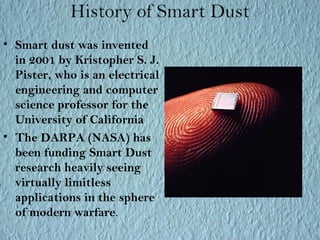
• Smart dust was invented 
in 2001 by Kristopher S. J. 
Pister, who is an electrical 
engineering and computer 
science professor for the 
University of California 
• The DARPA (NASA) has 
been funding Smart Dust 
research heavily seeing 
virtually limitless 
applications in the sphere 
of modern warfare.
Characteristics of 
Smart Dust(DARPA) 
Besides the functionality it has bi-directional 
radio, the microprocessor controller, and the 
battery. 
It has 20 meter communication range 
It has one week lifetime in continuous operation, 
2 years with 1% duty cycling. 
Current motes are about 5mm
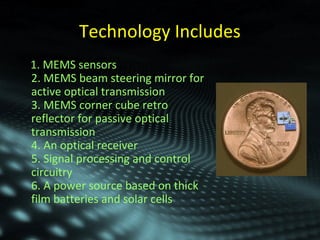
Technology Includes 
1. MEMS sensors 
2. MEMS beam steering mirror for 
active optical transmission 
3. MEMS corner cube retro 
reflector for passive optical 
transmission 
4. An optical receiver 
5. Signal processing and control 
circuitry 
6. A power source based on thick 
film batteries and solar cells
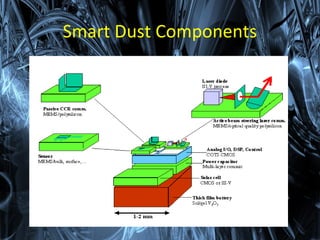
Smart Dust Components
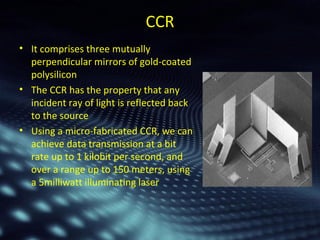
CCR 
• It comprises three mutually 
perpendicular mirrors of gold-coated 
polysilicon 
• The CCR has the property that any 
incident ray of light is reflected back 
to the source 
• Using a micro-fabricated CCR, we can 
achieve data transmission at a bit 
rate up to 1 kilobit per second, and 
over a range up to 150 meters, using 
a 5milliwatt illuminating laser
Operation on Mote 
• Periodically the microcontroller gets a reading from 
one of the sensors, which measure one of a number 
of physical or chemical stimuli such as temperature, 
ambient light, vibration, acceleration, or air pressure, 
processes the data, and stores it in memory. 
• It also occasionally turns on the optical receiver to 
see if anyone is trying to communicate with it 
• This communication may include new programs or 
messages from other motes 
• Microcontroller will use the corner cube retro 
reflector or laser to transmit sensor data or a 
message to a base station or another mote.
Power Savings 
• Most of the time, the majority of the mote is powered off 
with only a clock and a few timers running 
• A few of the timers control the sensors 
• When one of these timers expires, it powers up the 
corresponding sensor, takes a sample, and converts it to a 
digital word 
• Received data may either be stored directly in the SRAM or 
the microcontroller is powered up to perform more complex 
operations with it. 
• Some timer controls the receiver. When that timer expires, 
the receiver powers up and looks for an incoming packet
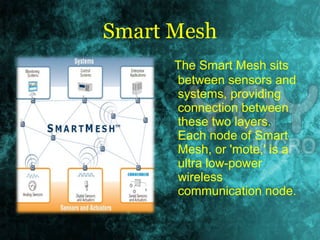
Smart Mesh 
The Smart Mesh sits 
between sensors and 
systems, providing 
connection between 
these two layers. 
Each node of Smart 
Mesh, or 'mote,' is a 
ultra low-power 
wireless 
communication node.
Space Exploration with Smart Dust 
• Deploying such a system on an alien world 
would be a lot cheaper than sending a 
massive rover, Lander, or orbiter. 
• The orbiter would act as a forward base of 
operations, centralizing incoming data, and 
the processing them before sending them to 
Earth. 
• Exporting the myth of Universe will be faster

Smart dust

  • 1.
    “SMART DUST” Sensingthe Future… - Sucheta Mandal
  • 2.
    Presentation Profile 1.Introduction 2.History 3.Technology 4.Mote Design
  • 3.
    Introducing Smart dust • It is mainly Micro-Electro-Mechanical System. • It combines sensing, robotics, computing that can sense light, temperature ,vibration , magnetism or chemicals. • They are usually networked wirelessly and are distributed over some area to perform tasks, usually sensing.
  • 4.
    History of SmartDust • Smart dust was invented in 2001 by Kristopher S. J. Pister, who is an electrical engineering and computer science professor for the University of California • The DARPA (NASA) has been funding Smart Dust research heavily seeing virtually limitless applications in the sphere of modern warfare.
  • 5.
    Characteristics of SmartDust(DARPA) Besides the functionality it has bi-directional radio, the microprocessor controller, and the battery. It has 20 meter communication range It has one week lifetime in continuous operation, 2 years with 1% duty cycling. Current motes are about 5mm
  • 6.
    Technology Includes 1.MEMS sensors 2. MEMS beam steering mirror for active optical transmission 3. MEMS corner cube retro reflector for passive optical transmission 4. An optical receiver 5. Signal processing and control circuitry 6. A power source based on thick film batteries and solar cells
  • 7.
  • 8.
    CCR • Itcomprises three mutually perpendicular mirrors of gold-coated polysilicon • The CCR has the property that any incident ray of light is reflected back to the source • Using a micro-fabricated CCR, we can achieve data transmission at a bit rate up to 1 kilobit per second, and over a range up to 150 meters, using a 5milliwatt illuminating laser
  • 9.
    Operation on Mote • Periodically the microcontroller gets a reading from one of the sensors, which measure one of a number of physical or chemical stimuli such as temperature, ambient light, vibration, acceleration, or air pressure, processes the data, and stores it in memory. • It also occasionally turns on the optical receiver to see if anyone is trying to communicate with it • This communication may include new programs or messages from other motes • Microcontroller will use the corner cube retro reflector or laser to transmit sensor data or a message to a base station or another mote.
  • 10.
    Power Savings •Most of the time, the majority of the mote is powered off with only a clock and a few timers running • A few of the timers control the sensors • When one of these timers expires, it powers up the corresponding sensor, takes a sample, and converts it to a digital word • Received data may either be stored directly in the SRAM or the microcontroller is powered up to perform more complex operations with it. • Some timer controls the receiver. When that timer expires, the receiver powers up and looks for an incoming packet
  • 11.
    Smart Mesh TheSmart Mesh sits between sensors and systems, providing connection between these two layers. Each node of Smart Mesh, or 'mote,' is a ultra low-power wireless communication node.
  • 12.
    Space Exploration withSmart Dust • Deploying such a system on an alien world would be a lot cheaper than sending a massive rover, Lander, or orbiter. • The orbiter would act as a forward base of operations, centralizing incoming data, and the processing them before sending them to Earth. • Exporting the myth of Universe will be faster