Strategies for Evolution of
PON
Submitted by:
Yatish Bathla
Introduction
 We study strategies for increasing the PON’s
capacity regardless of its technology: EPON
(Ethernet-based PON) or GPON (Gigabit
capable PON).
 In PON, a fiber is extended from an OLT
(Optical Line Terminal) at the Central Office
to a remote to an remote node located in the
service area (10–20 km from CO). From the
RN, fiber drops are extended to each ONU
Introduction
 Legacy PONs (EPON, GPON) generally use two
wavelengths as transmission channels. The
downstream channel (1490 nm) is broadcast in
nature, and any ONU can filter the data intended for
it. The upstream channel (1310 nm) is shared in time
among all ONUs. Thus, legacy PONs are referred to
as TDM (Time-Division Multiplexing) PON. OLT
authorizes timeslots when an ONU can transmit
 Bandwidth supported by legacy PONs is limited: 1
Gb/s upstream and downstream for EPON, and up to
2.5 Gb/s downstream/1.25 Gb/s upstream for GPON
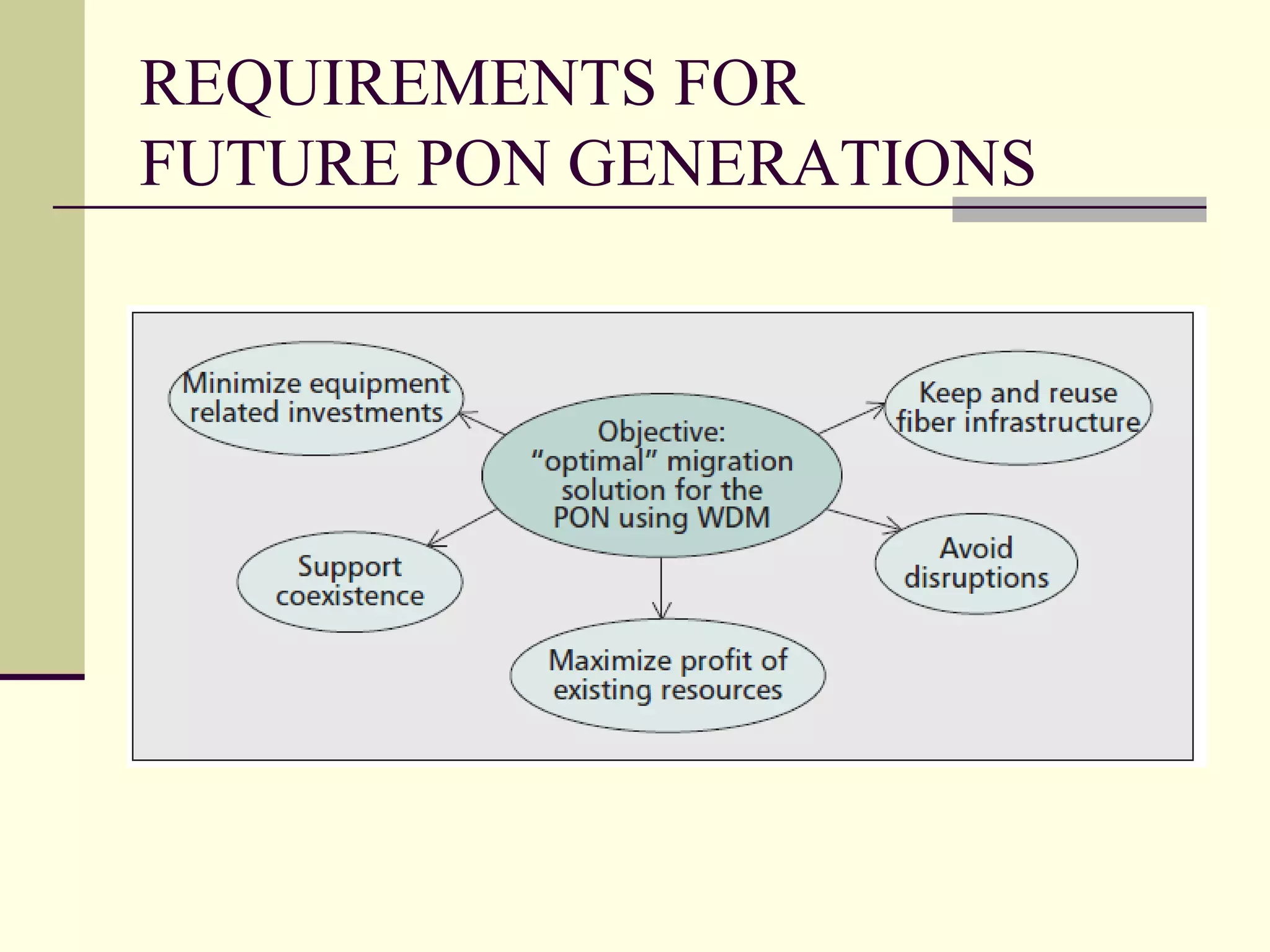
REQUIREMENTS FOR
FUTURE PON GENERATIONS
MAIN EVOLUTION PHASES AND
SCENARIOS
Three principal evolutionary phases:
 Line-rate upgrade
 Multi-wavelength channel migration
 Other future PON technologies
LINE-RATE UPGRADE
 A natural PON evolution is to increase
existing PON capacity to a higher line rate,
namely 10 Gb/s.
 Longer-term PON evolution may consider
higher line rates: 40 Gb/s or 100 Gb/s.
 Two sub-phases of evolution are expected:
Asymmetric and Symmetric line-rate
upgrades
Asymmetric Line-Rate Upgrade
(ALRU)
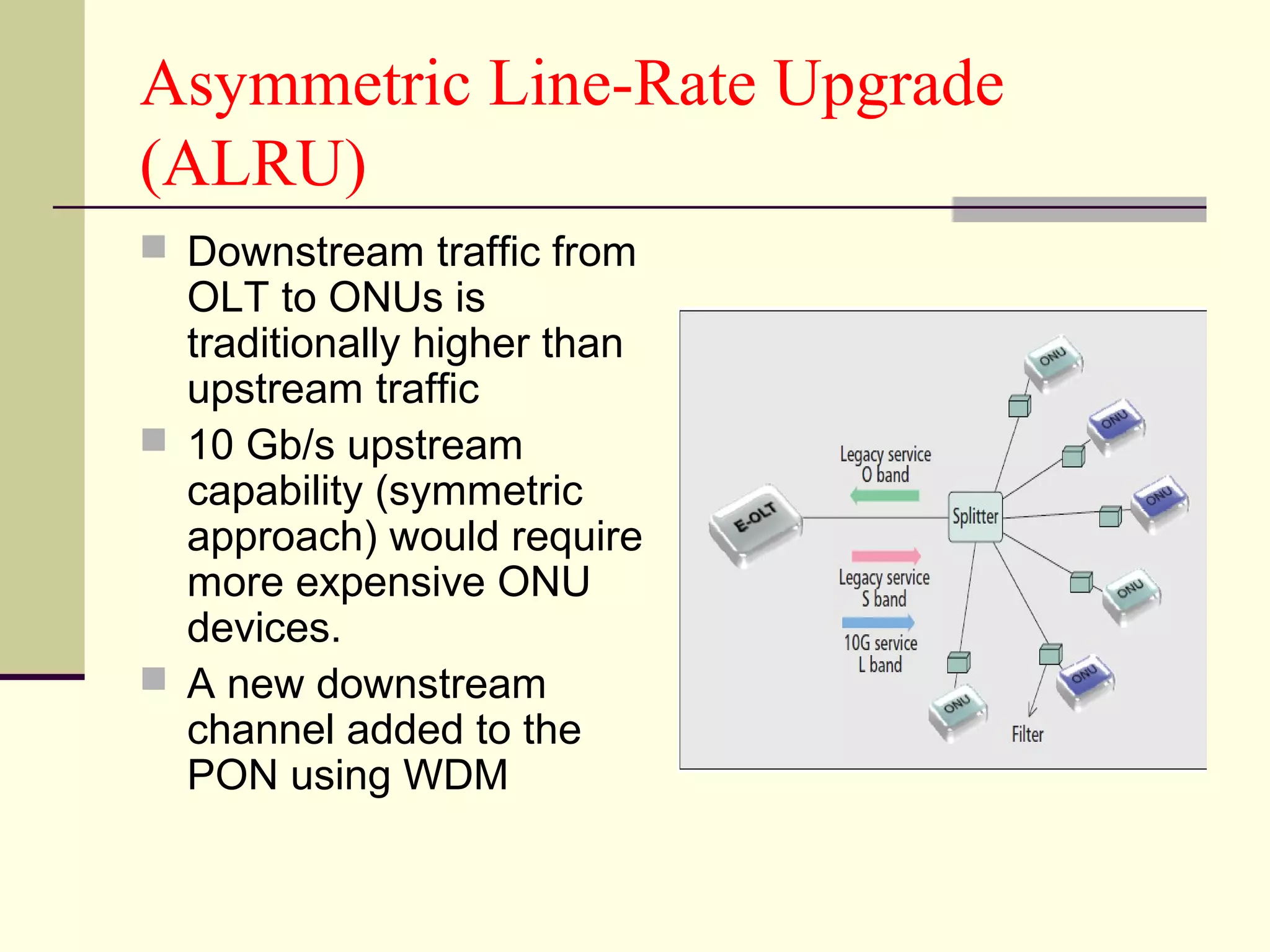
 Downstream traffic from
OLT to ONUs is
traditionally higher than
upstream traffic
 10 Gb/s upstream
capability (symmetric
approach) would require
more expensive ONU
devices.
 A new downstream
channel added to the
PON using WDM
ALRU DRAWBACK
 New wavelength blocking filters should be
attached to ONUs to avoid interferences
between downstream channels
 An external or embedded amplifier may be
needed at the OLT due to the low sensitivity
of the ONUs’ receivers and the low optical
power level needed to reach the receiver of
high-line
 A new class of PON chipsets is needed
Symmetric Line-Rate Upgrade
(SLRU)
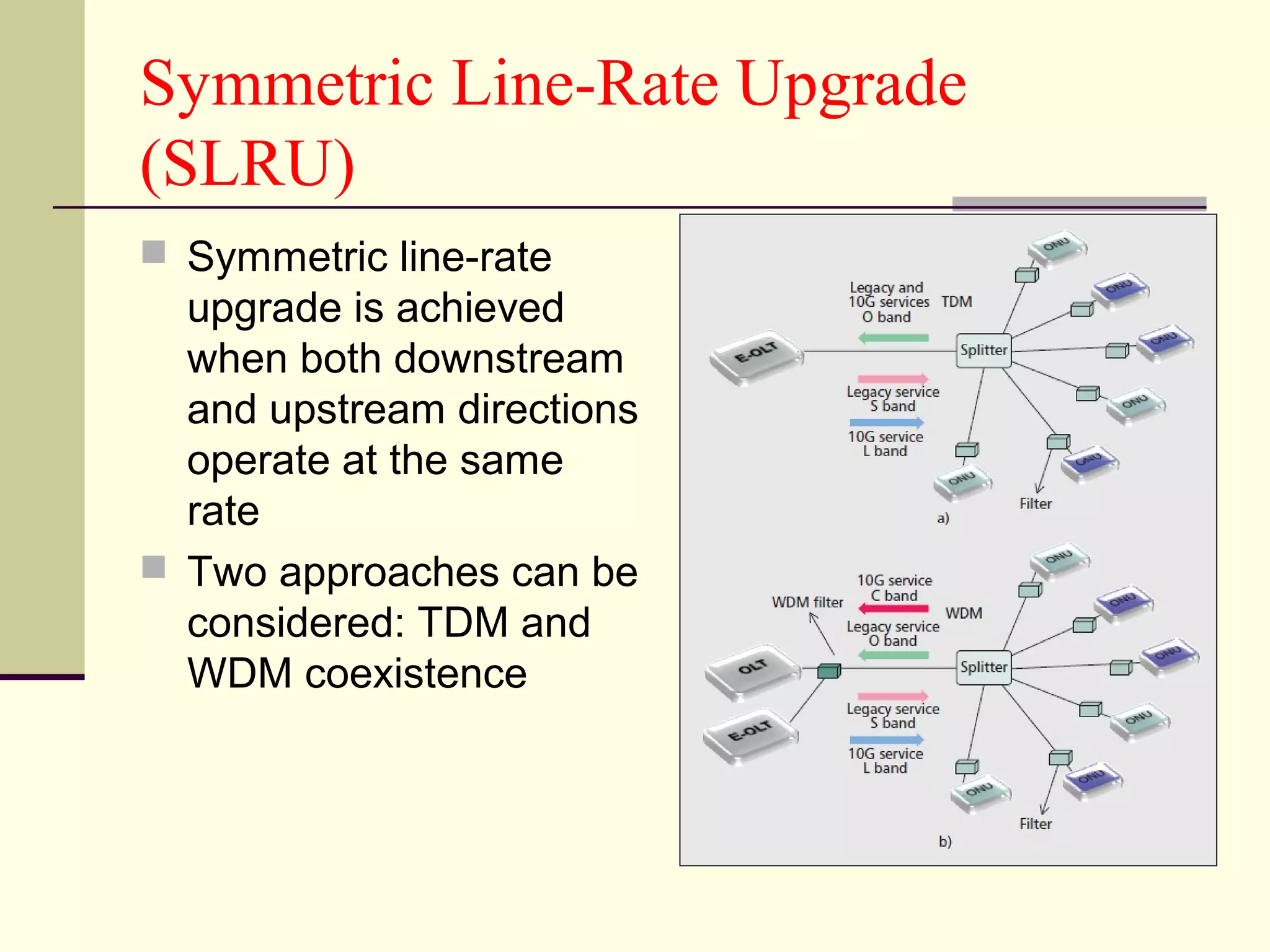
 Symmetric line-rate
upgrade is achieved
when both downstream
and upstream directions
operate at the same
rate
 Two approaches can be
considered: TDM and
WDM coexistence
SLRU DRAWBACK
 network implementation becomes complex
 An important challenge is imposed on the
OLT’s burst-mode receiver
 The new optical transmission for ONUs can
be more expensive
 Network disruption can occur due to
installation of a WDM filter
MULTIPLE WAVELENGTH
CHANNEL MIGRATION
 The natural second step for PON evolution is
based on WDM technology.
 The advantage of WDM is that it allows
coexistence between two or more PON
generations over the same infrastructure
 There are two main architectures:
WDM-PON and Overlaid-PONs
WDM-PON
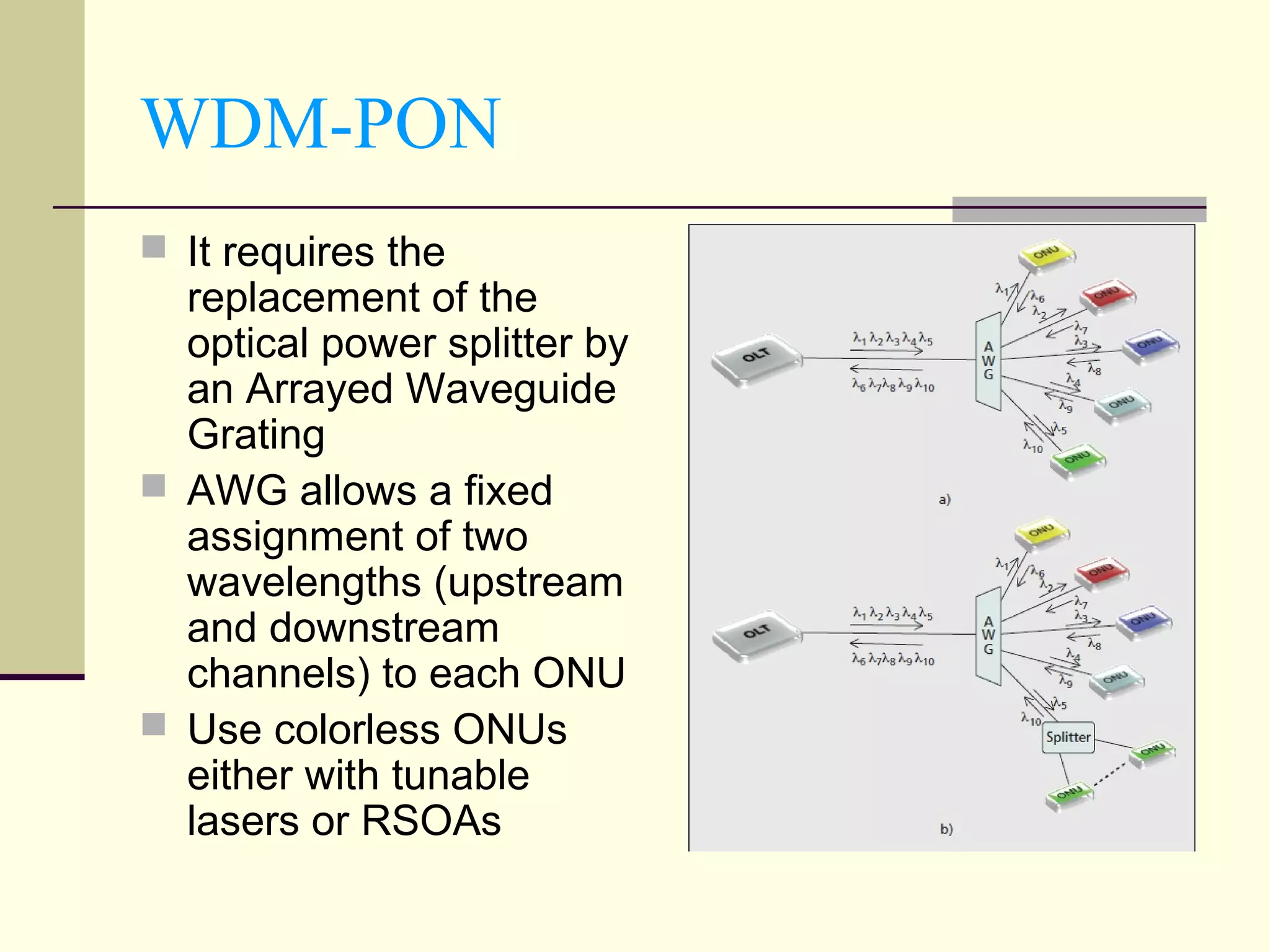
 It requires the
replacement of the
optical power splitter by
an Arrayed Waveguide
Grating
 AWG allows a fixed
assignment of two
wavelengths (upstream
and downstream
channels) to each ONU
 Use colorless ONUs
either with tunable
lasers or RSOAs
WDM-PON DRAWBACK
 Challenges to implement type of transceivers at the
OLT and ONU, sharp filtering, and type of RN.
 fixed-channel assignment is inflexible and does not
allow dynamic reuse of wavelengths by different
ONUs for efficient capacity utilization
 Price of RSOAs, Tunable Laser is one order of
magnitude higher than an entire (EPON-based) ONU
 A complete migration of all user devices will lead to
prohibitive costs
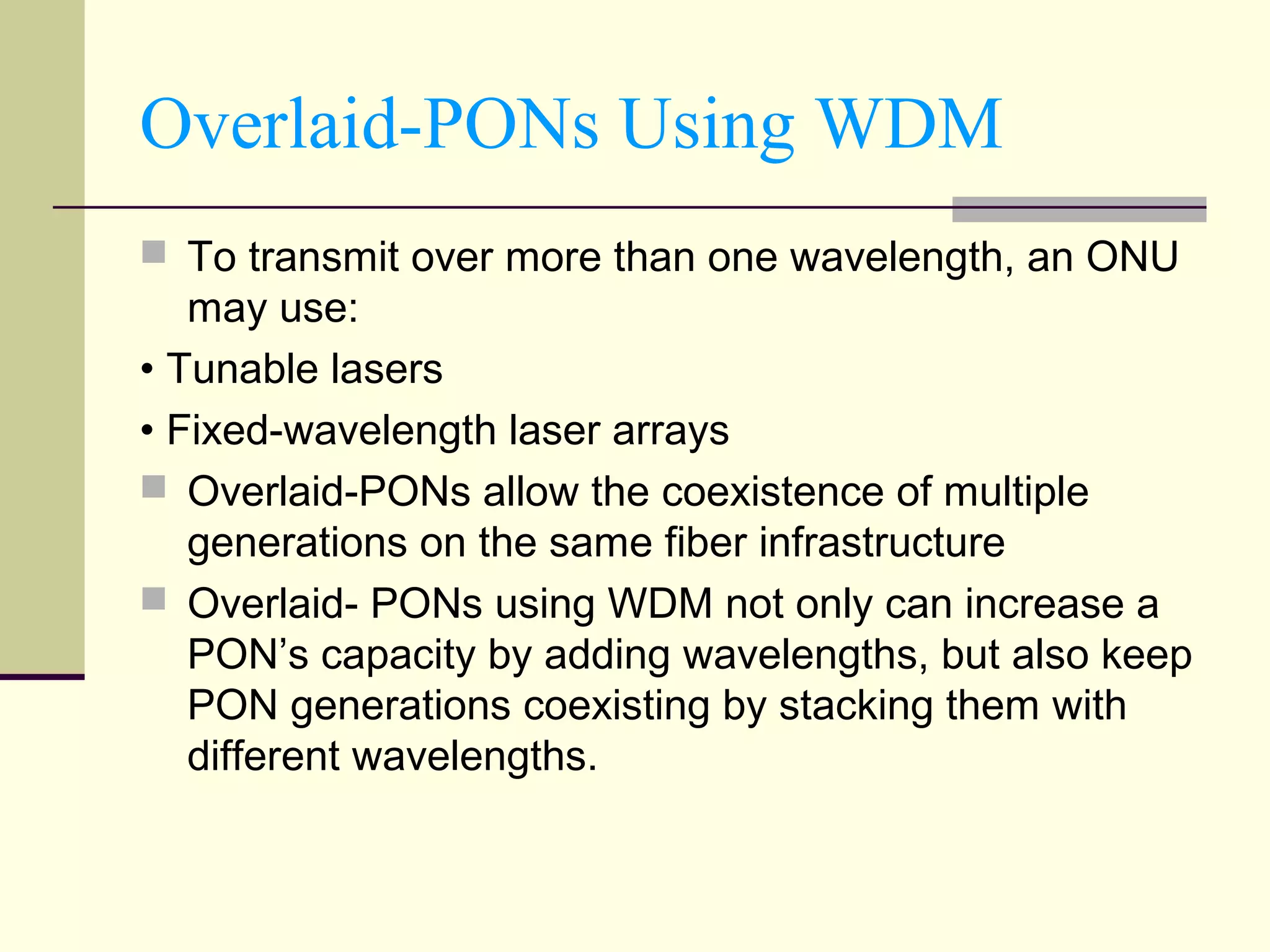
Overlaid-PONs Using WDM
 RN remains an optical
splitter, and it does not
need to be replaced by
an AWG
 In Overlaid-PONs, PON
capacity is incremented
by adding wavelength
channels based on
traffic demands
 OLT will control an
ONU’s usage of a
wavelength at a specific
timeslot
Overlaid-PONs Using WDM
 To transmit over more than one wavelength, an ONU
may use:
• Tunable lasers
• Fixed-wavelength laser arrays
 Overlaid-PONs allow the coexistence of multiple
generations on the same fiber infrastructure
 Overlaid- PONs using WDM not only can increase a
PON’s capacity by adding wavelengths, but also keep
PON generations coexisting by stacking them with
different wavelengths.
Overlaid-PONs DRAWBACK
 Require that new ONUs and OLT operate at
different wavelengths than existing ones
 Need blocking filters at the first migration
phase for all ONUs which are costly
 Tunable lasers are costly and Fixed-
wavelength laser arrays are less flexible
Comparisons: WDM-PON vs.
Overlaid-PONs
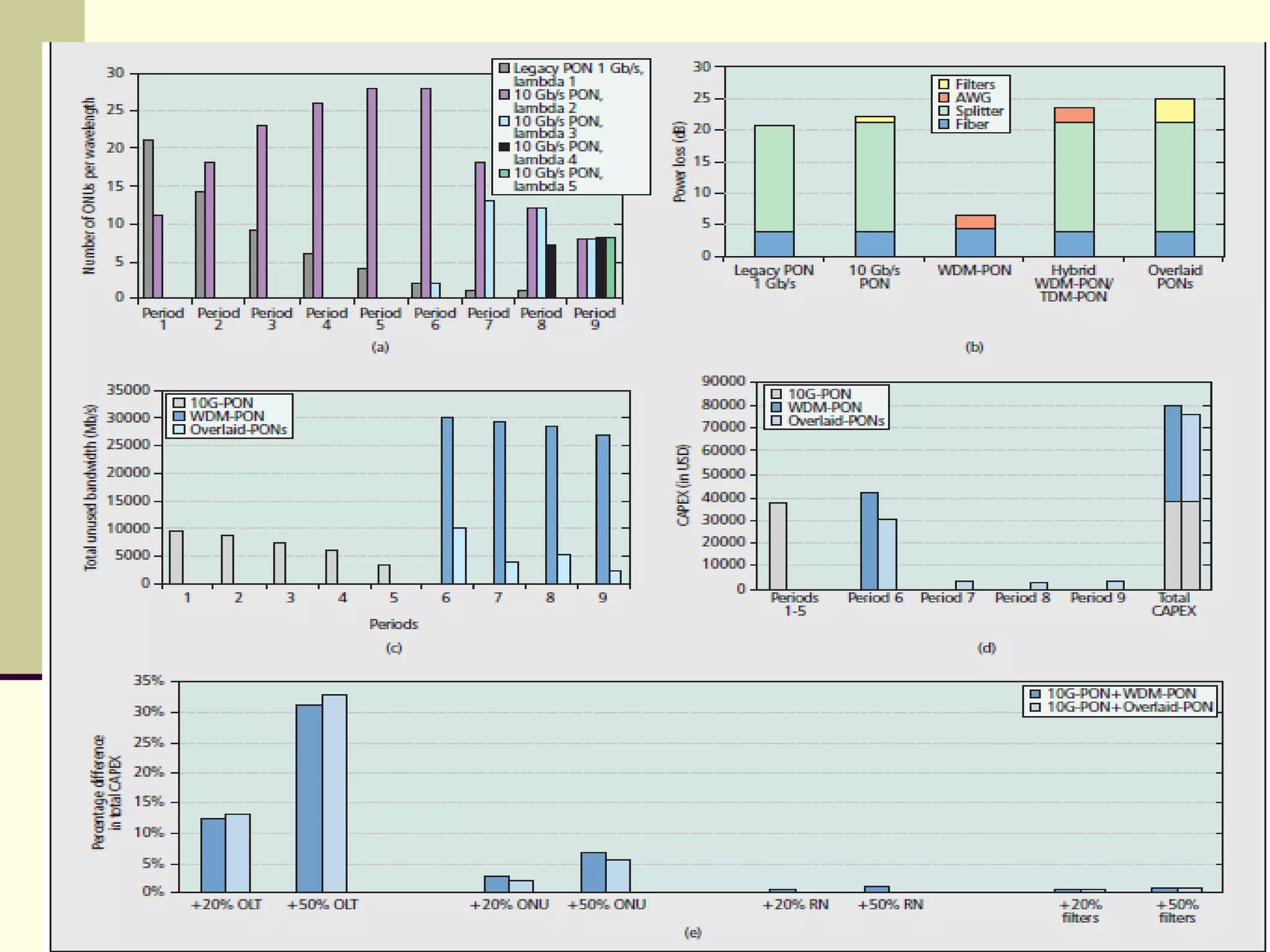
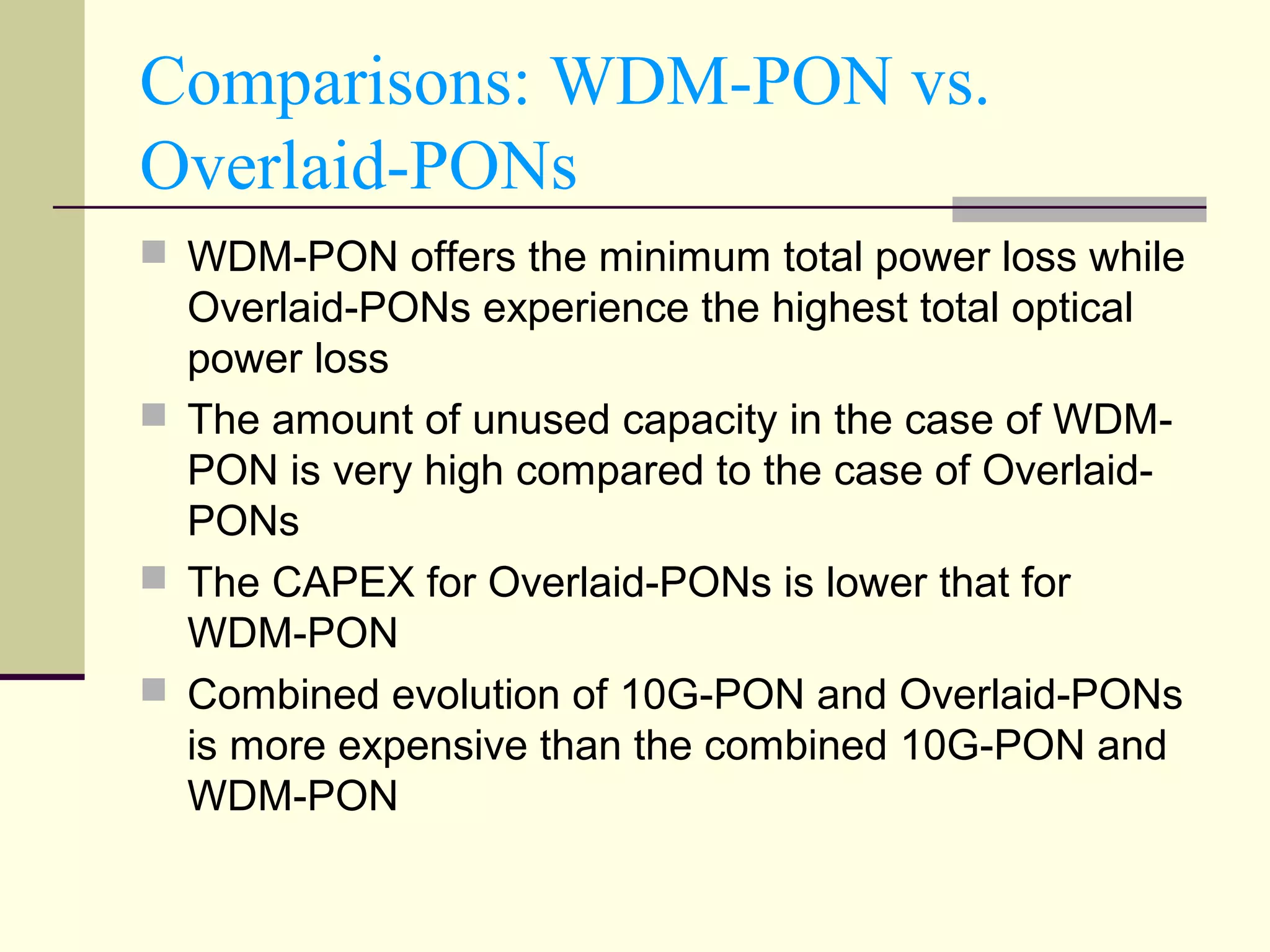
 WDM-PON offers the minimum total power loss while
Overlaid-PONs experience the highest total optical
power loss
 The amount of unused capacity in the case of WDM-
PON is very high compared to the case of Overlaid-
PONs
 The CAPEX for Overlaid-PONs is lower that for
WDM-PON
 Combined evolution of 10G-PON and Overlaid-PONs
is more expensive than the combined 10G-PON and
WDM-PON
OTHER FUTURE PON
TECHNOLOGIES
 It can carry different hybrids between WDM
and other multiplexing technologies such as
CDM ,SCM or it can be an upgrade of WDM-
based PONs by using Coherent PON
 CDM Hybrids — OCDM-PON technology
addresses capacity upgrade in PONs by
adding a code-based dimension to the
system.Design of orthogonal codes to reduce
interference and noise when the number of
users grows is an open issue
OTHER FUTURE PON
TECHNOLOGIES
 SCM Hybrids — With SCM, signals are
separated and shifted to different sub carrier
channels using modulation techniques. This
avoid interference with existing and operating
services on other channels.
 Coherent PONs — Transmitters are based on
coherent lasers and optical heterodyne or
homodyne reception. Coherent PON allows
longer reach (100 km) and a splitting factor of
1:1000, and can provide one different wavelength
channel per user
Conclusion
 An insightful cost analysis of future network evolution
and investment is needed, for which research on
colorless ONUs is important
 Smart allocation and coexistence of new and existing
users is needed, together with a graceful combination
of different types of users.
 increasing the optical power budget is essential to
follow Overlaid-PON’s solution.
 Analysis of future PON technologies is needed if it
can be related to cost and ease of implementation
 Amplified PON for longer reach is important to take
into account in PON evolution

Evolution of Passive optical network

  • 1.
    Strategies for Evolutionof PON Submitted by: Yatish Bathla
  • 2.
    Introduction  We studystrategies for increasing the PON’s capacity regardless of its technology: EPON (Ethernet-based PON) or GPON (Gigabit capable PON).  In PON, a fiber is extended from an OLT (Optical Line Terminal) at the Central Office to a remote to an remote node located in the service area (10–20 km from CO). From the RN, fiber drops are extended to each ONU
  • 3.
    Introduction  Legacy PONs(EPON, GPON) generally use two wavelengths as transmission channels. The downstream channel (1490 nm) is broadcast in nature, and any ONU can filter the data intended for it. The upstream channel (1310 nm) is shared in time among all ONUs. Thus, legacy PONs are referred to as TDM (Time-Division Multiplexing) PON. OLT authorizes timeslots when an ONU can transmit  Bandwidth supported by legacy PONs is limited: 1 Gb/s upstream and downstream for EPON, and up to 2.5 Gb/s downstream/1.25 Gb/s upstream for GPON
  • 4.
  • 5.
    MAIN EVOLUTION PHASESAND SCENARIOS Three principal evolutionary phases:  Line-rate upgrade  Multi-wavelength channel migration  Other future PON technologies
  • 6.
    LINE-RATE UPGRADE  Anatural PON evolution is to increase existing PON capacity to a higher line rate, namely 10 Gb/s.  Longer-term PON evolution may consider higher line rates: 40 Gb/s or 100 Gb/s.  Two sub-phases of evolution are expected: Asymmetric and Symmetric line-rate upgrades
  • 7.
    Asymmetric Line-Rate Upgrade (ALRU) Downstream traffic from OLT to ONUs is traditionally higher than upstream traffic  10 Gb/s upstream capability (symmetric approach) would require more expensive ONU devices.  A new downstream channel added to the PON using WDM
  • 8.
    ALRU DRAWBACK  Newwavelength blocking filters should be attached to ONUs to avoid interferences between downstream channels  An external or embedded amplifier may be needed at the OLT due to the low sensitivity of the ONUs’ receivers and the low optical power level needed to reach the receiver of high-line  A new class of PON chipsets is needed
  • 9.
    Symmetric Line-Rate Upgrade (SLRU) Symmetric line-rate upgrade is achieved when both downstream and upstream directions operate at the same rate  Two approaches can be considered: TDM and WDM coexistence
  • 10.
    SLRU DRAWBACK  networkimplementation becomes complex  An important challenge is imposed on the OLT’s burst-mode receiver  The new optical transmission for ONUs can be more expensive  Network disruption can occur due to installation of a WDM filter
  • 11.
    MULTIPLE WAVELENGTH CHANNEL MIGRATION The natural second step for PON evolution is based on WDM technology.  The advantage of WDM is that it allows coexistence between two or more PON generations over the same infrastructure  There are two main architectures: WDM-PON and Overlaid-PONs
  • 12.
    WDM-PON  It requiresthe replacement of the optical power splitter by an Arrayed Waveguide Grating  AWG allows a fixed assignment of two wavelengths (upstream and downstream channels) to each ONU  Use colorless ONUs either with tunable lasers or RSOAs
  • 13.
    WDM-PON DRAWBACK  Challengesto implement type of transceivers at the OLT and ONU, sharp filtering, and type of RN.  fixed-channel assignment is inflexible and does not allow dynamic reuse of wavelengths by different ONUs for efficient capacity utilization  Price of RSOAs, Tunable Laser is one order of magnitude higher than an entire (EPON-based) ONU  A complete migration of all user devices will lead to prohibitive costs
  • 14.
    Overlaid-PONs Using WDM RN remains an optical splitter, and it does not need to be replaced by an AWG  In Overlaid-PONs, PON capacity is incremented by adding wavelength channels based on traffic demands  OLT will control an ONU’s usage of a wavelength at a specific timeslot
  • 15.
    Overlaid-PONs Using WDM To transmit over more than one wavelength, an ONU may use: • Tunable lasers • Fixed-wavelength laser arrays  Overlaid-PONs allow the coexistence of multiple generations on the same fiber infrastructure  Overlaid- PONs using WDM not only can increase a PON’s capacity by adding wavelengths, but also keep PON generations coexisting by stacking them with different wavelengths.
  • 16.
    Overlaid-PONs DRAWBACK  Requirethat new ONUs and OLT operate at different wavelengths than existing ones  Need blocking filters at the first migration phase for all ONUs which are costly  Tunable lasers are costly and Fixed- wavelength laser arrays are less flexible
  • 18.
    Comparisons: WDM-PON vs. Overlaid-PONs WDM-PON offers the minimum total power loss while Overlaid-PONs experience the highest total optical power loss  The amount of unused capacity in the case of WDM- PON is very high compared to the case of Overlaid- PONs  The CAPEX for Overlaid-PONs is lower that for WDM-PON  Combined evolution of 10G-PON and Overlaid-PONs is more expensive than the combined 10G-PON and WDM-PON
  • 19.
    OTHER FUTURE PON TECHNOLOGIES It can carry different hybrids between WDM and other multiplexing technologies such as CDM ,SCM or it can be an upgrade of WDM- based PONs by using Coherent PON  CDM Hybrids — OCDM-PON technology addresses capacity upgrade in PONs by adding a code-based dimension to the system.Design of orthogonal codes to reduce interference and noise when the number of users grows is an open issue
  • 20.
    OTHER FUTURE PON TECHNOLOGIES SCM Hybrids — With SCM, signals are separated and shifted to different sub carrier channels using modulation techniques. This avoid interference with existing and operating services on other channels.  Coherent PONs — Transmitters are based on coherent lasers and optical heterodyne or homodyne reception. Coherent PON allows longer reach (100 km) and a splitting factor of 1:1000, and can provide one different wavelength channel per user
  • 21.
    Conclusion  An insightfulcost analysis of future network evolution and investment is needed, for which research on colorless ONUs is important  Smart allocation and coexistence of new and existing users is needed, together with a graceful combination of different types of users.  increasing the optical power budget is essential to follow Overlaid-PON’s solution.  Analysis of future PON technologies is needed if it can be related to cost and ease of implementation  Amplified PON for longer reach is important to take into account in PON evolution