Moore’s Law DiscussedJoseph C. Campbell – 02/20/2010
What is Moore’s LawA paper published in Electronic Magazine, Volume 38, Number 8, Page 114 on April 19, 1965 by Dr. Gordon E. Moore put forward:Costs and Curves“Reduced cost is one of the big attractions of integrated electronics, and the cost advantage continues to increase as the technology evolves toward the production of larger and larger circuit functions on a single semiconductor substrate. For simple circuits, the cost per component is nearly inversely proportional to the number of components, the result of the equivalent piece of semiconductor in the equivalent package containing more components. But as components are added, decreased yields more than compensate for the increased complexity, tending to raise the cost per component. Thus there is a minimum cost at any given time in the evolution of the technology. At present, it is reached when 50 components are used per circuit. But the minimum is rising rapidly while the entire cost curve is falling. If we look ahead five years, a plot of costs suggests that the minimum cost per component might be expected in circuits with about 1,000 components per circuit (providing such circuit functions can be produced in moderate quantities.) In 1970, the manufacturing cost per component can be expected to be only a tenth of the present cost. The complexity for minimum component costs has increased at a rate of roughly a factor of two per year . Certainly over the short term this rate can be expected to continue, if not to increase. Over the longer term, the rate of increase is a bit more uncertain, although there is no reason to believe it will not remain nearly constant for at least 10 years. That means by 1975, the number of components per integrated circuit for minimum cost will be 65,000. I believe that such a large circuit can be built on a single wafer.”Foot Notes:The phrase “Moore’s Law was coined  by Carver  Mead a professor at Caltech  around 1970Moore later  in 1975 restates the doubling as 2 years citing  “I noticed we were losing one of the key factors that let us make this remarkable rate of progress”There is a misnomer that the period is 18 months, this was actually a reinterpretation by David House then at Intel™  and not from Moore.Copyright  © 2010 Joseph C. Campbell2/20/20102
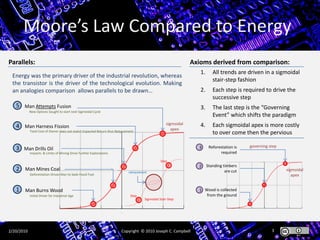
Moore’s Law Compared to EnergyAxioms derived from comparison:Parallels:All trends are driven in a sigmoidal stair-step fashionEach step is required to drive the successive stepThe last step is the “Governing Event” which shifts the paradigmEach sigmoidal apex is more costly to over come then the perviousEnergy was the primary driver of the industrial revolution, whereas the transistor is the driver of the technological evolution. Making an analogies comparison  allows parallels to be drawn…Man Attempts Fusion5New Options Sought to start next Sigmoidal CyclesigmoidalapexMan Harness Fission4Total Cost of Owner does not match Expected Return thus Retracementgoverning stepReforestation is requiredMan Drills Oil33Impacts  & Limits of Mining Drive Further ExplorationsStepStanding timbers are cut22Man Mines Coal2sigmoidalapexretracementDeforestation Drives Man to Seek Fossil FuelMan Burns Wood1Wood is collected from the ground1Initial Driver for Industrial AgeStepSigmoidal Stair-Step1Copyright  © 2010 Joseph C. Campbell2/20/20103
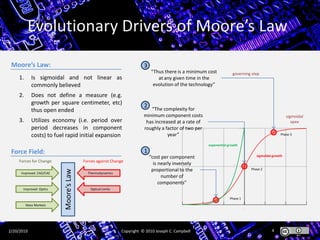
Evolutionary Drivers of Moore’s LawMoore’s Law:3“Thus there is a minimum cost at any given time in the evolution of the technology”governing stepIs sigmoidal and not linear as commonly believedDoes not define a measure (e.g. growth per square centimeter, etc) thus open endedUtilizes economy (i.e. period over period decreases in component costs) to fuel rapid initial expansion 2“The complexity for minimum component costs has increased at a rate of roughly a factor of two per year”sigmoidalapexPhase 3exponential growth  Force Field:1“cost per component is nearly inversely proportional to the number of components”sigmoidal growth Forces for ChangeForces against ChangePhase 2Improved  CAD/CAEThermodynamicsOptical LimitsImproved  OpticsMoore’s LawPhase 1Mass MarketsCopyright  © 2010 Joseph C. Campbell2/20/20104
Moore’s Law and Nano-EvolutionMany Futurist portray the “Nano-Revolution” as arriving via carbon “nano-tubes” or a form of exotic “grey goo” at some not to distant future time, however not now.   The reality is this will not be a “revolution” however an “evolution” and it was started in 1954 with the mass production of the transistor.Today this “evolution” can be found all round us, in our toaster to the microwave  oven via the embedded microprocessors which contain millions of  nano-sized electronic machines which do our bidding without us evening thinking about them.Today these devices lack autonomous organization, that will evolve with their ability to socially connect with other devices  via protocols such as Blue-Tooth and be extended by 4G developments creating “nano-swams”.As Moore’s Law continues to drive down  the cost and size of integrated circuits they will find their way into more and more devices which in turn will further fuel the information available for the nano-swams to share and therefore drive their actions…Copyright  © 2010 Joseph C. Campbell2/20/20105
The Importance of Moore’s lawAs a business enabler, Moore’s law is grossly underestimated as a driver of under-inflation in world economic markets.  Creating the equivalent the “Big Mac” measure using transistors one quickly see’s:“Since a transistor’s price in 1954 was 64 million times more than it is as of this writing, the economic value the industry has brought to the world is unimaginable. If we take 2006’s market and adjust for inflation, the value of to day’s integrated circuit production would be 13 peta-dollars – or $13,000 trillion. That is far larger than Gross World Product, which measures the value of output of all the world’s economies.”Into the Nano Era, Moore’s Law Beyond Planar Silicon CMOS – Dr Howard R. Huff 2009 Springer In addition to its intrinsic effect, Moore’s Law also drives external counter inflationary factors such as energy consumption by reducing the need for transportation, speeding production cycles, and reducing design times.  In addition it also adds to the positive turn over of cash within the markets by driving obsolesces at a feverish pace.  Where as business may purchase a truck and accept it performance for 10 to 15 years, business can not do the same with computing technology and maintain business viability…Copyright  © 2010 Joseph C. Campbell2/20/20106
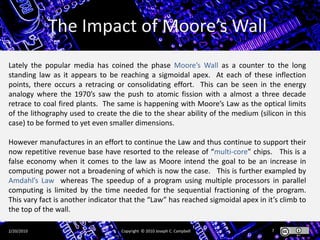
The Impact of Moore’s WallLately the popular media has coined the phase Moore’s Wall as a counter to the long standing law as it appears to be reaching a sigmoidal apex.  At each of these inflection points, there occurs a retracing or consolidating effort.  This can be seen in the energy analogy where the 1970’s saw the push to atomic fission with a almost a three decade retrace to coal fired plants.  The same is happening with Moore’s Law as the optical limits of the lithography used to create the die to the shear ability of the medium (silicon in this case) to be formed to yet even smaller dimensions.However manufactures in an effort to continue the Law and thus continue to support their now repetitive revenue base have resorted to the release of “multi-core” chips.   This is a false economy when it comes to the law as Moore intend the goal to be an increase in computing power not a broadening of which is now the case.   This is further exampled by Amdahl’s Law  whereas The speedup of a program using multiple processors in parallel computing is limited by the time needed for the sequential fractioning of the program.  This vary fact is another indicator that the “Law” has reached sigmoidal apex in it’s climb to the top of the wall.Copyright  © 2010 Joseph C. Campbell2/20/20107
The Future of Moore’s LawMany experts in the field believe that Moore’s Law will extend out to the year 2020 before significant pressures alter its driving forces.   Herein what are the potential “game changes” which may create the next and perpetuate the law?Some Candidates Are:New substrates such as  industrial grade diamond to replace silicon
Horizontal aggregation of computing power such as cloud computing

Moore’s Law Discussed

  • 1.
    Moore’s Law DiscussedJosephC. Campbell – 02/20/2010
  • 2.
    What is Moore’sLawA paper published in Electronic Magazine, Volume 38, Number 8, Page 114 on April 19, 1965 by Dr. Gordon E. Moore put forward:Costs and Curves“Reduced cost is one of the big attractions of integrated electronics, and the cost advantage continues to increase as the technology evolves toward the production of larger and larger circuit functions on a single semiconductor substrate. For simple circuits, the cost per component is nearly inversely proportional to the number of components, the result of the equivalent piece of semiconductor in the equivalent package containing more components. But as components are added, decreased yields more than compensate for the increased complexity, tending to raise the cost per component. Thus there is a minimum cost at any given time in the evolution of the technology. At present, it is reached when 50 components are used per circuit. But the minimum is rising rapidly while the entire cost curve is falling. If we look ahead five years, a plot of costs suggests that the minimum cost per component might be expected in circuits with about 1,000 components per circuit (providing such circuit functions can be produced in moderate quantities.) In 1970, the manufacturing cost per component can be expected to be only a tenth of the present cost. The complexity for minimum component costs has increased at a rate of roughly a factor of two per year . Certainly over the short term this rate can be expected to continue, if not to increase. Over the longer term, the rate of increase is a bit more uncertain, although there is no reason to believe it will not remain nearly constant for at least 10 years. That means by 1975, the number of components per integrated circuit for minimum cost will be 65,000. I believe that such a large circuit can be built on a single wafer.”Foot Notes:The phrase “Moore’s Law was coined by Carver Mead a professor at Caltech around 1970Moore later in 1975 restates the doubling as 2 years citing “I noticed we were losing one of the key factors that let us make this remarkable rate of progress”There is a misnomer that the period is 18 months, this was actually a reinterpretation by David House then at Intel™ and not from Moore.Copyright © 2010 Joseph C. Campbell2/20/20102
  • 3.
    Moore’s Law Comparedto EnergyAxioms derived from comparison:Parallels:All trends are driven in a sigmoidal stair-step fashionEach step is required to drive the successive stepThe last step is the “Governing Event” which shifts the paradigmEach sigmoidal apex is more costly to over come then the perviousEnergy was the primary driver of the industrial revolution, whereas the transistor is the driver of the technological evolution. Making an analogies comparison allows parallels to be drawn…Man Attempts Fusion5New Options Sought to start next Sigmoidal CyclesigmoidalapexMan Harness Fission4Total Cost of Owner does not match Expected Return thus Retracementgoverning stepReforestation is requiredMan Drills Oil33Impacts & Limits of Mining Drive Further ExplorationsStepStanding timbers are cut22Man Mines Coal2sigmoidalapexretracementDeforestation Drives Man to Seek Fossil FuelMan Burns Wood1Wood is collected from the ground1Initial Driver for Industrial AgeStepSigmoidal Stair-Step1Copyright © 2010 Joseph C. Campbell2/20/20103
  • 4.
    Evolutionary Drivers ofMoore’s LawMoore’s Law:3“Thus there is a minimum cost at any given time in the evolution of the technology”governing stepIs sigmoidal and not linear as commonly believedDoes not define a measure (e.g. growth per square centimeter, etc) thus open endedUtilizes economy (i.e. period over period decreases in component costs) to fuel rapid initial expansion 2“The complexity for minimum component costs has increased at a rate of roughly a factor of two per year”sigmoidalapexPhase 3exponential growth Force Field:1“cost per component is nearly inversely proportional to the number of components”sigmoidal growth Forces for ChangeForces against ChangePhase 2Improved CAD/CAEThermodynamicsOptical LimitsImproved OpticsMoore’s LawPhase 1Mass MarketsCopyright © 2010 Joseph C. Campbell2/20/20104
  • 5.
    Moore’s Law andNano-EvolutionMany Futurist portray the “Nano-Revolution” as arriving via carbon “nano-tubes” or a form of exotic “grey goo” at some not to distant future time, however not now. The reality is this will not be a “revolution” however an “evolution” and it was started in 1954 with the mass production of the transistor.Today this “evolution” can be found all round us, in our toaster to the microwave oven via the embedded microprocessors which contain millions of nano-sized electronic machines which do our bidding without us evening thinking about them.Today these devices lack autonomous organization, that will evolve with their ability to socially connect with other devices via protocols such as Blue-Tooth and be extended by 4G developments creating “nano-swams”.As Moore’s Law continues to drive down the cost and size of integrated circuits they will find their way into more and more devices which in turn will further fuel the information available for the nano-swams to share and therefore drive their actions…Copyright © 2010 Joseph C. Campbell2/20/20105
  • 6.
    The Importance ofMoore’s lawAs a business enabler, Moore’s law is grossly underestimated as a driver of under-inflation in world economic markets. Creating the equivalent the “Big Mac” measure using transistors one quickly see’s:“Since a transistor’s price in 1954 was 64 million times more than it is as of this writing, the economic value the industry has brought to the world is unimaginable. If we take 2006’s market and adjust for inflation, the value of to day’s integrated circuit production would be 13 peta-dollars – or $13,000 trillion. That is far larger than Gross World Product, which measures the value of output of all the world’s economies.”Into the Nano Era, Moore’s Law Beyond Planar Silicon CMOS – Dr Howard R. Huff 2009 Springer In addition to its intrinsic effect, Moore’s Law also drives external counter inflationary factors such as energy consumption by reducing the need for transportation, speeding production cycles, and reducing design times. In addition it also adds to the positive turn over of cash within the markets by driving obsolesces at a feverish pace. Where as business may purchase a truck and accept it performance for 10 to 15 years, business can not do the same with computing technology and maintain business viability…Copyright © 2010 Joseph C. Campbell2/20/20106
  • 7.
    The Impact ofMoore’s WallLately the popular media has coined the phase Moore’s Wall as a counter to the long standing law as it appears to be reaching a sigmoidal apex. At each of these inflection points, there occurs a retracing or consolidating effort. This can be seen in the energy analogy where the 1970’s saw the push to atomic fission with a almost a three decade retrace to coal fired plants. The same is happening with Moore’s Law as the optical limits of the lithography used to create the die to the shear ability of the medium (silicon in this case) to be formed to yet even smaller dimensions.However manufactures in an effort to continue the Law and thus continue to support their now repetitive revenue base have resorted to the release of “multi-core” chips. This is a false economy when it comes to the law as Moore intend the goal to be an increase in computing power not a broadening of which is now the case. This is further exampled by Amdahl’s Law whereas The speedup of a program using multiple processors in parallel computing is limited by the time needed for the sequential fractioning of the program. This vary fact is another indicator that the “Law” has reached sigmoidal apex in it’s climb to the top of the wall.Copyright © 2010 Joseph C. Campbell2/20/20107
  • 8.
    The Future ofMoore’s LawMany experts in the field believe that Moore’s Law will extend out to the year 2020 before significant pressures alter its driving forces. Herein what are the potential “game changes” which may create the next and perpetuate the law?Some Candidates Are:New substrates such as industrial grade diamond to replace silicon
  • 9.
    Horizontal aggregation ofcomputing power such as cloud computing