
Presented By:
Rajeshwar Singh (0612031083)
Shahul Sarraf (0612031095)
ECE Dept. (Final Year)
Under the Guidance of
Mr. Rajeev Mishra
Lect. ECE Dept.
ITM GIDA Gorakhpur
 What is Smart Dust?
 Smart dust Mote
 Internal Structure
 Block Diagram
 Architecture
 Tradeoffs
 Corner Cube Retro
Reflector
 Free Space Optical
Network
 Communication
Technology
 Fiber Optic
Communication
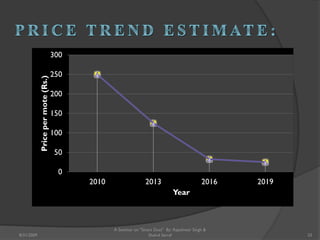
 Price Trends Estimate
 Application
 Military & Space
 Commercial
 Challenges
 Future Work
2
A Seminar on "Smart Dust" By: Rajeshwar Singh &
Shahul Sarraf8/31/2009
A tiny dust size device with extra-ordinary
capabilities.
Often called micro electro-mechanical
sensors (MEMS).
Combines sensing, computing, wireless
communication capabilities and autonomous
power supply within volume of only few
millimeters.
Useful in monitoring real world phenomenon
without disturbing the original process.
3
A Seminar on "Smart Dust" By: Rajeshwar Singh &
Shahul Sarraf8/31/2009
 So small and light in weight that they can
remain suspended in the environment like
an ordinary dust particle.
 The air currents can also move them in
the direction of flow.
 It is very hard to detect the presence of
the Smart Dust and it is even harder to get
rid of them once deployed.
4
A Seminar on "Smart Dust" By: Rajeshwar Singh &
Shahul Sarraf8/31/2009
The three key capabilities of smart dust are:
 Sensory capabilities
 Processing capabilities
 Communication capabilities
5
A Seminar on "Smart Dust" By: Rajeshwar Singh &
Shahul Sarraf8/31/2009
Market Look MovinginSurrounding
Architecture for
sensing Humidity
6
A Seminar on "Smart Dust" By: Rajeshwar Singh &
Shahul Sarraf8/31/2009
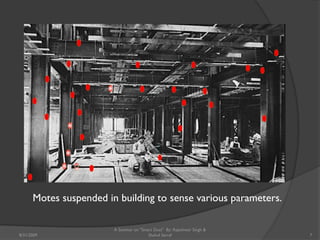
Motes suspended in building to sense various parameters.
7
A Seminar on "Smart Dust" By: Rajeshwar Singh &
Shahul Sarraf8/31/2009
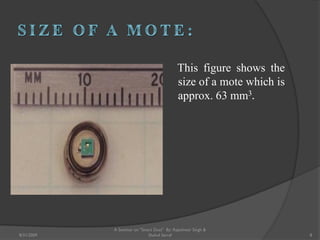
This figure shows the
size of a mote which is
approx. 63 mm3.
A Seminar on "Smart Dust" By: Rajeshwar Singh &
Shahul Sarraf8/31/2009 8
INTERNAL STRUCTURE
A Seminar on "Smart Dust" By: Rajeshwar Singh &
Shahul Sarraf8/31/2009 9
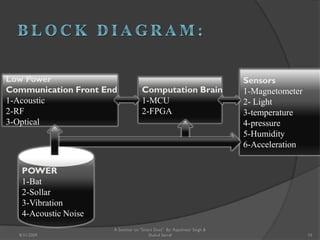
Low Power
Communication Front End
1-Acoustic
2-RF
3-Optical
Computation Brain
1-MCU
2-FPGA
Sensors
1-Magnetometer
2- Light
3-temperature
4-pressure
5-Humidity
6-Acceleration
POWER
1-Bat
2-Sollar
3-Vibration
4-Acoustic Noise
A Seminar on "Smart Dust" By: Rajeshwar Singh &
Shahul Sarraf8/31/2009 10
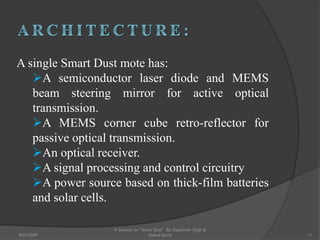
A single Smart Dust mote has:
A semiconductor laser diode and MEMS
beam steering mirror for active optical
transmission.
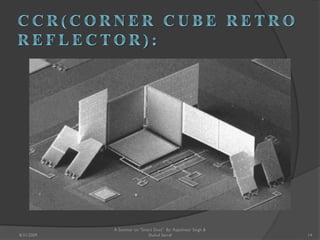
A MEMS corner cube retro-reflector for
passive optical transmission.
An optical receiver.
A signal processing and control circuitry
A power source based on thick-film batteries
and solar cells.
11
A Seminar on "Smart Dust" By: Rajeshwar Singh &
Shahul Sarraf8/31/2009
12
A Seminar on "Smart Dust" By: Rajeshwar Singh &
Shahul Sarraf8/31/2009
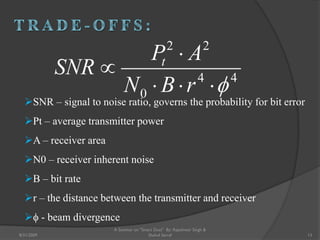
SNR – signal to noise ratio, governs the probability for bit error
Pt – average transmitter power
A – receiver area
N0 – receiver inherent noise
B – bit rate
r – the distance between the transmitter and receiver
 - beam divergence
13
A Seminar on "Smart Dust" By: Rajeshwar Singh &
Shahul Sarraf8/31/2009
14
A Seminar on "Smart Dust" By: Rajeshwar Singh &
Shahul Sarraf8/31/2009
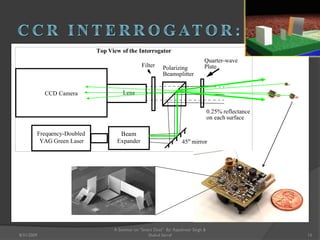
Top View of the Interrogator
CCD Camera Lens
Frequency-Doubled Beam
45o
mirror
Polarizing
Beamsplitter
Quarter-wave
PlateFilter
0.25% reflectance
on each surface
YAG Green Laser Expander
15
A Seminar on "Smart Dust" By: Rajeshwar Singh &
Shahul Sarraf8/31/2009
16
A Seminar on "Smart Dust" By: Rajeshwar Singh &
Shahul Sarraf8/31/2009
 Radio Frequency Transmission
 Optical transmission technique
a) Passive Laser based Communication
b) Active Laser based Communication
c) Fiber Optic Communication
17
A Seminar on "Smart Dust" By: Rajeshwar Singh &
Shahul Sarraf8/31/2009
 Employs semiconductor laser, fiber cable and
diode receiver to generate, transfer and detect
the optical signal.
 Similar to passive optical comm..
 Relatively small size of the optical transceiver
is employed with low-power operation.
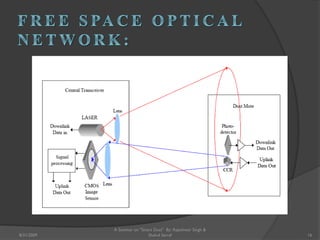
 CCR employed on each Dust mote to
modulate uplink data to base station.
18
A Seminar on "Smart Dust" By: Rajeshwar Singh &
Shahul Sarraf8/31/2009
 Does not require unbroken line-of-sight and the
link directionality.
 Each dust mote does not need to employ more
than one CCR.
 Comm.. between dust motes and a base station
can be guaranteed.
 It has a longer range of communication link
than that of a free space passive optical
communication.
20
A Seminar on "Smart Dust" By: Rajeshwar Singh &
Shahul Sarraf8/31/2009
 Optical fiber cables restrict the mobility of dust
mote.
 Since a base station should employ several
optical components for fiber connection to each
dust mote, it may complicate base station
design.
21
A Seminar on "Smart Dust" By: Rajeshwar Singh &
Shahul Sarraf8/31/2009
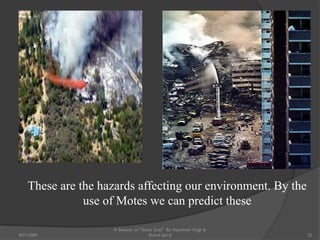
These are the hazards affecting our environment. By the
use of Motes we can predict these
22
A Seminar on "Smart Dust" By: Rajeshwar Singh &
Shahul Sarraf8/31/2009
0
50
100
150
200
250
300
2010 2013 2016 2019
Pricepermote(Rs.)
Year
23
A Seminar on "Smart Dust" By: Rajeshwar Singh &
Shahul Sarraf8/31/2009
 Internal and external spacecraft monitoring
 Meteorological and seismological monitoring in difficult terrain
and environments
 Land/space communication
 Chemical/biological environment sensing
 Meteorological sensing – for better aiming of guns and artillery
 Autonomous vehicles external aid
24
A Seminar on "Smart Dust" By: Rajeshwar Singh &
Shahul Sarraf8/31/2009
 Surveillance
Sensors minefield e.g. smart clear tracks on borders
 Urban engagement.
 Motion detection and enemy numbers
 Bunker/building mapping
 Peace time/treaty monitoring
 Intelligence in hostile areas/behind enemy lines
Transportation monitoring and traffic mapping
Missile hunting
Monitoring soldier vitals and injury
25
A Seminar on "Smart Dust" By: Rajeshwar Singh &
Shahul Sarraf8/31/2009
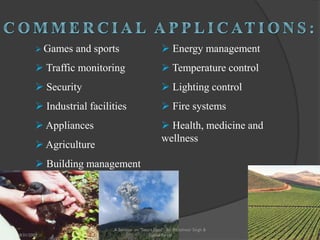
 Games and sports
 Traffic monitoring
 Security
 Industrial facilities
 Appliances
 Agriculture
 Building management
 Energy management
 Temperature control
 Lighting control
 Fire systems
 Health, medicine and
wellness
26
A Seminar on "Smart Dust" By: Rajeshwar Singh &
Shahul Sarraf8/31/2009
 It is difficult to fit all these devices in a small Smart
Dust both size wise and Energy wise.
 With devices so small, batteries present a massive
addition of weight.
27
A Seminar on "Smart Dust" By: Rajeshwar Singh &
Shahul Sarraf8/31/2009
 Design of multi hop network
 Autonomous network
configuration
 Data Fusion
 Network Decision making
 Large Scale Distributed
Processing
 Sensors Networks could be
as useful as the Internet
 Internet allows us faster,
easier access to data and
information from the digital
domain.
 Sensor Networks expand our
ability to access data from the
physical world (analog domain).
28
A Seminar on "Smart Dust" By: Rajeshwar Singh &
Shahul Sarraf8/31/2009
 There are many ongoing researches on
Smart Dust, the main purpose of these
researches is to make Smart Dust mote as
small as possible and to make it available at
as low price as possible. Soon we will see
Smart Dust being used in varied application
from all spans of life.
8/31/2009 29
A Seminar on "Smart Dust" By: Rajeshwar Singh &
Shahul Sarraf
30
A Seminar on "Smart Dust" By: Rajeshwar Singh &
Shahul Sarraf8/31/2009

Smart dust_2009

  • 1.
    Presented By: Rajeshwar Singh(0612031083) Shahul Sarraf (0612031095) ECE Dept. (Final Year) Under the Guidance of Mr. Rajeev Mishra Lect. ECE Dept. ITM GIDA Gorakhpur
  • 2.
     What isSmart Dust?  Smart dust Mote  Internal Structure  Block Diagram  Architecture  Tradeoffs  Corner Cube Retro Reflector  Free Space Optical Network  Communication Technology  Fiber Optic Communication  Price Trends Estimate  Application  Military & Space  Commercial  Challenges  Future Work 2 A Seminar on "Smart Dust" By: Rajeshwar Singh & Shahul Sarraf8/31/2009
  • 3.
    A tiny dustsize device with extra-ordinary capabilities. Often called micro electro-mechanical sensors (MEMS). Combines sensing, computing, wireless communication capabilities and autonomous power supply within volume of only few millimeters. Useful in monitoring real world phenomenon without disturbing the original process. 3 A Seminar on "Smart Dust" By: Rajeshwar Singh & Shahul Sarraf8/31/2009
  • 4.
     So smalland light in weight that they can remain suspended in the environment like an ordinary dust particle.  The air currents can also move them in the direction of flow.  It is very hard to detect the presence of the Smart Dust and it is even harder to get rid of them once deployed. 4 A Seminar on "Smart Dust" By: Rajeshwar Singh & Shahul Sarraf8/31/2009
  • 5.
    The three keycapabilities of smart dust are:  Sensory capabilities  Processing capabilities  Communication capabilities 5 A Seminar on "Smart Dust" By: Rajeshwar Singh & Shahul Sarraf8/31/2009
  • 6.
    Market Look MovinginSurrounding Architecturefor sensing Humidity 6 A Seminar on "Smart Dust" By: Rajeshwar Singh & Shahul Sarraf8/31/2009
  • 7.
    Motes suspended inbuilding to sense various parameters. 7 A Seminar on "Smart Dust" By: Rajeshwar Singh & Shahul Sarraf8/31/2009
  • 8.
    This figure showsthe size of a mote which is approx. 63 mm3. A Seminar on "Smart Dust" By: Rajeshwar Singh & Shahul Sarraf8/31/2009 8
  • 9.
    INTERNAL STRUCTURE A Seminaron "Smart Dust" By: Rajeshwar Singh & Shahul Sarraf8/31/2009 9
  • 10.
    Low Power Communication FrontEnd 1-Acoustic 2-RF 3-Optical Computation Brain 1-MCU 2-FPGA Sensors 1-Magnetometer 2- Light 3-temperature 4-pressure 5-Humidity 6-Acceleration POWER 1-Bat 2-Sollar 3-Vibration 4-Acoustic Noise A Seminar on "Smart Dust" By: Rajeshwar Singh & Shahul Sarraf8/31/2009 10
  • 11.
    A single SmartDust mote has: A semiconductor laser diode and MEMS beam steering mirror for active optical transmission. A MEMS corner cube retro-reflector for passive optical transmission. An optical receiver. A signal processing and control circuitry A power source based on thick-film batteries and solar cells. 11 A Seminar on "Smart Dust" By: Rajeshwar Singh & Shahul Sarraf8/31/2009
  • 12.
    12 A Seminar on"Smart Dust" By: Rajeshwar Singh & Shahul Sarraf8/31/2009
  • 13.
    SNR – signalto noise ratio, governs the probability for bit error Pt – average transmitter power A – receiver area N0 – receiver inherent noise B – bit rate r – the distance between the transmitter and receiver  - beam divergence 13 A Seminar on "Smart Dust" By: Rajeshwar Singh & Shahul Sarraf8/31/2009
  • 14.
    14 A Seminar on"Smart Dust" By: Rajeshwar Singh & Shahul Sarraf8/31/2009
  • 15.
    Top View ofthe Interrogator CCD Camera Lens Frequency-Doubled Beam 45o mirror Polarizing Beamsplitter Quarter-wave PlateFilter 0.25% reflectance on each surface YAG Green Laser Expander 15 A Seminar on "Smart Dust" By: Rajeshwar Singh & Shahul Sarraf8/31/2009
  • 16.
    16 A Seminar on"Smart Dust" By: Rajeshwar Singh & Shahul Sarraf8/31/2009
  • 17.
     Radio FrequencyTransmission  Optical transmission technique a) Passive Laser based Communication b) Active Laser based Communication c) Fiber Optic Communication 17 A Seminar on "Smart Dust" By: Rajeshwar Singh & Shahul Sarraf8/31/2009
  • 18.
     Employs semiconductorlaser, fiber cable and diode receiver to generate, transfer and detect the optical signal.  Similar to passive optical comm..  Relatively small size of the optical transceiver is employed with low-power operation.  CCR employed on each Dust mote to modulate uplink data to base station. 18 A Seminar on "Smart Dust" By: Rajeshwar Singh & Shahul Sarraf8/31/2009
  • 19.
     Does notrequire unbroken line-of-sight and the link directionality.  Each dust mote does not need to employ more than one CCR.  Comm.. between dust motes and a base station can be guaranteed.  It has a longer range of communication link than that of a free space passive optical communication. 20 A Seminar on "Smart Dust" By: Rajeshwar Singh & Shahul Sarraf8/31/2009
  • 20.
     Optical fibercables restrict the mobility of dust mote.  Since a base station should employ several optical components for fiber connection to each dust mote, it may complicate base station design. 21 A Seminar on "Smart Dust" By: Rajeshwar Singh & Shahul Sarraf8/31/2009
  • 21.
    These are thehazards affecting our environment. By the use of Motes we can predict these 22 A Seminar on "Smart Dust" By: Rajeshwar Singh & Shahul Sarraf8/31/2009
  • 22.
    0 50 100 150 200 250 300 2010 2013 20162019 Pricepermote(Rs.) Year 23 A Seminar on "Smart Dust" By: Rajeshwar Singh & Shahul Sarraf8/31/2009
  • 23.
     Internal andexternal spacecraft monitoring  Meteorological and seismological monitoring in difficult terrain and environments  Land/space communication  Chemical/biological environment sensing  Meteorological sensing – for better aiming of guns and artillery  Autonomous vehicles external aid 24 A Seminar on "Smart Dust" By: Rajeshwar Singh & Shahul Sarraf8/31/2009
  • 24.
     Surveillance Sensors minefielde.g. smart clear tracks on borders  Urban engagement.  Motion detection and enemy numbers  Bunker/building mapping  Peace time/treaty monitoring  Intelligence in hostile areas/behind enemy lines Transportation monitoring and traffic mapping Missile hunting Monitoring soldier vitals and injury 25 A Seminar on "Smart Dust" By: Rajeshwar Singh & Shahul Sarraf8/31/2009
  • 25.
     Games andsports  Traffic monitoring  Security  Industrial facilities  Appliances  Agriculture  Building management  Energy management  Temperature control  Lighting control  Fire systems  Health, medicine and wellness 26 A Seminar on "Smart Dust" By: Rajeshwar Singh & Shahul Sarraf8/31/2009
  • 26.
     It isdifficult to fit all these devices in a small Smart Dust both size wise and Energy wise.  With devices so small, batteries present a massive addition of weight. 27 A Seminar on "Smart Dust" By: Rajeshwar Singh & Shahul Sarraf8/31/2009
  • 27.
     Design ofmulti hop network  Autonomous network configuration  Data Fusion  Network Decision making  Large Scale Distributed Processing  Sensors Networks could be as useful as the Internet  Internet allows us faster, easier access to data and information from the digital domain.  Sensor Networks expand our ability to access data from the physical world (analog domain). 28 A Seminar on "Smart Dust" By: Rajeshwar Singh & Shahul Sarraf8/31/2009
  • 28.
     There aremany ongoing researches on Smart Dust, the main purpose of these researches is to make Smart Dust mote as small as possible and to make it available at as low price as possible. Soon we will see Smart Dust being used in varied application from all spans of life. 8/31/2009 29 A Seminar on "Smart Dust" By: Rajeshwar Singh & Shahul Sarraf
  • 29.
    30 A Seminar on"Smart Dust" By: Rajeshwar Singh & Shahul Sarraf8/31/2009