Smart Dust CIT
1
CHANNABASAVESHWARA
INSTITUTE OF TECHNOLOGY
KNEW - 2009
A PAPER
ON
NEXT CENTUARY CHALLENGE:
MOBILE NETWORKING “SMART DUST”
PRESENTED BY
UTPHALA P AND SANITHA G
[7TH SEM CSE]
Smart Dust CIT
2
Next Century Challenges:
Mobile Networking for “Smart Dust”
Abstract
Large-scale networks of wireless sensors are
becoming an active topic of research. Advances in
hardware technology and engineering design have
led to dramatic reductions in size, power
consumption and cost for digital circuitry,
wireless communications and
Micro ElectroMechanical Systems (MEMS).
This has enabled very compact, autonomous and
mobile nodes, each containing one or more
sensors,computation and communication
capabilities, and a power supply. The missing
ingredient is the networking and applications
layers needed to harness this revolutionary
capability into a complete system.
We review the key elements of the emergent
technology of “Smart Dust” and outline the
research challenges they present to the mobile
networking and systems community, which must
provide coherent connectivity to large numbers of
mobile network nodes co-located within
a small volume.
Introduction
“smart dust” is a emerging technology made up
from tiny wireless sensors or ”motes”. Eventually
this devices are smart enoughn to talk with other
sensors yet small enough to fit on the head of a
pin.Each mote is a tiny computer with a power
supply, one or more sensors, and communication
system.
These have beenenabled by the rapid convergence
of three key technologies:digital circuitry,wireless
communications, and Micro ElectroMechanical
Systems (MEMS). In each area, advances in
hardware technology and engineering design have
led to reductions in size, power consumption, and
cost.
This has enabled remarkably compact,
autonomous nodes, each containingone or more
sensors, computation and communication
capabilities, and a power supply.
Berkeley’s Smart Dust project, led by Professors
Pister and Kahn, explores the limits on size and
power consumption in autonomous sensor nodes.
Size reduction is paramount, to make the nodes as
inexpensive and easy-to-deploy as possible.
The research team is confident that they can
incorporate the requisite sensing, communication,
and computing hardware,along with a power
supply, in a volume no more than a few cubic
millimeters, while still achieving impressive
performance in terms of sensor functionality and
communications capability. These millimeter-
scale nodes are called “Smart Dust.”
In this paper, we are concerned with the
networking and applications challenges presented
by this radical new technology.These kinds of
networking nodes must consume extremely low
power, communicate at bit rates measured in
kilobits per second, and potentially need to
operate in high volumetric densities.
These requirements dictate the need
for novel ad hoc routing and media access
solutions. Smart dust will enable an unusual range
of applications, from sensor-rich “smart spaces”
to self-identification and historytracking for
virtually any kind of physical object.The study of
“Smart Dust systems” is very new. The main
purpose of this paper is to present some of the
technological opportunities and challenges, with
Smart Dust CIT
3
the goal of getting more systems-level researchers
interested in this critical area.
What is Smart Dust ?
Smartdust is a hypothetical wireless network of
tiny microelectromechanical (MEMS) sensors,
robots, or devices, that can detect (for example)
light, temperature, or vibration.
The devices, or motes, will eventually be the size
of a grain of sand, or even a dust particle, with
each mote having self-contained sensing,
computation, communication and power.
Characteristics
• A system is made of one or a few base stations
(interrogators) and as many smart dust motes as
possible or required
• Ubiquitous – sensors of different types
• Very task/application oriented design and
performance
• Wireless communication
• Self-organizing, self-optimizing, self-
configuring, self-sustaining.
• Very small (should be under 1mm3)
• Low power consumption
• Easy to deploy
• Based on current or very near future
components
Smart Dust Technology
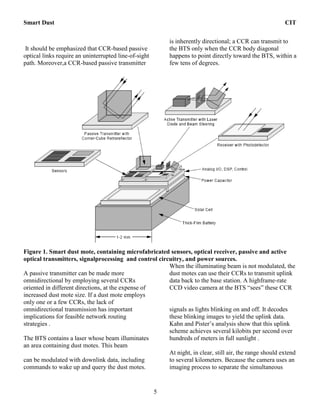
A Smart Dust mote is illustrated in Figure 1.
Integrated into a single package are MEMS
sensors, a semiconductor laser diode and MEMS
beam-steering mirror for active optical
transmission, a MEMS corner-cube retroreflector
for passive optical transmission, an optical
receiver, signal-processing and control circuitry,
and a power source based on thick-film batteries
and solar cells. This remarkable package has the
ability to sense and communicate, and is self-
powered!
A major challenge is to incorporate all these
functions while maintaining very low power
consumption, thereby maximizing operating life
given the limited volume available for energy
storage. Within the design goal of a cubic
millimeter volume, using the best available
battery technology, the total stored energy is on
the order of 1 Joule. If this energy is consumed
continuously over a day, the dust mote power
consumption cannot exceed roughly10
microwatts.
The functionality envisioned for Smart Dust can
be achieved only if the total power consumption
of a dust mote is limited to microwatt levels, and
if careful power management strategies are
utilized (i.e., the various parts of the dust mote are
powered on only when necessary).
To enable dust motes to function over the span of
days, solar cells could be employed to scavenge as
much energy as possible when the sun shines
(roughly 1 Joule per day) or when room lights are
turned on (about 1 millijoule per day).
Techniques for performing sensing and processing
at low power are reasonably well understood.
Developing a communications architecture for
ultra-low-power represents a more critical
challenge.
The primary candidate communication
technologies are based on radio frequency (RF) or
optical transmission techniques. Each technique
has its advantages and disadvantages.
RF presents a problem because dust motes offer
very limited space for antennas, thereby
demanding extremely short-wavelength (i.e.,
highfrequency)transmission. Communication in
this regime isnot currently compatible with low
power operation.
Smart Dust CIT
4
Furthermore,radio transceivers are relatively
complex circuits,making it difficult to reduce their
power consumption to the required microwatt
levels.
They require modulation, bandpass filtering and
demodulation circuitry, and additional circuitry is
required if the transmissions of a large number of
dust motes are to be multiplexed using time-,
frequency- or code-division multiple access.
An attractive alternative is to employ free-space
optical transmission. Kahn and Pister’s studies
have shown that when a line-of-sight path is
available, well-designed freespace optical links
require significantly lower energy per bit than
their RF counterparts.
There are several reasons for thepower advantage
of optical links. Optical transceives require only
simple baseband analog and digital circuitry;
no modulators, active bandpass filters or
demodulators are needed.
The short wavelength of visible or near-infrared
light (of the order of 1 micron) makes it possible
for a millimeter-scale device to emit a narrow
beam (i.e., high antennagain can be achieved).
As another consequence of this short wavelength,
a base-station transceiver (BTS) equipped with a
compact imaging receiver can decode the
simultaneous transmissions from a large number
of dust motes at different locations within the
receiver field of view, which is a form of space-
division multiplexing.
Successful decoding of these simultaneous
transmissions requires that dust motes not block
one another’s line of sight to the BTS. Such
blockage is unlikely, in view of the dust
motes’ small size. A second requirement for
decoding of simultaneous transmission is that the
images of different dust motes be formed on
different pixels in the BTS imaging receiver.
To get a feeling for the required receiver
resolution, consider the following example.
Suppose that the BTS views a 17 meter by 17
meter area containing SmartDust, and that it uses
a high-speed video camera with a very modest
256 by 256 pixel imaging array.
Each pixel views an area about 6.6 centimeters
square. Hence, simultaneous transmissions can be
decoded as long as the dust motes are separated
by a distance roughly the size of a pack of
cigarettes.
Another advantage of free-space optical
transmission is that a special MEMS structure
make it possible for dust motes to use passive
optical transmission techniques, i.e., to transmit
modulated optical signals without supplying any
optical power.
This structure is a corner-cube retroreflector, or
CCR. It comprises three mutually perpendicular
mirrors of gold-coated polysilicon. The CCR has
theproperty that any incident ray of light is
reflected back to the source (provided that it is
incident within a certain range
of angles centered about the cube’s body
diagonal).
If one of the mirrors is misaligned, this
retroreflection property is spoiled. The
microfabricated CCR includes an electrostatic
actuator that can deflect one of the mirrors at
kilohertz rates.
It has been demonstrated that a CCR illuminated
by an external light source can transmit back a
modulated signal at kilobits per second. Since the
dust mote itself does not emit light, the passive
transmitter consumes little power.
Using a microfabricated CCR, Chu and Pister
have demonstrated data transmission at a bit rate
up to 1 kilobit per second, and over a range up to
150 meters, using a 5-milliwatt illuminating
laser .
Smart Dust CIT
5
It should be emphasized that CCR-based passive
optical links require an uninterrupted line-of-sight
path. Moreover,a CCR-based passive transmitter
is inherently directional; a CCR can transmit to
the BTS only when the CCR body diagonal
happens to point directly toward the BTS, within a
few tens of degrees.
Figure 1. Smart dust mote, containing microfabricated sensors, optical receiver, passive and active
optical transmitters, signalprocessing and control circuitry, and power sources.
A passive transmitter can be made more
omnidirectional by employing several CCRs
oriented in different directions, at the expense of
increased dust mote size. If a dust mote employs
only one or a few CCRs, the lack of
omnidirectional transmission has important
implications for feasible network routing
strategies .
The BTS contains a laser whose beam illuminates
an area containing dust motes. This beam
can be modulated with downlink data, including
commands to wake up and query the dust motes.
When the illuminating beam is not modulated, the
dust motes can use their CCRs to transmit uplink
data back to the base station. A highframe-rate
CCD video camera at the BTS “sees” these CCR
signals as lights blinking on and off. It decodes
these blinking images to yield the uplink data.
Kahn and Pister’s analysis show that this uplink
scheme achieves several kilobits per second over
hundreds of meters in full sunlight .
At night, in clear, still air, the range should extend
to several kilometers. Because the camera uses an
imaging process to separate the simultaneous
Smart Dust CIT
6
transmissions from dust motes at different
locations, we say that it uses space-division
multiplexing.
The ability for a video camera to resolve these
transmissions is a consequence of the short
wavelength of visible or near-infrared light. This
does not require any coordination among the dust
motes, and thus, it does not complicate their
design.
When the application requires dust motes to use
active optical transmitters, MEMS technology can
be used to assemble a semiconductor laser, a
collimating lens and a beam-steering micro-
mirror, as shown in Figure 1.
Active transmitters make possible peer-to-peer
communication between dust motes, provided
there exists a line-of-sight path between them.
Power consumption imposes a trade-off between
bandwidth and range.
The dust motes can communication over longer
ranges (tens of kilometers) at low data rates or
higher bit rates (megabits per second) over shorter
distances.
The relatively high power consumption of
semiconductor lasers (of the order of 1 milliwatt)
dictates that these active transmitters be used for
short-duration burst-mode communication only.
Sensor networks using active dust mote
transmitters will require some protocol for dust
motes to aim their beams toward the receiving
parties.
SmartDust System Requirements
Power:
The dust motes must have enough energy to
survive anywhere from a few hours to
months in order to monitor an environment.
Because of the small size of the mote, energy
management is a key constraint of the design.
The power system consists of a thick-film battery
or a solar cell with a charge-integrating capacitor
to allow for charge retention for periods of
darkness, or both.
Current battery and capacitor technology can store
approximately 1J/mm3 and 10mJ/mm3,
respectively, while solar cells can provide about
1J/day/mm2 in sunlight and 1-10mJ/day/mm2
indoors.
Energy consumption must therefore be
minimized in every part of the system. The optical
receiver of smart dust consumes approximately
0.1 nJ/bit and the transmitter uses 1 nJ/bit. The
analog-to-digital converter will require 1
nJ/sample, and computations are anticipated to
consume under 1pJ/instruction.
Sensor:
Depending on its objective, the design integrates
various sensors, including light, temperature,
vibration, magnetic field, acoustic, and wind
shear, onto the mote.
The Micro Electro-Mechanical Systems (MEMS)
industry has been growing with major markets in
automotive pressure sensors and accelerometers,
medical sensors, and process control sensors.
Recent advances in technology have put many of
these sensor processes on exponentially
decreasing size/power/cost curves, and the results
of this technology are of direct use here.
The sensors could be classified into two groups:
weather monitors, and motion detectors.
The table 1 summarizes the different types of
sensors that can be used on the smart dust.
Communication:
Smart dust’s full potential can only be attained
when the sensor nodes communicate with
Smart Dust CIT
7
one another or with a central base station.
Communication system facilitates simultaneous
datacollection from thousands of sensors.
There are several constraints in designing of the
communication system due to the size and low
power of dust motes. In the downlink, the
central transceiver is assumed to broadcast to all
of the dust motes at a bit rate of several kbps
For the uplink, each dust motes must transfer at a
bit rate of 1kbps. When a smart dust
ensemble employs 1,000 dust motes, an aggregate
throughput is 1 Mbps.
The position of each dust mote should be
identified by the central transceiver with an
angular resolution of the order of 1/100 of the
field of view .
Both uplink and downlink should be able to
transfer data over a range of at least several
hundred meters. The size of the dust mote
transceiver should be around 1 mm3, and each
mote should require an average power
not exceeding 1 W. A very low probability of
data interception is preferred for both uplink and
downlink.
There are several secure transmission options for
communicating to and from such amote-sized
cubic-millimeter computer.
Application
Industrial Applications—In manufacturing
systems, hundreds of tiny wireless sensors
remotely monitor temperature, stress, vibration,
and other variables on or near failure points,
alerting technicians before failures occur and
saving costly downtime.
Homeland Security Applications —In
shipping containers, wireless sensors alert
customs and security officials if a container was
opened in transit.
At the same time, they perform inventory-
control functions such as identifying each item in
the shipment and recording the high and low
temperatures and humidity levels over the course
of the delivery.
Military Applications—Wireless sensors allow
technicians to track and locate service vehicles,
weapons,munitions, and supplies anywhere in the
system.
Wireless sensors embedded in equipment
and supplies alert personnel when equipment has
been exposed to out-of-tolerance environmental
conditions or has missed scheduled maintenance,
reducing the chance of equipment failure in the
field.
Wireless sensors scattered from planes or
specialized munitions sense motion, vibration,
temperature, or magnetic flux to locate enemy
combatants on the battlefield.
Other sensors help locate the source of
incoming small arms fire so that counterattacks
can be launched against snipers quickly and
precisely.
Health care Applications—In pharmaceutical
applications, smart tags track shipments and
ensure that counterfeit drugs cannot enter the
supply chain.
In medical applications, implanted or
wearable devices gather patient biometrics for
remote medical professionals, and allow medical
professionals to adjust theirpatients’ treatment
parameters remotely.
Agricultural Applications—Wireless sensors
placed in farmland monitor moisture levels so that
irrigation can be provided selectively to the areas
that need it.
Smart Dust CIT
8
These sensors can also monitor soil
chemistry,sunlight exposure, and other factors to
help farmers improve the yield of their crops.
Used in conjunction with electronically
actuated gates, farm animals can be automatically
identified and collected to receive inoculations or
other attention as needed, based on information on
each animal stored in a database.
Environmental Applications—Wireless
sensors placed on and below the soil and in trees
collect very detailed data about the fluctuations in
temperature and humidity in different parts of the
same ecosystem, to help researchers understand
that factors that determine how different species
of plants and animals proliferate.
Wireless sensors attached to animals track
their movements; placed throughout the habitat,
they sense the presence of the animals and record
information about their habits.
In addition, researchers have designed
specialized audio sensors with enough
computational capacity to recognize the song
patterns of specific bird species or to transmit
streaming video of the animal subjects through the
wireless network.
Wireless sensors monitor temperature and
humidity throughout the building, detect motion
or body temperature to switch on lights and heat
in occupied areas, evaluatesunlight intensity to
open and close shades as an aid to energy
conservation, and so forth.
Conclusion
Smart dust is made up of thousands of sand-grain-
sized sensors that can measure ambient light and
temperature. The sensors -- each one is called a
"mote" -- have wireless communications devices
attached to them, and if you put a bunch of them
near each other, they'll network themselves
automatically.
These sensors, which would cost pennies each if
mass-produced, could be plastered all over office
buildings and homes. Each room in an office
building might have a hundred or even a thousand
light- and temperature-sensing motes, all of which
would tie into a central computer that regulates
energy usage in the building.
Taken together, the motes would constitute a
huge sensor network of smart dust, a network that
would give engineers insight into how energy is
used and how it can be conserved. In a dust-
enabled building, computers would turn off lights
and climate control in empty rooms.
During peak energy usage times, air conditioners
that cool servers -- which drain a lot of the tech
world's power -- would be automatically shut off,
and then turned on again if the servers get too hot.
Thus it can very lead to world’s energy
conservation solutions.
Refferences
• The following urls:
•http://www.darpa.mil/
•http://robotics.eecs.berkeley.edu/~pister/SmartDu
st/
•http://wwwbsac.eecs.berkeley.edu/archive/users/
warneke-brett/SmartDust/index.html
• http://www.xbow.com/• http://www.dust-
inc.com/
•http://chemfaculty.ucsd.edu/sailor/research/highli
ghts.html
• http://www.nanotech-now.com/smartdust.htm

Smart Dust

  • 1.
    Smart Dust CIT 1 CHANNABASAVESHWARA INSTITUTEOF TECHNOLOGY KNEW - 2009 A PAPER ON NEXT CENTUARY CHALLENGE: MOBILE NETWORKING “SMART DUST” PRESENTED BY UTPHALA P AND SANITHA G [7TH SEM CSE]
  • 2.
    Smart Dust CIT 2 NextCentury Challenges: Mobile Networking for “Smart Dust” Abstract Large-scale networks of wireless sensors are becoming an active topic of research. Advances in hardware technology and engineering design have led to dramatic reductions in size, power consumption and cost for digital circuitry, wireless communications and Micro ElectroMechanical Systems (MEMS). This has enabled very compact, autonomous and mobile nodes, each containing one or more sensors,computation and communication capabilities, and a power supply. The missing ingredient is the networking and applications layers needed to harness this revolutionary capability into a complete system. We review the key elements of the emergent technology of “Smart Dust” and outline the research challenges they present to the mobile networking and systems community, which must provide coherent connectivity to large numbers of mobile network nodes co-located within a small volume. Introduction “smart dust” is a emerging technology made up from tiny wireless sensors or ”motes”. Eventually this devices are smart enoughn to talk with other sensors yet small enough to fit on the head of a pin.Each mote is a tiny computer with a power supply, one or more sensors, and communication system. These have beenenabled by the rapid convergence of three key technologies:digital circuitry,wireless communications, and Micro ElectroMechanical Systems (MEMS). In each area, advances in hardware technology and engineering design have led to reductions in size, power consumption, and cost. This has enabled remarkably compact, autonomous nodes, each containingone or more sensors, computation and communication capabilities, and a power supply. Berkeley’s Smart Dust project, led by Professors Pister and Kahn, explores the limits on size and power consumption in autonomous sensor nodes. Size reduction is paramount, to make the nodes as inexpensive and easy-to-deploy as possible. The research team is confident that they can incorporate the requisite sensing, communication, and computing hardware,along with a power supply, in a volume no more than a few cubic millimeters, while still achieving impressive performance in terms of sensor functionality and communications capability. These millimeter- scale nodes are called “Smart Dust.” In this paper, we are concerned with the networking and applications challenges presented by this radical new technology.These kinds of networking nodes must consume extremely low power, communicate at bit rates measured in kilobits per second, and potentially need to operate in high volumetric densities. These requirements dictate the need for novel ad hoc routing and media access solutions. Smart dust will enable an unusual range of applications, from sensor-rich “smart spaces” to self-identification and historytracking for virtually any kind of physical object.The study of “Smart Dust systems” is very new. The main purpose of this paper is to present some of the technological opportunities and challenges, with
  • 3.
    Smart Dust CIT 3 thegoal of getting more systems-level researchers interested in this critical area. What is Smart Dust ? Smartdust is a hypothetical wireless network of tiny microelectromechanical (MEMS) sensors, robots, or devices, that can detect (for example) light, temperature, or vibration. The devices, or motes, will eventually be the size of a grain of sand, or even a dust particle, with each mote having self-contained sensing, computation, communication and power. Characteristics • A system is made of one or a few base stations (interrogators) and as many smart dust motes as possible or required • Ubiquitous – sensors of different types • Very task/application oriented design and performance • Wireless communication • Self-organizing, self-optimizing, self- configuring, self-sustaining. • Very small (should be under 1mm3) • Low power consumption • Easy to deploy • Based on current or very near future components Smart Dust Technology A Smart Dust mote is illustrated in Figure 1. Integrated into a single package are MEMS sensors, a semiconductor laser diode and MEMS beam-steering mirror for active optical transmission, a MEMS corner-cube retroreflector for passive optical transmission, an optical receiver, signal-processing and control circuitry, and a power source based on thick-film batteries and solar cells. This remarkable package has the ability to sense and communicate, and is self- powered! A major challenge is to incorporate all these functions while maintaining very low power consumption, thereby maximizing operating life given the limited volume available for energy storage. Within the design goal of a cubic millimeter volume, using the best available battery technology, the total stored energy is on the order of 1 Joule. If this energy is consumed continuously over a day, the dust mote power consumption cannot exceed roughly10 microwatts. The functionality envisioned for Smart Dust can be achieved only if the total power consumption of a dust mote is limited to microwatt levels, and if careful power management strategies are utilized (i.e., the various parts of the dust mote are powered on only when necessary). To enable dust motes to function over the span of days, solar cells could be employed to scavenge as much energy as possible when the sun shines (roughly 1 Joule per day) or when room lights are turned on (about 1 millijoule per day). Techniques for performing sensing and processing at low power are reasonably well understood. Developing a communications architecture for ultra-low-power represents a more critical challenge. The primary candidate communication technologies are based on radio frequency (RF) or optical transmission techniques. Each technique has its advantages and disadvantages. RF presents a problem because dust motes offer very limited space for antennas, thereby demanding extremely short-wavelength (i.e., highfrequency)transmission. Communication in this regime isnot currently compatible with low power operation.
  • 4.
    Smart Dust CIT 4 Furthermore,radiotransceivers are relatively complex circuits,making it difficult to reduce their power consumption to the required microwatt levels. They require modulation, bandpass filtering and demodulation circuitry, and additional circuitry is required if the transmissions of a large number of dust motes are to be multiplexed using time-, frequency- or code-division multiple access. An attractive alternative is to employ free-space optical transmission. Kahn and Pister’s studies have shown that when a line-of-sight path is available, well-designed freespace optical links require significantly lower energy per bit than their RF counterparts. There are several reasons for thepower advantage of optical links. Optical transceives require only simple baseband analog and digital circuitry; no modulators, active bandpass filters or demodulators are needed. The short wavelength of visible or near-infrared light (of the order of 1 micron) makes it possible for a millimeter-scale device to emit a narrow beam (i.e., high antennagain can be achieved). As another consequence of this short wavelength, a base-station transceiver (BTS) equipped with a compact imaging receiver can decode the simultaneous transmissions from a large number of dust motes at different locations within the receiver field of view, which is a form of space- division multiplexing. Successful decoding of these simultaneous transmissions requires that dust motes not block one another’s line of sight to the BTS. Such blockage is unlikely, in view of the dust motes’ small size. A second requirement for decoding of simultaneous transmission is that the images of different dust motes be formed on different pixels in the BTS imaging receiver. To get a feeling for the required receiver resolution, consider the following example. Suppose that the BTS views a 17 meter by 17 meter area containing SmartDust, and that it uses a high-speed video camera with a very modest 256 by 256 pixel imaging array. Each pixel views an area about 6.6 centimeters square. Hence, simultaneous transmissions can be decoded as long as the dust motes are separated by a distance roughly the size of a pack of cigarettes. Another advantage of free-space optical transmission is that a special MEMS structure make it possible for dust motes to use passive optical transmission techniques, i.e., to transmit modulated optical signals without supplying any optical power. This structure is a corner-cube retroreflector, or CCR. It comprises three mutually perpendicular mirrors of gold-coated polysilicon. The CCR has theproperty that any incident ray of light is reflected back to the source (provided that it is incident within a certain range of angles centered about the cube’s body diagonal). If one of the mirrors is misaligned, this retroreflection property is spoiled. The microfabricated CCR includes an electrostatic actuator that can deflect one of the mirrors at kilohertz rates. It has been demonstrated that a CCR illuminated by an external light source can transmit back a modulated signal at kilobits per second. Since the dust mote itself does not emit light, the passive transmitter consumes little power. Using a microfabricated CCR, Chu and Pister have demonstrated data transmission at a bit rate up to 1 kilobit per second, and over a range up to 150 meters, using a 5-milliwatt illuminating laser .
  • 5.
    Smart Dust CIT 5 Itshould be emphasized that CCR-based passive optical links require an uninterrupted line-of-sight path. Moreover,a CCR-based passive transmitter is inherently directional; a CCR can transmit to the BTS only when the CCR body diagonal happens to point directly toward the BTS, within a few tens of degrees. Figure 1. Smart dust mote, containing microfabricated sensors, optical receiver, passive and active optical transmitters, signalprocessing and control circuitry, and power sources. A passive transmitter can be made more omnidirectional by employing several CCRs oriented in different directions, at the expense of increased dust mote size. If a dust mote employs only one or a few CCRs, the lack of omnidirectional transmission has important implications for feasible network routing strategies . The BTS contains a laser whose beam illuminates an area containing dust motes. This beam can be modulated with downlink data, including commands to wake up and query the dust motes. When the illuminating beam is not modulated, the dust motes can use their CCRs to transmit uplink data back to the base station. A highframe-rate CCD video camera at the BTS “sees” these CCR signals as lights blinking on and off. It decodes these blinking images to yield the uplink data. Kahn and Pister’s analysis show that this uplink scheme achieves several kilobits per second over hundreds of meters in full sunlight . At night, in clear, still air, the range should extend to several kilometers. Because the camera uses an imaging process to separate the simultaneous
  • 6.
    Smart Dust CIT 6 transmissionsfrom dust motes at different locations, we say that it uses space-division multiplexing. The ability for a video camera to resolve these transmissions is a consequence of the short wavelength of visible or near-infrared light. This does not require any coordination among the dust motes, and thus, it does not complicate their design. When the application requires dust motes to use active optical transmitters, MEMS technology can be used to assemble a semiconductor laser, a collimating lens and a beam-steering micro- mirror, as shown in Figure 1. Active transmitters make possible peer-to-peer communication between dust motes, provided there exists a line-of-sight path between them. Power consumption imposes a trade-off between bandwidth and range. The dust motes can communication over longer ranges (tens of kilometers) at low data rates or higher bit rates (megabits per second) over shorter distances. The relatively high power consumption of semiconductor lasers (of the order of 1 milliwatt) dictates that these active transmitters be used for short-duration burst-mode communication only. Sensor networks using active dust mote transmitters will require some protocol for dust motes to aim their beams toward the receiving parties. SmartDust System Requirements Power: The dust motes must have enough energy to survive anywhere from a few hours to months in order to monitor an environment. Because of the small size of the mote, energy management is a key constraint of the design. The power system consists of a thick-film battery or a solar cell with a charge-integrating capacitor to allow for charge retention for periods of darkness, or both. Current battery and capacitor technology can store approximately 1J/mm3 and 10mJ/mm3, respectively, while solar cells can provide about 1J/day/mm2 in sunlight and 1-10mJ/day/mm2 indoors. Energy consumption must therefore be minimized in every part of the system. The optical receiver of smart dust consumes approximately 0.1 nJ/bit and the transmitter uses 1 nJ/bit. The analog-to-digital converter will require 1 nJ/sample, and computations are anticipated to consume under 1pJ/instruction. Sensor: Depending on its objective, the design integrates various sensors, including light, temperature, vibration, magnetic field, acoustic, and wind shear, onto the mote. The Micro Electro-Mechanical Systems (MEMS) industry has been growing with major markets in automotive pressure sensors and accelerometers, medical sensors, and process control sensors. Recent advances in technology have put many of these sensor processes on exponentially decreasing size/power/cost curves, and the results of this technology are of direct use here. The sensors could be classified into two groups: weather monitors, and motion detectors. The table 1 summarizes the different types of sensors that can be used on the smart dust. Communication: Smart dust’s full potential can only be attained when the sensor nodes communicate with
  • 7.
    Smart Dust CIT 7 oneanother or with a central base station. Communication system facilitates simultaneous datacollection from thousands of sensors. There are several constraints in designing of the communication system due to the size and low power of dust motes. In the downlink, the central transceiver is assumed to broadcast to all of the dust motes at a bit rate of several kbps For the uplink, each dust motes must transfer at a bit rate of 1kbps. When a smart dust ensemble employs 1,000 dust motes, an aggregate throughput is 1 Mbps. The position of each dust mote should be identified by the central transceiver with an angular resolution of the order of 1/100 of the field of view . Both uplink and downlink should be able to transfer data over a range of at least several hundred meters. The size of the dust mote transceiver should be around 1 mm3, and each mote should require an average power not exceeding 1 W. A very low probability of data interception is preferred for both uplink and downlink. There are several secure transmission options for communicating to and from such amote-sized cubic-millimeter computer. Application Industrial Applications—In manufacturing systems, hundreds of tiny wireless sensors remotely monitor temperature, stress, vibration, and other variables on or near failure points, alerting technicians before failures occur and saving costly downtime. Homeland Security Applications —In shipping containers, wireless sensors alert customs and security officials if a container was opened in transit. At the same time, they perform inventory- control functions such as identifying each item in the shipment and recording the high and low temperatures and humidity levels over the course of the delivery. Military Applications—Wireless sensors allow technicians to track and locate service vehicles, weapons,munitions, and supplies anywhere in the system. Wireless sensors embedded in equipment and supplies alert personnel when equipment has been exposed to out-of-tolerance environmental conditions or has missed scheduled maintenance, reducing the chance of equipment failure in the field. Wireless sensors scattered from planes or specialized munitions sense motion, vibration, temperature, or magnetic flux to locate enemy combatants on the battlefield. Other sensors help locate the source of incoming small arms fire so that counterattacks can be launched against snipers quickly and precisely. Health care Applications—In pharmaceutical applications, smart tags track shipments and ensure that counterfeit drugs cannot enter the supply chain. In medical applications, implanted or wearable devices gather patient biometrics for remote medical professionals, and allow medical professionals to adjust theirpatients’ treatment parameters remotely. Agricultural Applications—Wireless sensors placed in farmland monitor moisture levels so that irrigation can be provided selectively to the areas that need it.
  • 8.
    Smart Dust CIT 8 Thesesensors can also monitor soil chemistry,sunlight exposure, and other factors to help farmers improve the yield of their crops. Used in conjunction with electronically actuated gates, farm animals can be automatically identified and collected to receive inoculations or other attention as needed, based on information on each animal stored in a database. Environmental Applications—Wireless sensors placed on and below the soil and in trees collect very detailed data about the fluctuations in temperature and humidity in different parts of the same ecosystem, to help researchers understand that factors that determine how different species of plants and animals proliferate. Wireless sensors attached to animals track their movements; placed throughout the habitat, they sense the presence of the animals and record information about their habits. In addition, researchers have designed specialized audio sensors with enough computational capacity to recognize the song patterns of specific bird species or to transmit streaming video of the animal subjects through the wireless network. Wireless sensors monitor temperature and humidity throughout the building, detect motion or body temperature to switch on lights and heat in occupied areas, evaluatesunlight intensity to open and close shades as an aid to energy conservation, and so forth. Conclusion Smart dust is made up of thousands of sand-grain- sized sensors that can measure ambient light and temperature. The sensors -- each one is called a "mote" -- have wireless communications devices attached to them, and if you put a bunch of them near each other, they'll network themselves automatically. These sensors, which would cost pennies each if mass-produced, could be plastered all over office buildings and homes. Each room in an office building might have a hundred or even a thousand light- and temperature-sensing motes, all of which would tie into a central computer that regulates energy usage in the building. Taken together, the motes would constitute a huge sensor network of smart dust, a network that would give engineers insight into how energy is used and how it can be conserved. In a dust- enabled building, computers would turn off lights and climate control in empty rooms. During peak energy usage times, air conditioners that cool servers -- which drain a lot of the tech world's power -- would be automatically shut off, and then turned on again if the servers get too hot. Thus it can very lead to world’s energy conservation solutions. Refferences • The following urls: •http://www.darpa.mil/ •http://robotics.eecs.berkeley.edu/~pister/SmartDu st/ •http://wwwbsac.eecs.berkeley.edu/archive/users/ warneke-brett/SmartDust/index.html • http://www.xbow.com/• http://www.dust- inc.com/ •http://chemfaculty.ucsd.edu/sailor/research/highli ghts.html • http://www.nanotech-now.com/smartdust.htm