Submitted To:  Submitted By: Prof. Paras Dhawan  KhushbooKapoor MCA 4 th  B Roll No:30
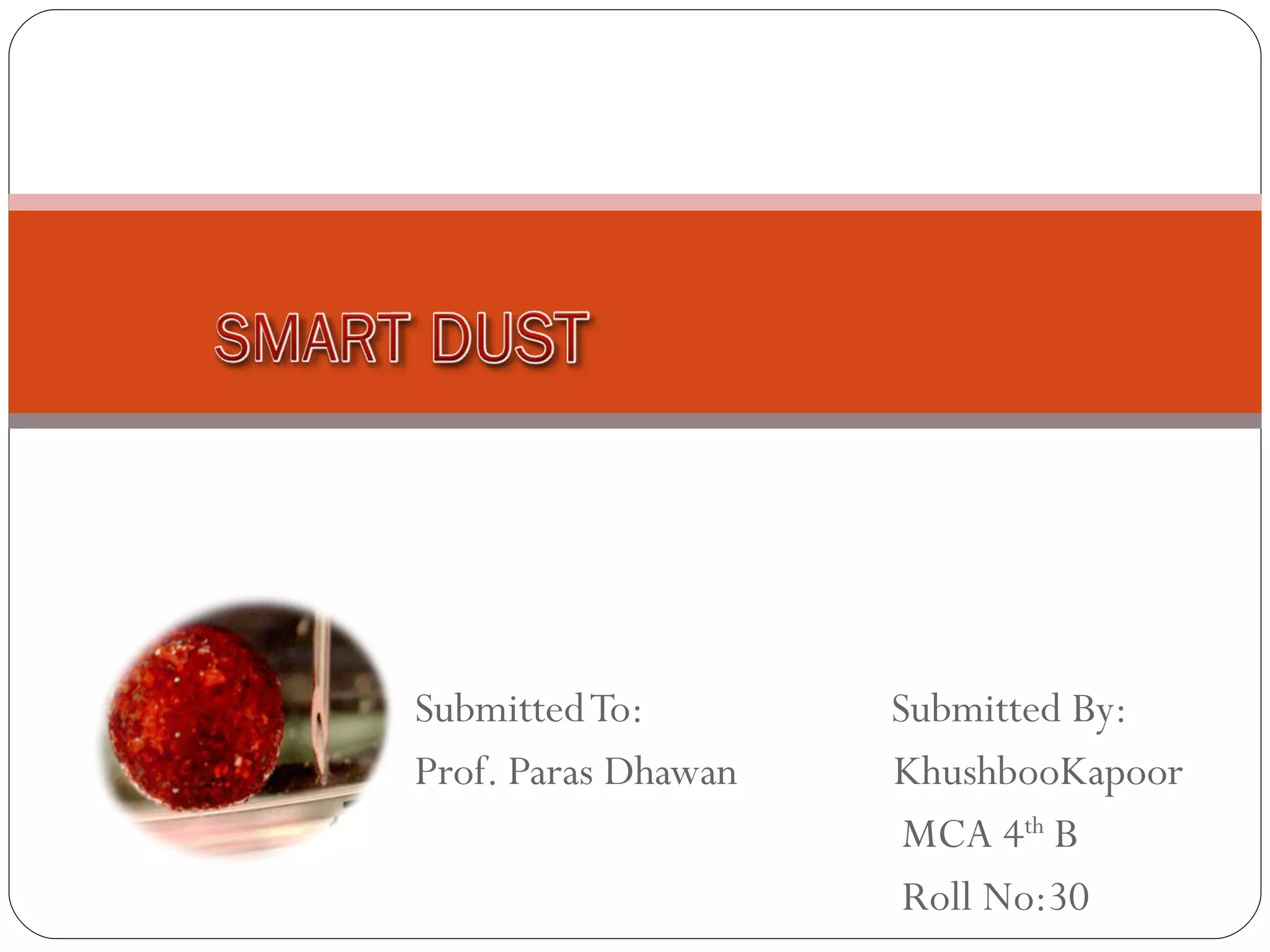
What is Smart Dust? “ SMART DUST”   is an autonomous sensing, computing, communication and power source in a cubic millimeter Conceived by Dr. Kris Pister of UC Berkeley Small devices that can collect information from on-board sensors and transmit it over a wireless network that automatically sets itself up Also called “Motes” Possible sensors include temperature, relative humidity, illumination, acceleration, magnetic field, pressure, chemical vapors, camera, microphone, … These “motes” have memories, microprocessor,   radio receiver and transmitter
Smart Dust Components
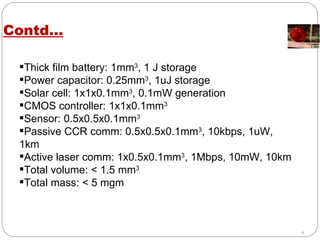
Contd… Thick film battery: 1mm 3 , 1 J storage Power capacitor: 0.25mm 3 , 1uJ storage Solar cell: 1x1x0.1mm 3 , 0.1mW generation CMOS controller: 1x1x0.1mm 3 Sensor: 0.5x0.5x0.1mm 3 Passive CCR comm: 0.5x0.5x0.1mm 3 , 10kbps, 1uW, 1km Active laser comm: 1x0.5x0.1mm 3 , 1Mbps, 10mW, 10km Total volume: < 1.5 mm 3 Total mass: < 5 mgm
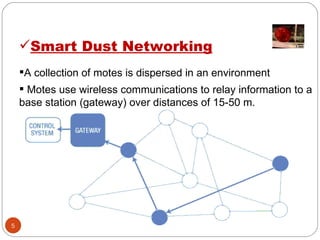
Smart Dust Networking A collection of motes is dispersed in an environment Motes use wireless communications to relay information to a base station (gateway) over distances of 15-50 m.
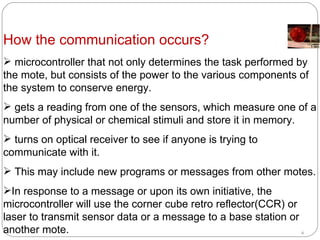
How the communication occurs? microcontroller that not only determines the task performed by the mote, but consists of the power to the various components of the system to conserve energy.  gets a reading from one of the sensors, which measure one of a number of physical or chemical stimuli and store it in memory.  turns on optical receiver to see if anyone is trying to communicate with it.  This may include new programs or messages from other motes.  In response to a message or upon its own initiative, the microcontroller will use the corner cube retro reflector(CCR) or laser to transmit sensor data or a message to a base station or another mote.
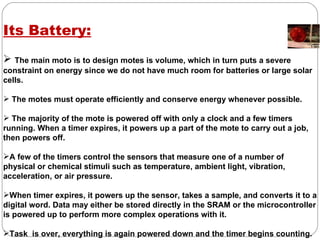
Its Battery: The main moto is to design motes is volume, which in turn puts a severe constraint on energy since we do not have much room for batteries or large solar cells.  The motes must operate efficiently and conserve energy whenever possible. The majority of the mote is powered off with only a clock and a few timers running. When a timer expires, it powers up a part of the mote to carry out a job, then powers off.  A few of the timers control the sensors that measure one of a number of physical or chemical stimuli such as temperature, ambient light, vibration, acceleration, or air pressure.  When timer expires, it powers up the sensor, takes a sample, and converts it to a digital word. Data may either be stored directly in the SRAM or the microcontroller is powered up to perform more complex operations with it. Task  is over, everything is again powered down and the timer begins counting.
Communication ways It can be in 3 ways Radio-Frequency Communications Optical Communication: passive dust mode transmitters Optical Communication: active dust mode transmitters
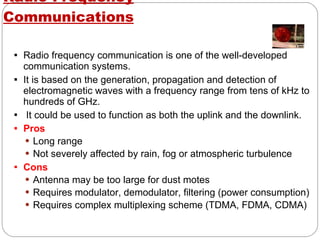
Radio-Frequency Communications Radio frequency communication is one of the well-developed communication systems. It is based on the generation, propagation and detection of electromagnetic waves with a frequency range from tens of kHz to hundreds of GHz. It could be used to function as both the uplink and the downlink. Pros Long range Not severely affected by rain, fog or atmospheric turbulence Cons Antenna may be too large for dust motes Requires modulator, demodulator, filtering (power consumption) Requires complex multiplexing scheme (TDMA, FDMA, CDMA)
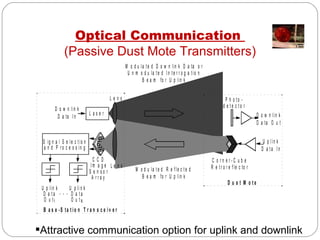
Optical Communication  (Passive Dust Mote Transmitters) Attractive communication option for uplink and downlink
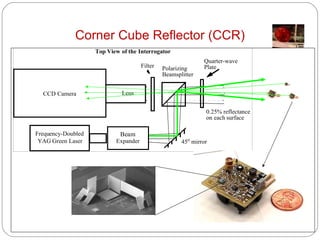
Corner Cube Reflector (CCR)
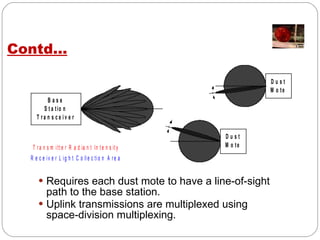
Contd... Requires each dust mote to have a line-of-sight path to the base station. Uplink transmissions are multiplexed using space-division multiplexing.
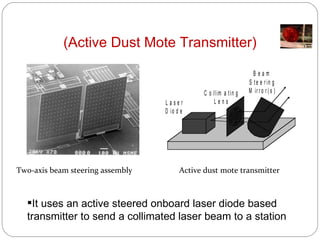
(Active Dust Mote Transmitter) Two-axis beam steering assembly Active dust mote transmitter It uses an active steered onboard laser diode based  transmitter to send a collimated laser beam to a station
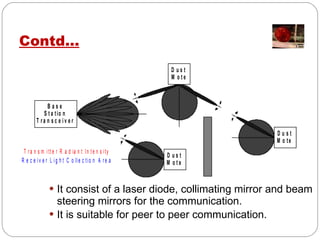
Contd… It consist of a laser diode, collimating mirror and beam steering mirrors for the communication. It is suitable for peer to peer communication.
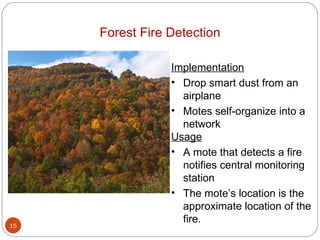
Forest Fire Detection Implementation Drop smart dust from an airplane Motes self-organize into a network Usage A mote that detects a fire notifies central monitoring station The mote’s location is the approximate location of the fire.
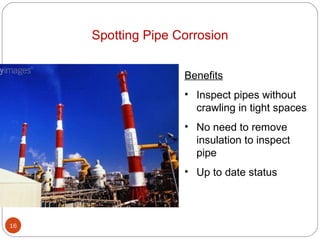
Spotting Pipe Corrosion Benefits Inspect pipes without crawling in tight spaces No need to remove insulation to inspect pipe Up to date status
Other Applications are: Security and Tracking   Health and Wellness Monitoring (enter human bodies and check for physiological problems ). Factory and Process Automation . Seismic and Structural Monitoring . Monitor traffic and redirecting it .
CONCLUSION Smart dust motes incorporate sensing, computation, communications and power in a mm 3  volume. Free-space optical communication offers advantages in terms of size, power and network throughput. On the technology Software and hardware are open-source Many potential civilian and military applications Promising technology if cost goes down On regulatory aspects Investigate their impact on existing services Low power device
 

Smartdust

  • 1.
    Submitted To: Submitted By: Prof. Paras Dhawan KhushbooKapoor MCA 4 th B Roll No:30
  • 2.
    What is SmartDust? “ SMART DUST” is an autonomous sensing, computing, communication and power source in a cubic millimeter Conceived by Dr. Kris Pister of UC Berkeley Small devices that can collect information from on-board sensors and transmit it over a wireless network that automatically sets itself up Also called “Motes” Possible sensors include temperature, relative humidity, illumination, acceleration, magnetic field, pressure, chemical vapors, camera, microphone, … These “motes” have memories, microprocessor, radio receiver and transmitter
  • 3.
  • 4.
    Contd… Thick filmbattery: 1mm 3 , 1 J storage Power capacitor: 0.25mm 3 , 1uJ storage Solar cell: 1x1x0.1mm 3 , 0.1mW generation CMOS controller: 1x1x0.1mm 3 Sensor: 0.5x0.5x0.1mm 3 Passive CCR comm: 0.5x0.5x0.1mm 3 , 10kbps, 1uW, 1km Active laser comm: 1x0.5x0.1mm 3 , 1Mbps, 10mW, 10km Total volume: < 1.5 mm 3 Total mass: < 5 mgm
  • 5.
    Smart Dust NetworkingA collection of motes is dispersed in an environment Motes use wireless communications to relay information to a base station (gateway) over distances of 15-50 m.
  • 6.
    How the communicationoccurs? microcontroller that not only determines the task performed by the mote, but consists of the power to the various components of the system to conserve energy. gets a reading from one of the sensors, which measure one of a number of physical or chemical stimuli and store it in memory. turns on optical receiver to see if anyone is trying to communicate with it. This may include new programs or messages from other motes. In response to a message or upon its own initiative, the microcontroller will use the corner cube retro reflector(CCR) or laser to transmit sensor data or a message to a base station or another mote.
  • 7.
    Its Battery: Themain moto is to design motes is volume, which in turn puts a severe constraint on energy since we do not have much room for batteries or large solar cells. The motes must operate efficiently and conserve energy whenever possible. The majority of the mote is powered off with only a clock and a few timers running. When a timer expires, it powers up a part of the mote to carry out a job, then powers off. A few of the timers control the sensors that measure one of a number of physical or chemical stimuli such as temperature, ambient light, vibration, acceleration, or air pressure. When timer expires, it powers up the sensor, takes a sample, and converts it to a digital word. Data may either be stored directly in the SRAM or the microcontroller is powered up to perform more complex operations with it. Task is over, everything is again powered down and the timer begins counting.
  • 8.
    Communication ways Itcan be in 3 ways Radio-Frequency Communications Optical Communication: passive dust mode transmitters Optical Communication: active dust mode transmitters
  • 9.
    Radio-Frequency Communications Radiofrequency communication is one of the well-developed communication systems. It is based on the generation, propagation and detection of electromagnetic waves with a frequency range from tens of kHz to hundreds of GHz. It could be used to function as both the uplink and the downlink. Pros Long range Not severely affected by rain, fog or atmospheric turbulence Cons Antenna may be too large for dust motes Requires modulator, demodulator, filtering (power consumption) Requires complex multiplexing scheme (TDMA, FDMA, CDMA)
  • 10.
    Optical Communication (Passive Dust Mote Transmitters) Attractive communication option for uplink and downlink
  • 11.
  • 12.
    Contd... Requires eachdust mote to have a line-of-sight path to the base station. Uplink transmissions are multiplexed using space-division multiplexing.
  • 13.
    (Active Dust MoteTransmitter) Two-axis beam steering assembly Active dust mote transmitter It uses an active steered onboard laser diode based transmitter to send a collimated laser beam to a station
  • 14.
    Contd… It consistof a laser diode, collimating mirror and beam steering mirrors for the communication. It is suitable for peer to peer communication.
  • 15.
    Forest Fire DetectionImplementation Drop smart dust from an airplane Motes self-organize into a network Usage A mote that detects a fire notifies central monitoring station The mote’s location is the approximate location of the fire.
  • 16.
    Spotting Pipe CorrosionBenefits Inspect pipes without crawling in tight spaces No need to remove insulation to inspect pipe Up to date status
  • 17.
    Other Applications are:Security and Tracking Health and Wellness Monitoring (enter human bodies and check for physiological problems ). Factory and Process Automation . Seismic and Structural Monitoring . Monitor traffic and redirecting it .
  • 18.
    CONCLUSION Smart dustmotes incorporate sensing, computation, communications and power in a mm 3 volume. Free-space optical communication offers advantages in terms of size, power and network throughput. On the technology Software and hardware are open-source Many potential civilian and military applications Promising technology if cost goes down On regulatory aspects Investigate their impact on existing services Low power device
  • 19.