HIGH VOLTAGE MINI PROJECT
TOPIC:- FUSE CHARACTERISTICS
GROUP MEMBERS :-
AKANSHA (1CR18EE007)
DURGA RANI (1CR18EE030)
ANAND PRAKASH TIWARI (1CR18EE011)
ASHRAF (1CR18EE053)
TEACHER IN CHARGE:-
MS. PARVATHY T
A fuse is an electrical safety device that operates to provide overcurrent
protection of an electrical circuit. Its essential component is a metal wire or strip
that melts when too much current flows through it, thereby stopping or interrupting
the current.
IT’S ADVANTAGES:-
• Fuse is cheapest type of protection in an electrical circuit
• Fuse needs zero maintenance
• Operation of fuse is simple and no complexity is involved
• The operation time of fuse can be made much smaller than operation of circuit
breaker. It is the primary protection device against short circuits
• It affords current limiting effect under short-circuit conditions
• Fuse inverse time current characteristic has the ability to use for over-load
protection
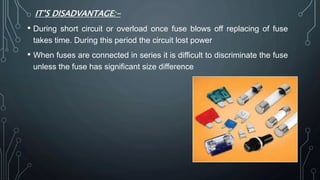
IT’S DISADVANTAGE:-
• During short circuit or overload once fuse blows off replacing of fuse
takes time. During this period the circuit lost power
• When fuses are connected in series it is difficult to discriminate the fuse
unless the fuse has significant size difference
CHARACTERISTICS OF FUSE ELEMENT:
1.low melting point e.g., tin, lead.
2.high conductivity e.g., silver, copper.
3.free from deterioration due to oxidation e.g., silver
4.low cost e.g., lead, tin, copper
The above discussion reveals that no material possesses all the
characteristics. For instance, lead has low melting point but it has high
specific resistance and is liable to oxidation. Similarly, copper has high
conductivity and low cost but oxidizes rapidly. Therefore, a compromise
is made in the selection of material for a Fuses Definition.
FUSE ELEMENT MATERIALS:-
Commonly used materials:
Lead, tin, zinc, copper & silver.
• Small current = tin or an alloy of lead & tin(lead 37%, tin 63%)
• Larger current= copper or silver is employed.
ZINC is good if a fuse with considerable time-lag is required
The present trend is to use silver despite its high cost due to the following
reasons :
• It is comparatively free from oxidation.
• It does not deteriorate when used in dry air.
• The coefficient of expansion of silver is so small that no critical fatigue occurs. Therefore,
the fuse element can carry the rated current continuously for a long time.
• The conductivity of silver is very high. Therefore, for a given rating of fuse element, the
mass of silver metal required is smaller than that of other materials. This minimizes the
problem of clearing the mass of vaporized material set free on fusion and thus permits
fast operating speed.
• Due to comparatively low specific heat, silver fusible elements can be raised from
normal temperature to vaporization quicker than other fusible elements. Moreover, the
resistance of silver increases abruptly as the melting temperature is reached, thus
making the transition from melting to vaporization almost instantaneous. Consequently,
operation becomes very much faster at higher
• Silver vaporizes at a temperature much lower than the one at which its vapour will
readily Therefore, when an arc is formed through the vaporized portion of the element,
the arc path has high resistance. As a result, short-circuit current is quickly interrupted.
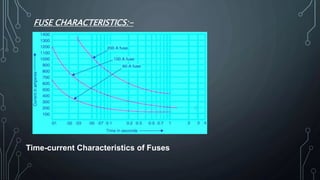
FUSE CHARACTERISTICS:-
Time-current Characteristics of Fuses
• Time-current characteristics are the most important specifications of
fuses.
• Fuses are designed to only withstand continuous current that is
equivalent to their rated current. When the current flowing through a
fuse exceeds the rated current, the fuse must cut off the current within
a predetermined time interval, thus ensuring the current flow is
interrupted.
• For this reason, the melting time of a fuse when exposed to
overcurrent is specified by international and national standards for
each type of fuse.
• Time-current standard values specify an upper threshold for the melting
time to prevent an overcurrent from flowing continuously and resulting in fire
or damage to connected electrical wiring and electric devices. This is the
ultimate purpose of a fuse.
• At the same time, a lower threshold is specified to ensure the current is not
interrupted during the initial rush at the start of the current flow, and thus
ensure durability.
• Time-current characteristics differ by fuse type. For example, motor circuits
employ slow blow fuses (SBF) that feature a slow-blow mechanism to
withstand the comparatively long current rush that is produced when a motor
starts operating.
• It is common practice to use SBFs for circuits using motors of automatic
wipers and power windows, and BFs for applications such as lamps.
REFERENCES
• https://en.wikipedia.org/wiki/Fuse_(electrical)
• https://www.eeeguide.com/fuses-definition/
• https://electricalvoice.com/fuses-characteristics-applications-
types-of-fuses/
• https://tse4.mm.bing.net/th?id=OIP.vnfdZX0P7mnMvUUEVLZRz
QHaEN&pid=Api&P=0&w=327&h=187
• https://tse4.explicit.bing.net/th?id=OIP.k9DCS_vToixKZNUszBe
NAQAAAA&pid=Api&P=0&w=300&h=300
FUSE CHARACTERISTICS HIGHT VOLTAGE

FUSE CHARACTERISTICS HIGHT VOLTAGE

  • 1.
    HIGH VOLTAGE MINIPROJECT TOPIC:- FUSE CHARACTERISTICS GROUP MEMBERS :- AKANSHA (1CR18EE007) DURGA RANI (1CR18EE030) ANAND PRAKASH TIWARI (1CR18EE011) ASHRAF (1CR18EE053) TEACHER IN CHARGE:- MS. PARVATHY T
  • 2.
    A fuse isan electrical safety device that operates to provide overcurrent protection of an electrical circuit. Its essential component is a metal wire or strip that melts when too much current flows through it, thereby stopping or interrupting the current. IT’S ADVANTAGES:- • Fuse is cheapest type of protection in an electrical circuit • Fuse needs zero maintenance • Operation of fuse is simple and no complexity is involved • The operation time of fuse can be made much smaller than operation of circuit breaker. It is the primary protection device against short circuits • It affords current limiting effect under short-circuit conditions • Fuse inverse time current characteristic has the ability to use for over-load protection
  • 3.
    IT’S DISADVANTAGE:- • Duringshort circuit or overload once fuse blows off replacing of fuse takes time. During this period the circuit lost power • When fuses are connected in series it is difficult to discriminate the fuse unless the fuse has significant size difference
  • 4.
    CHARACTERISTICS OF FUSEELEMENT: 1.low melting point e.g., tin, lead. 2.high conductivity e.g., silver, copper. 3.free from deterioration due to oxidation e.g., silver 4.low cost e.g., lead, tin, copper The above discussion reveals that no material possesses all the characteristics. For instance, lead has low melting point but it has high specific resistance and is liable to oxidation. Similarly, copper has high conductivity and low cost but oxidizes rapidly. Therefore, a compromise is made in the selection of material for a Fuses Definition.
  • 5.
    FUSE ELEMENT MATERIALS:- Commonlyused materials: Lead, tin, zinc, copper & silver. • Small current = tin or an alloy of lead & tin(lead 37%, tin 63%) • Larger current= copper or silver is employed. ZINC is good if a fuse with considerable time-lag is required
  • 6.
    The present trendis to use silver despite its high cost due to the following reasons : • It is comparatively free from oxidation. • It does not deteriorate when used in dry air. • The coefficient of expansion of silver is so small that no critical fatigue occurs. Therefore, the fuse element can carry the rated current continuously for a long time. • The conductivity of silver is very high. Therefore, for a given rating of fuse element, the mass of silver metal required is smaller than that of other materials. This minimizes the problem of clearing the mass of vaporized material set free on fusion and thus permits fast operating speed. • Due to comparatively low specific heat, silver fusible elements can be raised from normal temperature to vaporization quicker than other fusible elements. Moreover, the resistance of silver increases abruptly as the melting temperature is reached, thus making the transition from melting to vaporization almost instantaneous. Consequently, operation becomes very much faster at higher • Silver vaporizes at a temperature much lower than the one at which its vapour will readily Therefore, when an arc is formed through the vaporized portion of the element, the arc path has high resistance. As a result, short-circuit current is quickly interrupted.
  • 7.
  • 8.
    • Time-current characteristicsare the most important specifications of fuses. • Fuses are designed to only withstand continuous current that is equivalent to their rated current. When the current flowing through a fuse exceeds the rated current, the fuse must cut off the current within a predetermined time interval, thus ensuring the current flow is interrupted. • For this reason, the melting time of a fuse when exposed to overcurrent is specified by international and national standards for each type of fuse.
  • 9.
    • Time-current standardvalues specify an upper threshold for the melting time to prevent an overcurrent from flowing continuously and resulting in fire or damage to connected electrical wiring and electric devices. This is the ultimate purpose of a fuse. • At the same time, a lower threshold is specified to ensure the current is not interrupted during the initial rush at the start of the current flow, and thus ensure durability. • Time-current characteristics differ by fuse type. For example, motor circuits employ slow blow fuses (SBF) that feature a slow-blow mechanism to withstand the comparatively long current rush that is produced when a motor starts operating. • It is common practice to use SBFs for circuits using motors of automatic wipers and power windows, and BFs for applications such as lamps.
  • 11.
    REFERENCES • https://en.wikipedia.org/wiki/Fuse_(electrical) • https://www.eeeguide.com/fuses-definition/ •https://electricalvoice.com/fuses-characteristics-applications- types-of-fuses/ • https://tse4.mm.bing.net/th?id=OIP.vnfdZX0P7mnMvUUEVLZRz QHaEN&pid=Api&P=0&w=327&h=187 • https://tse4.explicit.bing.net/th?id=OIP.k9DCS_vToixKZNUszBe NAQAAAA&pid=Api&P=0&w=300&h=300