ELECTRICAL FUSES
By: Jai Parewa
WHAT IS A FUSE ?
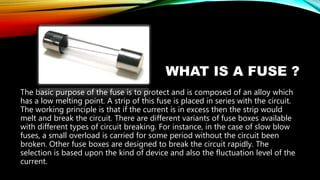
The basic purpose of the fuse is to protect and is composed of an alloy which
has a low melting point. A strip of this fuse is placed in series with the circuit.
The working principle is that if the current is in excess then the strip would
melt and break the circuit. There are different variants of fuse boxes available
with different types of circuit breaking. For instance, in the case of slow blow
fuses, a small overload is carried for some period without the circuit been
broken. Other fuse boxes are designed to break the circuit rapidly. The
selection is based upon the kind of device and also the fluctuation level of the
current.
TYPES OF FUSES
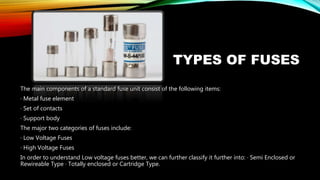
The main components of a standard fuse unit consist of the following items:
· Metal fuse element
· Set of contacts
· Support body
The major two categories of fuses include:
· Low Voltage Fuses
· High Voltage Fuses
In order to understand Low voltage fuses better, we can further classify it further into: · Semi Enclosed or
Rewireable Type · Totally enclosed or Cartridge Type.
REWIREABLE FUSES
This kind of fuse is most commonly used in the case of domestic wiring and small scale usage.
Another name for this type is the KIT-KAT type fuse. The main composition is of a porcelain
base which holds the wires. The fuse element is located inside a carrier that is also made out of
porcelain. It is possible for you to remove the fuse carrier without any risk of electrical shock.
Normally what happens is that when the fuse blows, you can replace it without having to
change the complete thing. The main metals or alloys used in making fuse wire include lead,
tinned copper, aluminum or tin lead alloy. When there is an over surge that causes the fuse
element to blow off, you can replace it. A new fuse carrier is inserted in the base. The main
advantage of this type of fuse is that it is easy to install and also replace without risking any
electrical injury. But there are certain shortcomings associated with it too. For instance, with
this fuse you would have an element of unreliability. There is a level of lack of discrimination
and a small time lag, which may hinder its functionality. With a slow speed of operation, you
also get a low rupturing capacity. Other types have current limiting features, and this one does
not. All this being said it is still a valuable fuse device for small scale usage
TOTALLY ENCLOSED OR
CARTRIDGE TYPE FUSES
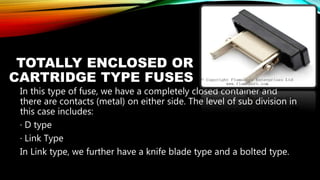
In this type of fuse, we have a completely closed container and
there are contacts (metal) on either side. The level of sub division in
this case includes:
· D type
· Link Type
In Link type, we further have a knife blade type and a bolted type.
ANL/ANE FUSES
ANL kind of fuses is mostly used in cars
for the audio systems. They are available in
various sizes. As opposed to others
, this one has no wire terminal block.
HOW TO CHECK THE FUSES?
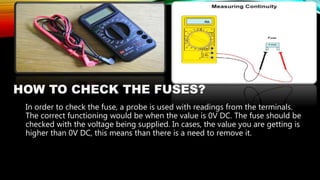
In order to check the fuse, a probe is used with readings from the terminals.
The correct functioning would be when the value is 0V DC. The fuse should be
checked with the voltage being supplied. In cases, the value you are getting is
higher than 0V DC, this means than there is a need to remove it.
USE OF FUSES
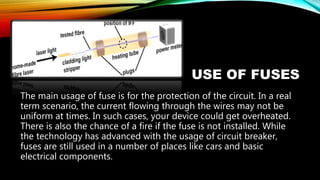
The main usage of fuse is for the protection of the circuit. In a real
term scenario, the current flowing through the wires may not be
uniform at times. In such cases, your device could get overheated.
There is also the chance of a fire if the fuse is not installed. While
the technology has advanced with the usage of circuit breaker,
fuses are still used in a number of places like cars and basic
electrical components.
THANK YOU

Electrical fuses

  • 1.
  • 2.
    WHAT IS AFUSE ? The basic purpose of the fuse is to protect and is composed of an alloy which has a low melting point. A strip of this fuse is placed in series with the circuit. The working principle is that if the current is in excess then the strip would melt and break the circuit. There are different variants of fuse boxes available with different types of circuit breaking. For instance, in the case of slow blow fuses, a small overload is carried for some period without the circuit been broken. Other fuse boxes are designed to break the circuit rapidly. The selection is based upon the kind of device and also the fluctuation level of the current.
  • 3.
    TYPES OF FUSES Themain components of a standard fuse unit consist of the following items: · Metal fuse element · Set of contacts · Support body The major two categories of fuses include: · Low Voltage Fuses · High Voltage Fuses In order to understand Low voltage fuses better, we can further classify it further into: · Semi Enclosed or Rewireable Type · Totally enclosed or Cartridge Type.
  • 4.
    REWIREABLE FUSES This kindof fuse is most commonly used in the case of domestic wiring and small scale usage. Another name for this type is the KIT-KAT type fuse. The main composition is of a porcelain base which holds the wires. The fuse element is located inside a carrier that is also made out of porcelain. It is possible for you to remove the fuse carrier without any risk of electrical shock. Normally what happens is that when the fuse blows, you can replace it without having to change the complete thing. The main metals or alloys used in making fuse wire include lead, tinned copper, aluminum or tin lead alloy. When there is an over surge that causes the fuse element to blow off, you can replace it. A new fuse carrier is inserted in the base. The main advantage of this type of fuse is that it is easy to install and also replace without risking any electrical injury. But there are certain shortcomings associated with it too. For instance, with this fuse you would have an element of unreliability. There is a level of lack of discrimination and a small time lag, which may hinder its functionality. With a slow speed of operation, you also get a low rupturing capacity. Other types have current limiting features, and this one does not. All this being said it is still a valuable fuse device for small scale usage
  • 5.
    TOTALLY ENCLOSED OR CARTRIDGETYPE FUSES In this type of fuse, we have a completely closed container and there are contacts (metal) on either side. The level of sub division in this case includes: · D type · Link Type In Link type, we further have a knife blade type and a bolted type.
  • 6.
    ANL/ANE FUSES ANL kindof fuses is mostly used in cars for the audio systems. They are available in various sizes. As opposed to others , this one has no wire terminal block.
  • 7.
    HOW TO CHECKTHE FUSES? In order to check the fuse, a probe is used with readings from the terminals. The correct functioning would be when the value is 0V DC. The fuse should be checked with the voltage being supplied. In cases, the value you are getting is higher than 0V DC, this means than there is a need to remove it.
  • 8.
    USE OF FUSES Themain usage of fuse is for the protection of the circuit. In a real term scenario, the current flowing through the wires may not be uniform at times. In such cases, your device could get overheated. There is also the chance of a fire if the fuse is not installed. While the technology has advanced with the usage of circuit breaker, fuses are still used in a number of places like cars and basic electrical components.
  • 9.