Power System Protection
FUSES
Name :- Premkumar Binde Ram
Branch :- Electrical(2nd year 3G)
Roll No :- 25
College :- Devi Mahalaxami Polytechnique
College
Introduction
• Fuse was patented by Thomas Edison in 1890
• Fuse is the simplest & cheapest device used for interrupting
an electrical circuit under short circuit or excessive.
• The fuse element is generally made of materials having-
 low melting point,
high conductivity
and least deterioration due to oxidation e.g., silver, copper
etc.
Advantages & Disadvantages
1. It is the cheapest form of
protection available.
2. It requires no maintenance.
3. Its operation is inherently
completely automatic unlike a
circuit breaker which requires
an elaborate equipment for
automatic action.
4. It can break heavy short-circuit
currents without noise or
smoke.
1. Considerable time is lost in
rewiring or replacing a fuse after
operation.
2. On heavy short-circuits,
discrimination between fuses in
series cannot be obtained unless
there is sufficient difference in the
sizes of the fuses concerned.
3. The current-time characteristic of a
fuse cannot always be co-related
with that of the protected apparatus.
Fuse Element Materials
• It is comparatively free from oxidation.
• It does not deteriorate when used in dry air.
• The coefficient of expansion of silver is so small that no critical fatigue occurs.
Therefore, the fuse element can carry the rated current continuously for a long
time.
• The conductivity of silver is very high. Therefore, for a given rating of fuse
element, the mass of silver metal required is smaller than that of other materials.
This minimizes the problem of clearing the mass of vaporized material set free
on fusion and thus permits fast operating speed.
• Due to comparatively low specific heat, silver fusible elements can be raised
from normal temperature to vaporization quicker than other fusible elements.
Moreover, the resistance of silver increases abruptly as the melting temperature
is reached, thus making the transition from melting to vaporization almost
instantaneous. Consequently, operation becomes very much faster at higher
currents.
• Silver vaporizes at a temperature much lower than the one at which its vapor
will readily ionise. Therefore, when an arc is formed through the vaporized
portion of the element, the arc path has high resistance. As a result, short-circuit
current is quickly interrupted.
The fusing current depends upon the various factors such as :
(a) material of fuse element
(b) length – the smaller the length, the greater the current
because a short fuse can easily conduct away all the heat
(c) diameter
(d) size and location of terminals
(e) previous history
(f) type of enclosure used
Types of Fuses
In general, fuses may be classified into :
 Low voltages fuses:
(i) Semi-enclosed rewireable fuse
(ii) High Rupturing Capacity (H.R.C.) cartridge fuse
 High voltage fuses:
(i) Cartridge type
(ii) Liquid type
(iii) Metal clad fuses
It is a usual practice to provide isolating switches in series with fuses
where it is necessary to permit fuses to be replaced or rewired with
safety. If such means of isolation are not available, the fuses must be
so shielded as to protect the user against accidental contact with the
live metal when the fuse carrier is being inserted or removed.
Semi-enclosed Rewireable fuse High Rupturing Capacity
(H.R.C.)
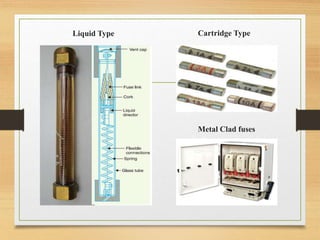
Liquid Type Cartridge Type
Metal Clad fuses
Semi-enclosed rewireable fuse
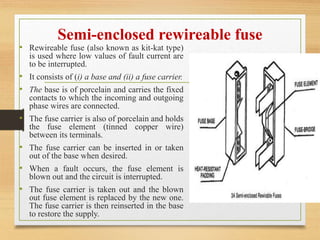
• Rewireable fuse (also known as kit-kat type)
is used where low values of fault current are
to be interrupted.
• It consists of (i) a base and (ii) a fuse carrier.
• The base is of porcelain and carries the fixed
contacts to which the incoming and outgoing
phase wires are connected.
• The fuse carrier is also of porcelain and holds
the fuse element (tinned copper wire)
between its terminals.
• The fuse carrier can be inserted in or taken
out of the base when desired.
• When a fault occurs, the fuse element is
blown out and the circuit is interrupted.
• The fuse carrier is taken out and the blown
out fuse element is replaced by the new one.
The fuse carrier is then reinserted in the base
to restore the supply.
High-Rupturing capacity (H.R.C.) cartridge fuse
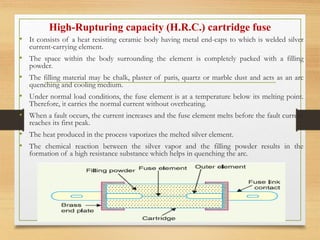
• It consists of a heat resisting ceramic body having metal end-caps to which is welded silver
current-carrying element.
• The space within the body surrounding the element is completely packed with a filling
powder.
• The filling material may be chalk, plaster of paris, quartz or marble dust and acts as an arc
quenching and cooling medium.
• Under normal load conditions, the fuse element is at a temperature below its melting point.
Therefore, it carries the normal current without overheating.
• When a fault occurs, the current increases and the fuse element melts before the fault current
reaches its first peak.
• The heat produced in the process vaporizes the melted silver element.
• The chemical reaction between the silver vapor and the filling powder results in the
formation of a high resistance substance which helps in quenching the arc.
High Voltage Fuses
Cartridge type:
• This is similar in general construction to the low voltage cartridge
type except that special design features are incorporated.
• Some designs employ fuse elements wound in the form of a helix so
as to avoid corona effects at higher voltages.
• On some designs, there are two fuse elements in parallel ; one of low
resistance (silver wire) and the other of high resistance (tungsten
wire).
• Under normal load conditions, the low resistance element carries the
normal current.
• When a fault occurs, the low-resistance element is blown out and the
high resistance element reduces the short-circuit current and finally
breaks the circuit.
High voltage cartridge fuses are used upto 33 kV with breaking
capacity of about 8700 A at that voltage. Rating of the order of 200 A
at 6·6 kV and 11 kV and 50 A at 33 kV are also availa.ble
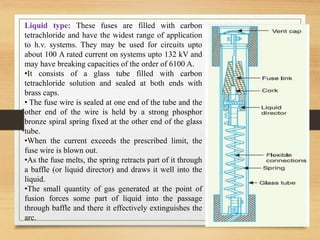
Liquid type: These fuses are filled with carbon
tetrachloride and have the widest range of application
to h.v. systems. They may be used for circuits upto
about 100 A rated current on systems upto 132 kV and
may have breaking capacities of the order of 6100 A.
•It consists of a glass tube filled with carbon
tetrachloride solution and sealed at both ends with
brass caps.
• The fuse wire is sealed at one end of the tube and the
other end of the wire is held by a strong phosphor
bronze spiral spring fixed at the other end of the glass
tube.
•When the current exceeds the prescribed limit, the
fuse wire is blown out.
•As the fuse melts, the spring retracts part of it through
a baffle (or liquid director) and draws it well into the
liquid.
•The small quantity of gas generated at the point of
fusion forces some part of liquid into the passage
through baffle and there it effectively extinguishes the
arc.
Metal clad fuses: Metal clad oil-immersed fuses have
been developed with the object of providing a substitute
for the oil circuit breaker. Such fuses can be used for
very high voltage circuits and operate most
satisfactorily under short-circuit conditions
approaching their rated capacity.
4 fuses

4 fuses

  • 1.
  • 2.
    Name :- PremkumarBinde Ram Branch :- Electrical(2nd year 3G) Roll No :- 25 College :- Devi Mahalaxami Polytechnique College
  • 3.
    Introduction • Fuse waspatented by Thomas Edison in 1890 • Fuse is the simplest & cheapest device used for interrupting an electrical circuit under short circuit or excessive. • The fuse element is generally made of materials having-  low melting point, high conductivity and least deterioration due to oxidation e.g., silver, copper etc.
  • 5.
    Advantages & Disadvantages 1.It is the cheapest form of protection available. 2. It requires no maintenance. 3. Its operation is inherently completely automatic unlike a circuit breaker which requires an elaborate equipment for automatic action. 4. It can break heavy short-circuit currents without noise or smoke. 1. Considerable time is lost in rewiring or replacing a fuse after operation. 2. On heavy short-circuits, discrimination between fuses in series cannot be obtained unless there is sufficient difference in the sizes of the fuses concerned. 3. The current-time characteristic of a fuse cannot always be co-related with that of the protected apparatus.
  • 6.
    Fuse Element Materials •It is comparatively free from oxidation. • It does not deteriorate when used in dry air. • The coefficient of expansion of silver is so small that no critical fatigue occurs. Therefore, the fuse element can carry the rated current continuously for a long time. • The conductivity of silver is very high. Therefore, for a given rating of fuse element, the mass of silver metal required is smaller than that of other materials. This minimizes the problem of clearing the mass of vaporized material set free on fusion and thus permits fast operating speed. • Due to comparatively low specific heat, silver fusible elements can be raised from normal temperature to vaporization quicker than other fusible elements. Moreover, the resistance of silver increases abruptly as the melting temperature is reached, thus making the transition from melting to vaporization almost instantaneous. Consequently, operation becomes very much faster at higher currents. • Silver vaporizes at a temperature much lower than the one at which its vapor will readily ionise. Therefore, when an arc is formed through the vaporized portion of the element, the arc path has high resistance. As a result, short-circuit current is quickly interrupted.
  • 7.
    The fusing currentdepends upon the various factors such as : (a) material of fuse element (b) length – the smaller the length, the greater the current because a short fuse can easily conduct away all the heat (c) diameter (d) size and location of terminals (e) previous history (f) type of enclosure used
  • 8.
    Types of Fuses Ingeneral, fuses may be classified into :  Low voltages fuses: (i) Semi-enclosed rewireable fuse (ii) High Rupturing Capacity (H.R.C.) cartridge fuse  High voltage fuses: (i) Cartridge type (ii) Liquid type (iii) Metal clad fuses It is a usual practice to provide isolating switches in series with fuses where it is necessary to permit fuses to be replaced or rewired with safety. If such means of isolation are not available, the fuses must be so shielded as to protect the user against accidental contact with the live metal when the fuse carrier is being inserted or removed.
  • 9.
    Semi-enclosed Rewireable fuseHigh Rupturing Capacity (H.R.C.)
  • 10.
    Liquid Type CartridgeType Metal Clad fuses
  • 11.
    Semi-enclosed rewireable fuse •Rewireable fuse (also known as kit-kat type) is used where low values of fault current are to be interrupted. • It consists of (i) a base and (ii) a fuse carrier. • The base is of porcelain and carries the fixed contacts to which the incoming and outgoing phase wires are connected. • The fuse carrier is also of porcelain and holds the fuse element (tinned copper wire) between its terminals. • The fuse carrier can be inserted in or taken out of the base when desired. • When a fault occurs, the fuse element is blown out and the circuit is interrupted. • The fuse carrier is taken out and the blown out fuse element is replaced by the new one. The fuse carrier is then reinserted in the base to restore the supply.
  • 12.
    High-Rupturing capacity (H.R.C.)cartridge fuse • It consists of a heat resisting ceramic body having metal end-caps to which is welded silver current-carrying element. • The space within the body surrounding the element is completely packed with a filling powder. • The filling material may be chalk, plaster of paris, quartz or marble dust and acts as an arc quenching and cooling medium. • Under normal load conditions, the fuse element is at a temperature below its melting point. Therefore, it carries the normal current without overheating. • When a fault occurs, the current increases and the fuse element melts before the fault current reaches its first peak. • The heat produced in the process vaporizes the melted silver element. • The chemical reaction between the silver vapor and the filling powder results in the formation of a high resistance substance which helps in quenching the arc.
  • 13.
    High Voltage Fuses Cartridgetype: • This is similar in general construction to the low voltage cartridge type except that special design features are incorporated. • Some designs employ fuse elements wound in the form of a helix so as to avoid corona effects at higher voltages. • On some designs, there are two fuse elements in parallel ; one of low resistance (silver wire) and the other of high resistance (tungsten wire). • Under normal load conditions, the low resistance element carries the normal current. • When a fault occurs, the low-resistance element is blown out and the high resistance element reduces the short-circuit current and finally breaks the circuit. High voltage cartridge fuses are used upto 33 kV with breaking capacity of about 8700 A at that voltage. Rating of the order of 200 A at 6·6 kV and 11 kV and 50 A at 33 kV are also availa.ble
  • 14.
    Liquid type: Thesefuses are filled with carbon tetrachloride and have the widest range of application to h.v. systems. They may be used for circuits upto about 100 A rated current on systems upto 132 kV and may have breaking capacities of the order of 6100 A. •It consists of a glass tube filled with carbon tetrachloride solution and sealed at both ends with brass caps. • The fuse wire is sealed at one end of the tube and the other end of the wire is held by a strong phosphor bronze spiral spring fixed at the other end of the glass tube. •When the current exceeds the prescribed limit, the fuse wire is blown out. •As the fuse melts, the spring retracts part of it through a baffle (or liquid director) and draws it well into the liquid. •The small quantity of gas generated at the point of fusion forces some part of liquid into the passage through baffle and there it effectively extinguishes the arc.
  • 15.
    Metal clad fuses:Metal clad oil-immersed fuses have been developed with the object of providing a substitute for the oil circuit breaker. Such fuses can be used for very high voltage circuits and operate most satisfactorily under short-circuit conditions approaching their rated capacity.