1
FUSE
CHARACTERISTICS
Overview
 Overview of protection classes
• General Purpose
• Motor Protection
• High Speed
 Time current Curves
 I2t values
 Let through current and cut-off curves
 Rated voltage dimensioning
 Rated current dimensioning
• Derating factors
 Dimensioning I2t Values
 Influence of overloads
 Cyclic loading
2
General Purpose Fuses
3
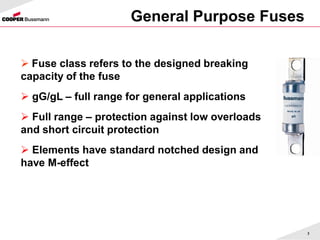
 Fuse class refers to the designed breaking
capacity of the fuse
 gG/gL – full range for general applications
 Full range – protection against low overloads
and short circuit protection
 Elements have standard notched design and
have M-effect
Motor Protection
4
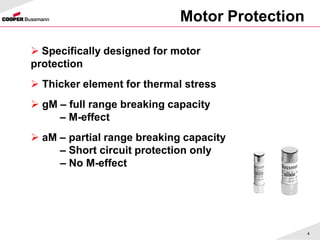
 Specifically designed for motor
protection
 Thicker element for thermal stress
 gM – full range breaking capacity
– M-effect
 aM – partial range breaking capacity
– Short circuit protection only
– No M-effect
5
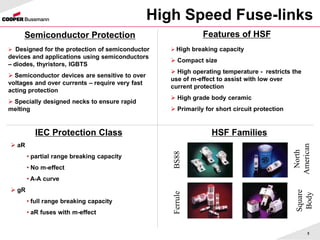
High Speed Fuse-links
Features of HSF
 High breaking capacity
 Compact size
 High operating temperature - restricts the
use of m-effect to assist with low over
current protection
 High grade body ceramic
 Primarily for short circuit protection
IEC Protection Class
 aR
• partial range breaking capacity
• No m-effect
• A-A curve
 gR
• full range breaking capacity
• aR fuses with m-effect
Semiconductor Protection
 Designed for the protection of semiconductor
devices and applications using semiconductors
– diodes, thyristors, IGBTS
 Semiconductor devices are sensitive to over
voltages and over currents – require very fast
acting protection
 Specially designed necks to ensure rapid
melting
HSF Families
BS88
North
American
Ferrule
Square
Body
6
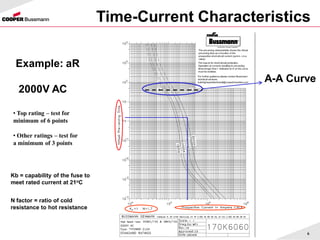
Time-Current Characteristics
Kb = capability of the fuse to
meet rated current at 21oC
N factor = ratio of cold
resistance to hot resistance
Example: aR
2000V AC
A-A Curve
• Top rating – test for
minimum of 6 points
• Other ratings – test for
a minimum of 3 points
7
A-A Curve
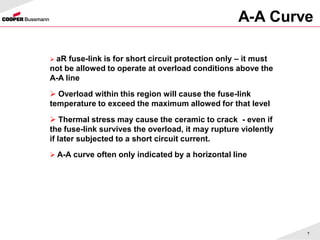
 aR fuse-link is for short circuit protection only – it must
not be allowed to operate at overload conditions above the
A-A line
 Overload within this region will cause the fuse-link
temperature to exceed the maximum allowed for that level
 Thermal stress may cause the ceramic to crack - even if
the fuse-link survives the overload, it may rupture violently
if later subjected to a short circuit current.
 A-A curve often only indicated by a horizontal line
8
Time Current Characteristics
Example: gR
 No A-A Curve
 Fuse can operate in any
given situation
 Relatively slow fuse
compared to an aR type
9
I2t - energy integral
Short circuit conditions – heat generated is far greater than
heat dissipated – temperature of restrictions reach melting
point almost instantaneously
Pre-Arcing I2t – expresses the amount of energy required
to melt the element before it begins to arc
Arcing I2t – expresses the amount of energy generated
from the arcing point to the point at which the over current is
safely interrupted
Clearing I2t – Sum of the pre-arc I2t and arcing I2t -
expresses the total energy the fuse will let through during an
operation
10
I2t - energy integral
Pre-arcing I2t
• The pre-arcing I2t value tends to a minimum when the
fuse is subject to high currents
• Directly related to cross sectional area squared
• Min i2t = constant x (cross section)2
• Constant depends on material properties
Arcing I2t
• The arcing I2t value varies with applied voltage, fault
level and power factor
11
I2t - energy integral
Clearing I2t
• The total I2t figures are quoted at worst case
scenario
- Applied working voltage (rated fuse voltage)
- Power factor cos φ = 0.15
- Short circuit level 10-15 times rated current
• Semiconductor manufacturers produce I2t ratings
which should not be exceeded during fusing at all
times below 10ms
Total i2t value of the fuse-link must be less than the
I2t capability of the device
12
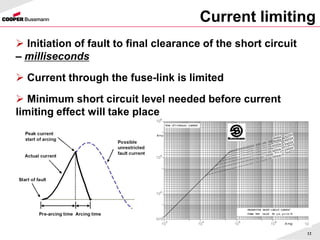
Current limiting
 Initiation of fault to final clearance of the short circuit
– milliseconds
 Current through the fuse-link is limited
 Minimum short circuit level needed before current
limiting effect will take place
Rated Voltage Dimensioning
13
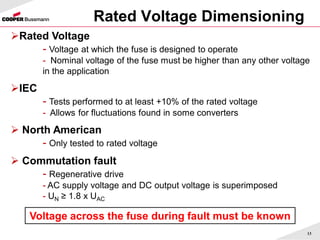
Rated Voltage
- Voltage at which the fuse is designed to operate
- Nominal voltage of the fuse must be higher than any other voltage
in the application
IEC
- Tests performed to at least +10% of the rated voltage
- Allows for fluctuations found in some converters
 North American
- Only tested to rated voltage
 Commutation fault
- Regenerative drive
- AC supply voltage and DC output voltage is superimposed
- UN ≥ 1.8 x UAC
Voltage across the fuse during fault must be known
Rated voltage Dimensioning cont…
14
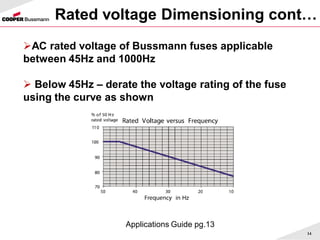
AC rated voltage of Bussmann fuses applicable
between 45Hz and 1000Hz
 Below 45Hz – derate the voltage rating of the fuse
using the curve as shown
Applications Guide pg.13
The Arc Voltage
15
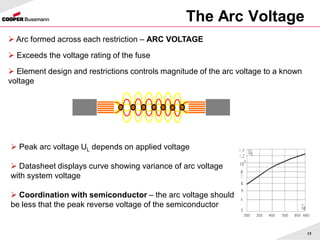
 Arc formed across each restriction – ARC VOLTAGE
 Exceeds the voltage rating of the fuse
 Element design and restrictions controls magnitude of the arc voltage to a known
voltage
 Peak arc voltage UL depends on applied voltage
 Datasheet displays curve showing variance of arc voltage
with system voltage
 Coordination with semiconductor – the arc voltage should
be less that the peak reverse voltage of the semiconductor
Rated Current Dimensioning
16
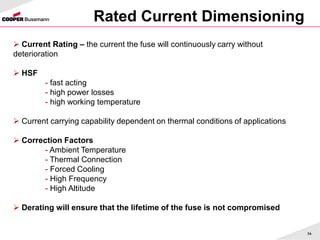
 Current Rating – the current the fuse will continuously carry without
deterioration
 HSF
- fast acting
- high power losses
- high working temperature
 Current carrying capability dependent on thermal conditions of applications
 Correction Factors
- Ambient Temperature
- Thermal Connection
- Forced Cooling
- High Frequency
- High Altitude
 Derating will ensure that the lifetime of the fuse is not compromised
Ambient Temperature
17
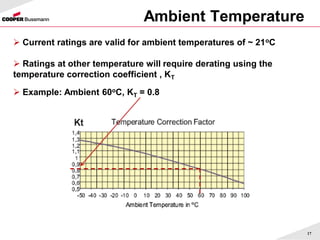
 Current ratings are valid for ambient temperatures of ~ 21oC
 Ratings at other temperature will require derating using the
temperature correction coefficient , KT
 Example: Ambient 60oC, KT = 0.8
Thermal Connection Factor
18
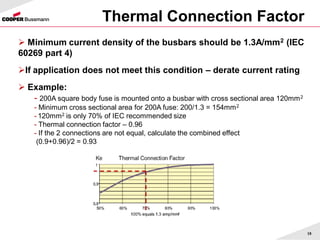
 Minimum current density of the busbars should be 1.3A/mm2 (IEC
60269 part 4)
If application does not meet this condition – derate current rating
 Example:
- 200A square body fuse is mounted onto a busbar with cross sectional area 120mm2
- Minimum cross sectional area for 200A fuse: 200/1.3 = 154mm2
- 120mm2 is only 70% of IEC recommended size
- Thermal connection factor – 0.96
- If the 2 connections are not equal, calculate the combined effect
(0.9+0.96)/2 = 0.93
Cooling Air Correction Factor
19
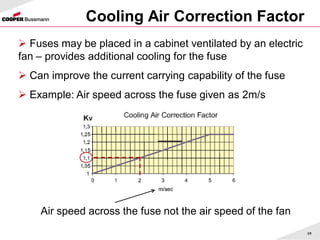
 Fuses may be placed in a cabinet ventilated by an electric
fan – provides additional cooling for the fuse
 Can improve the current carrying capability of the fuse
 Example: Air speed across the fuse given as 2m/s
Air speed across the fuse not the air speed of the fan
Frequency Correction
20
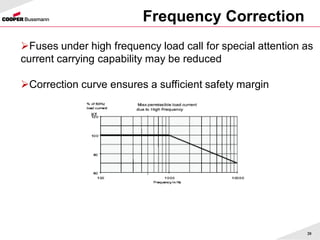
Fuses under high frequency load call for special attention as
current carrying capability may be reduced
Correction curve ensures a sufficient safety margin
High Altitude
21
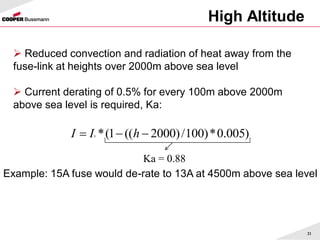
 Reduced convection and radiation of heat away from the
fuse-link at heights over 2000m above sea level
 Current derating of 0.5% for every 100m above 2000m
above sea level is required, Ka:
)
005
.
0
*
)
100
/
)
2000
((
1
(
* 

 h
I
I N
Example: 15A fuse would de-rate to 13A at 4500m above sea level
Ka = 0.88
Example
22
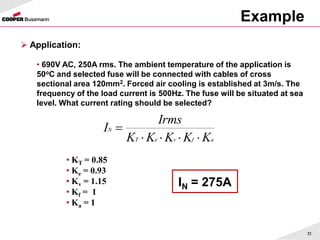
 Application:
• 690V AC, 250A rms. The ambient temperature of the application is
50oC and selected fuse will be connected with cables of cross
sectional area 120mm2. Forced air cooling is established at 3m/s. The
frequency of the load current is 500Hz. The fuse will be situated at sea
level. What current rating should be selected?
a
f
v
e
T
N
K
K
K
K
K
Irms
I





IN = 275A
• KT = 0.85
• Ke = 0.93
• Kv = 1.15
• Kf = 1
• Ka = 1
Influence of overloads
23
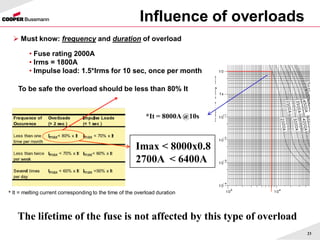
 Must know: frequency and duration of overload
• Fuse rating 2000A
• Irms = 1800A
• Impulse load: 1.5*Irms for 10 sec, once per month
*It = 8000A@10s
* It = melting current corresponding to the time of the overload duration
The lifetime of the fuse is not affected by this type of overload
Imax < 8000x0.8
2700A < 6400A
To be safe the overload should be less than 80% It
Cyclic Loading – G Factor
24
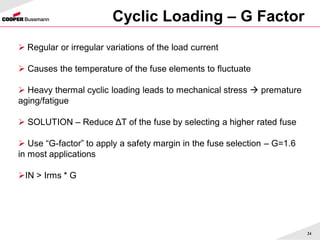
 Regular or irregular variations of the load current
 Causes the temperature of the fuse elements to fluctuate
 Heavy thermal cyclic loading leads to mechanical stress  premature
aging/fatigue
 SOLUTION – Reduce ΔT of the fuse by selecting a higher rated fuse
 Use “G-factor” to apply a safety margin in the fuse selection – G=1.6
in most applications
IN > Irms * G
Cyclic Pulse Factor B
25
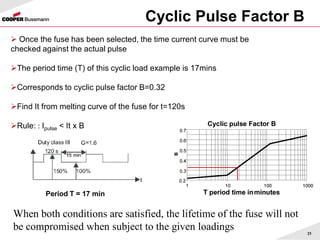
Period T = 17 min
 Once the fuse has been selected, the time current curve must be
checked against the actual pulse
The period time (T) of this cyclic load example is 17mins
Corresponds to cyclic pulse factor B=0.32
Find It from melting curve of the fuse for t=120s
Rule: : Ipulse < It x B
When both conditions are satisfied, the lifetime of the fuse will not
be compromised when subject to the given loadings

2_Fuse_Characteristics.pdf

  • 1.
  • 2.
    Overview  Overview ofprotection classes • General Purpose • Motor Protection • High Speed  Time current Curves  I2t values  Let through current and cut-off curves  Rated voltage dimensioning  Rated current dimensioning • Derating factors  Dimensioning I2t Values  Influence of overloads  Cyclic loading 2
  • 3.
    General Purpose Fuses 3 Fuse class refers to the designed breaking capacity of the fuse  gG/gL – full range for general applications  Full range – protection against low overloads and short circuit protection  Elements have standard notched design and have M-effect
  • 4.
    Motor Protection 4  Specificallydesigned for motor protection  Thicker element for thermal stress  gM – full range breaking capacity – M-effect  aM – partial range breaking capacity – Short circuit protection only – No M-effect
  • 5.
    5 High Speed Fuse-links Featuresof HSF  High breaking capacity  Compact size  High operating temperature - restricts the use of m-effect to assist with low over current protection  High grade body ceramic  Primarily for short circuit protection IEC Protection Class  aR • partial range breaking capacity • No m-effect • A-A curve  gR • full range breaking capacity • aR fuses with m-effect Semiconductor Protection  Designed for the protection of semiconductor devices and applications using semiconductors – diodes, thyristors, IGBTS  Semiconductor devices are sensitive to over voltages and over currents – require very fast acting protection  Specially designed necks to ensure rapid melting HSF Families BS88 North American Ferrule Square Body
  • 6.
    6 Time-Current Characteristics Kb =capability of the fuse to meet rated current at 21oC N factor = ratio of cold resistance to hot resistance Example: aR 2000V AC A-A Curve • Top rating – test for minimum of 6 points • Other ratings – test for a minimum of 3 points
  • 7.
    7 A-A Curve  aRfuse-link is for short circuit protection only – it must not be allowed to operate at overload conditions above the A-A line  Overload within this region will cause the fuse-link temperature to exceed the maximum allowed for that level  Thermal stress may cause the ceramic to crack - even if the fuse-link survives the overload, it may rupture violently if later subjected to a short circuit current.  A-A curve often only indicated by a horizontal line
  • 8.
    8 Time Current Characteristics Example:gR  No A-A Curve  Fuse can operate in any given situation  Relatively slow fuse compared to an aR type
  • 9.
    9 I2t - energyintegral Short circuit conditions – heat generated is far greater than heat dissipated – temperature of restrictions reach melting point almost instantaneously Pre-Arcing I2t – expresses the amount of energy required to melt the element before it begins to arc Arcing I2t – expresses the amount of energy generated from the arcing point to the point at which the over current is safely interrupted Clearing I2t – Sum of the pre-arc I2t and arcing I2t - expresses the total energy the fuse will let through during an operation
  • 10.
    10 I2t - energyintegral Pre-arcing I2t • The pre-arcing I2t value tends to a minimum when the fuse is subject to high currents • Directly related to cross sectional area squared • Min i2t = constant x (cross section)2 • Constant depends on material properties Arcing I2t • The arcing I2t value varies with applied voltage, fault level and power factor
  • 11.
    11 I2t - energyintegral Clearing I2t • The total I2t figures are quoted at worst case scenario - Applied working voltage (rated fuse voltage) - Power factor cos φ = 0.15 - Short circuit level 10-15 times rated current • Semiconductor manufacturers produce I2t ratings which should not be exceeded during fusing at all times below 10ms Total i2t value of the fuse-link must be less than the I2t capability of the device
  • 12.
    12 Current limiting  Initiationof fault to final clearance of the short circuit – milliseconds  Current through the fuse-link is limited  Minimum short circuit level needed before current limiting effect will take place
  • 13.
    Rated Voltage Dimensioning 13 RatedVoltage - Voltage at which the fuse is designed to operate - Nominal voltage of the fuse must be higher than any other voltage in the application IEC - Tests performed to at least +10% of the rated voltage - Allows for fluctuations found in some converters  North American - Only tested to rated voltage  Commutation fault - Regenerative drive - AC supply voltage and DC output voltage is superimposed - UN ≥ 1.8 x UAC Voltage across the fuse during fault must be known
  • 14.
    Rated voltage Dimensioningcont… 14 AC rated voltage of Bussmann fuses applicable between 45Hz and 1000Hz  Below 45Hz – derate the voltage rating of the fuse using the curve as shown Applications Guide pg.13
  • 15.
    The Arc Voltage 15 Arc formed across each restriction – ARC VOLTAGE  Exceeds the voltage rating of the fuse  Element design and restrictions controls magnitude of the arc voltage to a known voltage  Peak arc voltage UL depends on applied voltage  Datasheet displays curve showing variance of arc voltage with system voltage  Coordination with semiconductor – the arc voltage should be less that the peak reverse voltage of the semiconductor
  • 16.
    Rated Current Dimensioning 16 Current Rating – the current the fuse will continuously carry without deterioration  HSF - fast acting - high power losses - high working temperature  Current carrying capability dependent on thermal conditions of applications  Correction Factors - Ambient Temperature - Thermal Connection - Forced Cooling - High Frequency - High Altitude  Derating will ensure that the lifetime of the fuse is not compromised
  • 17.
    Ambient Temperature 17  Currentratings are valid for ambient temperatures of ~ 21oC  Ratings at other temperature will require derating using the temperature correction coefficient , KT  Example: Ambient 60oC, KT = 0.8
  • 18.
    Thermal Connection Factor 18 Minimum current density of the busbars should be 1.3A/mm2 (IEC 60269 part 4) If application does not meet this condition – derate current rating  Example: - 200A square body fuse is mounted onto a busbar with cross sectional area 120mm2 - Minimum cross sectional area for 200A fuse: 200/1.3 = 154mm2 - 120mm2 is only 70% of IEC recommended size - Thermal connection factor – 0.96 - If the 2 connections are not equal, calculate the combined effect (0.9+0.96)/2 = 0.93
  • 19.
    Cooling Air CorrectionFactor 19  Fuses may be placed in a cabinet ventilated by an electric fan – provides additional cooling for the fuse  Can improve the current carrying capability of the fuse  Example: Air speed across the fuse given as 2m/s Air speed across the fuse not the air speed of the fan
  • 20.
    Frequency Correction 20 Fuses underhigh frequency load call for special attention as current carrying capability may be reduced Correction curve ensures a sufficient safety margin
  • 21.
    High Altitude 21  Reducedconvection and radiation of heat away from the fuse-link at heights over 2000m above sea level  Current derating of 0.5% for every 100m above 2000m above sea level is required, Ka: ) 005 . 0 * ) 100 / ) 2000 (( 1 ( *    h I I N Example: 15A fuse would de-rate to 13A at 4500m above sea level Ka = 0.88
  • 22.
    Example 22  Application: • 690VAC, 250A rms. The ambient temperature of the application is 50oC and selected fuse will be connected with cables of cross sectional area 120mm2. Forced air cooling is established at 3m/s. The frequency of the load current is 500Hz. The fuse will be situated at sea level. What current rating should be selected? a f v e T N K K K K K Irms I      IN = 275A • KT = 0.85 • Ke = 0.93 • Kv = 1.15 • Kf = 1 • Ka = 1
  • 23.
    Influence of overloads 23 Must know: frequency and duration of overload • Fuse rating 2000A • Irms = 1800A • Impulse load: 1.5*Irms for 10 sec, once per month *It = 8000A@10s * It = melting current corresponding to the time of the overload duration The lifetime of the fuse is not affected by this type of overload Imax < 8000x0.8 2700A < 6400A To be safe the overload should be less than 80% It
  • 24.
    Cyclic Loading –G Factor 24  Regular or irregular variations of the load current  Causes the temperature of the fuse elements to fluctuate  Heavy thermal cyclic loading leads to mechanical stress  premature aging/fatigue  SOLUTION – Reduce ΔT of the fuse by selecting a higher rated fuse  Use “G-factor” to apply a safety margin in the fuse selection – G=1.6 in most applications IN > Irms * G
  • 25.
    Cyclic Pulse FactorB 25 Period T = 17 min  Once the fuse has been selected, the time current curve must be checked against the actual pulse The period time (T) of this cyclic load example is 17mins Corresponds to cyclic pulse factor B=0.32 Find It from melting curve of the fuse for t=120s Rule: : Ipulse < It x B When both conditions are satisfied, the lifetime of the fuse will not be compromised when subject to the given loadings