Introduction to Fuse
•• A fuse is a safety device used in electrical
circuits.
• • Protects electrical equipment from
overcurrent.
• • Works by melting the fuse wire when
current exceeds limit.
4.
Need for Fuse
•• Prevents damage to appliances.
• • Avoids risk of fire due to overheating.
• • Provides simple and cost-effective
protection.
5.
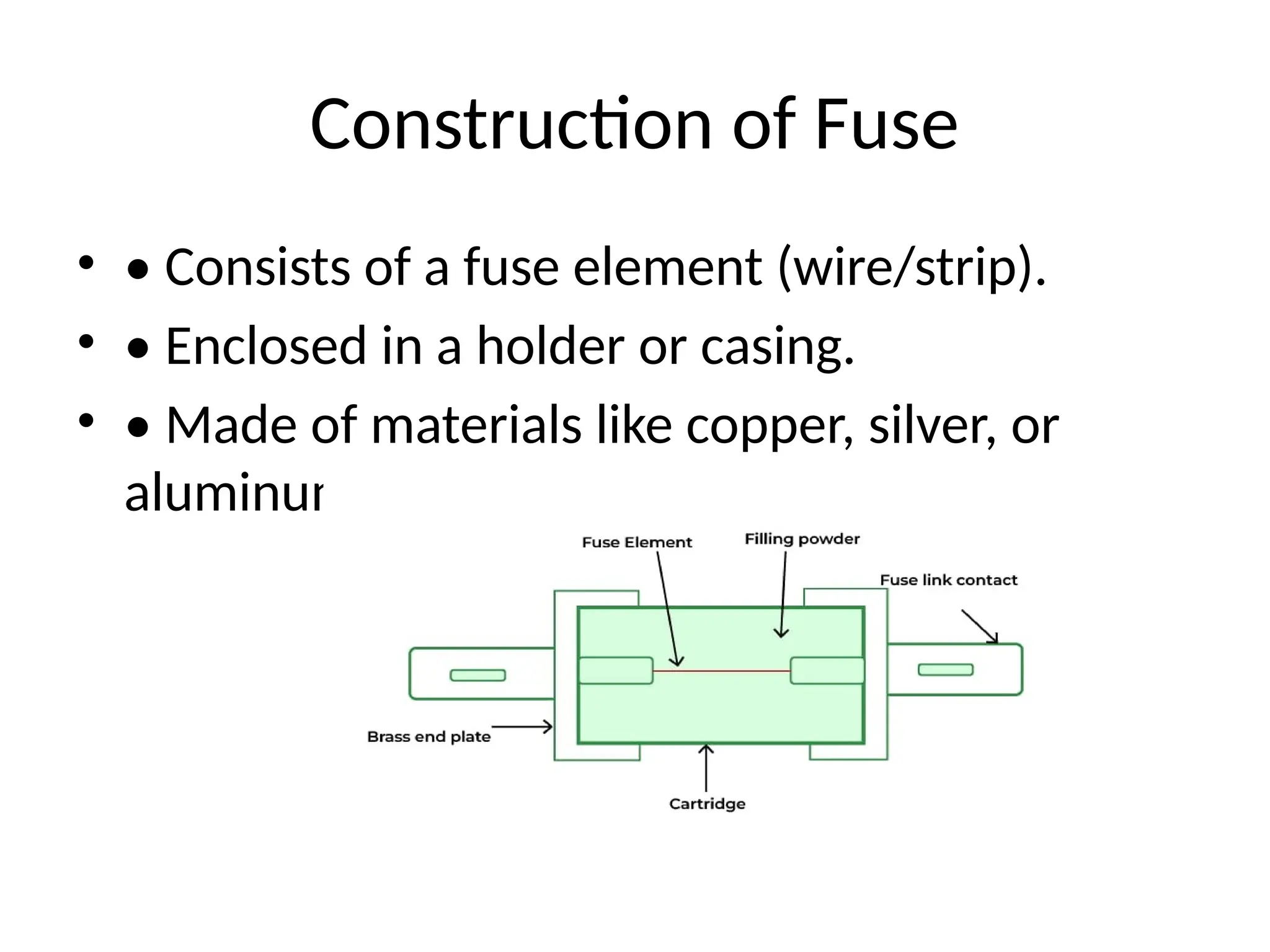
Construction of Fuse
•• Consists of a fuse element (wire/strip).
• • Enclosed in a holder or casing.
• • Made of materials like copper, silver, or
aluminum.
6.
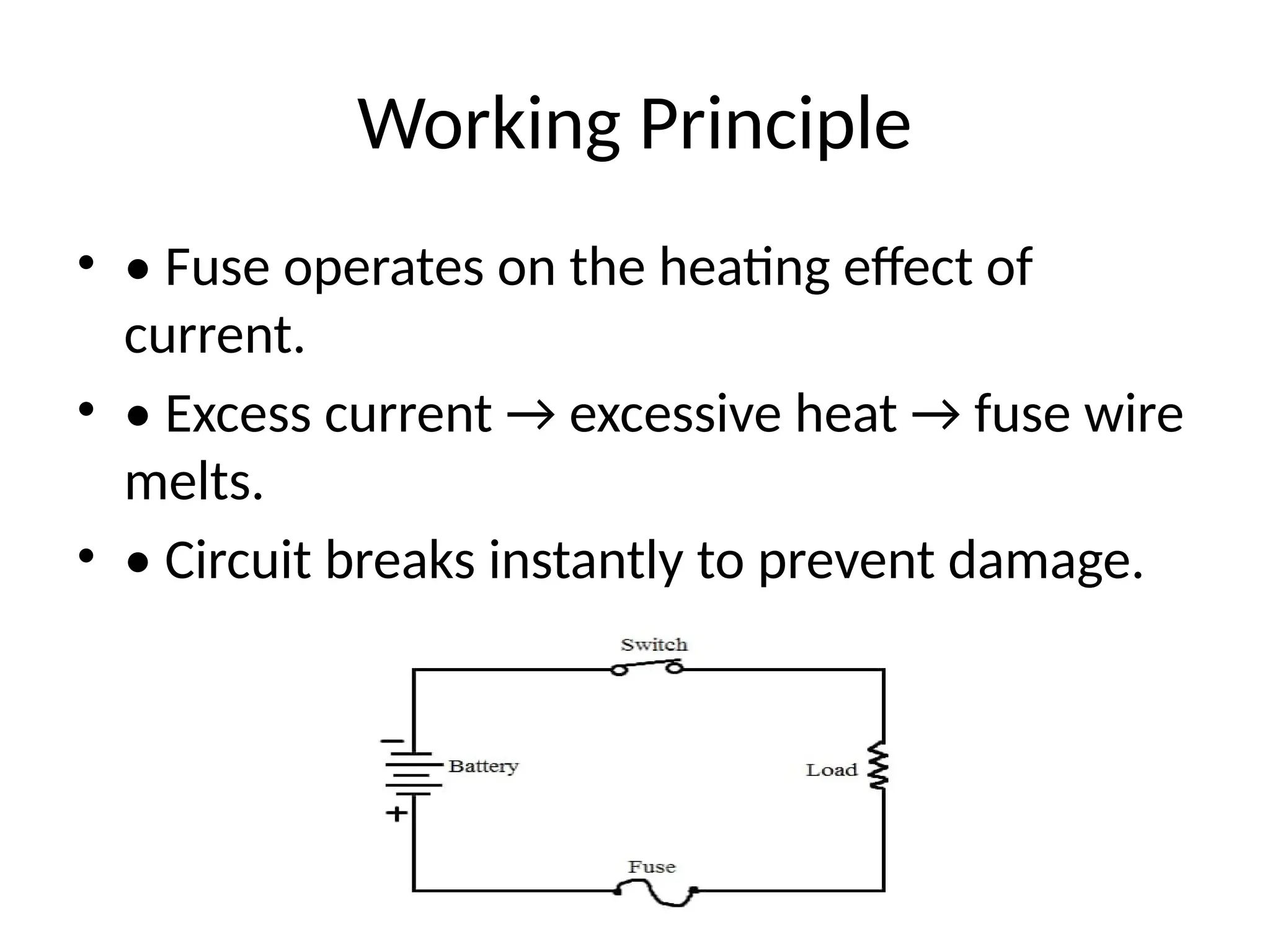
Working Principle
• •Fuse operates on the heating effect of
current.
• • Excess current → excessive heat → fuse wire
melts.
• • Circuit breaks instantly to prevent damage.
7.
Characteristics of Fuse
•• Current rating
• • Voltage rating
• • Breaking capacity
• • Response time
8.
Types of Fuse(Classification)
• Fuses are broadly classified into:
• • AC Fuses
• • DC Fuses
• • Based on size: Cartridge, Rewirable, etc.
9.
AC Fuse
• •Specifically designed for alternating current
circuits.
• • Used in household and industrial
applications.
10.
DC Fuse
• •Designed for direct current circuits.
• • Requires special design to avoid arc
formation.
11.
Cartridge Fuse
• •Cylindrical shape with metal caps.
• • Commonly used in domestic wiring.
• • High reliability and replacement ease.
12.
Rewirable Fuse
• •Contains a fuse carrier and base.
• • Fuse wire can be replaced easily after
operation.
• • Economical and reusable.
13.
Drop-out Fuse
• •Used in high-voltage transmission lines.
• • Fuse element drops out when blown.
• • Provides visible indication of operation.
14.
HRC Fuse (HighRupturing Capacity)
• • Designed for high fault current capacity.
• • Filled with quartz powder to absorb arc
energy.
• • Used in industrial applications.
15.
Advantages of Fuse
•• Simple design and low cost.
• • Quick response to overcurrent.
• • Maintenance-free in most cases.
16.
Disadvantages of Fuse
•• Needs replacement after operation.
• • Not suitable for repeated tripping.
• • Limited breaking capacity compared to
circuit breakers.
17.
Applications of Fuse
•• Household electrical appliances.
• • Industrial machines.
• • Automotive circuits.
• • Power systems protection.


![AnyTrans for iOS 8.9.14.20251127 With Crack for MacOS [Latest] pptx](https://cdn.slidesharecdn.com/ss_thumbnails/softwareoverview-251207190907-2316965f-thumbnail.jpg?width=640&height=640&fit=bounds)


![Moho Pro 14.4 Crack for MacOS Works Until 2050 [Latest] pptx](https://cdn.slidesharecdn.com/ss_thumbnails/softwareoverview-251207192639-797289c4-thumbnail.jpg?width=640&height=640&fit=bounds)

![Soundtoys Mac v5.5.5.0 Crack for MacOS Full Version [Latest] pptx](https://cdn.slidesharecdn.com/ss_thumbnails/softwareoverview-251207193711-91d8ae6b-thumbnail.jpg?width=640&height=640&fit=bounds)

![CleanMyMac X v5.2.8 Crack for MacOS Full Version [Latest] pptx](https://cdn.slidesharecdn.com/ss_thumbnails/softwareoverview-251207194121-a81f0142-thumbnail.jpg?width=640&height=640&fit=bounds)


