FUNDUS
EXAMINATION
SOUMITRA DAS
METHODS OF EXAMINATION
DIRECT OPHTHALMOSCOPY
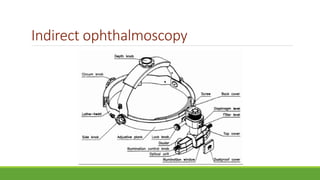
INDIRECT OPHTHALMOSCOPY
INDIRECT SLIT LAMP BIOMICROSCOPY
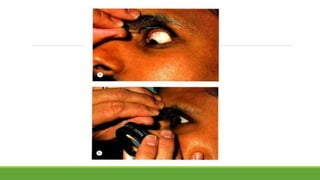
Why do we dilate pupils?
PUPILLARY DILATION
Combination of phenylephrine [2.5 %] &
tropicamide [1 %]
then eyes closed
Dilation attained = 15-30 min
Normal reactivity = 4 - 8 hrs
Conditions which to avoid : iris supported lens
shallow AC
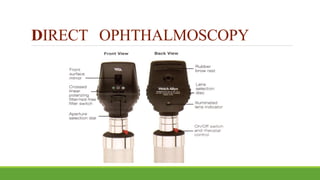
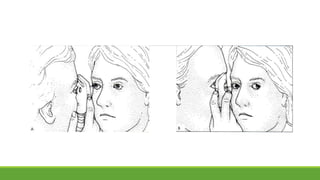
DIRECT OPHTHALMOSCOPY
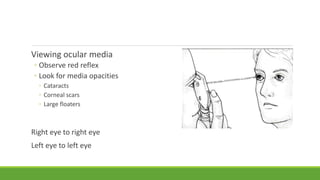
Viewing ocular media
◦ Observe red reflex
◦ Look for media opacities
◦ Cataracts
◦ Corneal scars
◦ Large floaters
Right eye to right eye
Left eye to left eye
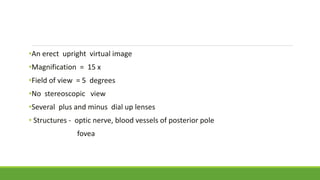
•An erect upright virtual image
•Magnification = 15 x
•Field of view = 5 degrees
•No stereoscopic view
•Several plus and minus dial up lenses
• Structures - optic nerve, blood vessels of posterior pole
fovea
Advantages
◦ Portable
◦ Easy to use
◦ Upright image
◦ Magnification  15x
◦ Can use w/o dilation
Disadvantages
◦ Small field of view
◦ Lack of stereopsis
◦ Media opacities can degrade image
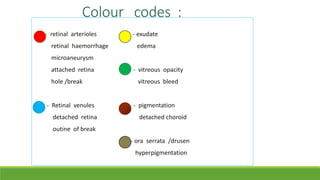
- retinal arterioles - exudate
retinal haemorrhage edema
microaneurysm
attached retina - vitreous opacity
hole /break vitreous bleed
- Retinal venules - pigmentation
detached retina detached choroid
outine of break
- ora serrata /drusen
hyperpigmentation
Colour codes :
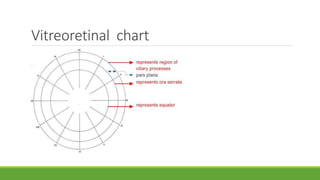
Vitreoretinal chart
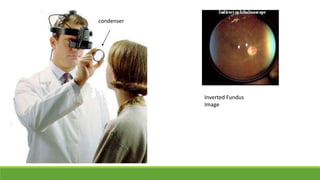
Indirect ophthalmoscopy
condenser
Inverted Fundus
Image
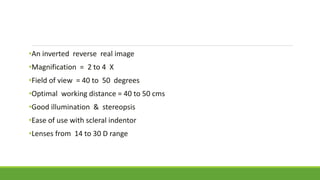
•An inverted reverse real image
•Magnification = 2 to 4 X
•Field of view = 40 to 50 degrees
•Optimal working distance = 40 to 50 cms
•Good illumination & stereopsis
•Ease of use with scleral indentor
•Lenses from 14 to 30 D range
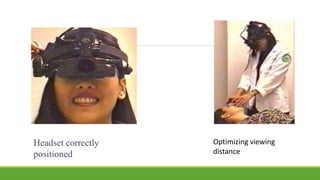
Headset correctly
positioned
Optimizing viewing
distance
Monocular or binocular
Advantages:
◦ Wide field of view
◦ Binocular instruments provide stereopsis
Disadvantages:
◦ Requires more skill
◦ Decreased magnification (3x)
◦ Requires dilation
◦ Inverted image
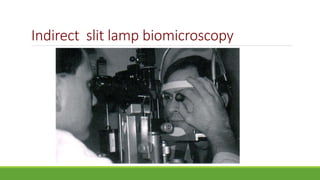
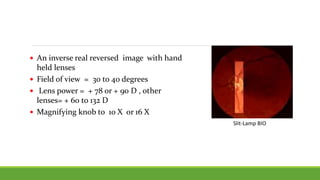
Indirect slit lamp biomicroscopy
•Field of View & Mag:
• FOV <indirect but >direct
• varies w/lens & slit lamp mag
•Inverted image
•Stereopsis
•Dilated pupil
•Requires skill
Slit-Lamp BIO
 An inverse real reversed image with hand
held lenses
 Field of view = 30 to 40 degrees
 Lens power = + 78 or + 90 D , other
lenses= + 60 to 132 D
 Magnifying knob to 10 X or 16 X
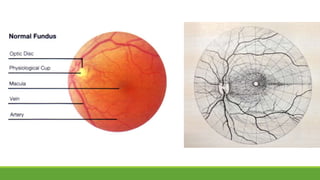
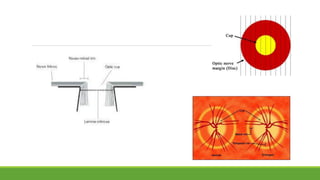
Optic disc
DISC:
DIAMETER – 1.5mm [1 disc diameter]
COLOR – Pale pink
SHAPE – Circular
EDGES – Regular
TERMINATION OF ALL
LAYERS EXCEPT NFL
CUP: C/D ratio – 0.3 to 0.4
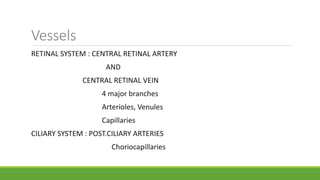
Vessels
RETINAL SYSTEM : CENTRAL RETINAL ARTERY
AND
CENTRAL RETINAL VEIN
4 major branches
Arterioles, Venules
Capillaries
CILIARY SYSTEM : POST.CILIARY ARTERIES
Choriocapillaries
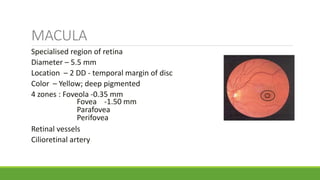
MACULA
Specialised region of retina
Diameter – 5.5 mm
Location – 2 DD - temporal margin of disc
Color – Yellow; deep pigmented
4 zones : Foveola -0.35 mm
Fovea -1.50 mm
Parafovea
Perifovea
Retinal vessels
Cilioretinal artery
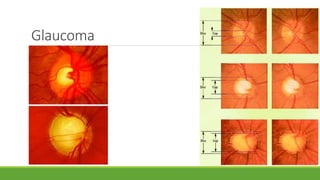
Glaucoma
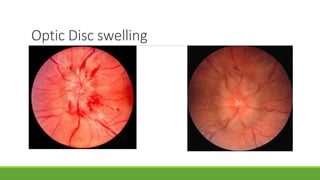
Optic Disc swelling
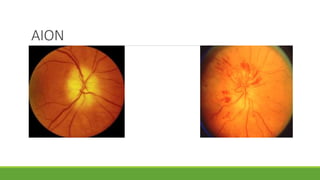
AION
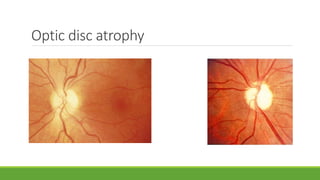
Optic disc atrophy
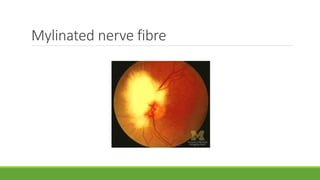
Mylinated nerve fibre
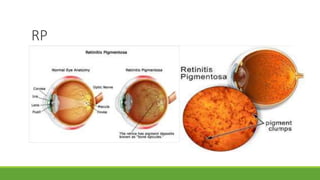
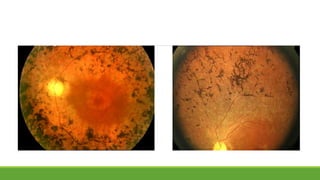
RP
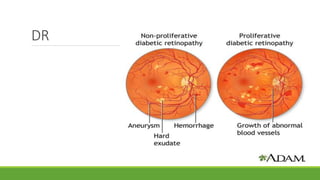
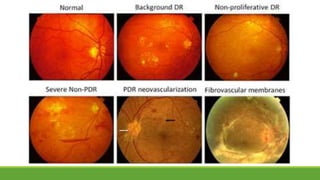
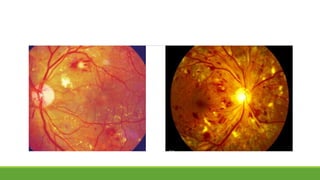
DR
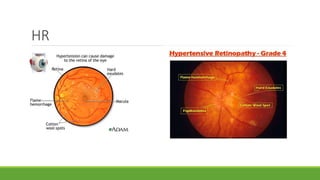
HR
THANK YOU

Fundus examination