GUIDE-DR SURAJKUMAR KURIL SIR
DIRECT OPHTHALMOSCOPY
-DR PRATIK KISHAN LAKHMAWAR
Contents
• Introduction
• History
• Direct ophthalmoscope
• Optics
• Distant direct ophthalmoscopy
• Procedure of direct ophthalmoscopy
• Normal fundus
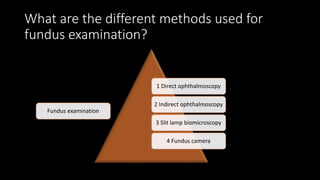
What are the different methods used for
fundus examination?
Fundus examination
1 Direct ophthalmoscopy
2 Indirect ophthalmoscopy
3 Slit lamp biomicroscopy
4 Fundus camera
Introduction
• It is handheld instrument used to examine the fundus of eye.
• It is the most commonly practiced method for routine fundus
examination.
• It is used to examine central 7 to 10 degree of retina
• “The physician using a direct ophthalmoscope is like a one-eyed
Eskimo peering into an igloo from the entryway with a flashlight.”
History
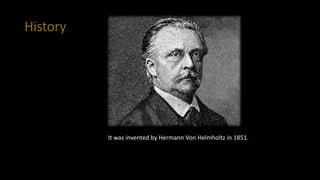
It was invented by Hermann Von Helmholtz in 1851.
Optics
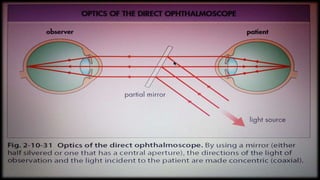
• Convergent beam of light is reflected on to patients retina.
• The emergent rays from patients retina reach the observer through
the viewing hole present in the ophthalmoscope.
• If the observer is not emmetropic then the correcting lenses must be
interposed which are present in the ophthalmoscope.
How is the image formed?
• The image formed on observers retina is-
• Erect
• Virtual
• 15 times magnified (in emmetropes)
Procedure
• It should be performed in semi dark room.
• Ideally the pupils should be dilated with mydriatic agent.
• Patient should be looking straight.
Position of examination
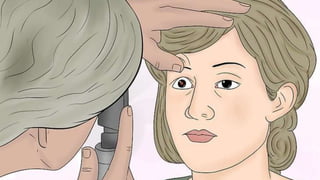
• The subject should be examined in sitting or lying down position.
• While examining the left eye of the subject the examiner should be
on left side of the subject and should hold the instrument in the left
hand and use left eye.
• And while examining right eye stand on right side ,hold the
instrument in right eye and use right eye.
What is distant direct ophthalmoscopy?
• The ophthalmoscope should be kept at a distance of 20-25 cm from
the patient’s eye.
• Normally a red reflex is seen at the pupillary area.
• It is used to examine the condition of different media of the eye.
Uses
 Opacities in the ocular media are seen as dark spots in the red glow at
the pupillary area.
 The plane of the opacities can be assessed by asking the patient to
move the eye from side to side while the examiner is observing the
pupillary glow (based on parallax principle).
 Opacities in front of the pupil move in the direction of eye movement.
 Opacities in the pupillary plane do not move.
 Ospacities behind the pupillary plane move opposite the direction of
eye movement.
• Once the red reflex is seen on distant direct ophthalmoscopy
observer should move as close to the patients eye as possible(it
should be at the anterior focal palne of the patients eye i.e. 15.4 mm
from the cornea.
• Once the retina is focused details should be examined like disc, blood
vessels, macula etc.
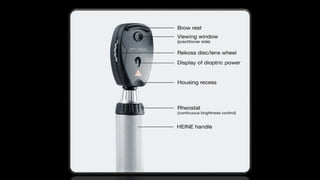
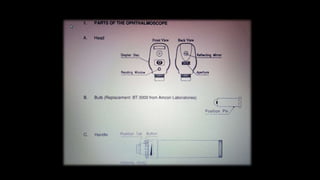
Parts of direct ophthalmoscope
• Body-
 To hold the battery.
 The body has switch with a rheostat that can control illumination.
• Head-
 Eyepiece
 Lens rack
 Power dial
 Filter selector
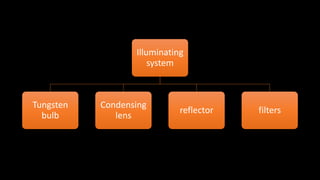
Direct ophthalmoscope consist of two
systems
Viewing
system
Sight hole
Focusing
aperture
Illuminating
system
Tungsten
bulb
Condensing
lens
reflector filters
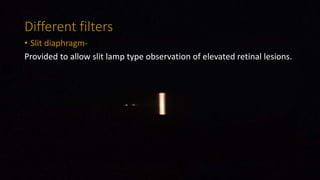
Different filters
• Slit diaphragm-
Provided to allow slit lamp type observation of elevated retinal lesions.
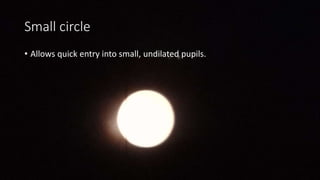
Small circle
• Allows quick entry into small, undilated pupils.
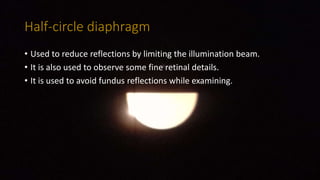
Half-circle diaphragm
• Used to reduce reflections by limiting the illumination beam.
• It is also used to observe some fine retinal details.
• It is used to avoid fundus reflections while examining.
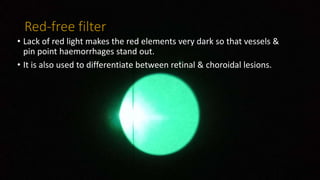
Red-free filter
• Lack of red light makes the red elements very dark so that vessels &
pin point haemorrhages stand out.
• It is also used to differentiate between retinal & choroidal lesions.
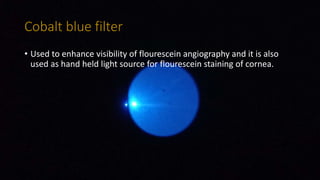
Cobalt blue filter
• Used to enhance visibility of flourescein angiography and it is also
used as hand held light source for flourescein staining of cornea.
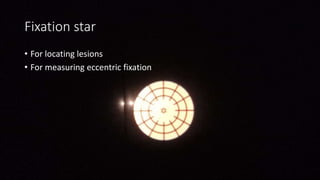
Fixation star
• For locating lesions
• For measuring eccentric fixation
Normal fundus
• The fundus of the eye is the interior surface of the eye opposite the
lens and includes the retina, optic disc, macula, fovea, and posterior
pole.
• The term fundus may also be inclusive of Bruch's membrane and the
choroid.
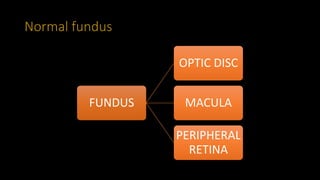
Normal fundus
FUNDUS
OPTIC DISC
MACULA
PERIPHERAL
RETINA
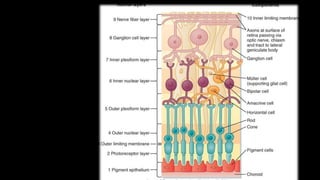
What is RETINA?
• Retina is the innermost tunic of the eye.
• It is thin,transparent, delicate membrane.
• It is the most developed tissue of the eye.
Fundus examination is used for
• Routinely used to assess and diagnose vitreo-retinal diseases such
as diabetic retinopathy, hypertensive retinopathy, retinal tear and
detachment, macular hole retinal haemorrhages, retinal artery
and vein occlusion, Choroidal tumour, macular oedema.
• Examine the extent of the defects, abnormalities to plan a proper
treatment.
• Evaluate the Success of the treatment.
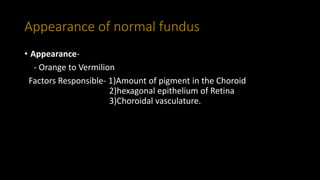
Appearance of normal fundus
• Appearance-
• r- Orange to Vermilion
Factors Responsible- 1)Amount of pigment in the Choroid
2)hexagonal epithelium of Retina
3)Choroidal vasculature.
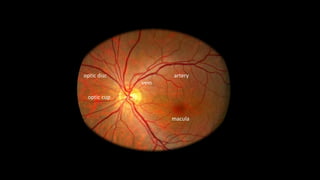
optic disc artery
vein
optic cup
macula
Optic disc
• Optic disc- It’s a Ophthalmoscopic view of nerve head , while Papilla
is the term for Microscopical sections.
• Its an insensitive area in Retina where Ganglion cell axons exit to
form optic nerve.
• Location- Nasal to Geometrical axis
• Diameter- 1.5 mm(1 Disc Diopter)
• Colour- Pale red or Yellowish red tint
• Normal colour of the disc is due to
1. Axonal bundles – transparent
2. Transmit the light
3. Reflected by disc capillaries
4. Disc appears pale red to yellowish tint
• Shape- Round or vertically Oval
• Edges- Regular
• Physiological Cup- It’s a depression seen in the disc.
• The size of Physiological Cup not affected by Age Or
Hypermetropia.
• Vessels- Central Retinal artery and vein emerge through its
centre.
• Normal C/D Ratio—0.3-0.5
Physiological cup
• At the centre of the optic disc, there is a short funnel shaped
depression from which retinal vessels appear to emerge.
• 15% optic discs do not show physiological cupping.
• Nasal border is steeper than temporal border.
• C/D ratio- 0.3-0.5
• Depth of cup depends upon size, shape, obliguity and vascularity of
disc.
• Size of physiological cup is not affected by age or hypermetropia.
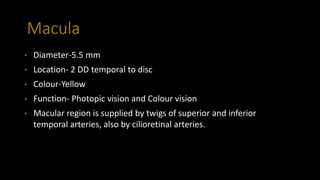
Macula
• Diameter-5.5 mm
• Location- 2 DD temporal to disc
• Colour-Yellow
• Function- Photopic vision and Colour vision
• Macular region is supplied by twigs of superior and inferior
temporal arteries, also by cilioretinal arteries.
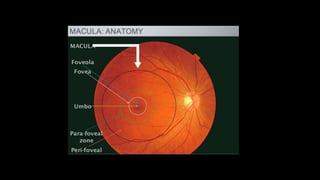
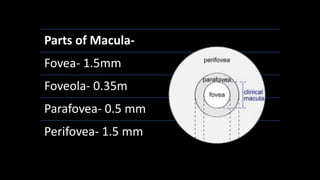
Parts of Macula-
Fovea- 1.5mm
Foveola- 0.35m
Parafovea- 0.5 mm
Perifovea- 1.5 mm
Fovea
• It is the centre of macula.
• Fully developed after 4 years.
• Thick basement membrane.
• Prone for macular holes.
Foveola
• Centre of Fovea-Foveola
• Foveola- It is small ,circular, area of deeper red than surrounding
fundus.
• Foveola has only Cones, No Rods.
• Centre of foveola- Umbo , which is seen as bright spot of light on
ophthalmoscopy called as Foveal reflex.
• Vision is most acute at foveola.
• Foveal avascular zone- is devoid of retinal blood vessels. It is 0.4-
0.6mm in diameter.
•At fovea- 1 lacs to 3 lacs per mm2
•3mm away from fovea- 6000 per
mm2
•10 mm away from fovea- 4000
per mm2
Cone
density in
and
around
fovea-
Other uses of direct ophthalmoscope
Pupil-
Pupil can be evaluated by comparing size & shape.
Anterior segment-
With +13 to +15D lens in ophthalmoscope cornea, lids, sclera, lashes &
iris can also be examined.
Vitreous-
With +6 to +7D lens vitreous floaters & opacities can be examined
Advantages
Easy procedure
It can be used in non dilating pupils as well
It can be carried everywhere
Refractive power can be adjusted
Disadvantages
Limited view
Monoocular view
Stereoscopic view not possible
It is expensive
THANK YOU..

Direct ophthalmoscopy

  • 1.
    GUIDE-DR SURAJKUMAR KURILSIR DIRECT OPHTHALMOSCOPY -DR PRATIK KISHAN LAKHMAWAR
  • 2.
    Contents • Introduction • History •Direct ophthalmoscope • Optics • Distant direct ophthalmoscopy • Procedure of direct ophthalmoscopy • Normal fundus
  • 3.
    What are thedifferent methods used for fundus examination? Fundus examination 1 Direct ophthalmoscopy 2 Indirect ophthalmoscopy 3 Slit lamp biomicroscopy 4 Fundus camera
  • 4.
    Introduction • It ishandheld instrument used to examine the fundus of eye. • It is the most commonly practiced method for routine fundus examination. • It is used to examine central 7 to 10 degree of retina • “The physician using a direct ophthalmoscope is like a one-eyed Eskimo peering into an igloo from the entryway with a flashlight.”
  • 5.
    History It was inventedby Hermann Von Helmholtz in 1851.
  • 6.
    Optics • Convergent beamof light is reflected on to patients retina. • The emergent rays from patients retina reach the observer through the viewing hole present in the ophthalmoscope. • If the observer is not emmetropic then the correcting lenses must be interposed which are present in the ophthalmoscope.
  • 8.
    How is theimage formed? • The image formed on observers retina is- • Erect • Virtual • 15 times magnified (in emmetropes)
  • 9.
    Procedure • It shouldbe performed in semi dark room. • Ideally the pupils should be dilated with mydriatic agent. • Patient should be looking straight.
  • 10.
    Position of examination •The subject should be examined in sitting or lying down position. • While examining the left eye of the subject the examiner should be on left side of the subject and should hold the instrument in the left hand and use left eye. • And while examining right eye stand on right side ,hold the instrument in right eye and use right eye.
  • 12.
    What is distantdirect ophthalmoscopy? • The ophthalmoscope should be kept at a distance of 20-25 cm from the patient’s eye. • Normally a red reflex is seen at the pupillary area. • It is used to examine the condition of different media of the eye.
  • 13.
    Uses  Opacities inthe ocular media are seen as dark spots in the red glow at the pupillary area.  The plane of the opacities can be assessed by asking the patient to move the eye from side to side while the examiner is observing the pupillary glow (based on parallax principle).  Opacities in front of the pupil move in the direction of eye movement.  Opacities in the pupillary plane do not move.  Ospacities behind the pupillary plane move opposite the direction of eye movement.
  • 14.
    • Once thered reflex is seen on distant direct ophthalmoscopy observer should move as close to the patients eye as possible(it should be at the anterior focal palne of the patients eye i.e. 15.4 mm from the cornea. • Once the retina is focused details should be examined like disc, blood vessels, macula etc.
  • 15.
    Parts of directophthalmoscope • Body-  To hold the battery.  The body has switch with a rheostat that can control illumination. • Head-  Eyepiece  Lens rack  Power dial  Filter selector
  • 16.
    Direct ophthalmoscope consistof two systems Viewing system Sight hole Focusing aperture
  • 17.
  • 20.
    Different filters • Slitdiaphragm- Provided to allow slit lamp type observation of elevated retinal lesions.
  • 21.
    Small circle • Allowsquick entry into small, undilated pupils.
  • 22.
    Half-circle diaphragm • Usedto reduce reflections by limiting the illumination beam. • It is also used to observe some fine retinal details. • It is used to avoid fundus reflections while examining.
  • 23.
    Red-free filter • Lackof red light makes the red elements very dark so that vessels & pin point haemorrhages stand out. • It is also used to differentiate between retinal & choroidal lesions.
  • 24.
    Cobalt blue filter •Used to enhance visibility of flourescein angiography and it is also used as hand held light source for flourescein staining of cornea.
  • 25.
    Fixation star • Forlocating lesions • For measuring eccentric fixation
  • 26.
    Normal fundus • Thefundus of the eye is the interior surface of the eye opposite the lens and includes the retina, optic disc, macula, fovea, and posterior pole. • The term fundus may also be inclusive of Bruch's membrane and the choroid.
  • 27.
  • 28.
    What is RETINA? •Retina is the innermost tunic of the eye. • It is thin,transparent, delicate membrane. • It is the most developed tissue of the eye.
  • 30.
    Fundus examination isused for • Routinely used to assess and diagnose vitreo-retinal diseases such as diabetic retinopathy, hypertensive retinopathy, retinal tear and detachment, macular hole retinal haemorrhages, retinal artery and vein occlusion, Choroidal tumour, macular oedema. • Examine the extent of the defects, abnormalities to plan a proper treatment. • Evaluate the Success of the treatment.
  • 31.
    Appearance of normalfundus • Appearance- • r- Orange to Vermilion Factors Responsible- 1)Amount of pigment in the Choroid 2)hexagonal epithelium of Retina 3)Choroidal vasculature.
  • 32.
  • 33.
    Optic disc • Opticdisc- It’s a Ophthalmoscopic view of nerve head , while Papilla is the term for Microscopical sections. • Its an insensitive area in Retina where Ganglion cell axons exit to form optic nerve. • Location- Nasal to Geometrical axis • Diameter- 1.5 mm(1 Disc Diopter)
  • 34.
    • Colour- Palered or Yellowish red tint • Normal colour of the disc is due to 1. Axonal bundles – transparent 2. Transmit the light 3. Reflected by disc capillaries 4. Disc appears pale red to yellowish tint
  • 35.
    • Shape- Roundor vertically Oval • Edges- Regular • Physiological Cup- It’s a depression seen in the disc. • The size of Physiological Cup not affected by Age Or Hypermetropia. • Vessels- Central Retinal artery and vein emerge through its centre. • Normal C/D Ratio—0.3-0.5
  • 36.
    Physiological cup • Atthe centre of the optic disc, there is a short funnel shaped depression from which retinal vessels appear to emerge. • 15% optic discs do not show physiological cupping. • Nasal border is steeper than temporal border. • C/D ratio- 0.3-0.5 • Depth of cup depends upon size, shape, obliguity and vascularity of disc. • Size of physiological cup is not affected by age or hypermetropia.
  • 37.
    Macula • Diameter-5.5 mm •Location- 2 DD temporal to disc • Colour-Yellow • Function- Photopic vision and Colour vision • Macular region is supplied by twigs of superior and inferior temporal arteries, also by cilioretinal arteries.
  • 38.
    Parts of Macula- Fovea-1.5mm Foveola- 0.35m Parafovea- 0.5 mm Perifovea- 1.5 mm
  • 40.
    Fovea • It isthe centre of macula. • Fully developed after 4 years. • Thick basement membrane. • Prone for macular holes.
  • 41.
    Foveola • Centre ofFovea-Foveola • Foveola- It is small ,circular, area of deeper red than surrounding fundus. • Foveola has only Cones, No Rods. • Centre of foveola- Umbo , which is seen as bright spot of light on ophthalmoscopy called as Foveal reflex. • Vision is most acute at foveola. • Foveal avascular zone- is devoid of retinal blood vessels. It is 0.4- 0.6mm in diameter.
  • 42.
    •At fovea- 1lacs to 3 lacs per mm2 •3mm away from fovea- 6000 per mm2 •10 mm away from fovea- 4000 per mm2 Cone density in and around fovea-
  • 43.
    Other uses ofdirect ophthalmoscope Pupil- Pupil can be evaluated by comparing size & shape. Anterior segment- With +13 to +15D lens in ophthalmoscope cornea, lids, sclera, lashes & iris can also be examined. Vitreous- With +6 to +7D lens vitreous floaters & opacities can be examined
  • 44.
    Advantages Easy procedure It canbe used in non dilating pupils as well It can be carried everywhere Refractive power can be adjusted
  • 45.
  • 46.