Direct
Direct
Ophthalmoscopy
Ophthalmoscopy
By Thomas Anders Brevik
What is it used for?
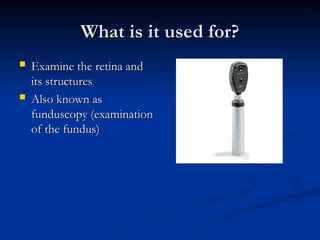
 Examine the retina and
Examine the retina and
its structures
its structures
 Also known as
Also known as
funduscopy (examination
of the fundus)
of the fundus)
 Turning the dial to positive (or green) numbers
Turning the dial to positive (or green) numbers
increases the refractive index – short focal length lenses
– for examining cornea, iris, or opacities in vitreous or
lens. e.g. start at +20 and use the slit light
 Turning the dial to negative (or red) numbers decreases
Turning the dial to negative (or red) numbers decreases
– infinite focal length lens that fits your refractive
power (individual) – for examining retina, start at +10
as you move in and dim the scope light about halfway
 Rule of thumb: You will focus on the retina with same
Rule of thumb: You will focus on the retina with same
number as your refractive error, then correct for your
patients refractive error
 Have patient sit in a comfortable position
Have patient sit in a comfortable position
 Tell them to look at something straight ahead and level
Tell them to look at something straight ahead and level
over your shoulder
over your shoulder
 Dim light in the room, so patients pupils dilate a little.
Dim light in the room, so patients pupils dilate a little.
You can also use mydriatic eyedrops to dilate the pupil
 Hold ophthalmoscope in same hand as eye you are
Hold ophthalmoscope in same hand as eye you are
looking at, and looking through (e.g. left hand for
examining patients left eye, using your left eye)
 Hold head steady with thumb above eyebrow, or hold
Hold head steady with thumb above eyebrow, or hold
shoulder
shoulder
 At about 30cm distance with light on eye, locate red reflex (seen
At about 30cm distance with light on eye, locate red reflex (seen
as an orange glow in the pupil)
 Follow red reflex into the eye as 15 degrees lateral to the patients
Follow red reflex into the eye as 15 degrees lateral to the patients
line of vision, this will get you directly into the optic disc
 If you cannot find the disc, trace any blood vessels back to it
If you cannot find the disc, trace any blood vessels back to it
 Examine vessels in all 4 quadrants of eye (upper and lower nasal
Examine vessels in all 4 quadrants of eye (upper and lower nasal
and temporal quadrants)
 Identify macula – slightly darker pigmented area, 2 optic disc
Identify macula – slightly darker pigmented area, 2 optic disc
widths lateral away from the optic disc
 You can tell the patient to look at the light – this will put the
You can tell the patient to look at the light – this will put the
macula in your focus, however don’t look at it too long as it can
be irritating
be irritating
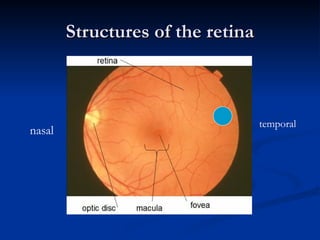
Structures of the retina
nasal
temporal
 1 The size, shape and borders of the optic disc
1 The size, shape and borders of the optic disc
 2 The disc to cup ratio
2 The disc to cup ratio
 3 The relative size of the arteries and veins
3 The relative size of the arteries and veins
 4 The texture of the retina
4 The texture of the retina
 5 The color of the retina
5 The color of the retina
 6 Trace the vascular structure to the equator of
6 Trace the vascular structure to the equator of
the retina.
the retina.
 7 Find the macula and note its color and size
7 Find the macula and note its color and size
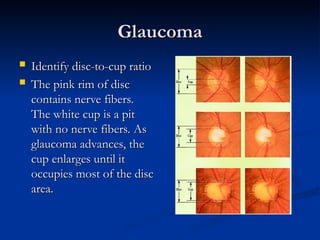
Glaucoma
Glaucoma
 Identify disc-to-cup ratio
Identify disc-to-cup ratio
 The pink rim of disc
The pink rim of disc
contains nerve fibers.
The white cup is a pit
with no nerve fibers. As
glaucoma advances, the
cup enlarges until it
occupies most of the disc
area.
area.
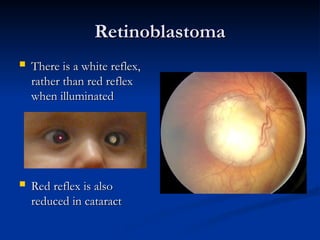
Retinoblastoma
Retinoblastoma
 There is a white reflex,
There is a white reflex,
rather than red reflex
when illuminated
when illuminated
 Red reflex is also
Red reflex is also
reduced in cataract
reduced in cataract
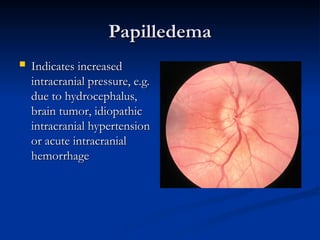
Papilledema
Papilledema
 Indicates increased
Indicates increased
intracranial pressure, e.g.
due to hydrocephalus,
brain tumor, idiopathic
intracranial hypertension
or acute intracranial
hemorrhage
hemorrhage
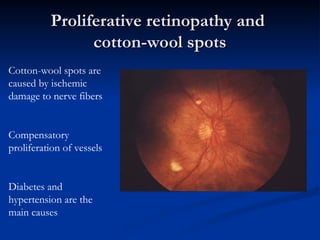
Proliferative retinopathy and
cotton-wool spots
cotton-wool spots
Cotton-wool spots are
caused by ischemic
damage to nerve fibers
Compensatory
proliferation of vessels
Diabetes and
hypertension are the
main causes
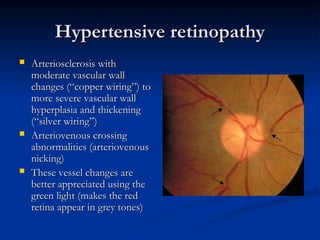
Hypertensive retinopathy
 Arteriosclerosis with
Arteriosclerosis with
moderate vascular wall
changes (“copper wiring”) to
more severe vascular wall
hyperplasia and thickening
(“silver wiring”)
(“silver wiring”)
 Arteriovenous crossing
Arteriovenous crossing
abnormalities (arteriovenous
nicking)
nicking)
 These vessel changes are
These vessel changes are
better appreciated using the
green light (makes the red
retina appear in grey tones)
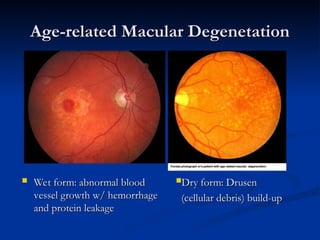
Age-related Macular Degenetation
 Wet form: abnormal blood
Wet form: abnormal blood
vessel growth w/ hemorrhage
and protein leakage
and protein leakage
Dry form: Drusen
Dry form: Drusen
(cellular debris) build-up
 http://www.youtube.com/watch?v=AutUi09JI
XY&feature=related
 http://www.jaapa.com/beyond-the-red-reflex-e
xamining-the-eye-with-an-ophthalmoscope/artic
le/151311/

how to do direct Ophthalmoscopy for undergrads.ppt

  • 1.
  • 2.
    What is itused for? What is it used for?  Examine the retina and Examine the retina and its structures its structures  Also known as Also known as funduscopy (examination funduscopy (examination of the fundus) of the fundus)
  • 3.
     Turning thedial to positive (or green) numbers Turning the dial to positive (or green) numbers increases the refractive index – short focal length lenses increases the refractive index – short focal length lenses – for examining cornea, iris, or opacities in vitreous or – for examining cornea, iris, or opacities in vitreous or lens. e.g. start at +20 and use the slit light lens. e.g. start at +20 and use the slit light  Turning the dial to negative (or red) numbers decreases Turning the dial to negative (or red) numbers decreases – infinite focal length lens that fits your refractive – infinite focal length lens that fits your refractive power (individual) – for examining retina, start at +10 power (individual) – for examining retina, start at +10 as you move in and dim the scope light about halfway as you move in and dim the scope light about halfway  Rule of thumb: You will focus on the retina with same Rule of thumb: You will focus on the retina with same number as your refractive error, then correct for your number as your refractive error, then correct for your patients refractive error patients refractive error
  • 4.
     Have patientsit in a comfortable position Have patient sit in a comfortable position  Tell them to look at something straight ahead and level Tell them to look at something straight ahead and level over your shoulder over your shoulder  Dim light in the room, so patients pupils dilate a little. Dim light in the room, so patients pupils dilate a little. You can also use mydriatic eyedrops to dilate the pupil You can also use mydriatic eyedrops to dilate the pupil  Hold ophthalmoscope in same hand as eye you are Hold ophthalmoscope in same hand as eye you are looking at, and looking through (e.g. left hand for looking at, and looking through (e.g. left hand for examining patients left eye, using your left eye) examining patients left eye, using your left eye)  Hold head steady with thumb above eyebrow, or hold Hold head steady with thumb above eyebrow, or hold shoulder shoulder
  • 5.
     At about30cm distance with light on eye, locate red reflex (seen At about 30cm distance with light on eye, locate red reflex (seen as an orange glow in the pupil) as an orange glow in the pupil)  Follow red reflex into the eye as 15 degrees lateral to the patients Follow red reflex into the eye as 15 degrees lateral to the patients line of vision, this will get you directly into the optic disc line of vision, this will get you directly into the optic disc  If you cannot find the disc, trace any blood vessels back to it If you cannot find the disc, trace any blood vessels back to it  Examine vessels in all 4 quadrants of eye (upper and lower nasal Examine vessels in all 4 quadrants of eye (upper and lower nasal and temporal quadrants) and temporal quadrants)  Identify macula – slightly darker pigmented area, 2 optic disc Identify macula – slightly darker pigmented area, 2 optic disc widths lateral away from the optic disc widths lateral away from the optic disc  You can tell the patient to look at the light – this will put the You can tell the patient to look at the light – this will put the macula in your focus, however don’t look at it too long as it can macula in your focus, however don’t look at it too long as it can be irritating be irritating
  • 6.
    Structures of theretina Structures of the retina nasal temporal
  • 7.
     1 Thesize, shape and borders of the optic disc 1 The size, shape and borders of the optic disc  2 The disc to cup ratio 2 The disc to cup ratio  3 The relative size of the arteries and veins 3 The relative size of the arteries and veins  4 The texture of the retina 4 The texture of the retina  5 The color of the retina 5 The color of the retina  6 Trace the vascular structure to the equator of 6 Trace the vascular structure to the equator of the retina. the retina.  7 Find the macula and note its color and size 7 Find the macula and note its color and size
  • 8.
    Glaucoma Glaucoma  Identify disc-to-cupratio Identify disc-to-cup ratio  The pink rim of disc The pink rim of disc contains nerve fibers. contains nerve fibers. The white cup is a pit The white cup is a pit with no nerve fibers. As with no nerve fibers. As glaucoma advances, the glaucoma advances, the cup enlarges until it cup enlarges until it occupies most of the disc occupies most of the disc area. area.
  • 9.
    Retinoblastoma Retinoblastoma  There isa white reflex, There is a white reflex, rather than red reflex rather than red reflex when illuminated when illuminated  Red reflex is also Red reflex is also reduced in cataract reduced in cataract
  • 10.
    Papilledema Papilledema  Indicates increased Indicatesincreased intracranial pressure, e.g. intracranial pressure, e.g. due to hydrocephalus, due to hydrocephalus, brain tumor, idiopathic brain tumor, idiopathic intracranial hypertension intracranial hypertension or acute intracranial or acute intracranial hemorrhage hemorrhage
  • 11.
    Proliferative retinopathy and Proliferativeretinopathy and cotton-wool spots cotton-wool spots Cotton-wool spots are caused by ischemic damage to nerve fibers Compensatory proliferation of vessels Diabetes and hypertension are the main causes
  • 12.
    Hypertensive retinopathy Hypertensive retinopathy Arteriosclerosis with Arteriosclerosis with moderate vascular wall moderate vascular wall changes (“copper wiring”) to changes (“copper wiring”) to more severe vascular wall more severe vascular wall hyperplasia and thickening hyperplasia and thickening (“silver wiring”) (“silver wiring”)  Arteriovenous crossing Arteriovenous crossing abnormalities (arteriovenous abnormalities (arteriovenous nicking) nicking)  These vessel changes are These vessel changes are better appreciated using the better appreciated using the green light (makes the red green light (makes the red retina appear in grey tones) retina appear in grey tones)
  • 13.
    Age-related Macular Degenetation Age-relatedMacular Degenetation  Wet form: abnormal blood Wet form: abnormal blood vessel growth w/ hemorrhage vessel growth w/ hemorrhage and protein leakage and protein leakage Dry form: Drusen Dry form: Drusen (cellular debris) build-up (cellular debris) build-up
  • 14.