Fundamentals of Photovoltaics 
Nov 5th – 7th 2014
Course Overview 
i 
Wed Nov 5 
1. The Sun – Mauritzio Salaris, JMU 
2. Solar spectrum and basic device response – R. Treharne 
3. Detailed Balance – R. Treharne 
Thu Nov 6 
4. Semiconductors 101 – R. Treharne 
5. Junctions – R. Treharne 
6. Junction Characterisation – R. Treharne 
Fri Nov 7 
7. Materials Stability – K. Durose 
8. Optical properties of semiconductors – T. Veal 
9. Advanced characterisation of band phenomena – V. Dhanak 
10. Photovoltaics – Current and future PV technologies – K. Durose 
Mon Nov 10 
EXAM 
Download Lectures Overview here!
Questions? 
ii 
#cdtpvC1
Lecture 1 
Solar spectrum and basic device response 
R. Treharne 
Nov 5th 2014
Lecture Outline 
L2 
● Super speedy history of PV 
● The photovoltaic effect 
● AM1.5 spectrum 
● Solar simulators and ratings 
● The ideal diode equation + equivalent circuits 
● J-V curves and important device parameters 
● Parasitic resistances 
● External quantum efficiency (EQE)
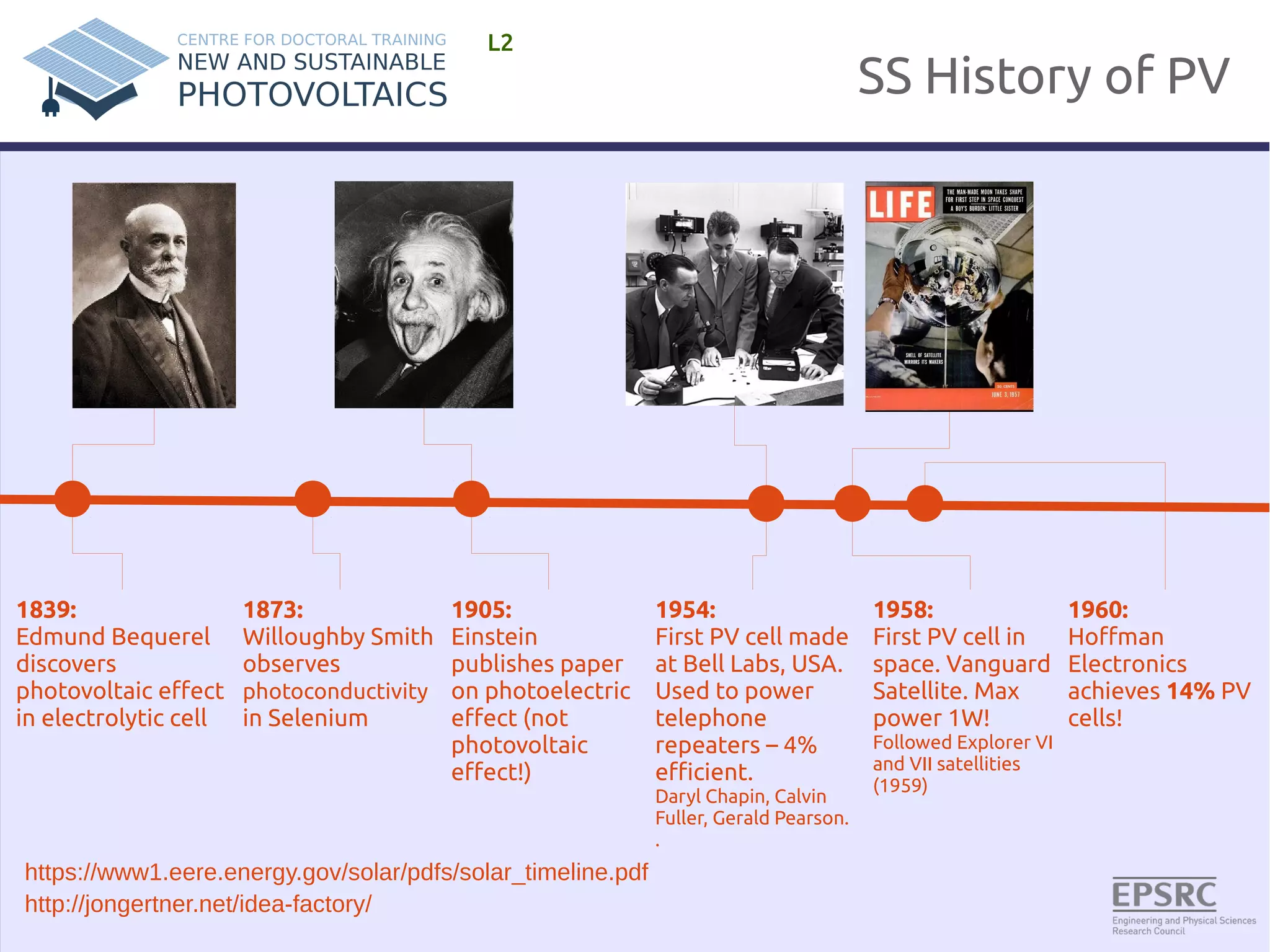
SS History of PV 
L2 
1839: 
Edmund Bequerel 
discovers 
photovoltaic effect 
in electrolytic cell 
1873: 
Willoughby Smith 
observes 
photoconductivity 
in Selenium 
1905: 
Einstein 
publishes paper 
on photoelectric 
effect (not 
photovoltaic 
effect!) 
1954: 
First PV cell made 
at Bell Labs, USA. 
Used to power 
telephone 
repeaters – 4% 
efficient. 
Daryl Chapin, Calvin 
Fuller, Gerald Pearson. 
. 
1958: 
First PV cell in 
space. Vanguard 
Satellite. Max 
power 1W! 
Followed Explorer VI 
and VII satellities 
(1959) 
https://www1.eere.energy.gov/solar/pdfs/solar_timeline.pdf 
http://jongertner.net/idea-factory/ 
1960: 
Hoffman 
Electronics 
achieves 14% PV 
cells!
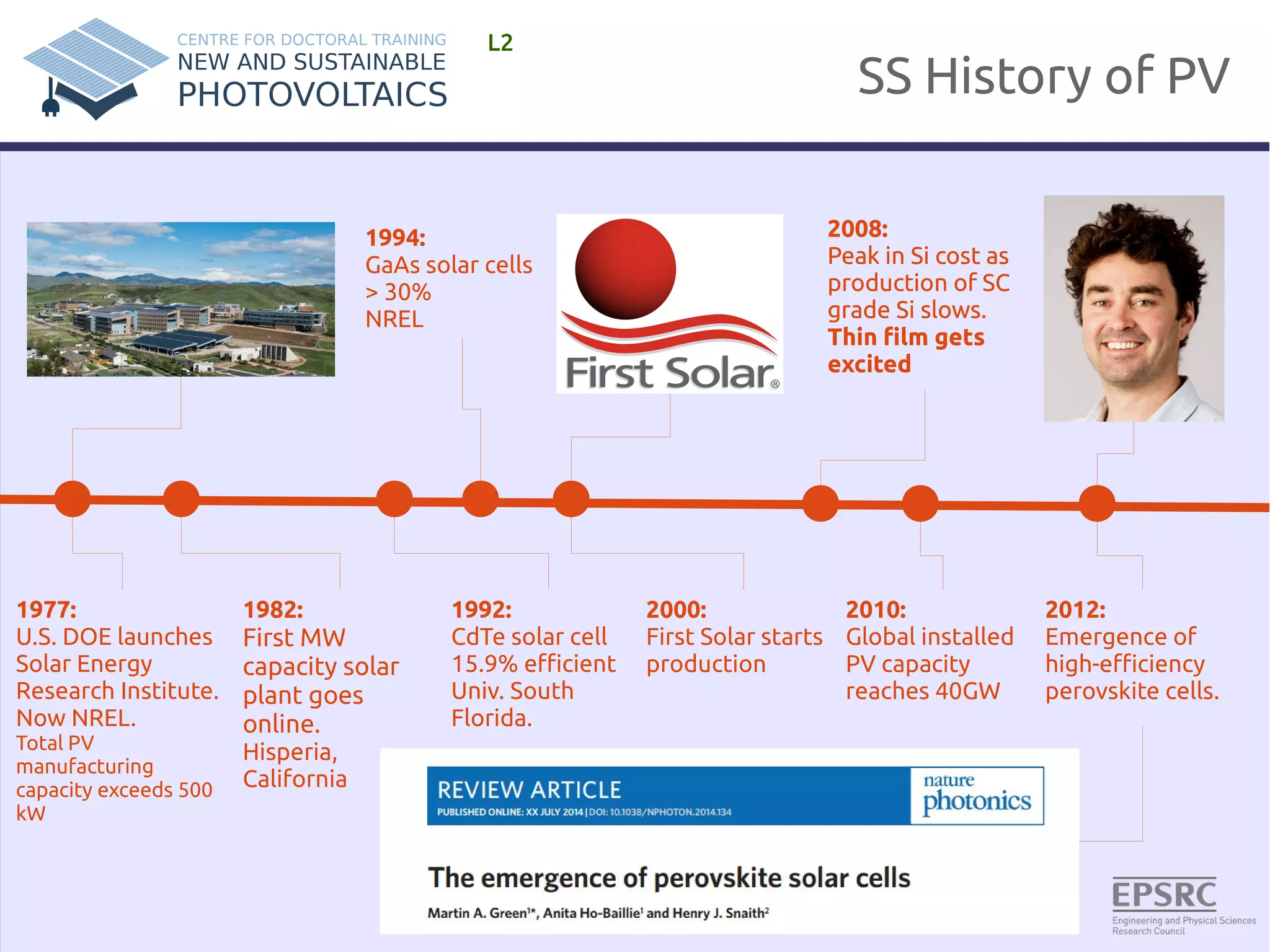
SS History of PV 
L2 
1977: 
U.S. DOE launches 
Solar Energy 
Research Institute. 
Now NREL. 
Total PV 
manufacturing 
capacity exceeds 500 
kW 
1994: 
GaAs solar cells 
> 30% 
NREL 
1982: 
First MW 
capacity solar 
plant goes 
online. 
Hisperia, 
California 
1992: 
CdTe solar cell 
15.9% efficient 
Univ. South 
Florida. 
2000: 
First Solar starts 
production 
2008: 
Peak in Si cost as 
production of SC 
grade Si slows. 
Thin film gets 
excited 
2010: 
Global installed 
PV capacity 
reaches 40GW 
2012: 
Emergence of 
high-efficiency 
perovskite cells.
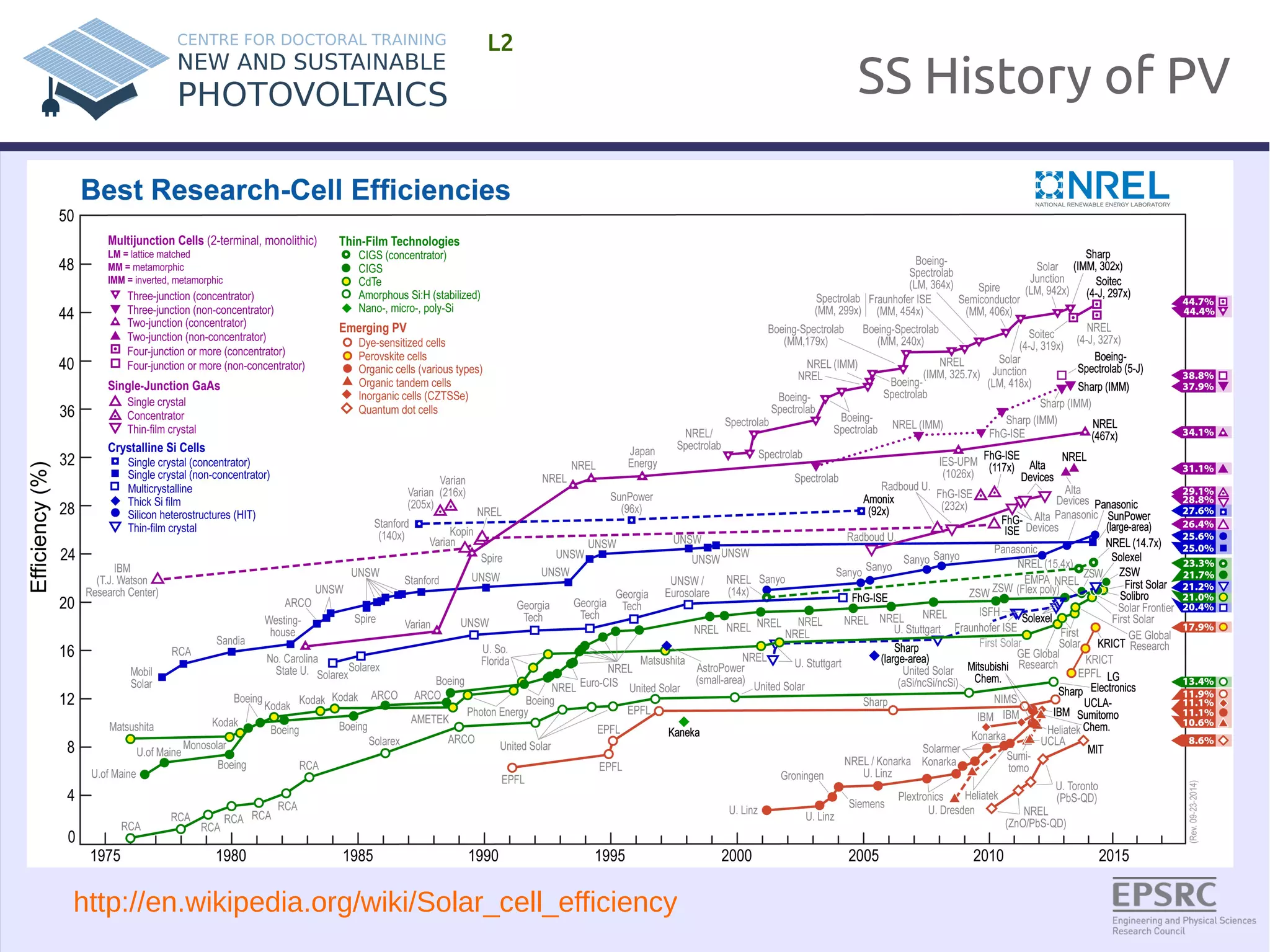
SS History of PV 
L2 
http://en.wikipedia.org/wiki/Solar_cell_efficiency
Photovoltaic Effect 
L2 4 
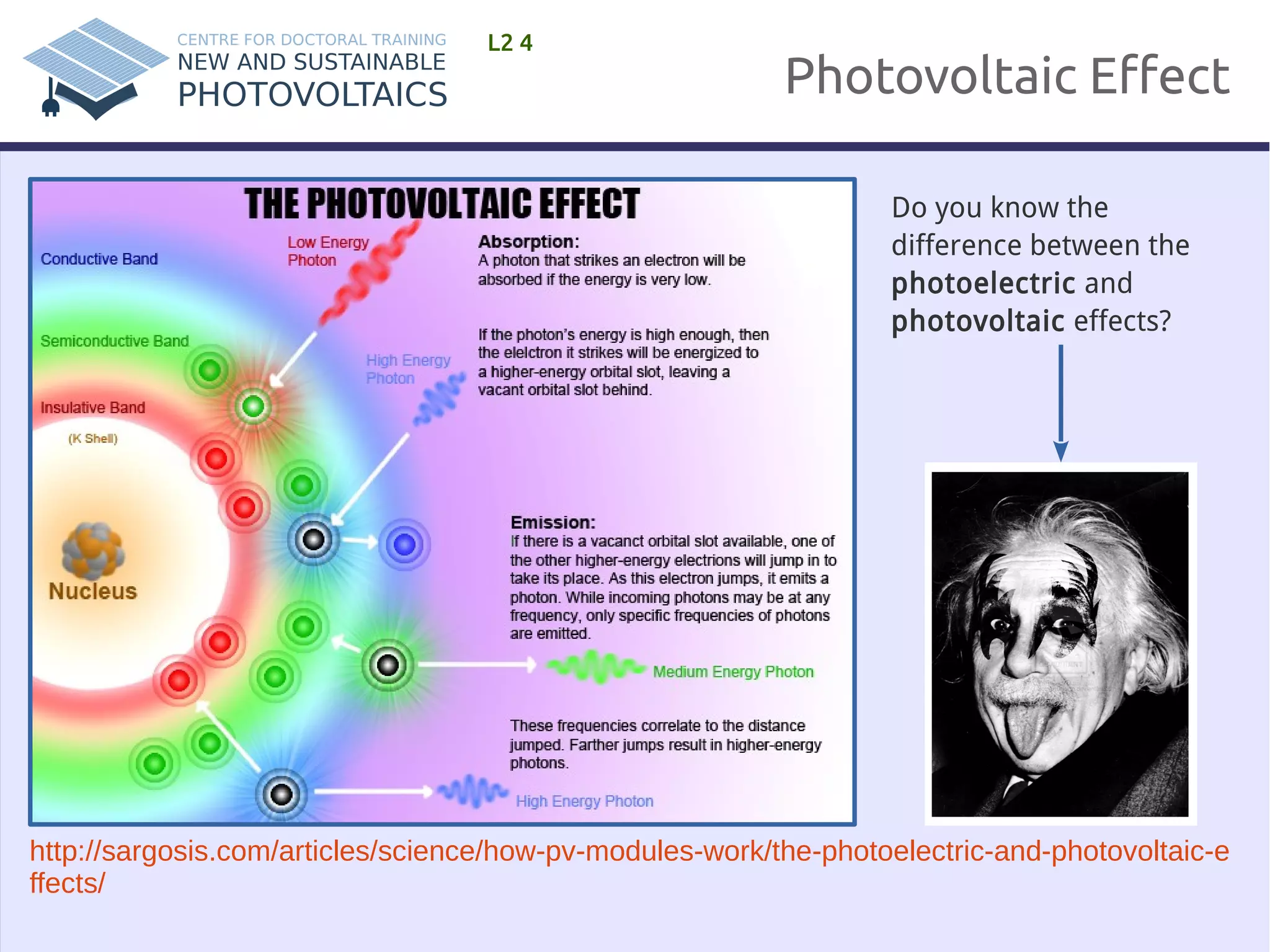
Do you know the 
difference between the 
photoelectric and 
photovoltaic effects? 
http://sargosis.com/articles/science/how-pv-modules-work/the-photoelectric-and-photovoltaic-e 
ffects/
Photovoltaic Effect 
L2 5 
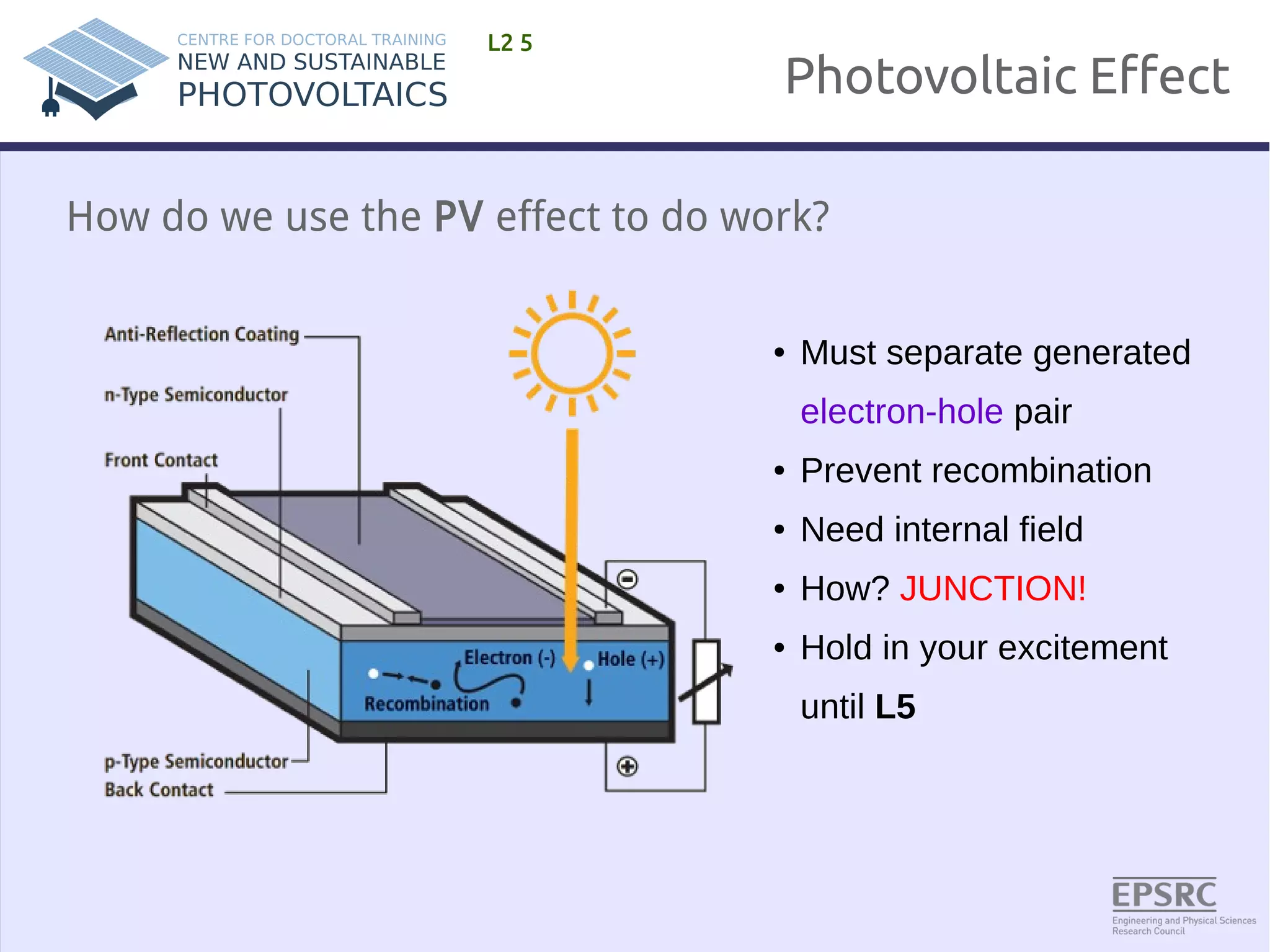
How do we use the PV effect to do work? 
● Must separate generated 
electron-hole pair 
● Prevent recombination 
● Need internal field 
● How? JUNCTION! 
● Hold in your excitement 
until L5
AM1.5 Spectrum 
L2 
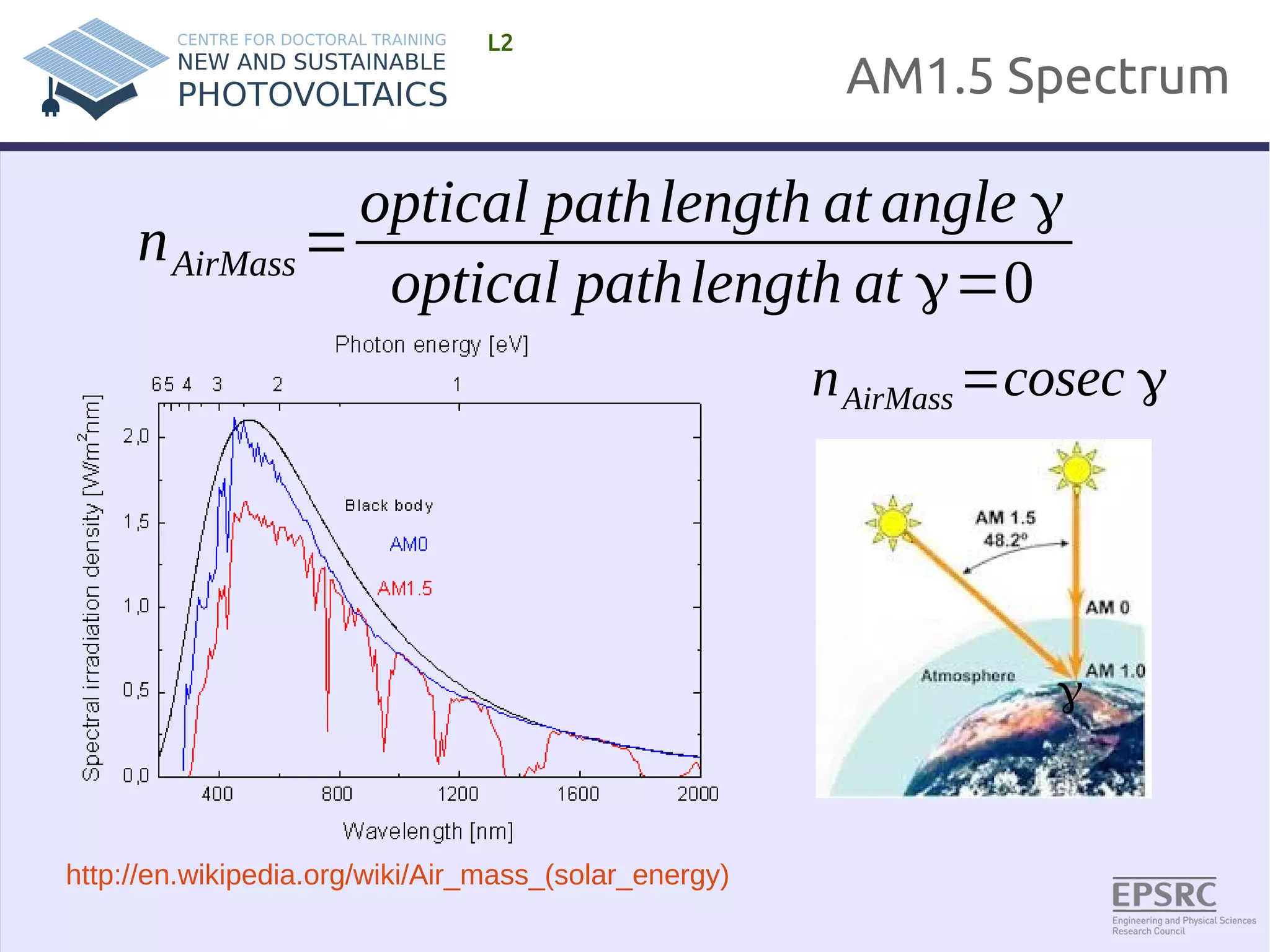
nAirMass= 
optical pathlength at angle γ 
optical pathlength at γ=0 
nAirMass=cosec γ 
γ 
http://en.wikipedia.org/wiki/Air_mass_(solar_energy)
AM1.5 Spectrum 
L2 
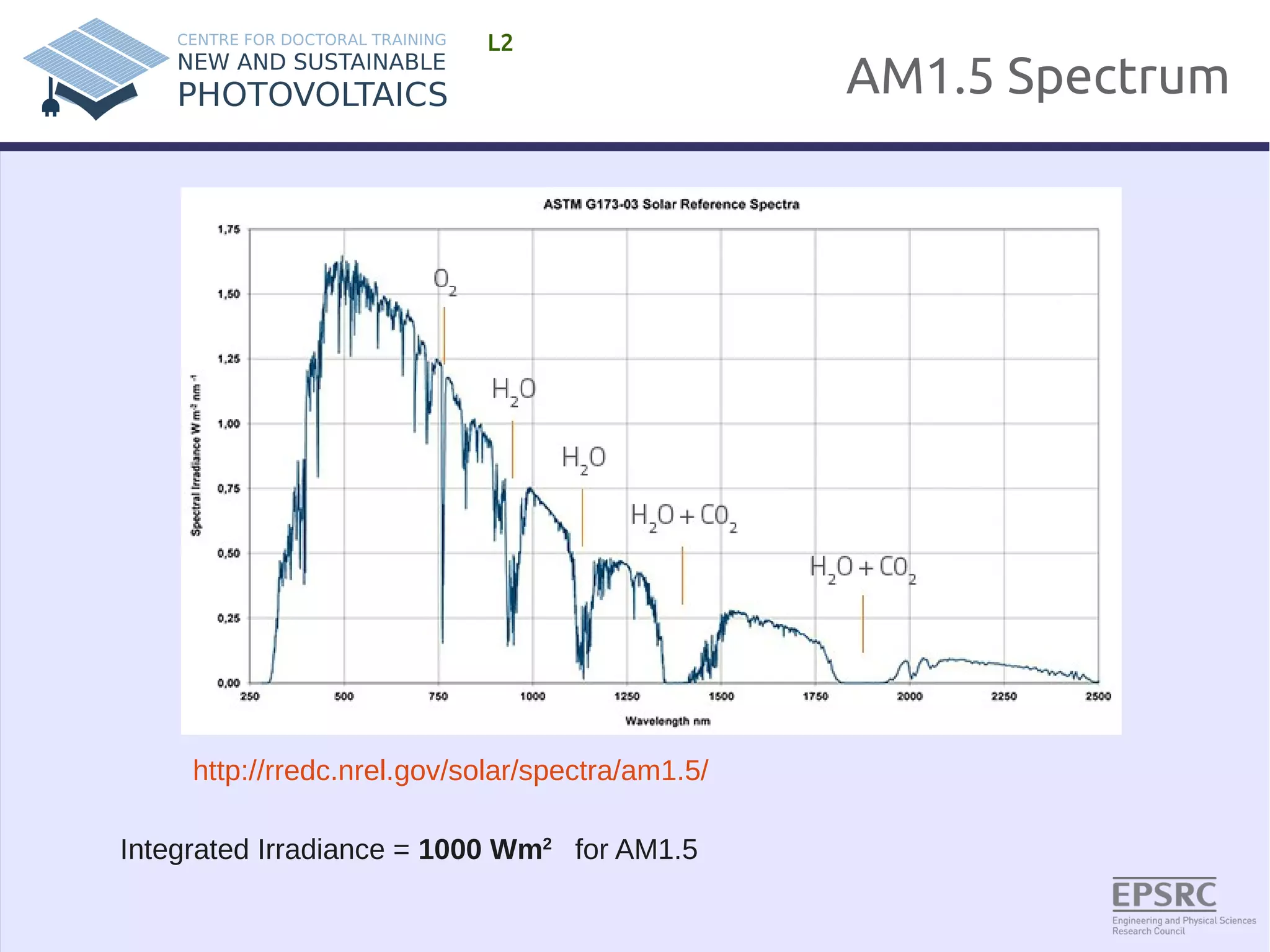
http://rredc.nrel.gov/solar/spectra/am1.5/ 
Integrated Irradiance = 1000 Wm2 for AM1.5
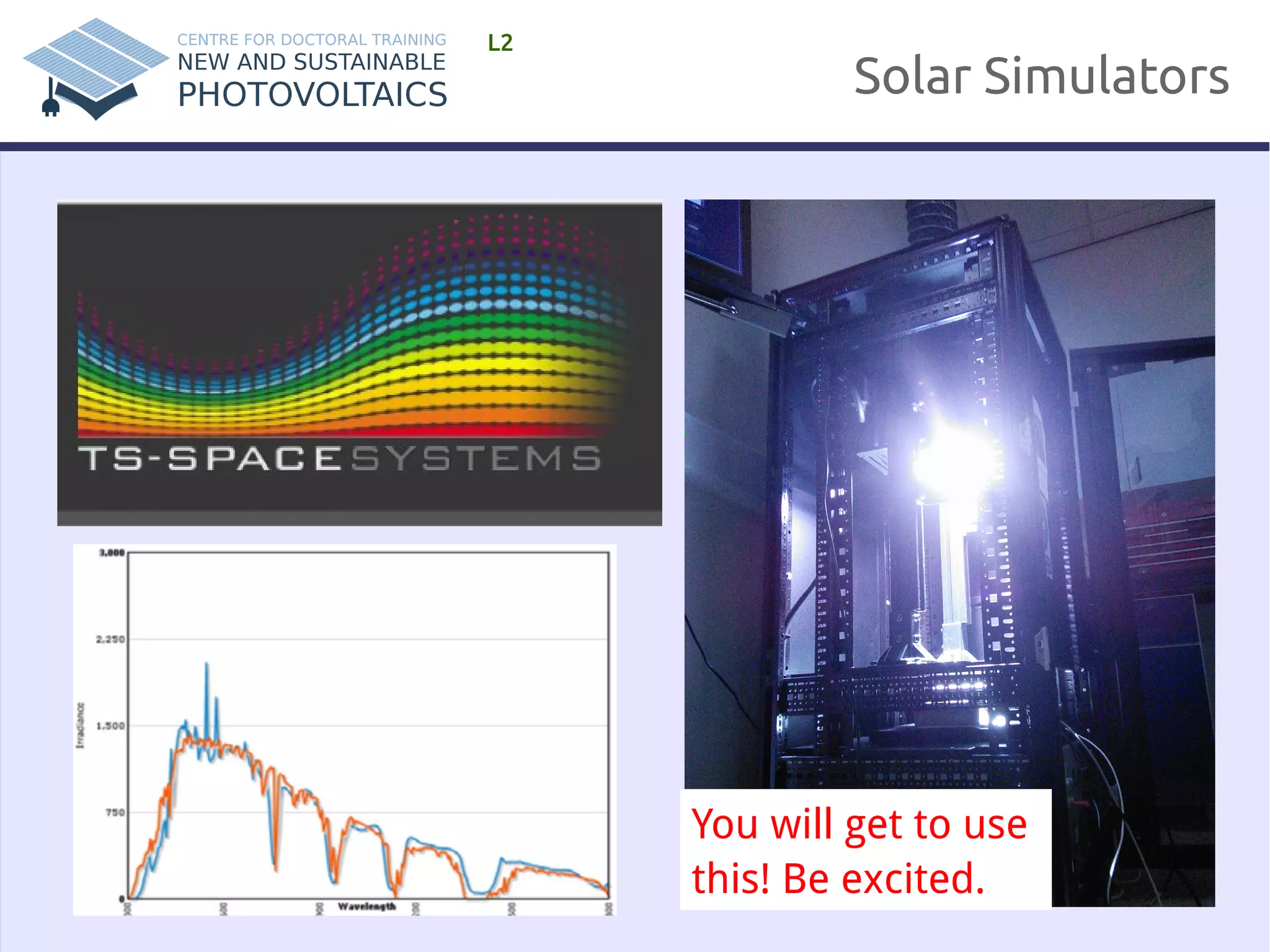
Solar Simulators 
L2 
The light from a solar simulator is controlled in 3 dimensions: 
1) Spectral content 
2) Spatial uniformity 
3) Temporal stability 
Classification Spectral Match 
(each interval) 
Irradiance Spacial 
Non-Uniformity 
Temperal 
Instability 
A 0.75-1.25 2% 2% 
B 0.6-1.4 5% 5% 
C 0.4-2.0 10% 10% 
http://en.wikipedia.org/wiki/Solar_simulator
Solar Simulators 
L2 
You will get to use 
this! Be excited.
Ideal Diode Equation 
L2 
William Shockley: 
Co-inventor of the transistor 
with Bardeen and Brattain 1948 
Nobel Prize: 1956 
(Also a eugenicist) 
Often called the Shockley equation: 
J=J 0 [exp( eV 
k BT )−1 ] 
J0 – Dark saturation current. 
V – applied voltage across the terminals of the diode 
e – Electronic charge 
kB – Boltzmann's constant 
T – Absolute temperature (K) 
Might derive this later for fun! (L5) 
If every you need some inspiration: Read this! 
http://books.google.co.uk/books/about/The_Idea_Factory.html?id=uOMt_XCo81QC&redir_esc=y
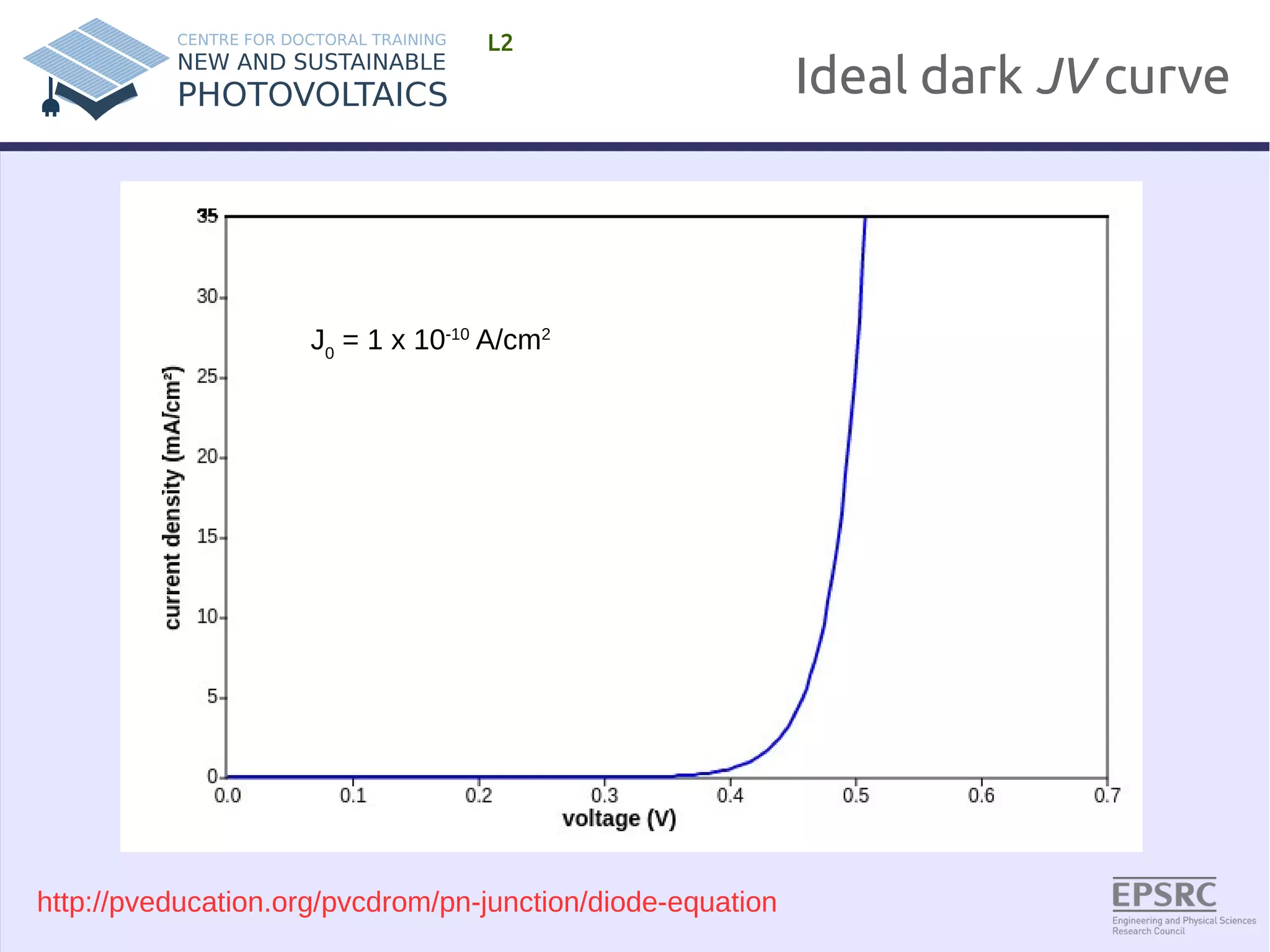
Ideal dark JV curve 
L2 
J0 = 1 x 10⁻¹⁰ A/cm2 
http://pveducation.org/pvcdrom/pn-junction/diode-equation
Ideal diode for solar cell 
L2 
Sign convention: Lets say that the direction of a generated photo-current JL is 
positive with respect to a negative dark current Jdark 
J=J L−J dark 
J=J L−J 0 [exp( eV 
k BT )−1] 
Equivalent Circuit: 
Ideal solar cell
Light JV response 
L2 
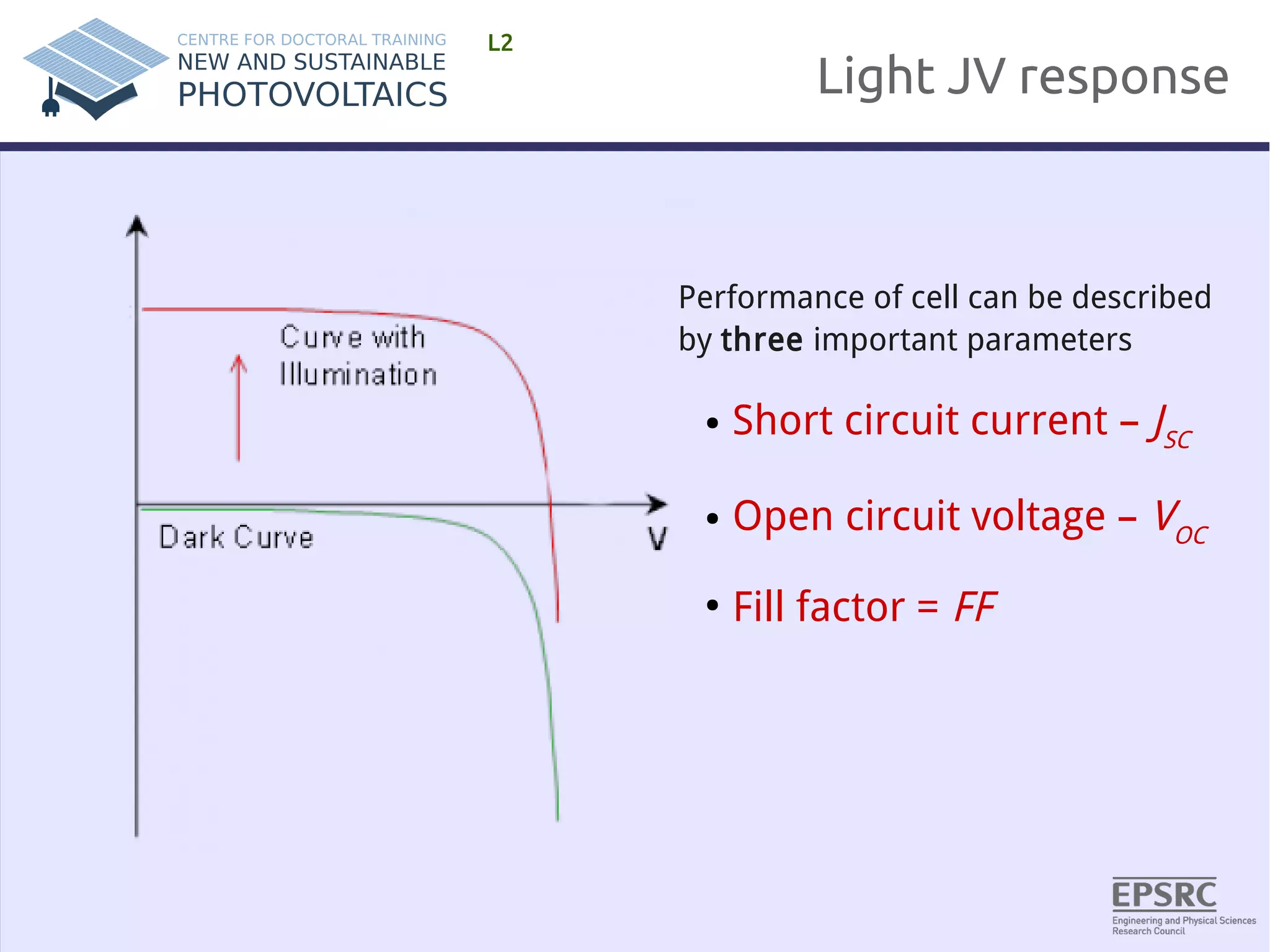
Performance of cell can be described 
by three important parameters 
● Short circuit current – JSC 
● Open circuit voltage – VOC 
● Fill factor = FF
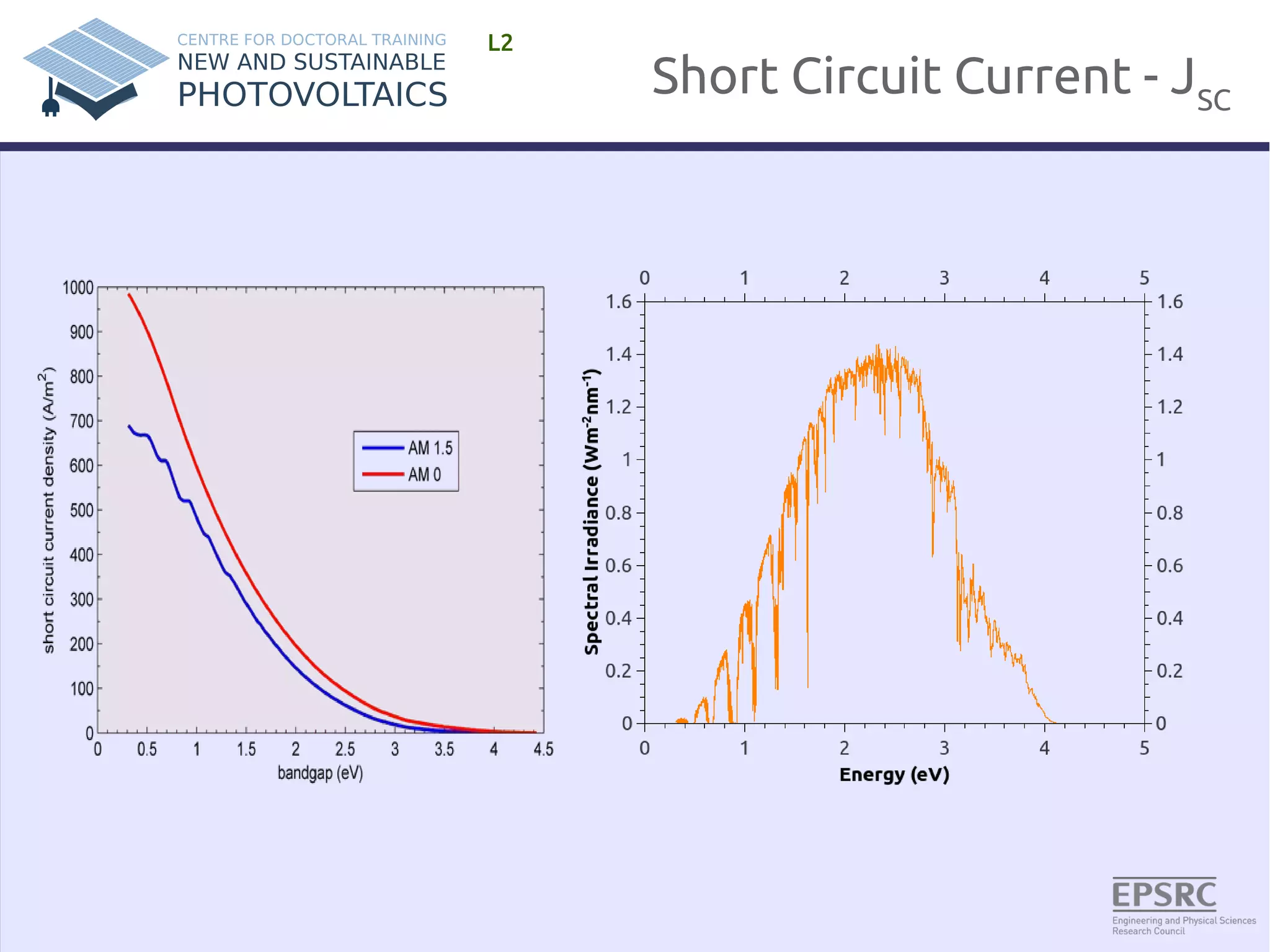
Short Circuit Current - JSC 
L2 
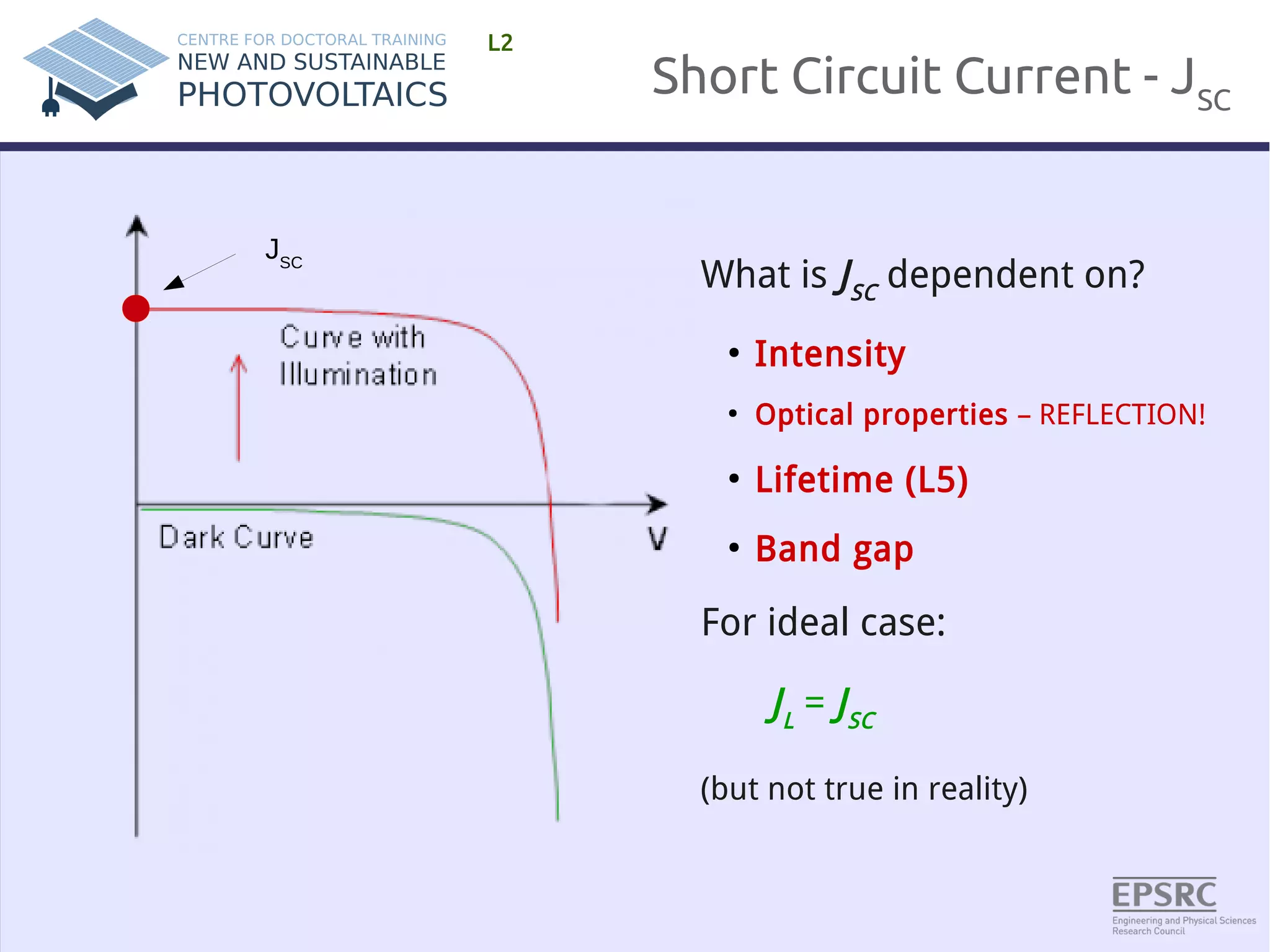
JSC What is JSC dependent on? 
● Intensity 
● Optical properties – REFLECTION! 
● Lifetime (L5) 
● Band gap 
For ideal case: 
JL = JSC 
(but not true in reality)
Short Circuit Current - JSC 
L2
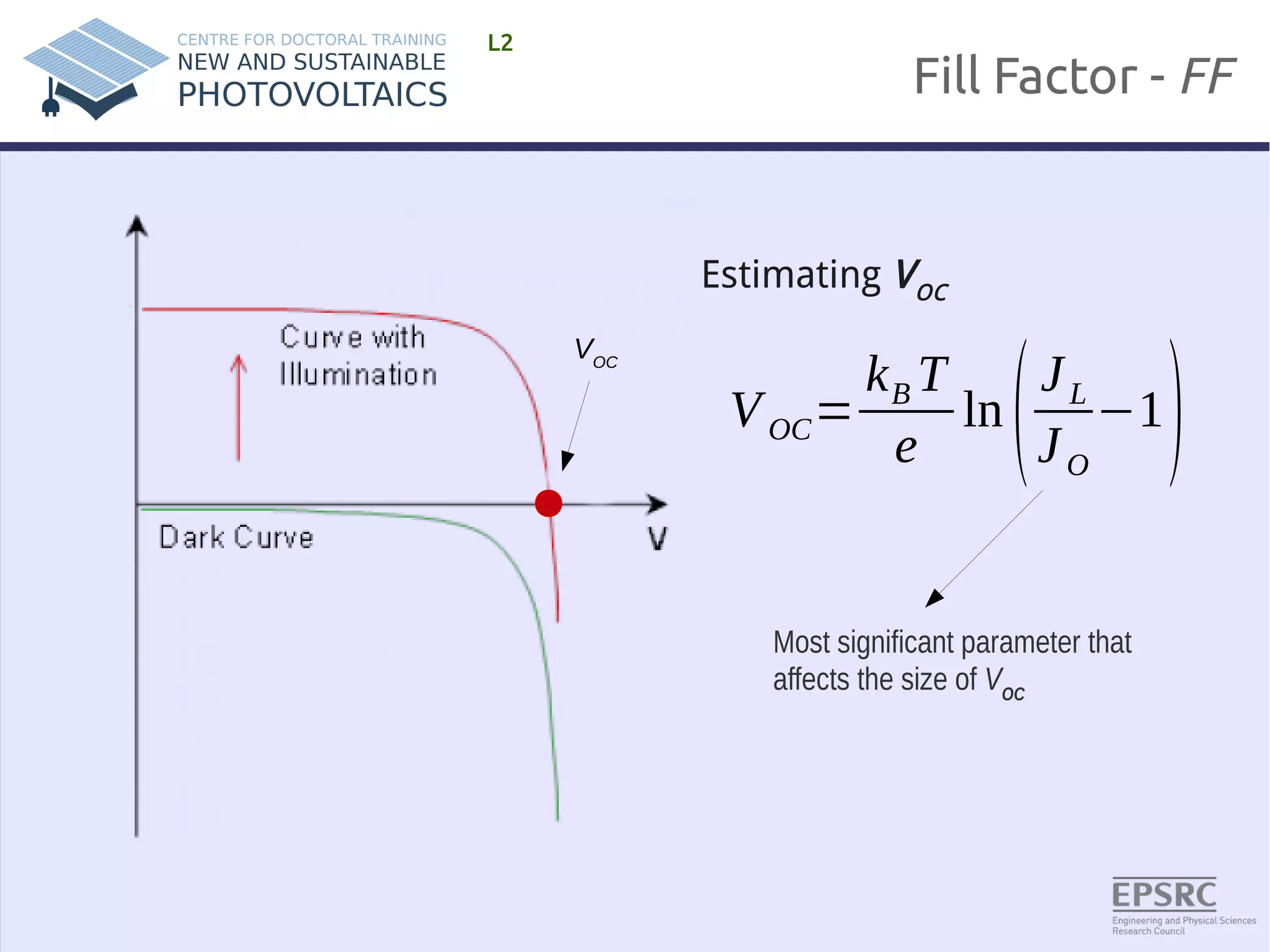
Fill Factor - FF 
L2 
VOC 
Estimating VOC 
VOC= 
kBT 
e 
ln (J L 
J O 
−1) 
Most significant parameter that 
affects the size of VOC
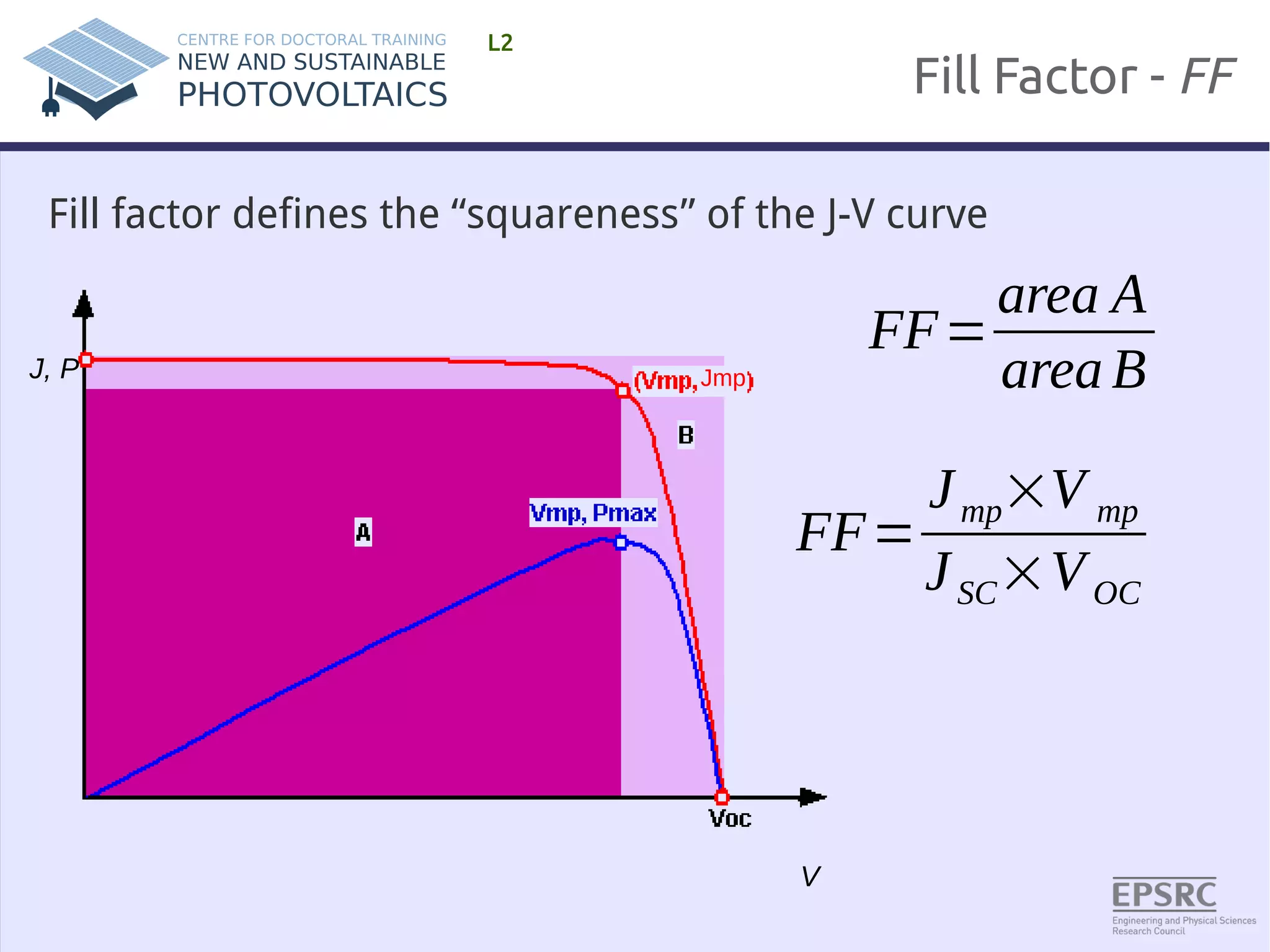
Fill Factor - FF 
L2 
Fill factor defines the “squareness” of the J-V curve 
J, P 
V 
Jmp 
FF= 
area A 
areaB 
FF= 
J mp×V mp 
J SC×VOC
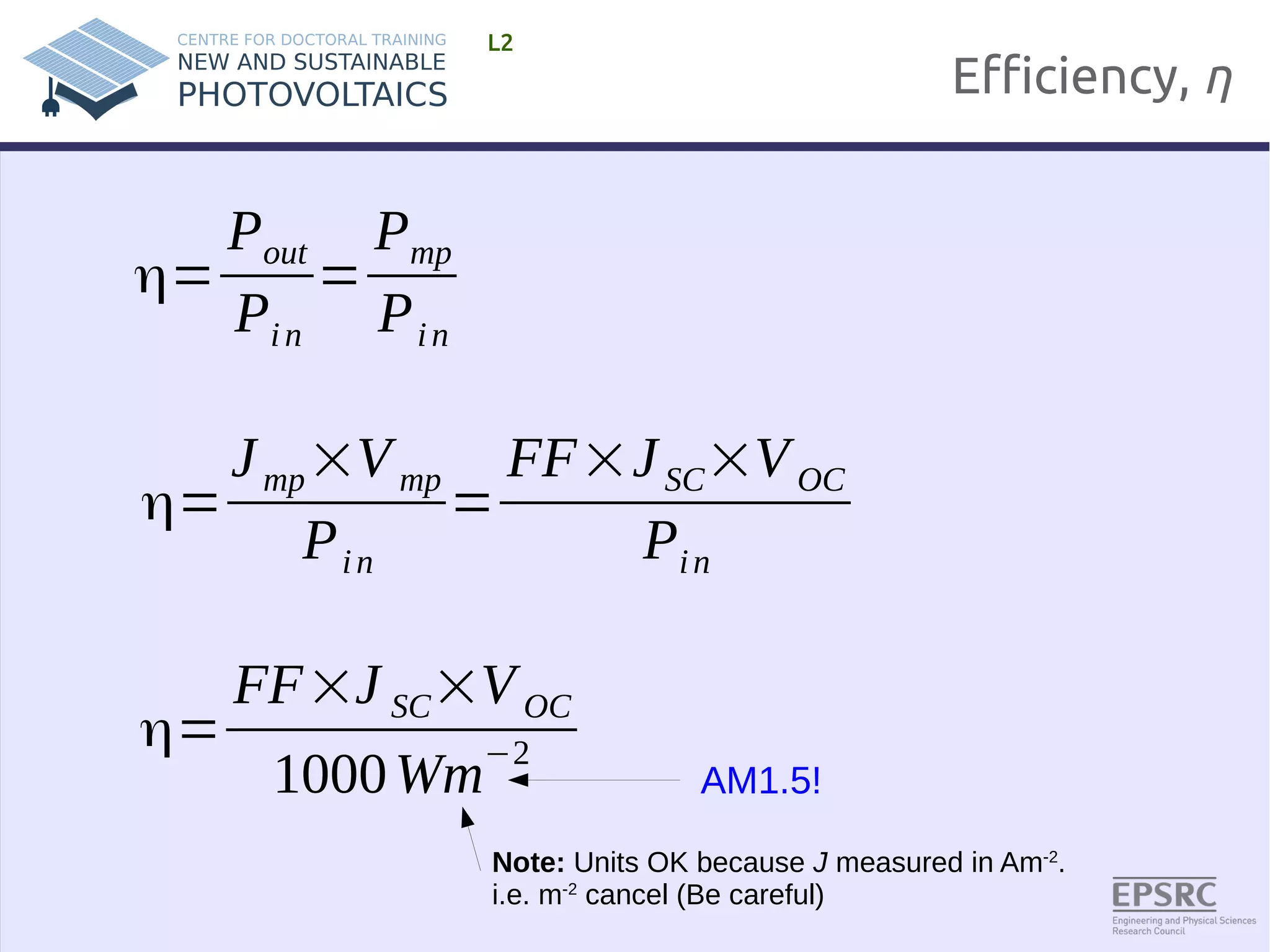
Efficiency, η 
L2 
η= 
Pout 
Pi n 
= 
Pmp 
Pi n 
η= 
J mp×Vmp 
Pi n 
= 
FF×J SC×VOC 
Pi n 
AM1.5! 
η= 
FF×J SC×VOC 
1000Wm−2 
Note: Units OK because J measured in Am-2. 
i.e. m-2 cancel (Be careful)
Series Resistance, Rs 
L2 
Origin of series resistance in solar cell: 
● Simply a property of real materials – i.e. non infinite mobility 
● Resistances associated with back and front contacts to cell 
Can represent sum of series resistance effects in equivalent circuit 
using a single resistor in series: 
Rs 
J=J L−J 0 [exp(e (V +JRs) 
kBT )−1] Uh oh! 
Recursive Equation!
Series Resistance 
L2 
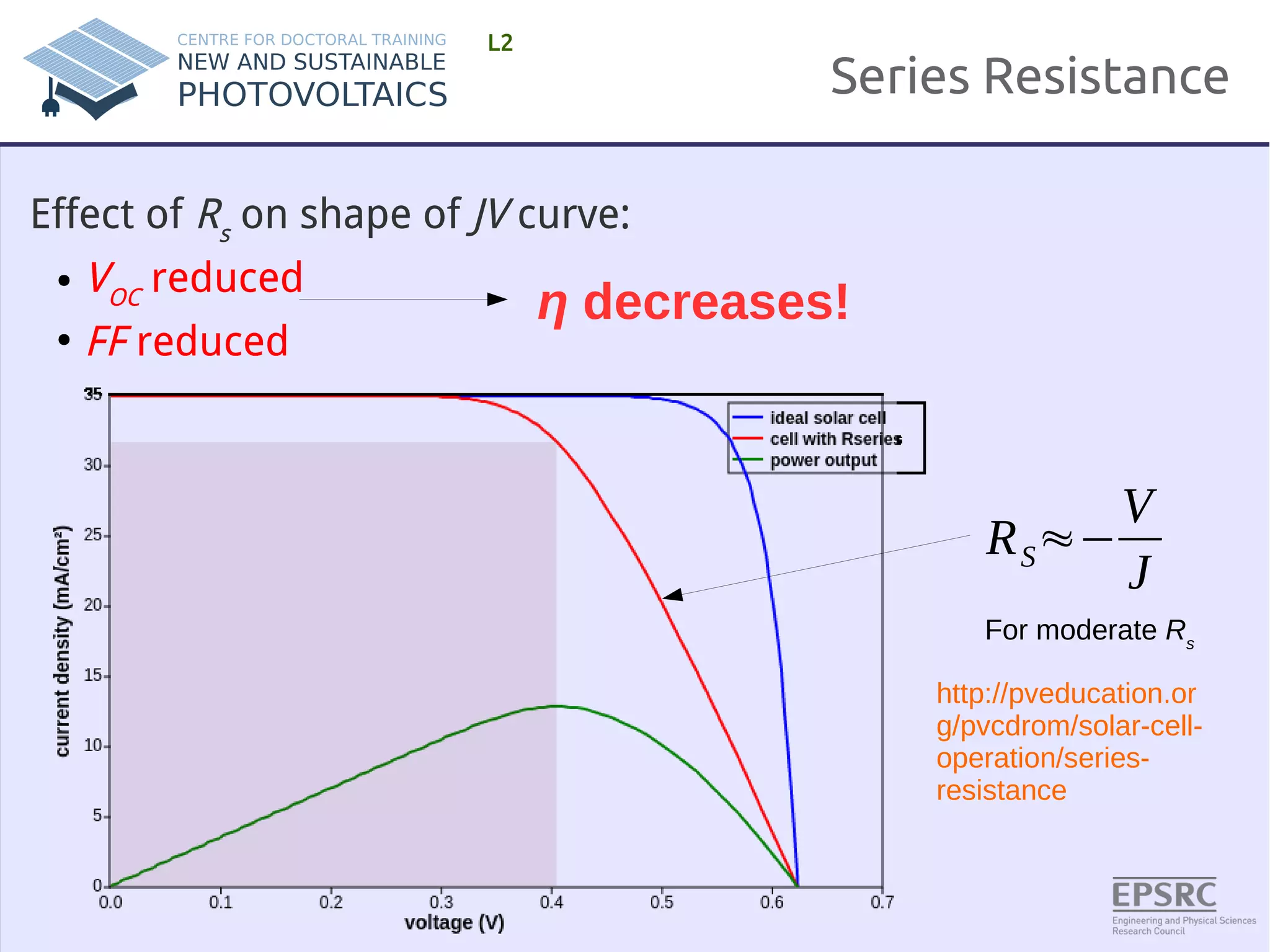
Effect of Rs on shape of JV curve: 
● VOC reduced 
● FF reduced 
η decreases! 
RS≈− 
V 
J 
For moderate Rs 
http://pveducation.or 
g/pvcdrom/solar-cell-operation/ 
series-resistance
Shunt Resistance, RSH 
L2 
Origin of shunt resistance in solar cell: 
● Usually the result of poor fabrication methods 
● Short circuit paths between electrodes of cell 
Can represent sum of shunts in equivalent circuit using a single 
resistor in parallel to diode: 
J=J L−J 0 [exp(e (V +JRs) 
kBT )−1]− 
V +JRS 
RSH
Shunt Resistance, RSH 
L2 
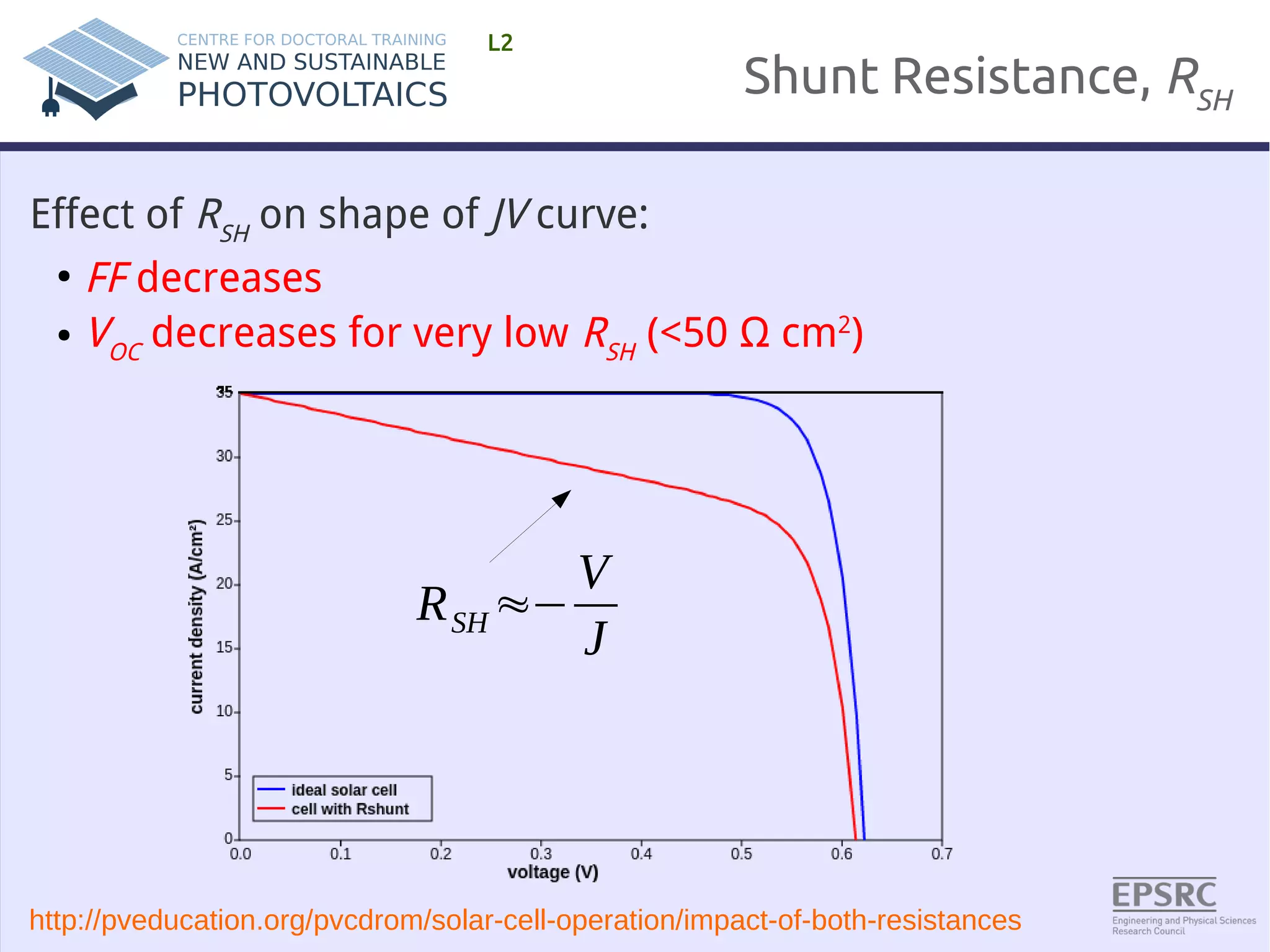
Effect of RSH on shape of JV curve: 
● FF decreases 
● VOC decreases for very low RSH (<50 Ω cm2) 
RSH≈− 
V 
J 
http://pveducation.org/pvcdrom/solar-cell-operation/impact-of-both-resistances
Ideality Factor 
L2 
No such thing as an ideal diode 
J=J 0 [exp( eV 
nk BT )−1] 
● n – typically takes values of between 1 and 2 (but can be higher) 
● Originally used as a fudge factor for empirical data 
● Now understood to be related to quality of SC material 
● Related to carrier recombination (L4)
Diode Ideality Factor 
L2 
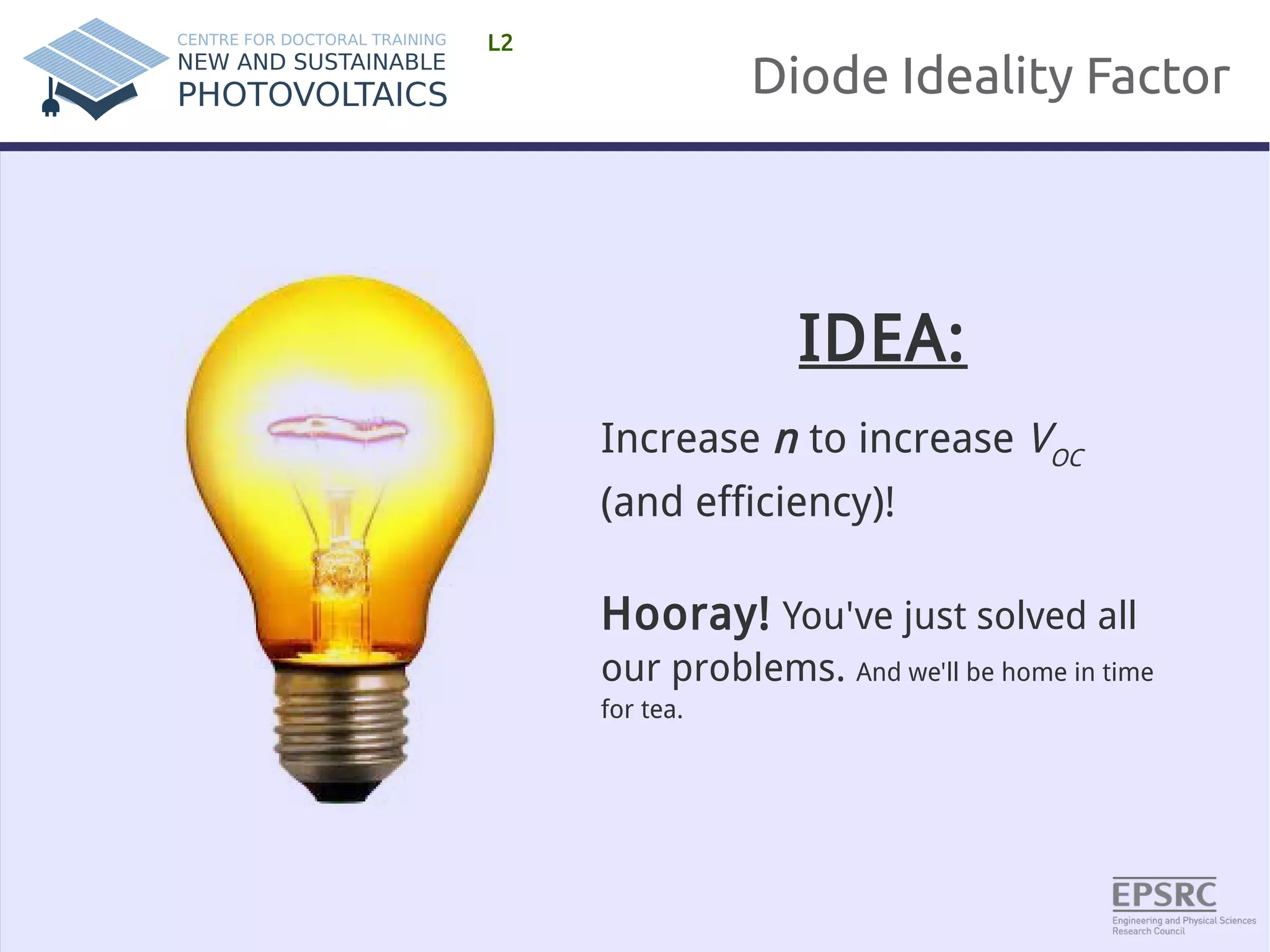
IDEA: 
Increase n to increase VOC 
(and efficiency)! 
Hooray! You've just solved all 
our problems. And we'll be home in time 
for tea.
Diode Ideality Factor 
L2 
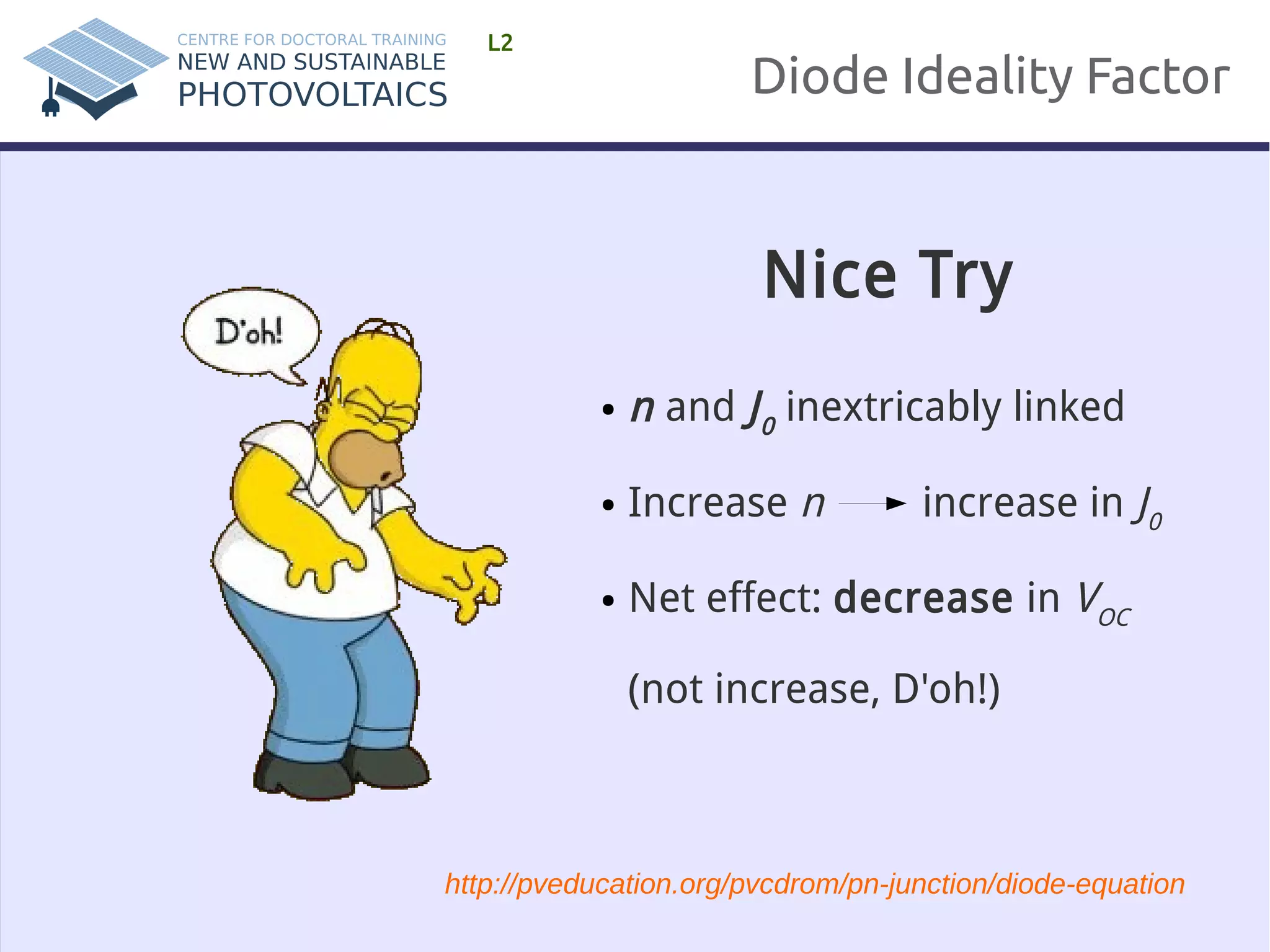
Nice Try 
● n and J0 inextricably linked 
● Increase n increase in J0 
● Net effect: decrease in VOC 
(not increase, D'oh!) 
http://pveducation.org/pvcdrom/pn-junction/diode-equation
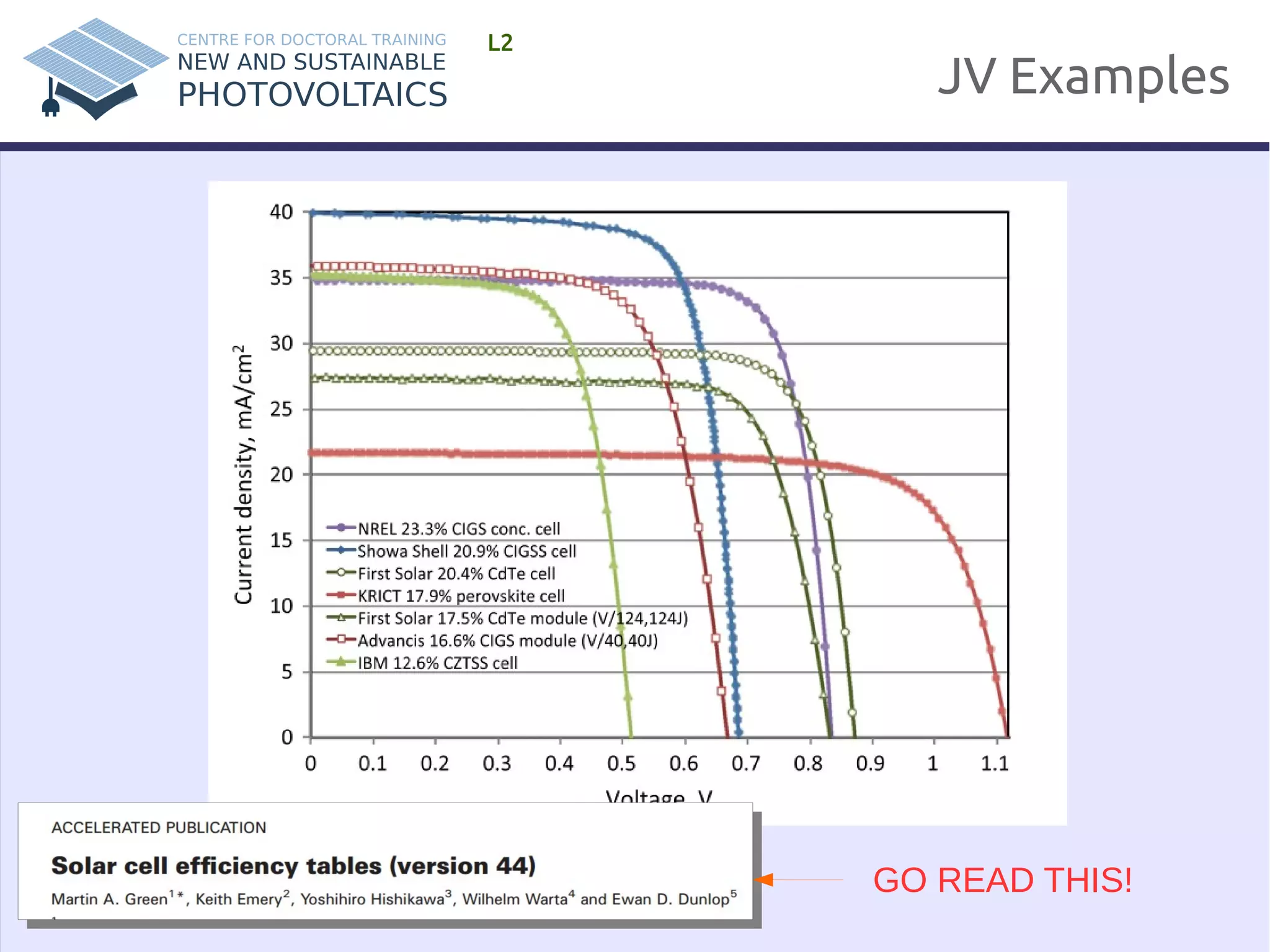
JV Examples 
L2 
GO READ THIS!
Quantum Efficiency 
L2 
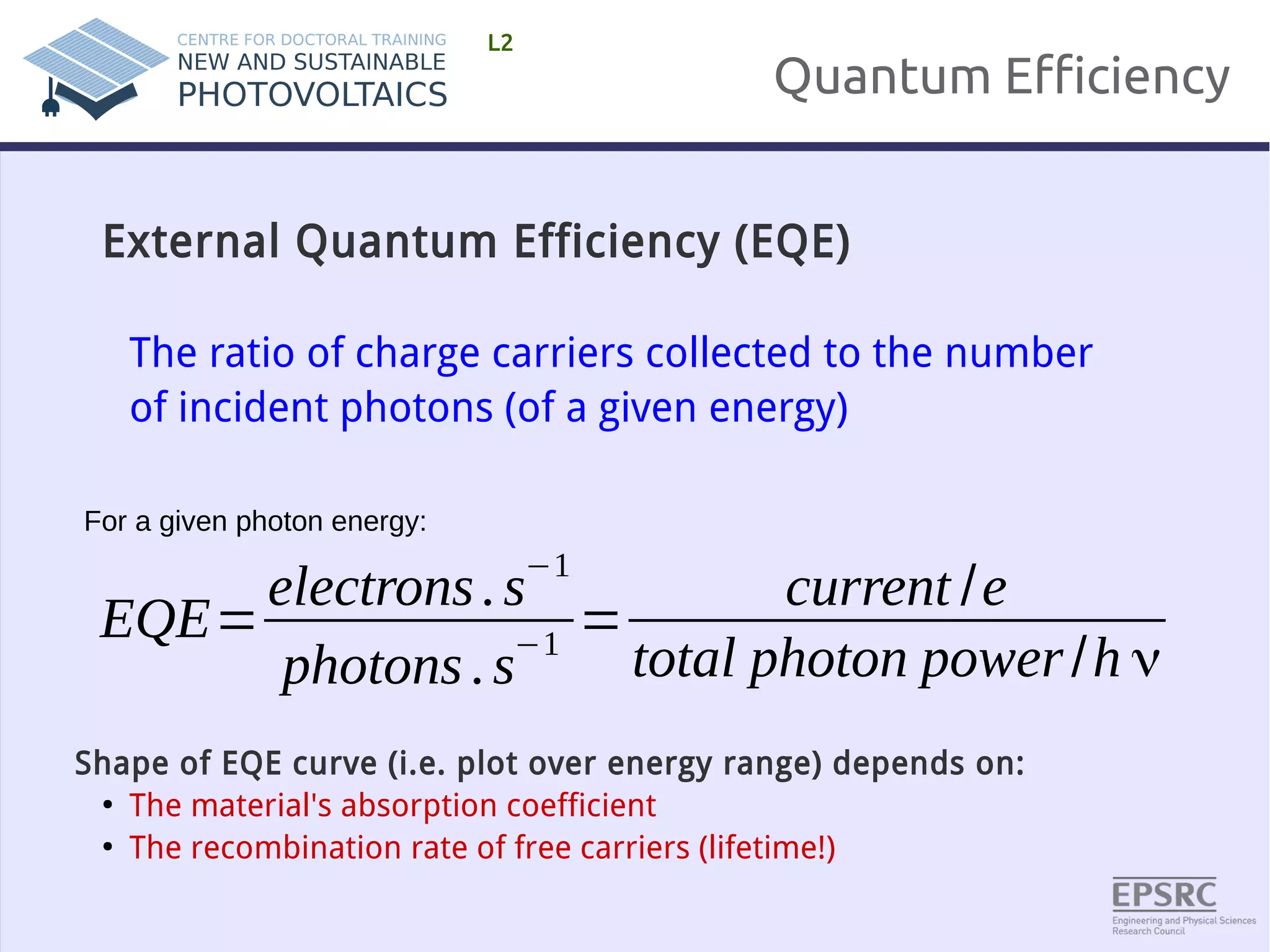
External Quantum Efficiency (EQE) 
The ratio of charge carriers collected to the number 
of incident photons (of a given energy) 
EQE=electrons . s−1 
photons . s−1 = current /e 
total photon power /h ν 
For a given photon energy: 
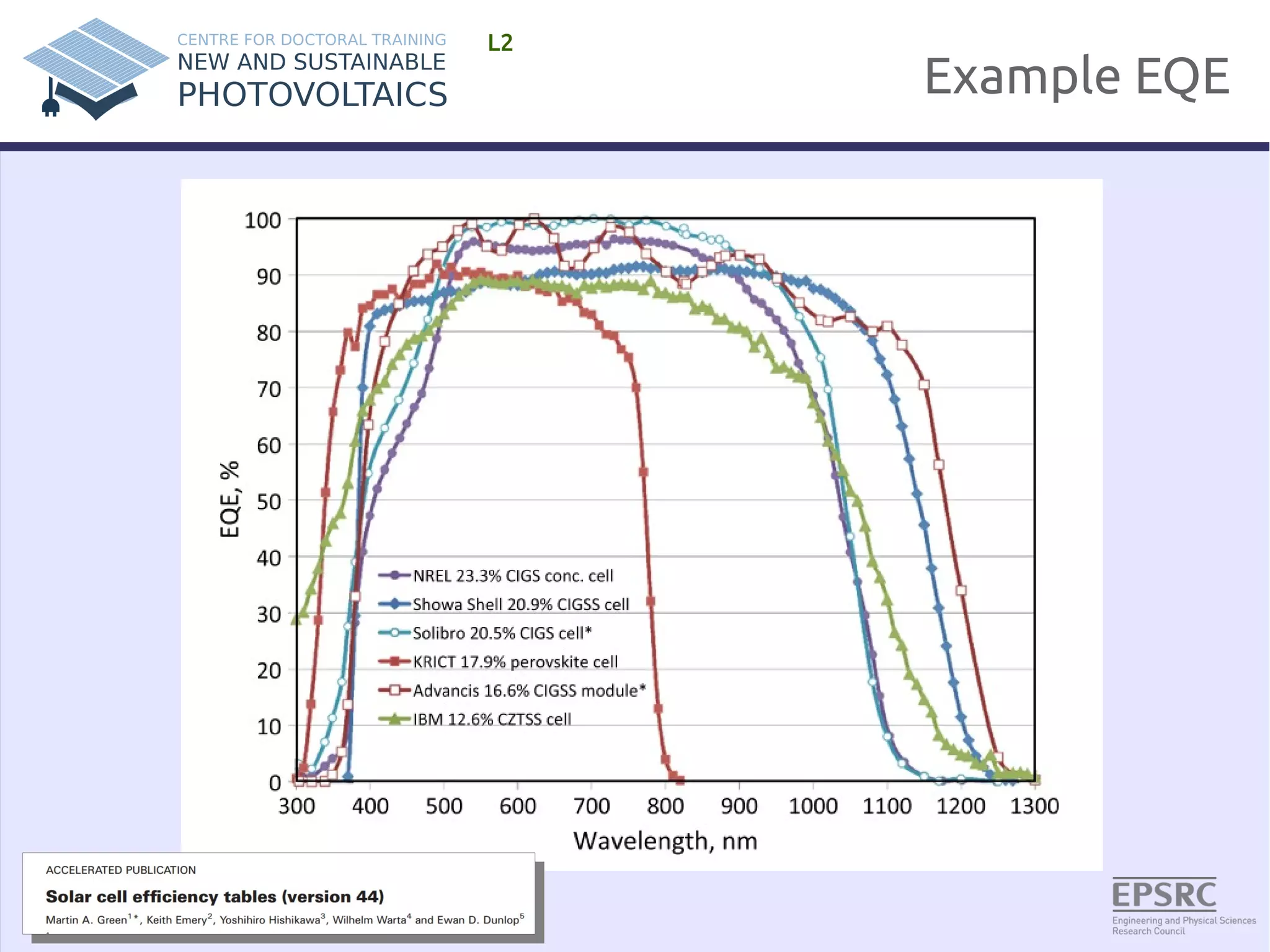
Shape of EQE curve (i.e. plot over energy range) depends on: 
● The material's absorption coefficient 
● The recombination rate of free carriers (lifetime!)
Quantum Efficiency 
L2 
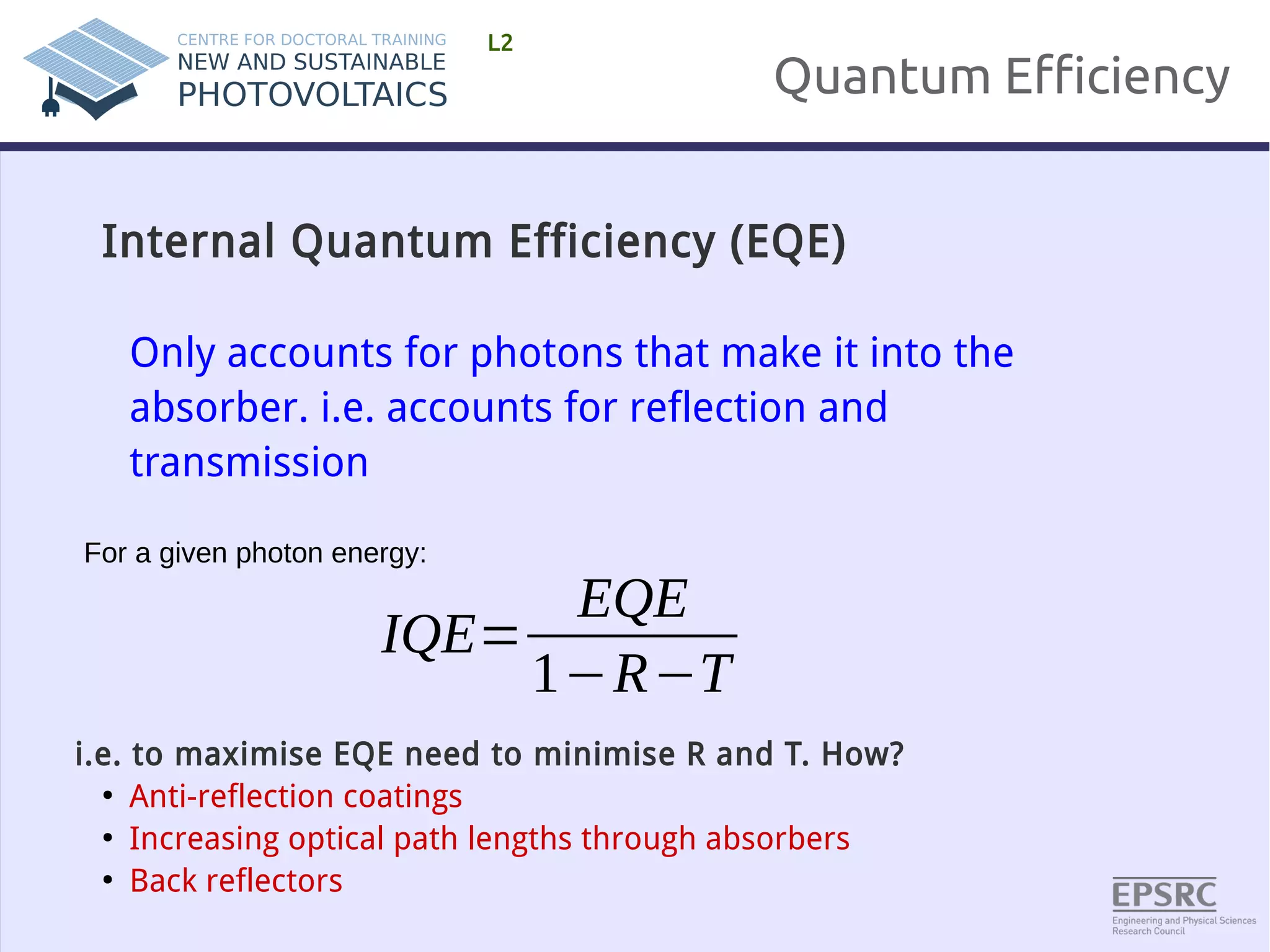
Internal Quantum Efficiency (EQE) 
Only accounts for photons that make it into the 
absorber. i.e. accounts for reflection and 
transmission 
IQE= 
EQE 
1−R−T 
For a given photon energy: 
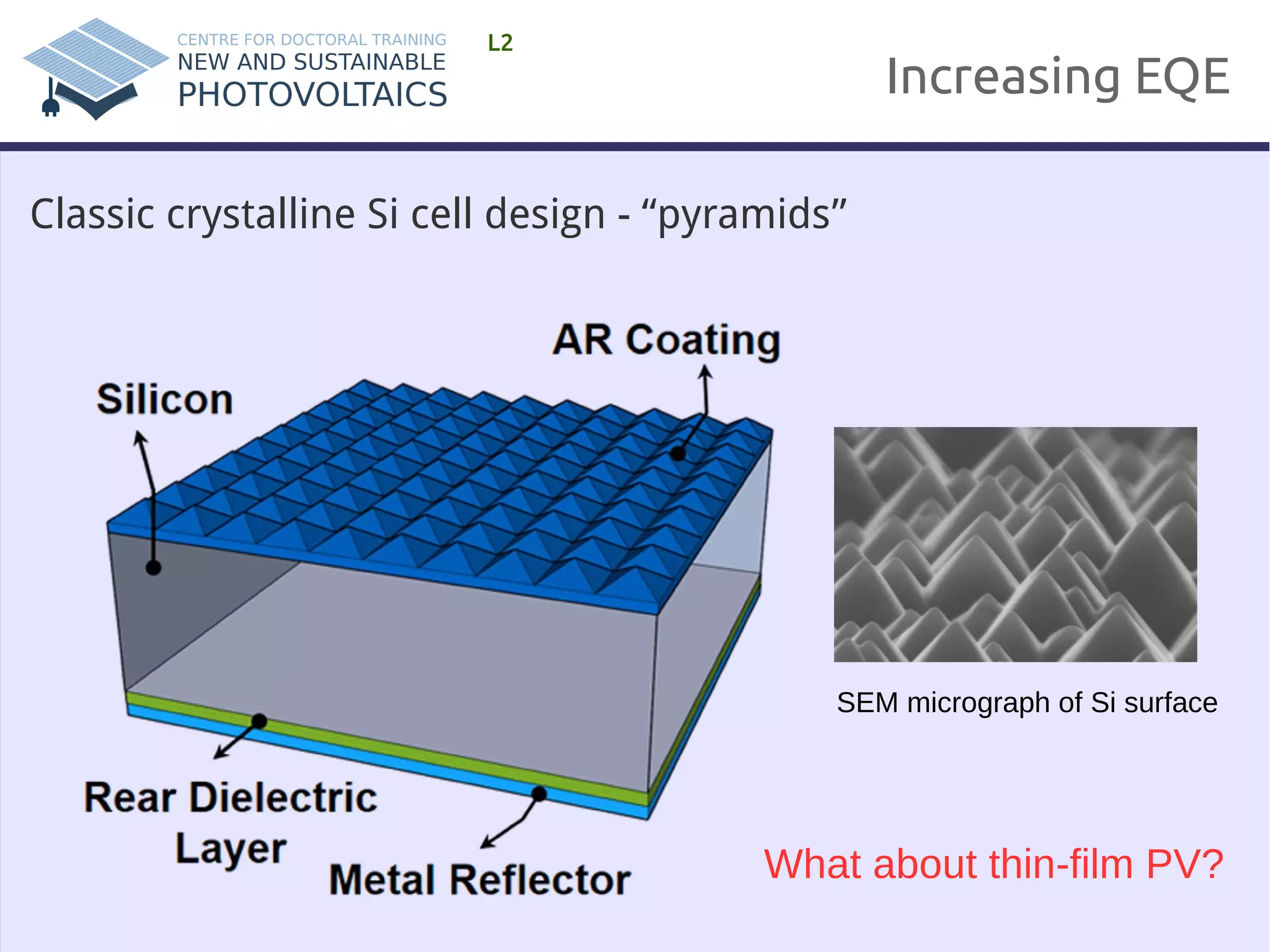
i.e. to maximise EQE need to minimise R and T. How? 
● Anti-reflection coatings 
● Increasing optical path lengths through absorbers 
● Back reflectors
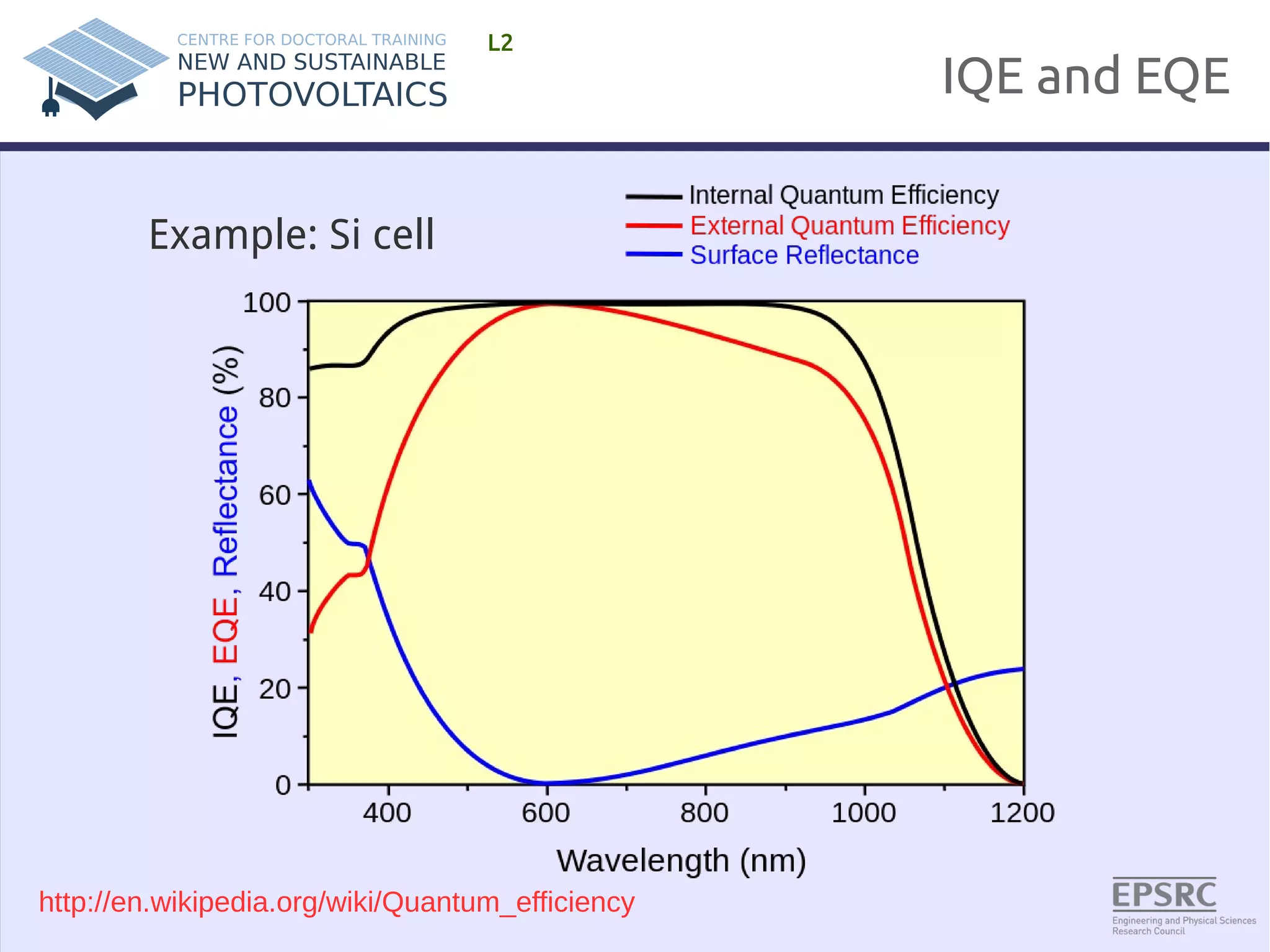
IQE and EQE 
L2 
Example: Si cell 
http://en.wikipedia.org/wiki/Quantum_efficiency
Increasing EQE 
L2 
Classic crystalline Si cell design - “pyramids” 
SEM micrograph of Si surface 
What about thin-film PV?
Example EQE 
L2
Summary 
L2 
● Super speedy history of PV 
● The photovoltaic effect 
● AM1.5 spectrum 
● Solar simulators and ratings 
● The ideal diode equation + equivalent circuits 
● J-V curves and important device parameters 
● Parasitic resistances 
● External quantum efficiency (EQE)

Fundamentals of Photovoltaics: Lecture 1

  • 1.
    Fundamentals of Photovoltaics Nov 5th – 7th 2014
  • 2.
    Course Overview i Wed Nov 5 1. The Sun – Mauritzio Salaris, JMU 2. Solar spectrum and basic device response – R. Treharne 3. Detailed Balance – R. Treharne Thu Nov 6 4. Semiconductors 101 – R. Treharne 5. Junctions – R. Treharne 6. Junction Characterisation – R. Treharne Fri Nov 7 7. Materials Stability – K. Durose 8. Optical properties of semiconductors – T. Veal 9. Advanced characterisation of band phenomena – V. Dhanak 10. Photovoltaics – Current and future PV technologies – K. Durose Mon Nov 10 EXAM Download Lectures Overview here!
  • 3.
  • 4.
    Lecture 1 Solarspectrum and basic device response R. Treharne Nov 5th 2014
  • 5.
    Lecture Outline L2 ● Super speedy history of PV ● The photovoltaic effect ● AM1.5 spectrum ● Solar simulators and ratings ● The ideal diode equation + equivalent circuits ● J-V curves and important device parameters ● Parasitic resistances ● External quantum efficiency (EQE)
  • 6.
    SS History ofPV L2 1839: Edmund Bequerel discovers photovoltaic effect in electrolytic cell 1873: Willoughby Smith observes photoconductivity in Selenium 1905: Einstein publishes paper on photoelectric effect (not photovoltaic effect!) 1954: First PV cell made at Bell Labs, USA. Used to power telephone repeaters – 4% efficient. Daryl Chapin, Calvin Fuller, Gerald Pearson. . 1958: First PV cell in space. Vanguard Satellite. Max power 1W! Followed Explorer VI and VII satellities (1959) https://www1.eere.energy.gov/solar/pdfs/solar_timeline.pdf http://jongertner.net/idea-factory/ 1960: Hoffman Electronics achieves 14% PV cells!
  • 7.
    SS History ofPV L2 1977: U.S. DOE launches Solar Energy Research Institute. Now NREL. Total PV manufacturing capacity exceeds 500 kW 1994: GaAs solar cells > 30% NREL 1982: First MW capacity solar plant goes online. Hisperia, California 1992: CdTe solar cell 15.9% efficient Univ. South Florida. 2000: First Solar starts production 2008: Peak in Si cost as production of SC grade Si slows. Thin film gets excited 2010: Global installed PV capacity reaches 40GW 2012: Emergence of high-efficiency perovskite cells.
  • 8.
    SS History ofPV L2 http://en.wikipedia.org/wiki/Solar_cell_efficiency
  • 9.
    Photovoltaic Effect L24 Do you know the difference between the photoelectric and photovoltaic effects? http://sargosis.com/articles/science/how-pv-modules-work/the-photoelectric-and-photovoltaic-e ffects/
  • 10.
    Photovoltaic Effect L25 How do we use the PV effect to do work? ● Must separate generated electron-hole pair ● Prevent recombination ● Need internal field ● How? JUNCTION! ● Hold in your excitement until L5
  • 11.
    AM1.5 Spectrum L2 nAirMass= optical pathlength at angle γ optical pathlength at γ=0 nAirMass=cosec γ γ http://en.wikipedia.org/wiki/Air_mass_(solar_energy)
  • 12.
    AM1.5 Spectrum L2 http://rredc.nrel.gov/solar/spectra/am1.5/ Integrated Irradiance = 1000 Wm2 for AM1.5
  • 13.
    Solar Simulators L2 The light from a solar simulator is controlled in 3 dimensions: 1) Spectral content 2) Spatial uniformity 3) Temporal stability Classification Spectral Match (each interval) Irradiance Spacial Non-Uniformity Temperal Instability A 0.75-1.25 2% 2% B 0.6-1.4 5% 5% C 0.4-2.0 10% 10% http://en.wikipedia.org/wiki/Solar_simulator
  • 14.
    Solar Simulators L2 You will get to use this! Be excited.
  • 15.
    Ideal Diode Equation L2 William Shockley: Co-inventor of the transistor with Bardeen and Brattain 1948 Nobel Prize: 1956 (Also a eugenicist) Often called the Shockley equation: J=J 0 [exp( eV k BT )−1 ] J0 – Dark saturation current. V – applied voltage across the terminals of the diode e – Electronic charge kB – Boltzmann's constant T – Absolute temperature (K) Might derive this later for fun! (L5) If every you need some inspiration: Read this! http://books.google.co.uk/books/about/The_Idea_Factory.html?id=uOMt_XCo81QC&redir_esc=y
  • 16.
    Ideal dark JVcurve L2 J0 = 1 x 10⁻¹⁰ A/cm2 http://pveducation.org/pvcdrom/pn-junction/diode-equation
  • 17.
    Ideal diode forsolar cell L2 Sign convention: Lets say that the direction of a generated photo-current JL is positive with respect to a negative dark current Jdark J=J L−J dark J=J L−J 0 [exp( eV k BT )−1] Equivalent Circuit: Ideal solar cell
  • 18.
    Light JV response L2 Performance of cell can be described by three important parameters ● Short circuit current – JSC ● Open circuit voltage – VOC ● Fill factor = FF
  • 19.
    Short Circuit Current- JSC L2 JSC What is JSC dependent on? ● Intensity ● Optical properties – REFLECTION! ● Lifetime (L5) ● Band gap For ideal case: JL = JSC (but not true in reality)
  • 20.
  • 21.
    Fill Factor -FF L2 VOC Estimating VOC VOC= kBT e ln (J L J O −1) Most significant parameter that affects the size of VOC
  • 22.
    Fill Factor -FF L2 Fill factor defines the “squareness” of the J-V curve J, P V Jmp FF= area A areaB FF= J mp×V mp J SC×VOC
  • 23.
    Efficiency, η L2 η= Pout Pi n = Pmp Pi n η= J mp×Vmp Pi n = FF×J SC×VOC Pi n AM1.5! η= FF×J SC×VOC 1000Wm−2 Note: Units OK because J measured in Am-2. i.e. m-2 cancel (Be careful)
  • 24.
    Series Resistance, Rs L2 Origin of series resistance in solar cell: ● Simply a property of real materials – i.e. non infinite mobility ● Resistances associated with back and front contacts to cell Can represent sum of series resistance effects in equivalent circuit using a single resistor in series: Rs J=J L−J 0 [exp(e (V +JRs) kBT )−1] Uh oh! Recursive Equation!
  • 25.
    Series Resistance L2 Effect of Rs on shape of JV curve: ● VOC reduced ● FF reduced η decreases! RS≈− V J For moderate Rs http://pveducation.or g/pvcdrom/solar-cell-operation/ series-resistance
  • 26.
    Shunt Resistance, RSH L2 Origin of shunt resistance in solar cell: ● Usually the result of poor fabrication methods ● Short circuit paths between electrodes of cell Can represent sum of shunts in equivalent circuit using a single resistor in parallel to diode: J=J L−J 0 [exp(e (V +JRs) kBT )−1]− V +JRS RSH
  • 27.
    Shunt Resistance, RSH L2 Effect of RSH on shape of JV curve: ● FF decreases ● VOC decreases for very low RSH (<50 Ω cm2) RSH≈− V J http://pveducation.org/pvcdrom/solar-cell-operation/impact-of-both-resistances
  • 28.
    Ideality Factor L2 No such thing as an ideal diode J=J 0 [exp( eV nk BT )−1] ● n – typically takes values of between 1 and 2 (but can be higher) ● Originally used as a fudge factor for empirical data ● Now understood to be related to quality of SC material ● Related to carrier recombination (L4)
  • 29.
    Diode Ideality Factor L2 IDEA: Increase n to increase VOC (and efficiency)! Hooray! You've just solved all our problems. And we'll be home in time for tea.
  • 30.
    Diode Ideality Factor L2 Nice Try ● n and J0 inextricably linked ● Increase n increase in J0 ● Net effect: decrease in VOC (not increase, D'oh!) http://pveducation.org/pvcdrom/pn-junction/diode-equation
  • 31.
    JV Examples L2 GO READ THIS!
  • 32.
    Quantum Efficiency L2 External Quantum Efficiency (EQE) The ratio of charge carriers collected to the number of incident photons (of a given energy) EQE=electrons . s−1 photons . s−1 = current /e total photon power /h ν For a given photon energy: Shape of EQE curve (i.e. plot over energy range) depends on: ● The material's absorption coefficient ● The recombination rate of free carriers (lifetime!)
  • 33.
    Quantum Efficiency L2 Internal Quantum Efficiency (EQE) Only accounts for photons that make it into the absorber. i.e. accounts for reflection and transmission IQE= EQE 1−R−T For a given photon energy: i.e. to maximise EQE need to minimise R and T. How? ● Anti-reflection coatings ● Increasing optical path lengths through absorbers ● Back reflectors
  • 34.
    IQE and EQE L2 Example: Si cell http://en.wikipedia.org/wiki/Quantum_efficiency
  • 35.
    Increasing EQE L2 Classic crystalline Si cell design - “pyramids” SEM micrograph of Si surface What about thin-film PV?
  • 36.
  • 37.
    Summary L2 ●Super speedy history of PV ● The photovoltaic effect ● AM1.5 spectrum ● Solar simulators and ratings ● The ideal diode equation + equivalent circuits ● J-V curves and important device parameters ● Parasitic resistances ● External quantum efficiency (EQE)