EE421 Renewable Energy Systems
Solar PV System
Mr. Ijaz Husnain
Photovoltaics (PV)
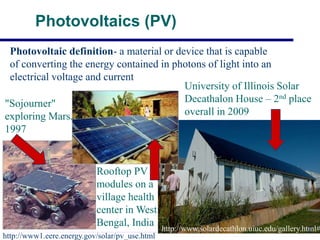
Photovoltaic definition- a material or device that is capable
of converting the energy contained in photons of light into an
electrical voltage and current
Rooftop PV
modules on a
village health
center in West
Bengal, India
http://www1.eere.energy.gov/solar/pv_use.html
"Sojourner"
exploring Mars,
1997
University of Illinois Solar
Decathalon House – 2nd place
overall in 2009
http://www.solardecathlon.uiuc.edu/gallery.html#
2
PV History
• Edmund Becquerel (1839) observed PV effect
• Adams and Richard Evans Day (1876) observed that
illuminating a junction causes photo voltaic effect
• Albert Einstein (1904)
• Czochralski (1940s) pronounced as chokh-RAHL-skee
• Vanguard I satellite (1958)
• Costs have recently dropped quite substantially
3
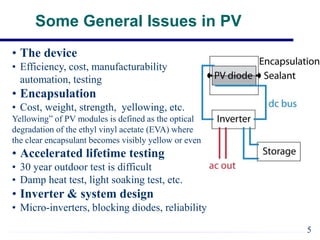
PV System Overview
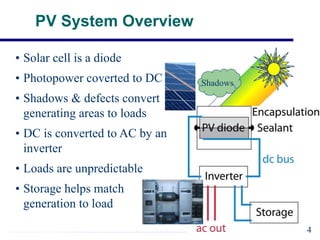
Shadows
• Solar cell is a diode
• Photopower coverted to DC
• Shadows & defects convert
generating areas to loads
• DC is converted to AC by an
inverter
• Loads are unpredictable
• Storage helps match
generation to load
4
Some General Issues in PV
• The device
• Efficiency, cost, manufacturability
automation, testing
• Encapsulation
• Cost, weight, strength, yellowing, etc.
Yellowing” of PV modules is defined as the optical
degradation of the ethyl vinyl acetate (EVA) where
the clear encapsulant becomes visibly yellow or even brown.
• Accelerated lifetime testing
• 30 year outdoor test is difficult
• Damp heat test, light soaking test, etc.
• Inverter & system design
• Micro-inverters, blocking diodes, reliability
5
6
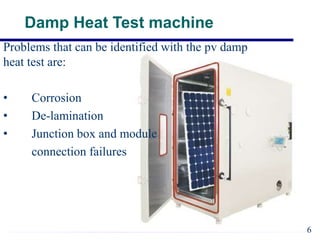
Damp Heat Test machine
Problems that can be identified with the pv damp
heat test are:
• Corrosion
• De-lamination
• Junction box and module
connection failures
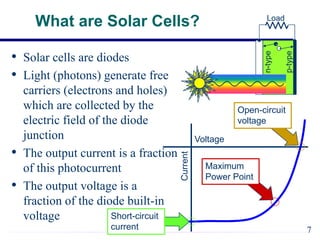
What are Solar Cells?
Current
Voltage
Open-circuit
voltage
Short-circuit
current
Maximum
Power Point
n-type
p-type
-
+
Load
• Solar cells are diodes
• Light (photons) generate free
carriers (electrons and holes)
which are collected by the
electric field of the diode
junction
• The output current is a fraction
of this photocurrent
• The output voltage is a
fraction of the diode built-in
voltage
7
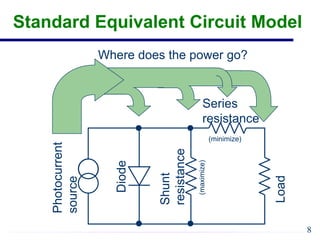
Standard Equivalent Circuit Model
Photocurrent
source
Diode
Shunt
resistance
Load
Series
resistance
Where does the power go?
(minimize)
(maximize)
8
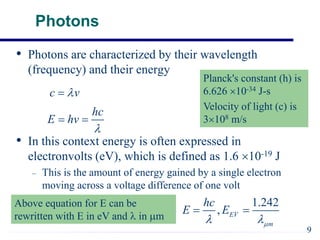
Photons
• Photons are characterized by their wavelength
(frequency) and their energy
• In this context energy is often expressed in
electronvolts (eV), which is defined as 1.6 10-19 J
– This is the amount of energy gained by a single electron
moving across a voltage difference of one volt
c v


hc
E hv

 
9
Planck's constant (h) is
6.626 10-34 J-s
Velocity of light (c) is
3108 m/s
1.242
, EV
m
hc
E E

 
 
Above equation for E can be
rewritten with E in eV and  in m
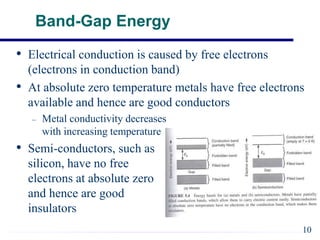
Band-Gap Energy
• Electrical conduction is caused by free electrons
(electrons in conduction band)
• At absolute zero temperature metals have free electrons
available and hence are good conductors
– Metal conductivity decreases
with increasing temperature
• Semi-conductors, such as
silicon, have no free
electrons at absolute zero
and hence are good
insulators
10
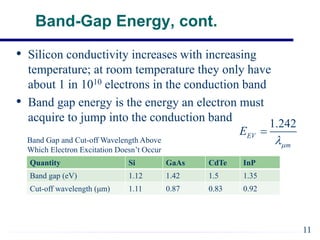
Band-Gap Energy, cont.
• Silicon conductivity increases with increasing
temperature; at room temperature they only have
about 1 in 1010 electrons in the conduction band
• Band gap energy is the energy an electron must
acquire to jump into the conduction band
11
Quantity Si GaAs CdTe InP
Band gap (eV) 1.12 1.42 1.5 1.35
Cut-off wavelength (μm) 1.11 0.87 0.83 0.92
Band Gap and Cut-off Wavelength Above
Which Electron Excitation Doesn’t Occur
1.242
EV
m
E



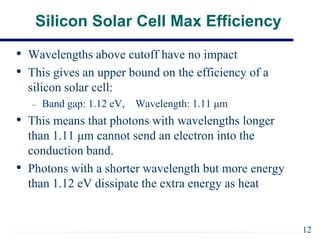
Silicon Solar Cell Max Efficiency
• Wavelengths above cutoff have no impact
• This gives an upper bound on the efficiency of a
silicon solar cell:
– Band gap: 1.12 eV, Wavelength: 1.11 μm
• This means that photons with wavelengths longer
than 1.11 μm cannot send an electron into the
conduction band.
• Photons with a shorter wavelength but more energy
than 1.12 eV dissipate the extra energy as heat
12
Silicon Solar Cell Max Efficiency
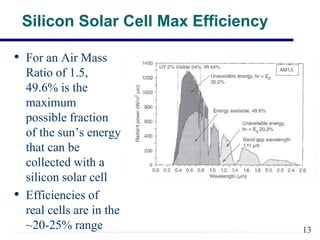
• For an Air Mass
Ratio of 1.5,
49.6% is the
maximum
possible fraction
of the sun’s energy
that can be
collected with a
silicon solar cell
• Efficiencies of
real cells are in the
~20-25% range 13
Solar Cell Efficiency
• Factors that add to losses
– Recombination of electrons/holes
– Internal resistance
– Photons might not get absorbed, or they may get reflected
– Heating
• Smaller band gap - easier to excite electrons, so more
photons have extra energy
– Results in higher current, lower voltage
• High band gap – opposite problem
• There must be some middle ground since P=VI (DC),
this is usually between 1.2 and 1.8 eV
14
Maximum Efficiency for Cells
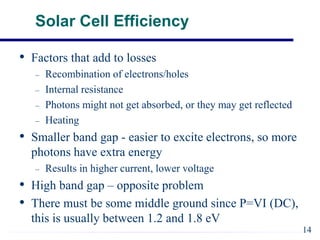
15
• The maximum efficiency of single-junction PV
cells for different materials was derived in 1961 by
Shockley and Queisser
Review of Diodes
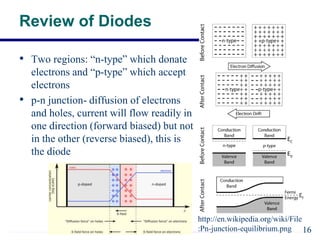
• Two regions: “n-type” which donate
electrons and “p-type” which accept
electrons
• p-n junction- diffusion of electrons
and holes, current will flow readily in
one direction (forward biased) but not
in the other (reverse biased), this is
the diode
http://en.wikipedia.org/wiki/File
:Pn-junction-equilibrium.png 16
The p-n Junction Diode
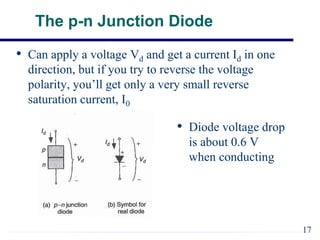
• Can apply a voltage Vd and get a current Id in one
direction, but if you try to reverse the voltage
polarity, you’ll get only a very small reverse
saturation current, I0
• Diode voltage drop
is about 0.6 V
when conducting
17
The p-n Junction Diode
Voltage-Current (VI) characteristics for a diode
/
0 ( -1)
d
qV kT
d
I I e

38.9
0 ( -1) (at 25 C)
d
V
d
I I e
 
k = Boltzmann’s constant
1.381x10⁻²³ [J/K]
T = junction temperature [K]
Vd = diode voltage
Id = diode current
q = electron charge 1.602x10⁻¹⁹ C
I0 = reverse saturation current
18
Circuit Models of PV Cells
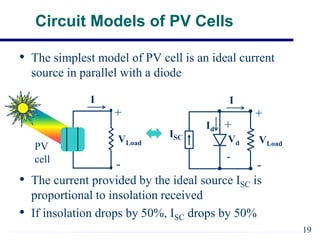
• The simplest model of PV cell is an ideal current
source in parallel with a diode
• The current provided by the ideal source ISC is
proportional to insolation received
• If insolation drops by 50%, ISC drops by 50%
ISC
Id
I
VLoad
+
-
I
VLoad
+
-
PV
cell
Vd
+
-
19
Circuit Models of PV Cells
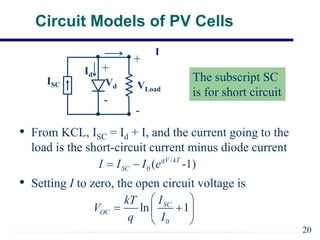
• From KCL, ISC = Id + I, and the current going to the
load is the short-circuit current minus diode current
• Setting I to zero, the open circuit voltage is
/
0 ( -1)
qV kT
SC
I I I e
 
0
ln 1
SC
OC
I
kT
V
q I
 
 
 
 
I
ISC
Id
VLoad
+
-
Vd
+
-
20
The subscript SC
is for short circuit
PV Cell I-V Characteristic
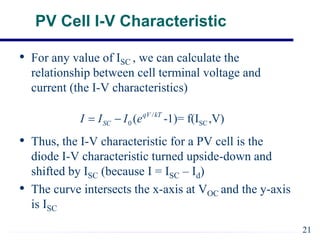
• For any value of ISC , we can calculate the
relationship between cell terminal voltage and
current (the I-V characteristics)
• Thus, the I-V characteristic for a PV cell is the
diode I-V characteristic turned upside-down and
shifted by ISC (because I = ISC – Id)
• The curve intersects the x-axis at VOC and the y-axis
is ISC
/
0 SC
( -1)= f(I ,V)
qV kT
SC
I I I e
 
21
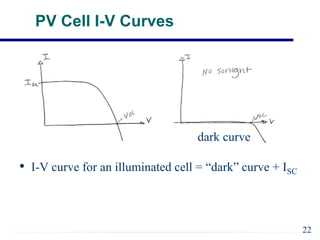
PV Cell I-V Curves
• I-V curve for an illuminated cell = “dark” curve + ISC
dark curve
22
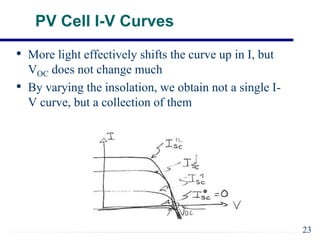
PV Cell I-V Curves
• More light effectively shifts the curve up in I, but
VOC does not change much
• By varying the insolation, we obtain not a single I-
V curve, but a collection of them
23
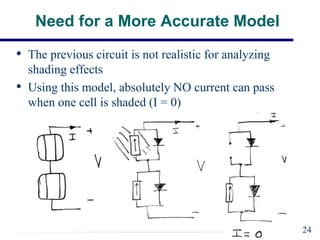
Need for a More Accurate Model
• The previous circuit is not realistic for analyzing
shading effects
• Using this model, absolutely NO current can pass
when one cell is shaded (I = 0)
24
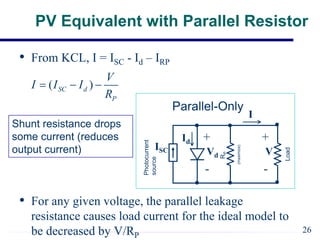
PV Equivalent Circuit
• It is true that shading has a big impact on solar cell
power output, but it is not as dramatic as this
suggests! Otherwise, a single shaded cell would
make the entire module’s output zero.
• A more accurate model includes a leakage
resistance RP in parallel with the current source and
the diode
• RP is large, ~RP > 100VOC/ISC
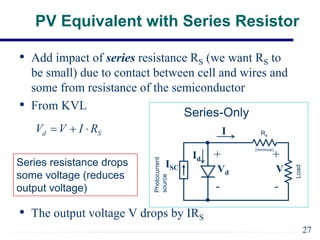
• A resistance RS in series accounts for the fact that
the output voltage V is not exactly the diode voltage
• RS is small, ~RS < 0.01VOC/ISC
25
PV Equivalent with Parallel Resistor
• From KCL, I = ISC - Id – IRP
• For any given voltage, the parallel leakage
resistance causes load current for the ideal model to
be decreased by V/RP
( )
SC d
P
V
I I I
R
  
Photocurrent
source
R
P
Load
(maximize)
Parallel-Only
ISC
I
V
+
-
Vd
+
-
Id
Shunt resistance drops
some current (reduces
output current)
26
PV Equivalent with Series Resistor
• Add impact of series resistance RS (we want RS to
be small) due to contact between cell and wires and
some from resistance of the semiconductor
• From KVL
• The output voltage V drops by IRS
d S
V V I R
  
Photocurrent
source
Load
Rs
(minimize)
Series-Only
ISC Vd
+
-
V
+
-
I
Id
Series resistance drops
some voltage (reduces
output voltage)
27
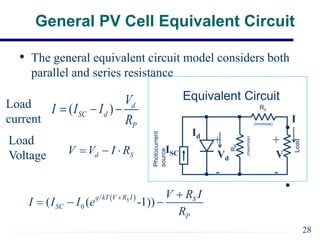
General PV Cell Equivalent Circuit
• The general equivalent circuit model considers both
parallel and series resistance
Photocurrent
source
R
P
Load
Rs
(minimize)
(maximize)
Equivalent Circuit
Id
I
ISC Vd
+
-
V
+
-
d S
V V I R
  
( ) d
SC d
P
V
I I I
R
  
 
/
0
( ( -1))
S
q kT V R I S
SC
P
V R I
I I I e
R
 
  
28
Load
current
Load
Voltage
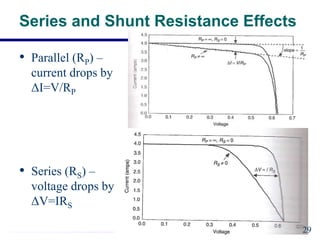
Series and Shunt Resistance Effects
• Parallel (RP) –
current drops by
ΔI=V/RP
• Series (RS) –
voltage drops by
ΔV=IRS
29
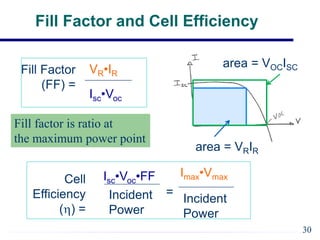
Fill Factor and Cell Efficiency
Cell
Efficiency
(h) =
Isc•Voc•FF
Incident
Power
Imax•Vmax
Incident
Power
=
Fill Factor
(FF) =
VR•IR
Isc•Voc
area = VRIR
area = VOCISC
30
Fill factor is ratio at
the maximum power point
31
Thanks!

Res lecture 11 solar pv

  • 1.
    EE421 Renewable EnergySystems Solar PV System Mr. Ijaz Husnain
  • 2.
    Photovoltaics (PV) Photovoltaic definition-a material or device that is capable of converting the energy contained in photons of light into an electrical voltage and current Rooftop PV modules on a village health center in West Bengal, India http://www1.eere.energy.gov/solar/pv_use.html "Sojourner" exploring Mars, 1997 University of Illinois Solar Decathalon House – 2nd place overall in 2009 http://www.solardecathlon.uiuc.edu/gallery.html# 2
  • 3.
    PV History • EdmundBecquerel (1839) observed PV effect • Adams and Richard Evans Day (1876) observed that illuminating a junction causes photo voltaic effect • Albert Einstein (1904) • Czochralski (1940s) pronounced as chokh-RAHL-skee • Vanguard I satellite (1958) • Costs have recently dropped quite substantially 3
  • 4.
    PV System Overview Shadows •Solar cell is a diode • Photopower coverted to DC • Shadows & defects convert generating areas to loads • DC is converted to AC by an inverter • Loads are unpredictable • Storage helps match generation to load 4
  • 5.
    Some General Issuesin PV • The device • Efficiency, cost, manufacturability automation, testing • Encapsulation • Cost, weight, strength, yellowing, etc. Yellowing” of PV modules is defined as the optical degradation of the ethyl vinyl acetate (EVA) where the clear encapsulant becomes visibly yellow or even brown. • Accelerated lifetime testing • 30 year outdoor test is difficult • Damp heat test, light soaking test, etc. • Inverter & system design • Micro-inverters, blocking diodes, reliability 5
  • 6.
    6 Damp Heat Testmachine Problems that can be identified with the pv damp heat test are: • Corrosion • De-lamination • Junction box and module connection failures
  • 7.
    What are SolarCells? Current Voltage Open-circuit voltage Short-circuit current Maximum Power Point n-type p-type - + Load • Solar cells are diodes • Light (photons) generate free carriers (electrons and holes) which are collected by the electric field of the diode junction • The output current is a fraction of this photocurrent • The output voltage is a fraction of the diode built-in voltage 7
  • 8.
    Standard Equivalent CircuitModel Photocurrent source Diode Shunt resistance Load Series resistance Where does the power go? (minimize) (maximize) 8
  • 9.
    Photons • Photons arecharacterized by their wavelength (frequency) and their energy • In this context energy is often expressed in electronvolts (eV), which is defined as 1.6 10-19 J – This is the amount of energy gained by a single electron moving across a voltage difference of one volt c v   hc E hv    9 Planck's constant (h) is 6.626 10-34 J-s Velocity of light (c) is 3108 m/s 1.242 , EV m hc E E      Above equation for E can be rewritten with E in eV and  in m
  • 10.
    Band-Gap Energy • Electricalconduction is caused by free electrons (electrons in conduction band) • At absolute zero temperature metals have free electrons available and hence are good conductors – Metal conductivity decreases with increasing temperature • Semi-conductors, such as silicon, have no free electrons at absolute zero and hence are good insulators 10
  • 11.
    Band-Gap Energy, cont. •Silicon conductivity increases with increasing temperature; at room temperature they only have about 1 in 1010 electrons in the conduction band • Band gap energy is the energy an electron must acquire to jump into the conduction band 11 Quantity Si GaAs CdTe InP Band gap (eV) 1.12 1.42 1.5 1.35 Cut-off wavelength (μm) 1.11 0.87 0.83 0.92 Band Gap and Cut-off Wavelength Above Which Electron Excitation Doesn’t Occur 1.242 EV m E   
  • 12.
    Silicon Solar CellMax Efficiency • Wavelengths above cutoff have no impact • This gives an upper bound on the efficiency of a silicon solar cell: – Band gap: 1.12 eV, Wavelength: 1.11 μm • This means that photons with wavelengths longer than 1.11 μm cannot send an electron into the conduction band. • Photons with a shorter wavelength but more energy than 1.12 eV dissipate the extra energy as heat 12
  • 13.
    Silicon Solar CellMax Efficiency • For an Air Mass Ratio of 1.5, 49.6% is the maximum possible fraction of the sun’s energy that can be collected with a silicon solar cell • Efficiencies of real cells are in the ~20-25% range 13
  • 14.
    Solar Cell Efficiency •Factors that add to losses – Recombination of electrons/holes – Internal resistance – Photons might not get absorbed, or they may get reflected – Heating • Smaller band gap - easier to excite electrons, so more photons have extra energy – Results in higher current, lower voltage • High band gap – opposite problem • There must be some middle ground since P=VI (DC), this is usually between 1.2 and 1.8 eV 14
  • 15.
    Maximum Efficiency forCells 15 • The maximum efficiency of single-junction PV cells for different materials was derived in 1961 by Shockley and Queisser
  • 16.
    Review of Diodes •Two regions: “n-type” which donate electrons and “p-type” which accept electrons • p-n junction- diffusion of electrons and holes, current will flow readily in one direction (forward biased) but not in the other (reverse biased), this is the diode http://en.wikipedia.org/wiki/File :Pn-junction-equilibrium.png 16
  • 17.
    The p-n JunctionDiode • Can apply a voltage Vd and get a current Id in one direction, but if you try to reverse the voltage polarity, you’ll get only a very small reverse saturation current, I0 • Diode voltage drop is about 0.6 V when conducting 17
  • 18.
    The p-n JunctionDiode Voltage-Current (VI) characteristics for a diode / 0 ( -1) d qV kT d I I e  38.9 0 ( -1) (at 25 C) d V d I I e   k = Boltzmann’s constant 1.381x10⁻²³ [J/K] T = junction temperature [K] Vd = diode voltage Id = diode current q = electron charge 1.602x10⁻¹⁹ C I0 = reverse saturation current 18
  • 19.
    Circuit Models ofPV Cells • The simplest model of PV cell is an ideal current source in parallel with a diode • The current provided by the ideal source ISC is proportional to insolation received • If insolation drops by 50%, ISC drops by 50% ISC Id I VLoad + - I VLoad + - PV cell Vd + - 19
  • 20.
    Circuit Models ofPV Cells • From KCL, ISC = Id + I, and the current going to the load is the short-circuit current minus diode current • Setting I to zero, the open circuit voltage is / 0 ( -1) qV kT SC I I I e   0 ln 1 SC OC I kT V q I         I ISC Id VLoad + - Vd + - 20 The subscript SC is for short circuit
  • 21.
    PV Cell I-VCharacteristic • For any value of ISC , we can calculate the relationship between cell terminal voltage and current (the I-V characteristics) • Thus, the I-V characteristic for a PV cell is the diode I-V characteristic turned upside-down and shifted by ISC (because I = ISC – Id) • The curve intersects the x-axis at VOC and the y-axis is ISC / 0 SC ( -1)= f(I ,V) qV kT SC I I I e   21
  • 22.
    PV Cell I-VCurves • I-V curve for an illuminated cell = “dark” curve + ISC dark curve 22
  • 23.
    PV Cell I-VCurves • More light effectively shifts the curve up in I, but VOC does not change much • By varying the insolation, we obtain not a single I- V curve, but a collection of them 23
  • 24.
    Need for aMore Accurate Model • The previous circuit is not realistic for analyzing shading effects • Using this model, absolutely NO current can pass when one cell is shaded (I = 0) 24
  • 25.
    PV Equivalent Circuit •It is true that shading has a big impact on solar cell power output, but it is not as dramatic as this suggests! Otherwise, a single shaded cell would make the entire module’s output zero. • A more accurate model includes a leakage resistance RP in parallel with the current source and the diode • RP is large, ~RP > 100VOC/ISC • A resistance RS in series accounts for the fact that the output voltage V is not exactly the diode voltage • RS is small, ~RS < 0.01VOC/ISC 25
  • 26.
    PV Equivalent withParallel Resistor • From KCL, I = ISC - Id – IRP • For any given voltage, the parallel leakage resistance causes load current for the ideal model to be decreased by V/RP ( ) SC d P V I I I R    Photocurrent source R P Load (maximize) Parallel-Only ISC I V + - Vd + - Id Shunt resistance drops some current (reduces output current) 26
  • 27.
    PV Equivalent withSeries Resistor • Add impact of series resistance RS (we want RS to be small) due to contact between cell and wires and some from resistance of the semiconductor • From KVL • The output voltage V drops by IRS d S V V I R    Photocurrent source Load Rs (minimize) Series-Only ISC Vd + - V + - I Id Series resistance drops some voltage (reduces output voltage) 27
  • 28.
    General PV CellEquivalent Circuit • The general equivalent circuit model considers both parallel and series resistance Photocurrent source R P Load Rs (minimize) (maximize) Equivalent Circuit Id I ISC Vd + - V + - d S V V I R    ( ) d SC d P V I I I R      / 0 ( ( -1)) S q kT V R I S SC P V R I I I I e R      28 Load current Load Voltage
  • 29.
    Series and ShuntResistance Effects • Parallel (RP) – current drops by ΔI=V/RP • Series (RS) – voltage drops by ΔV=IRS 29
  • 30.
    Fill Factor andCell Efficiency Cell Efficiency (h) = Isc•Voc•FF Incident Power Imax•Vmax Incident Power = Fill Factor (FF) = VR•IR Isc•Voc area = VRIR area = VOCISC 30 Fill factor is ratio at the maximum power point
  • 31.