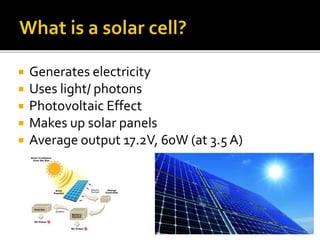
 Generates electricity
 Uses light/ photons
 Photovoltaic Effect
 Makes up solar panels
 Average output 17.2V, 60W (at 3.5 A)
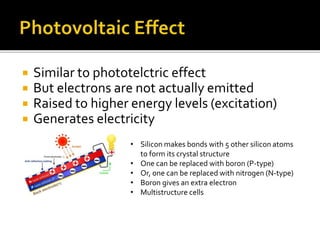
 Similar to phototelctric effect
 But electrons are not actually emitted
 Raised to higher energy levels (excitation)
 Generates electricity
• Silicon makes bonds with 5 other silicon atoms
to form its crystal structure
• One can be replaced with boron (P-type)
• Or, one can be replaced with nitrogen (N-type)
• Boron gives an extra electron
• Multistructure cells
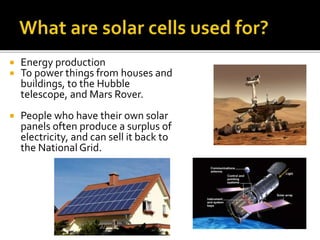
 Energy production
 To power things from houses and
buildings, to the Hubble
telescope, and Mars Rover.
 People who have their own solar
panels often produce a surplus of
electricity, and can sell it back to
the National Grid.
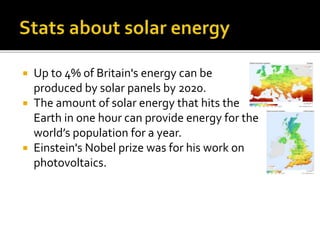
 Up to 4% of Britain's energy can be
produced by solar panels by 2020.
 The amount of solar energy that hits the
Earth in one hour can provide energy for the
world’s population for a year.
 Einstein's Nobel prize was for his work on
photovoltaics.
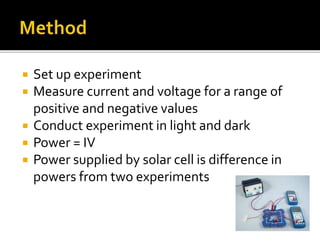
 Set up experiment
 Measure current and voltage for a range of
positive and negative values
 Conduct experiment in light and dark
 Power = IV
 Power supplied by solar cell is difference in
powers from two experiments

Solar cells

  • 2.
     Generates electricity Uses light/ photons  Photovoltaic Effect  Makes up solar panels  Average output 17.2V, 60W (at 3.5 A)
  • 3.
     Similar tophototelctric effect  But electrons are not actually emitted  Raised to higher energy levels (excitation)  Generates electricity • Silicon makes bonds with 5 other silicon atoms to form its crystal structure • One can be replaced with boron (P-type) • Or, one can be replaced with nitrogen (N-type) • Boron gives an extra electron • Multistructure cells
  • 4.
     Energy production To power things from houses and buildings, to the Hubble telescope, and Mars Rover.  People who have their own solar panels often produce a surplus of electricity, and can sell it back to the National Grid.
  • 5.
     Up to4% of Britain's energy can be produced by solar panels by 2020.  The amount of solar energy that hits the Earth in one hour can provide energy for the world’s population for a year.  Einstein's Nobel prize was for his work on photovoltaics.
  • 6.
     Set upexperiment  Measure current and voltage for a range of positive and negative values  Conduct experiment in light and dark  Power = IV  Power supplied by solar cell is difference in powers from two experiments