Lecture 6 
Junction characterisation 
Jon Major 
Nov 6th 2014
The PV research cycle 
L6 Voltage (V) -1.0-0.50.00.51.0 Current density (mA/cm2) -20020401.1% 4.9% 
Make cells 
Measure cells 
Despair 
Repeat 
Data
Lecture Outline 
LX 
• 
Analysis of current voltage (J-V) curves 
• 
External quantum efficiency (EQE) measurements 
• 
Capacitance voltage (C-V) measurements 
Key junction characterisation techniques
J-V analysis (J-V) 
L6 
Parasitic resistances 
Perfect p-n junction 
Real p-n junction 
A good device should have low RS 
And high RSh
J-V analysis (J-V) 
L6 
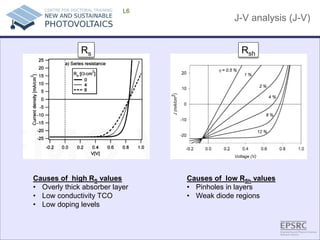
Rs 
Rsh 
Causes of high RS values 
• 
Overly thick absorber layer 
• 
Low conductivity TCO 
• 
Low doping levels 
Causes of low RSh values 
• 
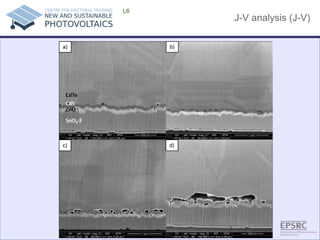
Pinholes in layers 
• 
Weak diode regions
J-V analysis (J-V) 
L6
J-V analysis (J-V) 
L6 
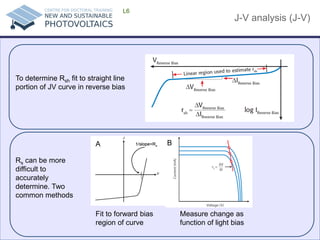
To determine Rsh fit to straight line portion of JV curve in reverse bias 
Rs can be more difficult to accurately determine. Two common methods 
Fit to forward bias region of curve 
Measure change as function of light bias 
A 
B
J-V analysis (J-V) 
L6 
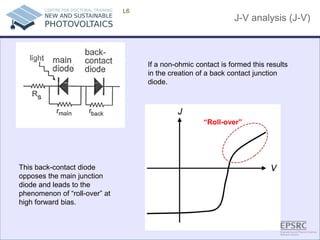
“Roll-over” 
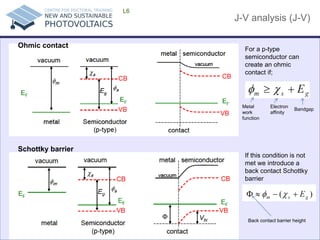
If a non-ohmic contact is formed this results in the creation of a back contact junction diode. 
This back-contact diode opposes the main junction diode and leads to the phenomenon of “roll-over” at high forward bias.
J-V analysis (J-V) 
L6 
For a p-type semiconductor can create an ohmic contact if; 
Schottky barrier 
Ohmic contact 
If this condition is not met we introduce a back contact Schottky barrier 
Electron affinity 
Bandgap 
Metal work function 
Back contact barrier height
J-V-T analysis 
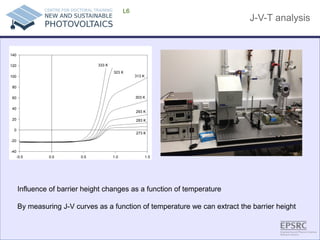
L6 -0.50.00.51.01.5 -40-20020406080100120140303 K293 K283 K333 K313 K323 K273 K 
Influence of barrier height changes as a function of temperature By measuring J-V curves as a function of temperature we can extract the barrier height
J-V-T analysis 
L6 
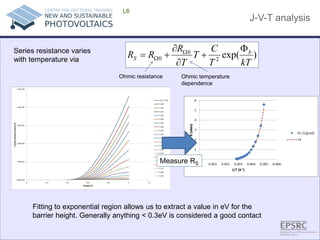
Fitting to exponential region allows us to extract a value in eV for the barrier height. Generally anything < 0.3eV is considered a good contact )exp(200kTTCTTRRRbSΦ+ ∂ ∂ +=ΩΩ 
Measure RS 
Series resistance varies with temperature via 
Ohmic resistance 
Ohmic temperature dependence
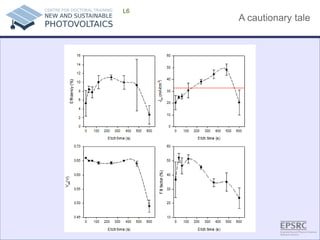
A cautionary tale 
L6
Errors in J-V analysis (J-V) 
L6 
• 
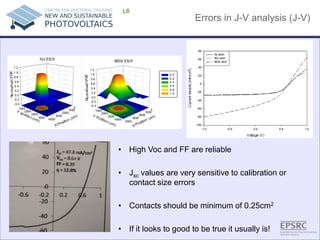
High Voc and FF are reliable 
• 
Jsc values are very sensitive to calibration or contact size errors 
• 
Contacts should be minimum of 0.25cm2 
• 
If it looks to good to be true it usually is!
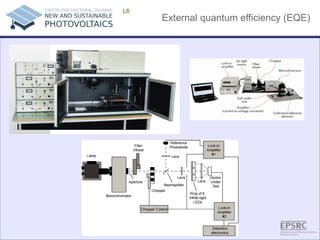
External quantum efficiency (EQE) 
L6
External quantum efficiency (EQE) 
L6 
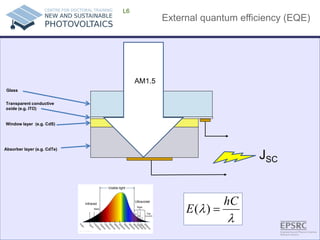
Absorber layer (e.g. CdTe) 
Window layer (e.g. CdS) 
Glass 
Transparent conductive oxide (e.g. ITO) λλhCE=)( 
AM1.5 
AM1.5 
JSC
External quantum efficiency (EQE) 
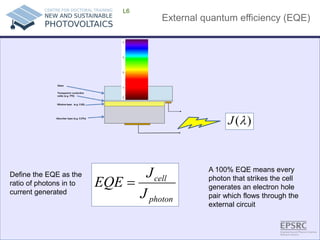
L6 )(λJphotoncellJJEQE= 
Define the EQE as the ratio of photons in to current generated 
A 100% EQE means every photon that strikes the cell generates an electron hole pair which flows through the external circuit
External quantum efficiency (EQE) 
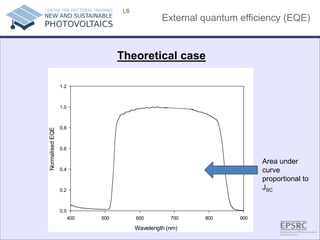
L6 Wavelength (nm) 400500600700800900 Normalised EQE 0.00.20.40.60.81.01.2 
Theoretical case 
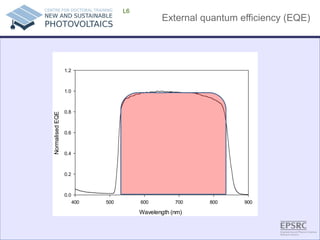
Area under curve proportional to JSC
External quantum efficiency (EQE) 
L6 
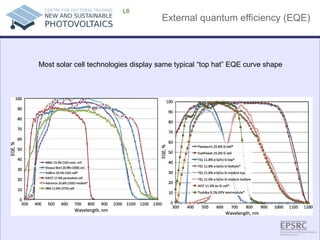
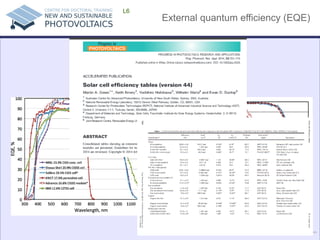
Most solar cell technologies display same typical “top hat” EQE curve shape
External quantum efficiency (EQE) 
L6
External quantum efficiency (EQE) 
L6 
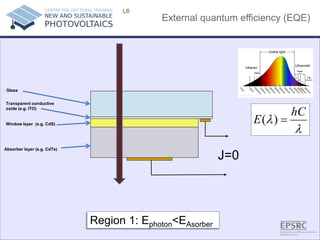
Absorber layer (e.g. CdTe) 
Window layer (e.g. CdS) 
Glass 
Transparent conductive oxide (e.g. ITO) λλhCE=)( 
J=0 
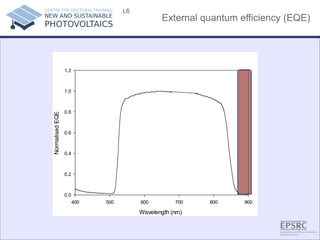
Region 1: Ephoton<EAsorber
External quantum efficiency (EQE) 
L6 Wavelength (nm) 400500600700800900 Normalised EQE 0.00.20.40.60.81.01.2
External quantum efficiency (EQE) 
L6 
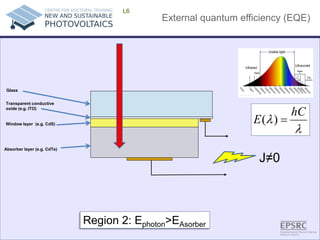
Absorber layer (e.g. CdTe) 
Window layer (e.g. CdS) 
Glass 
Transparent conductive oxide (e.g. ITO) λλhCE=)( 
J≠0 
Region 2: Ephoton>EAsorber
External quantum efficiency (EQE) 
L6 Wavelength (nm) 400500600700800900 Normalised EQE 0.00.20.40.60.81.01.2
External quantum efficiency (EQE) 
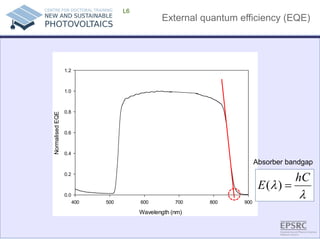
L6 Wavelength (nm) 400500600700800900 Normalised EQE 0.00.20.40.60.81.01.2 
Absorber bandgap 
λλhCE=)(
External quantum efficiency (EQE) 
L6 
Absorber layer (e.g. CdTe) 
Window layer (e.g. CdS) 
Glass 
Transparent conductive oxide (e.g. ITO) λλhCE=)( 
J=0 
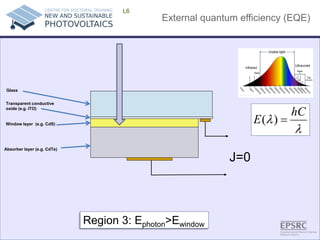
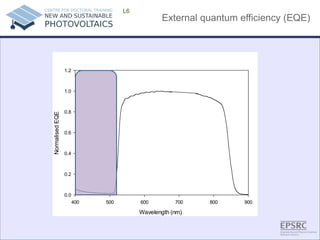
Region 3: Ephoton>Ewindow
External quantum efficiency (EQE) 
L6 Wavelength (nm) 400500600700800900 Normalised EQE 0.00.20.40.60.81.01.2
External quantum efficiency (EQE) 
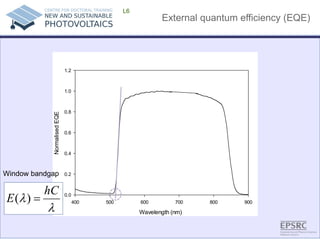
L6 Wavelength (nm) 400500600700800900 Normalised EQE 0.00.20.40.60.81.01.2 
Window bandgap 
λλhCE=)(
External quantum efficiency (EQE) 
L6 
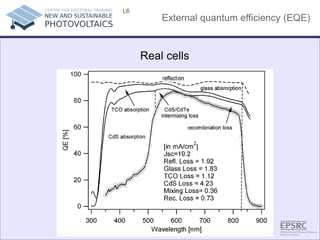
Real cells
External quantum efficiency (EQE) 
L6 
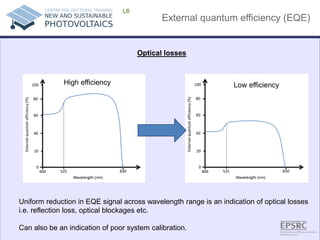
Optical losses 
Uniform reduction in EQE signal across wavelength range is an indication of optical losses i.e. reflection loss, optical blockages etc. 
Can also be an indication of poor system calibration. 
High efficiency 
Low efficiency
External quantum efficiency (EQE) 
L6 Wavelength (nm) 400500600700800900 Normalised EQE 0.00.20.40.60.81.01.2300nm CdS250nm CdS200nm CdS 
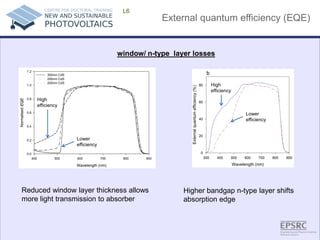
window/ n-type layer losses 
Reduced window layer thickness allows more light transmission to absorber 
Higher bandgap n-type layer shifts absorption edge 
High efficiency 
Lower efficiency 
High efficiency 
Lower efficiency
External quantum efficiency (EQE) 
L6 
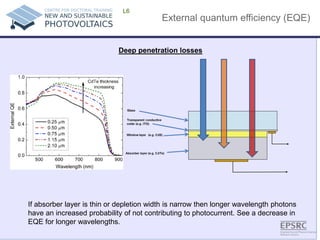
If absorber layer is thin or depletion width is narrow then longer wavelength photons have an increased probability of not contributing to photocurrent. See a decrease in EQE for longer wavelengths. 
Deep penetration losses
External quantum efficiency (EQE) 
L6 
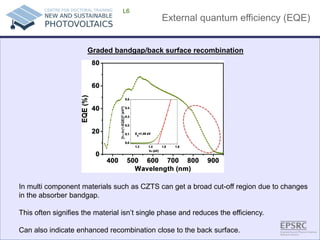
In multi component materials such as CZTS can get a broad cut-off region due to changes in the absorber bandgap. 
This often signifies the material isn’t single phase and reduces the efficiency. 
Can also indicate enhanced recombination close to the back surface. 
Graded bandgap/back surface recombination
External quantum efficiency (EQE) 
L6 
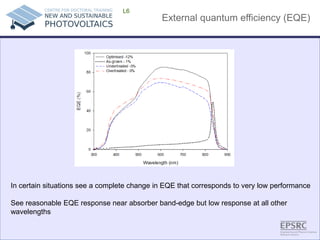
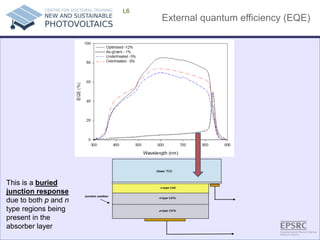
In certain situations see a complete change in EQE that corresponds to very low performance 
See reasonable EQE response near absorber band-edge but low response at all other wavelengths
External quantum efficiency (EQE) 
L6 
This is a buried junction response due to both p and n type regions being present in the absorber layer
Capacitance Voltage analysis (C-V) 
L6 
Capacitance-voltage measurements are useful in deriving particular parameters about PV devices. 
Depending on the type of solar cell, capacitance-voltage (C-V) measurements can be used to derive parameters such as the doping concentration 
and the built-in voltage of the junction. 
A capacitance-frequency (C-f) sweep can be used to provide information on the existence 
of traps in the depletion region. 
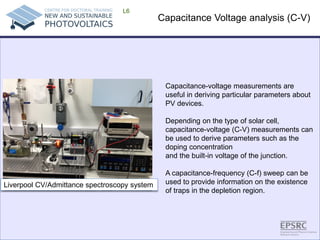
Liverpool CV/Admittance spectroscopy system
Capacitance Voltage analysis (C-V) 
L6 
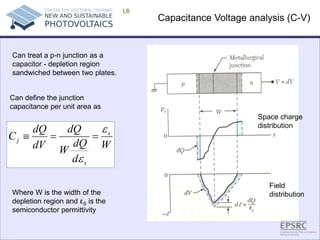
Field 
distribution 
Space charge 
distribution 
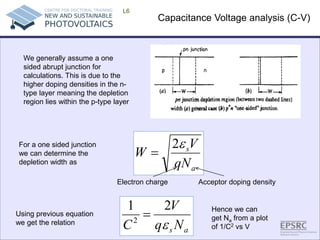
WddQWdQdVdQCssj εε ==≡ 
Can define the junction capacitance per unit area as 
Where W is the width of the depletion region and εS is the semiconductor permittivity 
Can treat a p-n junction as a capacitor - depletion region sandwiched between two plates.
Capacitance Voltage analysis (C-V) 
L6 asNqVCε 212= 
We generally assume a one sided abrupt junction for calculations. This is due to the higher doping densities in the n- type layer meaning the depletion region lies within the p-type layer asqNVW ε2= 
For a one sided junction we can determine the depletion width as 
Acceptor doping density 
Electron charge 
Using previous equation we get the relation 
Hence we can get Na from a plot of 1/C2 vs V
Capacitance Voltage analysis (C-V) 
L6 
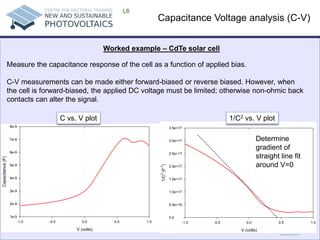
Measure the capacitance response of the cell as a function of applied bias. 
C-V measurements can be made either forward-biased or reverse biased. However, when the cell is forward-biased, the applied DC voltage must be limited; otherwise non-ohmic back contacts can alter the signal. 
V (volts) -1.0-0.50.00.51.0 Capacitance (F) 1e-92e-93e-94e-95e-96e-97e-98e-9 
Worked example – CdTe solar cell 
V (volts) -1.0-0.50.00.51.0 1/C2 (F-2) 0.05.0e+161.0e+171.5e+172.0e+172.5e+173.0e+173.5e+17 
Determine gradient of straight line fit around V=0 
C vs. V plot 
1/C2 vs. V plot
Capacitance Voltage analysis (C-V) 
L6 
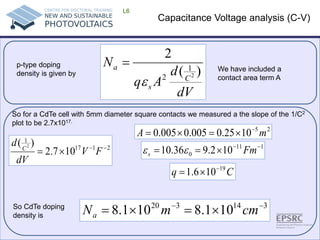
So for a CdTe cell with 5mm diameter square contacts we measured a the slope of the 1/C2 plot to be 2.7x10¹⁷. 
dVdAqNCsa)( 2212ε = 21171107.2)(2−−×=FVdVdC251025.0005.0005.0mA−×=×= 1110102.936.10−−×==Fmsεε Cq19106.1−×= 314320101.8101.8−−×=×=cmmNa 
So CdTe doping density is 
p-type doping density is given by 
We have included a contact area term A
Summary 
LX 
• 
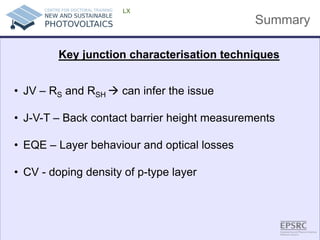
JV – RS and RSH  can infer the issue 
• 
J-V-T – Back contact barrier height measurements 
• 
EQE – Layer behaviour and optical losses 
• 
CV - doping density of p-type layer 
Key junction characterisation techniques

Lecture 6: Junction Characterisation

  • 1.
    Lecture 6 Junctioncharacterisation Jon Major Nov 6th 2014
  • 2.
    The PV researchcycle L6 Voltage (V) -1.0-0.50.00.51.0 Current density (mA/cm2) -20020401.1% 4.9% Make cells Measure cells Despair Repeat Data
  • 3.
    Lecture Outline LX • Analysis of current voltage (J-V) curves • External quantum efficiency (EQE) measurements • Capacitance voltage (C-V) measurements Key junction characterisation techniques
  • 4.
    J-V analysis (J-V) L6 Parasitic resistances Perfect p-n junction Real p-n junction A good device should have low RS And high RSh
  • 5.
    J-V analysis (J-V) L6 Rs Rsh Causes of high RS values • Overly thick absorber layer • Low conductivity TCO • Low doping levels Causes of low RSh values • Pinholes in layers • Weak diode regions
  • 6.
  • 7.
    J-V analysis (J-V) L6 To determine Rsh fit to straight line portion of JV curve in reverse bias Rs can be more difficult to accurately determine. Two common methods Fit to forward bias region of curve Measure change as function of light bias A B
  • 8.
    J-V analysis (J-V) L6 “Roll-over” If a non-ohmic contact is formed this results in the creation of a back contact junction diode. This back-contact diode opposes the main junction diode and leads to the phenomenon of “roll-over” at high forward bias.
  • 9.
    J-V analysis (J-V) L6 For a p-type semiconductor can create an ohmic contact if; Schottky barrier Ohmic contact If this condition is not met we introduce a back contact Schottky barrier Electron affinity Bandgap Metal work function Back contact barrier height
  • 10.
    J-V-T analysis L6-0.50.00.51.01.5 -40-20020406080100120140303 K293 K283 K333 K313 K323 K273 K Influence of barrier height changes as a function of temperature By measuring J-V curves as a function of temperature we can extract the barrier height
  • 11.
    J-V-T analysis L6 Fitting to exponential region allows us to extract a value in eV for the barrier height. Generally anything < 0.3eV is considered a good contact )exp(200kTTCTTRRRbSΦ+ ∂ ∂ +=ΩΩ Measure RS Series resistance varies with temperature via Ohmic resistance Ohmic temperature dependence
  • 12.
  • 13.
    Errors in J-Vanalysis (J-V) L6 • High Voc and FF are reliable • Jsc values are very sensitive to calibration or contact size errors • Contacts should be minimum of 0.25cm2 • If it looks to good to be true it usually is!
  • 14.
  • 15.
    External quantum efficiency(EQE) L6 Absorber layer (e.g. CdTe) Window layer (e.g. CdS) Glass Transparent conductive oxide (e.g. ITO) λλhCE=)( AM1.5 AM1.5 JSC
  • 16.
    External quantum efficiency(EQE) L6 )(λJphotoncellJJEQE= Define the EQE as the ratio of photons in to current generated A 100% EQE means every photon that strikes the cell generates an electron hole pair which flows through the external circuit
  • 17.
    External quantum efficiency(EQE) L6 Wavelength (nm) 400500600700800900 Normalised EQE 0.00.20.40.60.81.01.2 Theoretical case Area under curve proportional to JSC
  • 18.
    External quantum efficiency(EQE) L6 Most solar cell technologies display same typical “top hat” EQE curve shape
  • 19.
  • 20.
    External quantum efficiency(EQE) L6 Absorber layer (e.g. CdTe) Window layer (e.g. CdS) Glass Transparent conductive oxide (e.g. ITO) λλhCE=)( J=0 Region 1: Ephoton<EAsorber
  • 21.
    External quantum efficiency(EQE) L6 Wavelength (nm) 400500600700800900 Normalised EQE 0.00.20.40.60.81.01.2
  • 22.
    External quantum efficiency(EQE) L6 Absorber layer (e.g. CdTe) Window layer (e.g. CdS) Glass Transparent conductive oxide (e.g. ITO) λλhCE=)( J≠0 Region 2: Ephoton>EAsorber
  • 23.
    External quantum efficiency(EQE) L6 Wavelength (nm) 400500600700800900 Normalised EQE 0.00.20.40.60.81.01.2
  • 24.
    External quantum efficiency(EQE) L6 Wavelength (nm) 400500600700800900 Normalised EQE 0.00.20.40.60.81.01.2 Absorber bandgap λλhCE=)(
  • 25.
    External quantum efficiency(EQE) L6 Absorber layer (e.g. CdTe) Window layer (e.g. CdS) Glass Transparent conductive oxide (e.g. ITO) λλhCE=)( J=0 Region 3: Ephoton>Ewindow
  • 26.
    External quantum efficiency(EQE) L6 Wavelength (nm) 400500600700800900 Normalised EQE 0.00.20.40.60.81.01.2
  • 27.
    External quantum efficiency(EQE) L6 Wavelength (nm) 400500600700800900 Normalised EQE 0.00.20.40.60.81.01.2 Window bandgap λλhCE=)(
  • 28.
    External quantum efficiency(EQE) L6 Real cells
  • 29.
    External quantum efficiency(EQE) L6 Optical losses Uniform reduction in EQE signal across wavelength range is an indication of optical losses i.e. reflection loss, optical blockages etc. Can also be an indication of poor system calibration. High efficiency Low efficiency
  • 30.
    External quantum efficiency(EQE) L6 Wavelength (nm) 400500600700800900 Normalised EQE 0.00.20.40.60.81.01.2300nm CdS250nm CdS200nm CdS window/ n-type layer losses Reduced window layer thickness allows more light transmission to absorber Higher bandgap n-type layer shifts absorption edge High efficiency Lower efficiency High efficiency Lower efficiency
  • 31.
    External quantum efficiency(EQE) L6 If absorber layer is thin or depletion width is narrow then longer wavelength photons have an increased probability of not contributing to photocurrent. See a decrease in EQE for longer wavelengths. Deep penetration losses
  • 32.
    External quantum efficiency(EQE) L6 In multi component materials such as CZTS can get a broad cut-off region due to changes in the absorber bandgap. This often signifies the material isn’t single phase and reduces the efficiency. Can also indicate enhanced recombination close to the back surface. Graded bandgap/back surface recombination
  • 33.
    External quantum efficiency(EQE) L6 In certain situations see a complete change in EQE that corresponds to very low performance See reasonable EQE response near absorber band-edge but low response at all other wavelengths
  • 34.
    External quantum efficiency(EQE) L6 This is a buried junction response due to both p and n type regions being present in the absorber layer
  • 35.
    Capacitance Voltage analysis(C-V) L6 Capacitance-voltage measurements are useful in deriving particular parameters about PV devices. Depending on the type of solar cell, capacitance-voltage (C-V) measurements can be used to derive parameters such as the doping concentration and the built-in voltage of the junction. A capacitance-frequency (C-f) sweep can be used to provide information on the existence of traps in the depletion region. Liverpool CV/Admittance spectroscopy system
  • 36.
    Capacitance Voltage analysis(C-V) L6 Field distribution Space charge distribution WddQWdQdVdQCssj εε ==≡ Can define the junction capacitance per unit area as Where W is the width of the depletion region and εS is the semiconductor permittivity Can treat a p-n junction as a capacitor - depletion region sandwiched between two plates.
  • 37.
    Capacitance Voltage analysis(C-V) L6 asNqVCε 212= We generally assume a one sided abrupt junction for calculations. This is due to the higher doping densities in the n- type layer meaning the depletion region lies within the p-type layer asqNVW ε2= For a one sided junction we can determine the depletion width as Acceptor doping density Electron charge Using previous equation we get the relation Hence we can get Na from a plot of 1/C2 vs V
  • 38.
    Capacitance Voltage analysis(C-V) L6 Measure the capacitance response of the cell as a function of applied bias. C-V measurements can be made either forward-biased or reverse biased. However, when the cell is forward-biased, the applied DC voltage must be limited; otherwise non-ohmic back contacts can alter the signal. V (volts) -1.0-0.50.00.51.0 Capacitance (F) 1e-92e-93e-94e-95e-96e-97e-98e-9 Worked example – CdTe solar cell V (volts) -1.0-0.50.00.51.0 1/C2 (F-2) 0.05.0e+161.0e+171.5e+172.0e+172.5e+173.0e+173.5e+17 Determine gradient of straight line fit around V=0 C vs. V plot 1/C2 vs. V plot
  • 39.
    Capacitance Voltage analysis(C-V) L6 So for a CdTe cell with 5mm diameter square contacts we measured a the slope of the 1/C2 plot to be 2.7x10¹⁷. dVdAqNCsa)( 2212ε = 21171107.2)(2−−×=FVdVdC251025.0005.0005.0mA−×=×= 1110102.936.10−−×==Fmsεε Cq19106.1−×= 314320101.8101.8−−×=×=cmmNa So CdTe doping density is p-type doping density is given by We have included a contact area term A
  • 40.
    Summary LX • JV – RS and RSH  can infer the issue • J-V-T – Back contact barrier height measurements • EQE – Layer behaviour and optical losses • CV - doping density of p-type layer Key junction characterisation techniques