Lecture: Solar cell technologies, 
world records and some new 
concepts
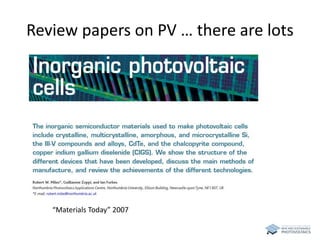
Review papers on PV … there are lots 
“Materials Today” 2007
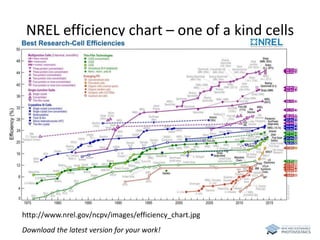
NREL efficiency chart – one of a kind cells 
http://www.nrel.gov/ncpv/images/efficiency_chart.jpg 
Download the latest version for your work!
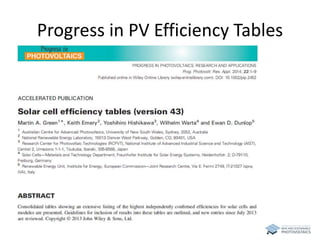
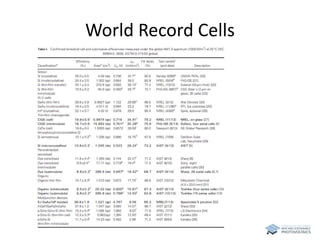
Progress in PV Efficiency Tables
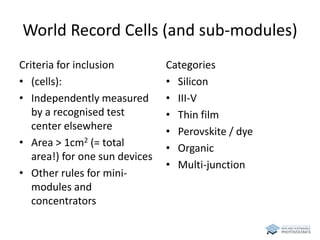
World Record Cells (and sub-modules) 
Criteria for inclusion 
• (cells): 
• Independently measured 
by a recognised test 
center elsewhere 
• Area > 1cm2 (= total 
area!) for one sun devices 
• Other rules for mini-modules 
and 
concentrators 
Categories 
• Silicon 
• III-V 
• Thin film 
• Perovskite / dye 
• Organic 
• Multi-junction
World Record Cells
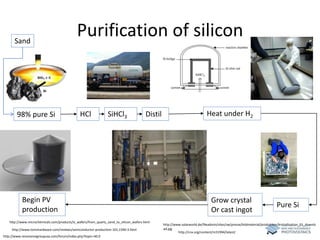
Purification of silicon 
98% pure Si HCl SiHCl3 Distil Heat under H2 
Pure Si 
Grow crystal 
Or cast ingot 
Begin PV 
production 
http://www.microchemicals.com/products/si_wafers/from_quartz_sand_to_silicon_wafers.html 
http://www.tomshardware.com/reviews/semiconductor-production-101,1590-3.html 
http://www.resonancegroupusa.com/forum/index.php?topic=40.0 
http://www.solarworld.de/fileadmin/sites/sw/presse/bildmaterial/produktion/kristallisation_01_downlo 
ad.jpg 
http://cnx.org/content/m31994/latest/ 
Sand
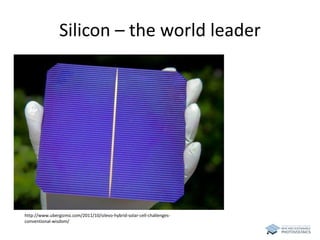
Silicon – the world leader 
http://www.ubergizmo.com/2011/10/silevo-hybrid-solar-cell-challenges-conventional- 
wisdom/
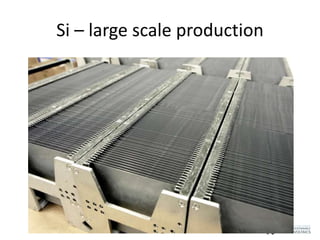
Si – large scale production
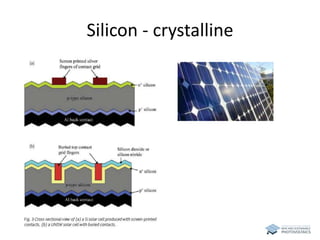
Silicon - crystalline
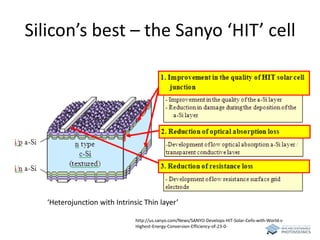
Silicon’s best – the Sanyo ‘HIT’ cell 
‘Heterojunction with Intrinsic Thin layer’ 
http://us.sanyo.com/News/SANYO-Develops-HIT-Solar-Cells-with-World-s- 
Highest-Energy-Conversion-Efficiency-of-23-0-
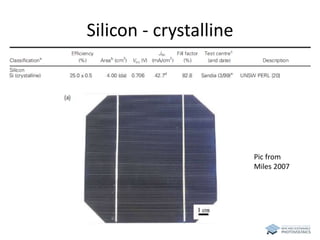
Silicon - crystalline 
Pic from 
Miles 2007
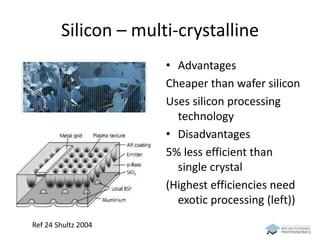
Silicon – multi-crystalline 
• Advantages 
Cheaper than wafer silicon 
Uses silicon processing 
technology 
• Disadvantages 
5% less efficient than 
single crystal 
(Highest efficiencies need 
exotic processing (left)) 
Ref 24 Shultz 2004
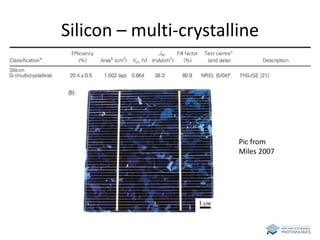
Silicon – multi-crystalline 
Pic from 
Miles 2007
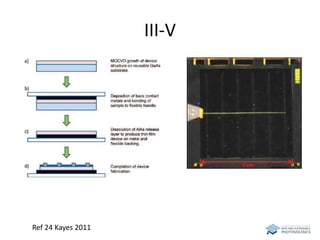
III-V 
Ref 24 Kayes 2011
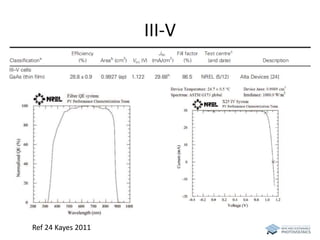
III-V 
Ref 24 Kayes 2011
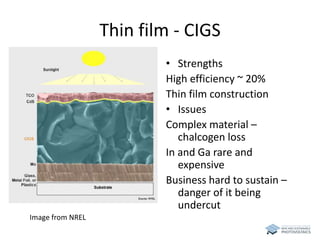
Thin film - CIGS 
• Strengths 
High efficiency ~ 20% 
Thin film construction 
• Issues 
Complex material – 
chalcogen loss 
In and Ga rare and 
expensive 
Business hard to sustain – 
danger of it being 
undercut 
Image from NREL
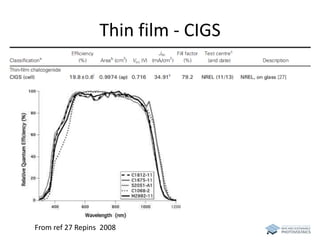
Thin film - CIGS 
From ref 27 Repins 2008
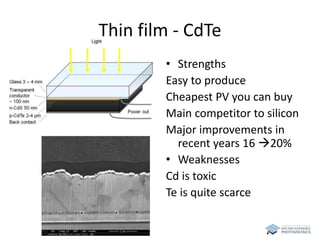
Thin film - CdTe 
• Strengths 
Easy to produce 
Cheapest PV you can buy 
Main competitor to silicon 
Major improvements in 
recent years 16 20% 
• Weaknesses 
Cd is toxic 
Te is quite scarce
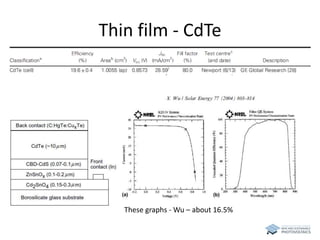
Thin film - CdTe 
These graphs - Wu – about 16.5%
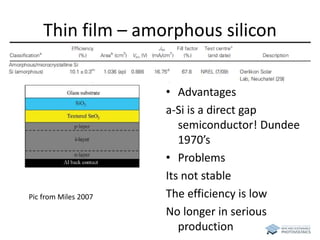
Thin film – amorphous silicon 
• Advantages 
a-Si is a direct gap 
semiconductor! Dundee 
1970’s 
• Problems 
Its not stable 
The efficiency is low 
No longer in serious 
production 
Pic from Miles 2007
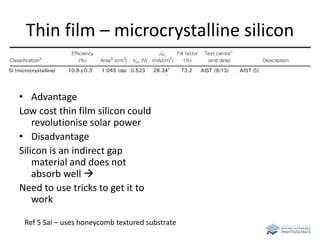
Thin film – microcrystalline silicon 
• Advantage 
Low cost thin film silicon could 
revolutionise solar power 
• Disadvantage 
Silicon is an indirect gap 
material and does not 
absorb well  
Need to use tricks to get it to 
work 
Ref 5 Sai – uses honeycomb textured substrate
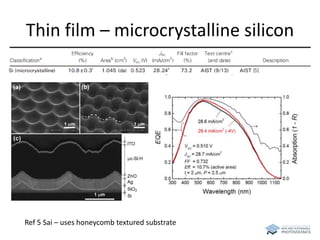
Thin film – microcrystalline silicon 
Ref 5 Sai – uses honeycomb textured substrate
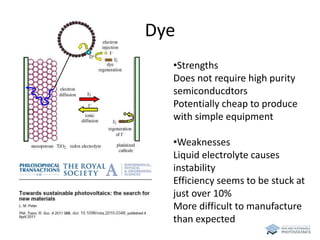
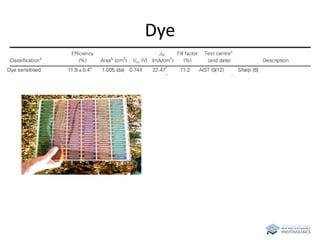
Dye 
•Strengths 
Does not require high purity 
semiconducdtors 
Potentially cheap to produce 
with simple equipment 
•Weaknesses 
Liquid electrolyte causes 
instability 
Efficiency seems to be stuck at 
just over 10% 
More difficult to manufacture 
than expected
Dye
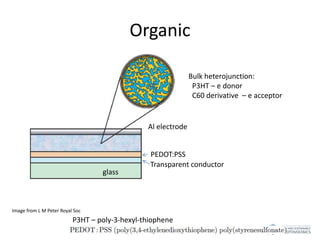
Organic 
Image from L M Peter Royal Soc 
Bulk heterojunction: 
P3HT – e donor 
C60 derivative – e acceptor 
glass 
Al electrode 
PEDOT:PSS 
Transparent conductor 
P3HT – poly-3-hexyl-thiophene
Organic 
• Advantages 
Has potential for low cost 
• Disadvantages 
Unstable – absorption is 
an antibonding 
transition 
Low efficiency 
Companies can’t make it 
pay
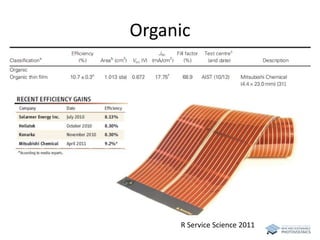
Organic 
R Service Science 2011
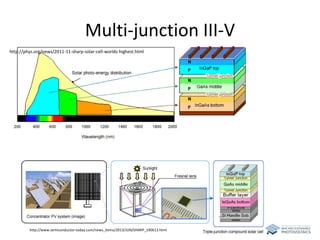
Multi-junction III-V 
http://phys.org/news/2011-11-sharp-solar-cell-worlds-highest.html 
http://www.semiconductor-today.com/news_items/2013/JUN/SHARP_190613.html
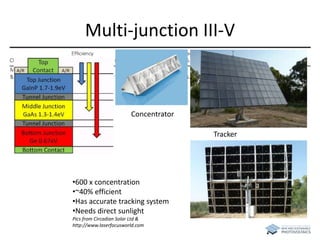
Multi-junction III-V 
Concentrator 
•600 x concentration 
•~40% efficient 
•Has accurate tracking system 
•Needs direct sunlight 
Pics from Circadian Solar Ltd & 
http://www.laserfocusworld.com 
Tracker
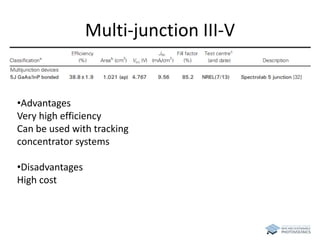
Multi-junction III-V 
•Advantages 
Very high efficiency 
Can be used with tracking 
concentrator systems 
•Disadvantages 
High cost
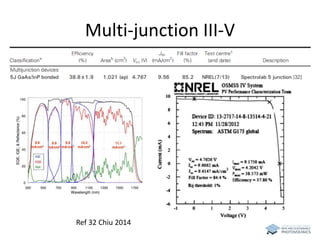
Multi-junction III-V 
Ref 32 Chiu 2014
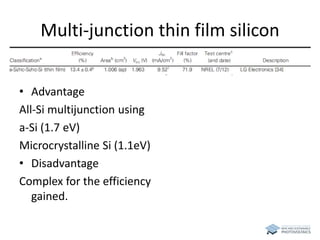
Multi-junction thin film silicon 
• Advantage 
All-Si multijunction using 
a-Si (1.7 eV) 
Microcrystalline Si (1.1eV) 
• Disadvantage 
Complex for the efficiency 
gained.
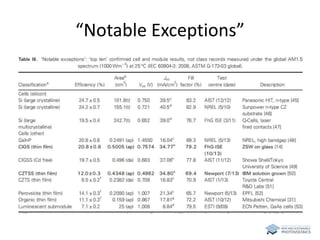
“Notable Exceptions”
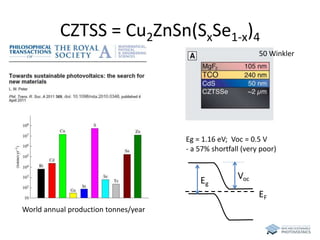
CZTSS = Cu2ZnSn(SxSe1-x)4 
World annual production tonnes/year 
50 Winkler 
Eg = 1.16 eV; Voc = 0.5 V 
- a 57% shortfall (very poor) 
EF 
Eg 
Voc
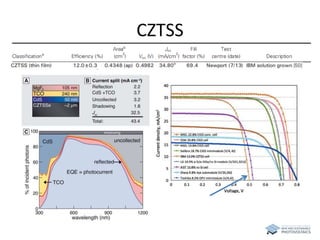
CZTSS
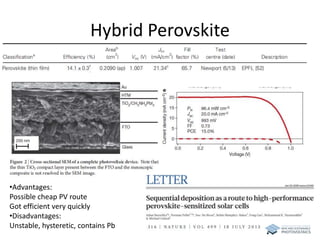
Hybrid Perovskite 
•Advantages: 
Possible cheap PV route 
Got efficient very quickly 
•Disadvantages: 
Unstable, hysteretic, contains Pb
Other concepts
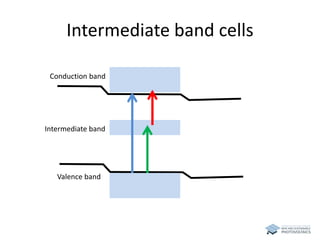
Intermediate band cells 
Conduction band 
Intermediate band 
Valence band
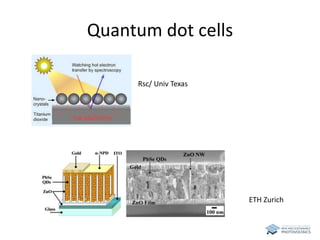
Quantum dot cells 
Rsc/ Univ Texas 
ETH Zurich
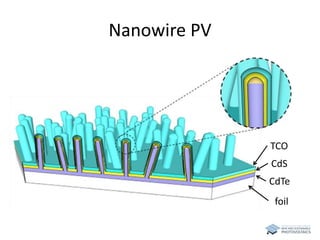
Nanowire PV 
TCO 
CdS 
CdTe 
foil

Lecture 10: Solar Cell Technologies

  • 1.
    Lecture: Solar celltechnologies, world records and some new concepts
  • 2.
    Review papers onPV … there are lots “Materials Today” 2007
  • 3.
    NREL efficiency chart– one of a kind cells http://www.nrel.gov/ncpv/images/efficiency_chart.jpg Download the latest version for your work!
  • 4.
    Progress in PVEfficiency Tables
  • 5.
    World Record Cells(and sub-modules) Criteria for inclusion • (cells): • Independently measured by a recognised test center elsewhere • Area > 1cm2 (= total area!) for one sun devices • Other rules for mini-modules and concentrators Categories • Silicon • III-V • Thin film • Perovskite / dye • Organic • Multi-junction
  • 6.
  • 7.
    Purification of silicon 98% pure Si HCl SiHCl3 Distil Heat under H2 Pure Si Grow crystal Or cast ingot Begin PV production http://www.microchemicals.com/products/si_wafers/from_quartz_sand_to_silicon_wafers.html http://www.tomshardware.com/reviews/semiconductor-production-101,1590-3.html http://www.resonancegroupusa.com/forum/index.php?topic=40.0 http://www.solarworld.de/fileadmin/sites/sw/presse/bildmaterial/produktion/kristallisation_01_downlo ad.jpg http://cnx.org/content/m31994/latest/ Sand
  • 8.
    Silicon – theworld leader http://www.ubergizmo.com/2011/10/silevo-hybrid-solar-cell-challenges-conventional- wisdom/
  • 9.
    Si – largescale production
  • 10.
  • 11.
    Silicon’s best –the Sanyo ‘HIT’ cell ‘Heterojunction with Intrinsic Thin layer’ http://us.sanyo.com/News/SANYO-Develops-HIT-Solar-Cells-with-World-s- Highest-Energy-Conversion-Efficiency-of-23-0-
  • 12.
    Silicon - crystalline Pic from Miles 2007
  • 13.
    Silicon – multi-crystalline • Advantages Cheaper than wafer silicon Uses silicon processing technology • Disadvantages 5% less efficient than single crystal (Highest efficiencies need exotic processing (left)) Ref 24 Shultz 2004
  • 14.
    Silicon – multi-crystalline Pic from Miles 2007
  • 15.
    III-V Ref 24Kayes 2011
  • 16.
    III-V Ref 24Kayes 2011
  • 17.
    Thin film -CIGS • Strengths High efficiency ~ 20% Thin film construction • Issues Complex material – chalcogen loss In and Ga rare and expensive Business hard to sustain – danger of it being undercut Image from NREL
  • 18.
    Thin film -CIGS From ref 27 Repins 2008
  • 19.
    Thin film -CdTe • Strengths Easy to produce Cheapest PV you can buy Main competitor to silicon Major improvements in recent years 16 20% • Weaknesses Cd is toxic Te is quite scarce
  • 20.
    Thin film -CdTe These graphs - Wu – about 16.5%
  • 21.
    Thin film –amorphous silicon • Advantages a-Si is a direct gap semiconductor! Dundee 1970’s • Problems Its not stable The efficiency is low No longer in serious production Pic from Miles 2007
  • 22.
    Thin film –microcrystalline silicon • Advantage Low cost thin film silicon could revolutionise solar power • Disadvantage Silicon is an indirect gap material and does not absorb well  Need to use tricks to get it to work Ref 5 Sai – uses honeycomb textured substrate
  • 23.
    Thin film –microcrystalline silicon Ref 5 Sai – uses honeycomb textured substrate
  • 24.
    Dye •Strengths Doesnot require high purity semiconducdtors Potentially cheap to produce with simple equipment •Weaknesses Liquid electrolyte causes instability Efficiency seems to be stuck at just over 10% More difficult to manufacture than expected
  • 25.
  • 26.
    Organic Image fromL M Peter Royal Soc Bulk heterojunction: P3HT – e donor C60 derivative – e acceptor glass Al electrode PEDOT:PSS Transparent conductor P3HT – poly-3-hexyl-thiophene
  • 27.
    Organic • Advantages Has potential for low cost • Disadvantages Unstable – absorption is an antibonding transition Low efficiency Companies can’t make it pay
  • 28.
    Organic R ServiceScience 2011
  • 29.
    Multi-junction III-V http://phys.org/news/2011-11-sharp-solar-cell-worlds-highest.html http://www.semiconductor-today.com/news_items/2013/JUN/SHARP_190613.html
  • 30.
    Multi-junction III-V Concentrator •600 x concentration •~40% efficient •Has accurate tracking system •Needs direct sunlight Pics from Circadian Solar Ltd & http://www.laserfocusworld.com Tracker
  • 31.
    Multi-junction III-V •Advantages Very high efficiency Can be used with tracking concentrator systems •Disadvantages High cost
  • 32.
  • 33.
    Multi-junction thin filmsilicon • Advantage All-Si multijunction using a-Si (1.7 eV) Microcrystalline Si (1.1eV) • Disadvantage Complex for the efficiency gained.
  • 34.
  • 35.
    CZTSS = Cu2ZnSn(SxSe1-x)4 World annual production tonnes/year 50 Winkler Eg = 1.16 eV; Voc = 0.5 V - a 57% shortfall (very poor) EF Eg Voc
  • 36.
  • 37.
    Hybrid Perovskite •Advantages: Possible cheap PV route Got efficient very quickly •Disadvantages: Unstable, hysteretic, contains Pb
  • 38.
  • 39.
    Intermediate band cells Conduction band Intermediate band Valence band
  • 40.
    Quantum dot cells Rsc/ Univ Texas ETH Zurich
  • 41.
    Nanowire PV TCO CdS CdTe foil