Download to read offline
![Second or fourth-order finite difference operators, which one is most effective?
Int. J. Stat. Math. 045
Table 1. Weights of some higher order centered finite difference approximation for the first derivatives on
equi-spaced grids
Order of
accuracy
4 u 3 u 2 u 1 u 0 u 1 u 2 u 3 u 4 u
2
2
1
0
2
1
4
12
1
-
12
8
0
12
8
-
12
1
6
60
1
60
9
60
45
0
60
45
60
9
60
1
8
840
3
840
32
840
168
840
672
0
840
672
840
168
840
32
840
3
Table 2. Weights of some higher order centered finite difference approximation for the second derivatives on equi-spaced
grids
Order of
accuracy
4 u 3 u 2 u 1 u 0 u 1 u 2 u 3 u 4 u
2 1 -2 1
4
12
1
12
16
12
30
12
16
12
1
6
180
2
180
27
180
270
180
490
180
27
180
27
180
3
8
560
1
315
8
5
1
5
8
72
205
5
8
5
1
315
8
560
1
where i u for i 1,2,3,4 has the equivalence ( 4 ), , ( 4 ) 4 4 u u x x u x x j j in the tables. In general,
schemes for any given derivatives of any chosen order can be derived from Taylor expansions as long as sufficient
number of sample points is used. These approximations are much more difficult far beyond the simple cases shown,
most especially, the higher order formulas. Readers are referred to the books by Fornberg (1995, 1998), Fornberg
and Driscoll (1999) where schematic illustration of how to generate the weights of higher order centered and one-side
finite differences formulas for approximating derivatives up to fourth-order equi-spaced grids with order of
accuracy up to eighth can be found.
For more general finite difference approximations, we follow the description given by Fornberg (2011) and present
briefly the short code that can be used to generate weights of any order approximation schemes on equi-spaced
grids. The program only requires Mathematica package (version seven and above) that contains pre-loaded Pade’
package. The complete code is
t=PadeApproximation[xs(Log[x]/h )m ,{x,1,{n,d}} ];
CoefficientList[{Denominator[t],Numerator[t]},x ]
The numbers d, m, n and s describe the shape of the stencil, where d is the number of grid intervals in between the
left- and right most derivative entries, m indicates the number of
derivatives to be approximated, n stands for the number of grid intervals in between the left- and rightmost function
entries, and s the number of grid intervals in between the leftmost derivative and function entries.
Error Analyses
Next, we need to ask ourselves why using fourth-order approximation scheme instead of the commonly used
second-order scheme approximation? To answer this question, let us quickly consider an example (Mathews and](https://image.slidesharecdn.com/pdf-140917114341-phpapp02/85/Second-or-fourth-order-finite-difference-operators-which-one-is-most-effective-3-320.jpg)
![Second or fourth-order finite difference operators, which one is most effective?
Owolabi 046
Fink 1999). Givenu(x) cos(x) , we use formulas (2.5) and (2.4) with x 0.1,0.01 and 0.001to find
approximations tou(0.8) . The true value here is taken to be u(0.8) cos(0.8) . For instance, the calculation for
x 0.01 with methods (2.5) is
0.696690000
0.0001
(0.81) 2 (0.80) (0.79)
(0.8)
u u u
u .
By subtracting the computed value from the true value, we found the error in this approximation to be 1.0671e-005.
The remaining calculations are summarized in the Table 3
Table3: Numerical approximation using the second-order
formula (2.5)
Step size (x) Approximation Error
x 1.0 -0.640548935 -0.056157774
x 0.1 -0.696126300 -0.000580409
x 0.01 -0.696600000 -0.000016709
x 0.001 -0.696000000 -0.000706709
In the same manner, for the fourth-order formula, we obtain
Table 4. Numerical approximation using the fourth-order
formula (2.4)
Step size (x) Approximation Error
x 1.0 -0.689625413 -0.007081296
x 0.1 -0.696705958 -0.000000751
x 0.01 -0.696000000 -0.000016709
x 0.001 -0.696750000 -0.000031709
The results obtained in the Tables 3 and 4 have shown that the fourth-order scheme produces a better
approximation when compared to its second-order counterpart. The optimal step-size for the formula (2.5) is at when
x 0.01 as shown in Table 3 and the optimal step-size to be used for equation (2.4) is whenx 0.1. We can
see here that the fourth-order allows large step-size.
Next, we analyze briefly the two approximation methods of orders ( ) 2 x and ( ) 4 x that are paramount to our
discussion in this paper. Let k k k u , where k is the error in computing ( ) k u x , then (2.5) can be written in
the form
( , )
( ) 2 ( ) ( )
( ) 2 E u x
x
u x x u x u x x
u x
. (3.6)
The error term E(u,x) consists of both the truncation and the round-off errors. That is,
12
( ) 2 ( ) ( ) ( )
( , ) ( , ) ( , )
2 (4)
2
x u c
x
x x x x x
E u x E u x E u x round trunc
(3.7)
where | ( ) | (4) u c is assumed to be bounded for c c(x)[x x, x x], then the truncation error in (3.7) goes
to zero in the same manner with ( ) 2 x . Since one can assume that each error k has magnitude , and that
| ( ) | (4) u x M , then we can obtain the error bound, if | | k and max[ , ]{ ( )} (4) M x x x x u x , then
| ( , ) | 4 / /12 2 2 E u x x Mx . On simplifying further, the optimum step size is obtained as
1/ 4 x (48 /M) and that | ( ) | cos( ) 1 (4) M u x x .
Int. J. Stat. Math. 047](https://image.slidesharecdn.com/pdf-140917114341-phpapp02/85/Second-or-fourth-order-finite-difference-operators-which-one-is-most-effective-4-320.jpg)
![Second or fourth-order finite difference operators, which one is most effective?
explaining the concept of physical space-time. As a result of this fact, methods for the solution of partial differential
equations, such as the method of lines by Hamdi et al. (2010) and Strikwerda (2004) are still active in the current
field of research. As a basic illustrative example of a PDE, let us consider the diffusion equation
, 0 2
2
t
x
u
D
t
u
(3.8)
where u(x, t) is the population density in biological or ecological processes or the concentration in the chemical or
physical contexts. D is regarded as the diffusion. Equation (3.8) also governs unsteady heat transfer in a solid
medium and one-dimensional Stokes flow.
Solution of equation of the form (3.8) is subjected to some auxiliary conditions that can be determined by the
highest order of the derivatives in each of the independent variables present (see Powers (2006), Meyer (1973),
Kreiss and Lorenz (1989)). To illustrate the method of lines procedure to solve diffusion equation (3.8), suppose that
u(x, t) is discretized in space with N 1points, of which N 1are the interior points, on a uniform grid with step
size x , we have
u x t u t j N j j ( , ) ( ), 0 , (3.9)
where the index j indicating a position along the grid in x and x is the spacing in x along the grid, assumed to be
constant. To find an algebraic approximation to the spatial
derivative 2 2 u / x in (3.8). For instance, the fourth-order centered finite difference approximation, yields the
following ODEs
]
12
( ) 16 ( ) 30 ( ) 16 ( ) ( )
[
( )
( ),
2
1 4 3 2 1 0
0
x
u t u t u t u t u t
D
dt
du t
u f t a
( ) ( ),
]
12
( ) 16 ( ) 30 ( ) 16 ( ) ( )
[
( )
2
1 1 2 3 4
u t f t
x
u t u t u t u t u t
D
dt
du t
N N
N N N N N N
(3.10)
subject to the initial condition
( , 0) ( ), 0 , 0 u x t u x j N j j (3.11)
where f (t) a and f (t) N are the left and right boundaries of u for all t. Equations (3.10) and (3.11) constitute the
complete MOL approximations of (3.8).
Order of Accuracy and Consistency
With the second order schemes and by means of the Taylors expansion, Eq. (3.8) becomes
( ) ( ).
( , )
320
( , )
6
( , )
24
( , )
2
( , ) ( , )
( , ) ( , ) ( , ) 2 ( , ) ( , )
2
0 0
4
0 0
2
0 0
2
0 0
2
0 0 0 0
2
0 0 0 0 0 0 0 0 0 0
t x
u x t
x
u x t D
t
u x t
x
u x t D
t
u x t D u x t
x
u x x t u x t u x x t
D
t
u x t t u x t
ttt xxxxxx
tt xxxx
t xx
(3.12)
The right hand side of (3.12) is the so-called truncation error, and the lowest powers of t and x in the truncation
error are the respective order of accuracies of the finite difference approximations in time and space. Thus, the finite
difference scheme in (3.12) is consistent with the diffusion equation (3.8) to first-order accuracy in time and second-order
accuracy in space.
In the same way, when fourth-order schemes are applied to (3.8), we obtain
Int. J. Stat. Math. 049](https://image.slidesharecdn.com/pdf-140917114341-phpapp02/85/Second-or-fourth-order-finite-difference-operators-which-one-is-most-effective-6-320.jpg)

![Second or fourth-order finite difference operators, which one is most effective?
Considering the sequence
s {l : k p, , 1,0, ,q} k ,
where p and q are positive integers. A square Toeplitz matrix L of order N is of the bandwidth (p q 1) N , if
its entry ij l is a member of the sequence s and zero otherwise. For instance, if p q 2, then L is a pentdiagonal
Toeplitz matrix.
The present paper is primarily concerned with the eigenvalues of Toeplitz matrices obtained from the finite difference
schemes. It will also be of paramount importance for determining the linear stability of our problems. The
eigenvalues of a tridiagonal Toeplitz matrix of arbitrary order N are well understood Mitchell (1980). The major
challenge rest upon the Toeplitz matrix with higher bandwidth, the eigenvalue problems become intractable, see for
instance the work of Sogabe (2004, 2008), although some algorithms have been derived for pentdiagonal matrices,
see Cinkir (2012), Hoffman (2001), Leveque (2007), Durran (2010), Kilic and El-Milkkawy (2008) and El-Milkkawy
(2004) for details. An attempt to circumvent the difficulty in finding the eigenvalues of higher bandwidth Toeplitz
matrices, we shall concentrate basically on the eigenvalues of the circulant Toeplitz matrices, which is more
importantly related to our assumption of periodic boundary conditions.
Stability Analysis
Let us consider the parabolic partial differential equation with one spatial independent variable
(1 )
2
2
u
u
x
u
t
u
, (4.15)
known as the Fisher equation, where , and are positive parameters. Using second order schemes, the Von
Neumann’s stability of the Eq. (4.15 ) can be verified as
1
2
1 4 sin2
k x m ,
where m k is the wave number, 2 t x called the Courant number (Courant et al. (1967)) and we also let
1, for simplicity. The maximum value of the sine function is considered so that 1 4 1 and 0 . For
0 , it implies that t 0 , which is impractical. Thus, we have0 1/ 2 . In order to ensure a stable solution
or reduce errors, maximum care must be exercised in selecting the value of . It further implies that for a givenx ,
the allowed value of t must be small enough to satisfy 1/ 2 . We conclude by saying that a finite difference
equation is stable if it produces a bounded solution when the exact solution is bounded, and is unstable if it produces
an unbounded solution when the exact solution is bounded.
Similarly, when the fourth order scheme is applied to (4.15), we obtain the amplification polynomial
8 8 1 0 4 3 2 G ,
where G 2cos2 32cos 3 . By Intermediate Value Theorem, we let
( ) 8 8 1 4 3 2 g G ,
which is a continuous function. We want to show that there exists a root 1 for g(x) 0 on [0, 1]. Observe
that g(0) 1 0and g(1) G with possibility of cases (i) G 0 (ii) G 0and (iii) G 0 . It is
obvious that the method is stable if |G |1, so the scheme is conditionally stable.
Linear stability analysis can also be verified by setting 0, reaction-diffusion Eq.(4.15) reduces to a standard
diffusion equation (3.8) , its two level difference is presented as
, 0,1,2, 1
1
0 L u L u b n n n n (4.16)
where n b is expected to have contained the boundary conditions and | | 0 0 L . For L I 0 , the difference scheme
(4.16) is explicit otherwise it is an implicit method. In the stability analysis of the matrix method, we determine the
conditions under which the error norm
n n u Er u u 1
where . indicates the stable norm, is bounded as n. Again, we can rewrite (4.16) in the form
Int. J. Stat. Math. 051](https://image.slidesharecdn.com/pdf-140917114341-phpapp02/85/Second-or-fourth-order-finite-difference-operators-which-one-is-most-effective-8-320.jpg)
![Second or fourth-order finite difference operators, which one is most effective?
, 0,1,2, 1 Er Er n n n
where 1
1
0 L L and is called the amplification matrix. With n=1, 2, ..., we have
1 0 1
Er Er
n n
n
.
Therefore, for the stability we require that 1 . In this paper, our particular case is when is symmetric matrix,
then ( )
2
in such a way that it equivalence form ( ) 1. Hence, von Neumann necessary condition is
satisfied.
Convergence
On applying the second order scheme to the diffusion equation (3.8) and let t k and xh , and expand
each terms in Taylors series, we obtain the truncation error formula
( )
2 12
2 12
( , ) ( , ) [ ( , ) 2 ( , ) ( , )]
4 2
2 2
4
4
2 2
2
2
1 1 1
u u k h
kh
u
k
u
h
h u
h
k
u
k
ku
E u x t u x t u x t u x t u x t
tt x
t tt x x
trunc j n j n j n j n j n
(4.17)
where u t t / and u x x / . The trunc E of the method is of order ( ) 2 2 k kh . The order of the method is
given as
( ) ( )
1 2 E k h
k trunc .
If the solution of the difference equation tends to the solution of the differential equation as h0 and k 0 , then
the difference equation is said to be convergent. The same process can be repeated for the fourth-order scheme.
Hence, we conclude with the definition of convergence.
Definition Convergence
Gedney (2011) that says; A finite difference equation (FDE) is consistent with a partial differential equation (PDE) if
the difference between the FDE and the PDE (i.e., the truncation error) vanishes as the sizes of the time step k or
t and spatial grid spacing h or x go to zero independently, is satisfied.
In addition, the Lax-Richtmyer (1956) equivalence theorem states that a consistent finite-difference scheme for a
partial differential equation for which the initial-value problem is well posed is convergent if and only if it is stable, for
a proof, readers are referred to Strikwerda (2004), Thomas(1995, 1999) and Sewel (1991). Finally, by Dahlquist
equivalence theorem, a linear multistep formula is convergent if and only if it is consistent and stable.
Symmetry
According to Fatunla (1988), Jain (1984) and Lambert and Watson (1976), the fourth-order schemes (2.3-2.4) is said
to be symmetric if when the values of s j and s j are interchanged, the function is the same or is multiplied by
minus one.
J J j J j j j j , , 0(1) (4.18)
where j and j correspond to the coefficients of the first and second characteristic polynomial when applied to
(3.8). It follows that
0
8
1
2 2
1 3
0 4
and
30
16
1
2 2
1 3
0 4
Owolabi 052
Hence, the method is symmetric.](https://image.slidesharecdn.com/pdf-140917114341-phpapp02/85/Second-or-fourth-order-finite-difference-operators-which-one-is-most-effective-9-320.jpg)
![Second or fourth-order finite difference operators, which one is most effective?
Numerical results
Numerical method of solution discussed earlier is applied to solve both the diffusion equation (3.8) and the reaction-diffusion
equation (4.15), subject to the initial condition
, [ , ]
cosh( )
1
( ,0) x a b
x
u x
(4.19)
and homogeneous Dirichlet boundary conditions
u(a, t) u(b, t) 0, t 0 (4.20)
The choices of parameters a and b determines how well the waves propagate. When both equations (3.8) and (4.15)
are discretized in space with the fourth-order central difference scheme (2.4), it results to the ordinary differential
equations in time. The resulting ODEs is advanced with the MATLAB ode15s solver.
Figure 3. Solution of the reaction-diffusion equation (4.15) at parameters values
D 0.5, 1/ 2, t 0.001, N 200 for x[15,15] .
Int. J. Stat. Math. 053
-10
-5
0
5
10
0
0.5
1
x 10
-3
0.2
0.4
0.6
0.8
t x
u(x,t)](https://image.slidesharecdn.com/pdf-140917114341-phpapp02/85/Second-or-fourth-order-finite-difference-operators-which-one-is-most-effective-10-320.jpg)
![Second or fourth-order finite difference operators, which one is most effective?
Figure 4: Solution of the reaction-diffusion equation (4.15) at parameters values
D 0.05, 1/8, 5, 1, t 0.01, N 200 for x[15,15] .
Conclusions
To this end, we have dealt with spatial discretization method using finite difference (FD) schemes of higher orders. A
less rigorous method of derivation of higher-order FD schemes has been reported with the aid of a Mathematica
program that contains the pre-loaded Pad'e package, with a view of circumventing the difficulty associated with the
derivation of FD formula with order greater than two, see Tables 1 and 2 for details. Also in this paper, the question
of ``why using fourth-order FD schemes against the commonly used second-order scheme'' is well-answered. A
proof to this assertion is clearly shown in the results presented in Tables 3 and 4 for the second- and fourth-order FD
schemes respectively for different values of x . It is evident from the results presented that the fourth-order scheme
yields a better approximation in comparison to the second-order scheme, as it permits the use of higher step-size.
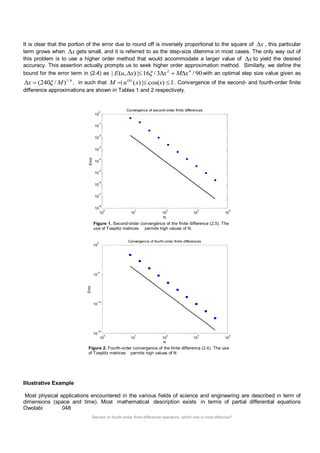
More importantly, the convergence test results presented in Figures 1 and 2 further justify the supremacy of fourth-order
scheme (2.4) over its second-order counterpart (2.5) by error factor of about 14 10 against 7 10 respectively.
Accuracy and suitability of our schemes was ascertained via the analysis of their basic properties such as order of
accuracy, consistency, convergence, stability and symmetry.
REFERENCES
Ascher UM, Ruth SJ, Wetton BTR, Implicit-explicit methods for time- dependent partial differential equations, SIAM
Journal on Numerical Analysis 32: 797-823.
Cinkir Z (2012). A fast elementary algorithm for computing the determinant of Toeplitz matrix. Numerical Analysis.
arXiv:1102.0453v2
Courant R, Friedrichs K, Lewy H (1967). On partial difference equations of mathematical physics. IBM Journal of
Research and Development. 11: 215-234.
Crank J, Nicolson E (1963). A practical method for numerical integration of solutions of partial differential equations
of heat-conduction type. Proceedings of the Cambridge Philosophical Society. 43: 50-67.
Owolabi 054
0
0.005
0.01
-15
-10
-5
0
5
10
15
0.3
0.4
0.5
0.6
0.7
0.8
0.9
x
t
u(x,t)](https://image.slidesharecdn.com/pdf-140917114341-phpapp02/85/Second-or-fourth-order-finite-difference-operators-which-one-is-most-effective-11-320.jpg)


This paper evaluates the effectiveness of second and fourth-order finite difference operators for solving time-dependent reaction-diffusion problems, highlighting why fourth-order methods are preferred. It discusses the method of lines for discretizing spatial derivatives in partial differential equations, leading to a system of ordinary differential equations in time. The paper also analyzes accuracy, stability, and convergence of these methods, providing computational experiments that demonstrate the superiority of fourth-order approximations over second-order ones.


