Content
The iGCSE
Chemistry
course
Section 1 Principles of Chemistry
Section 2 Chemistry of the Elements
Section 3 Organic Chemistry
Section 4 Physical Chemistry
Section 5 Chemistry in Society
Content
Section 3
Organic
Chemistry
a) Introduction
b) Alkanes
c) Alkenes
d) Ethanol
Lesson 1
a) Introduction
b) Alkanes
a) Introduction
b) 3.1 explain the terms homologous series, hydrocarbon,
saturated, unsaturated, general formula and isomerism.
b) Alkanes
3.2 recall that alkanes have the general formula CnH2n+2
3.3 draw displayed formulae for alkanes with up to five
carbon atoms in a molecule, and name the straight-chain
isomers
3.4 recall the products of the complete and incomplete
combustion of alkanes
3.5 describe the substitution reaction of methane with
bromine to form bromomethane in the presence of UV
light.
Organic Chemistry
What is
Organic
Chemistry?
Organic Chemistry
What is
Organic
Chemistry?
It’s the
chemistry of
carbon-
containing
compounds
Organic Chemistry
What is
Organic
Chemistry?
It’s the
chemistry of
carbon-
containing
compounds
Most of these compounds also contain
hydrogen, and many also contain oxygen
or other elements.
Organic Chemistry
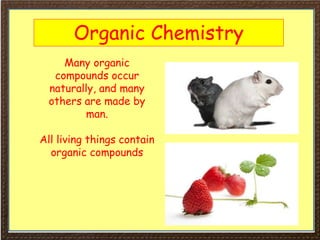
Many organic
compounds occur
naturally, and many
others are made by
man.
Organic Chemistry
Many organic
compounds occur
naturally, and many
others are made by
man.
All living things contain
organic compounds
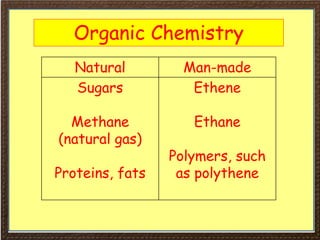
Organic Chemistry
Natural Man-made
Sugars
Methane
(natural gas)
Proteins, fats
Ethene
Ethane
Polymers, such
as polythene
Organic Chemistry
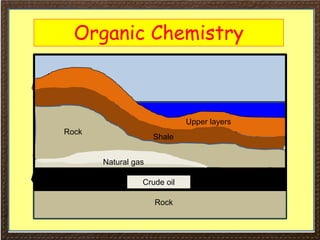
Crude oil is a
mixture of organic
compounds. It is
the raw material
used for the
manufacture of
plastics, solvents,
and thousands of
organic chemicals.
Organic Chemistry
Upper layers
Shale
Rock
Natural gas
Crude oil
Rock
Organic Chemistry
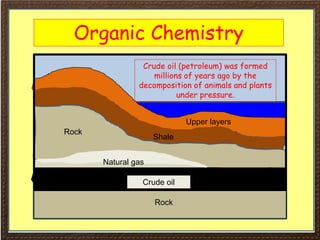
Upper layers
Shale
Rock
Natural gas
Crude oil
Rock
Crude oil (petroleum) was formed
millions of years ago by the
decomposition of animals and plants
under pressure.
Organic Chemistry
Upper layers
Shale
Rock
Natural gas
Crude oil
Rock
Crude oil is a dark viscous liquid
mixture of many different
hydrocarbons.
Organic Chemistry
Upper layers
Shale
Rock
Natural gas
Crude oil
Rock
Crude oil is a dark viscous liquid
mixture of many different
hydrocarbons.
Viscous = does
not flow
easily.
Organic Chemistry
Upper layers
Shale
Rock
Natural gas
Crude oil
Rock
Crude oil is a dark viscous liquid
mixture of many different
hydrocarbons.
Hydrocarbon =
compound containing
hydrogen and carbon
only
Organic Chemistry
Hydrocarbon =
compound containing
hydrogen and carbon
only
The LARGER the hydrocarbon
i.e. the greater the number of
carbon atoms in a molecule:
1. The less easily it flows (i.e.
the more viscous it is)
2. The less easily it ignites (i.e.
the less flammable it is)
3. The less volatile it is (i.e. it
doesn’t vaporise as easily)
4. The higher its boiling point.
Organic Chemistry
Upper layers
Shale
Rock
Natural gas
Crude oil
Rock
Crude oil is the major source of
energy in most industrial countries.
Over 90% is used as a fuel in
industry or transport.
There are three
stages in the refining
of crude oil.
There are three
stages in the refining
of crude oil.
Fractional
distillation
There are three
stages in the refining
of crude oil.
Fractional
distillation
Cracking
There are three
stages in the refining
of crude oil.
Fractional
distillation
Cracking
Reforming
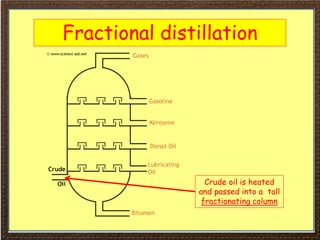
Fractional distillation
Crude oil is heated
and passed into a tall
fractionating column
Fractional distillation
Hydrocarbons with
the lowest boiling
points (gases) pass to
the top of the
column.
Fractional distillation
Hydrocarbons with
the highest boiling
points collect at the
bottom of the
column.
Fractional distillation
Intermediate
fractions are also
collected
Fractional distillation
The various fractions
are purified and
blended to use as
petrol, solvents, and
heating and diesel
oils.
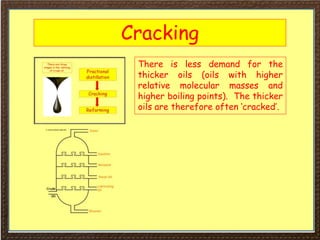
Cracking
There is less demand for the
thicker oils (oils with higher
relative molecular masses and
higher boiling points). The thicker
oils are therefore often ‘cracked’.
Cracking
There is less demand for the
thicker oils (oils with higher
relative molecular masses and
higher boiling points). The thicker
oils are therefore often ‘cracked’.
This means that the larger
molecules are broken down into
smaller ones suitable for making
petrol. This can be done in 2 ways.
Cracking
There is less demand for the
thicker oils (oils with higher
relative molecular masses and
higher boiling points). The thicker
oils are therefore often ‘cracked’.
This means that the larger
molecules are broken down into
smaller ones suitable for making
petrol. This can be done in 2 ways.
Thermal cracking – using heat
Catalytic cracking – using heat
and a catalyst
Reforming
In reforming, hydrocarbons with
small chains of carbon atoms are
converted to hydrocarbons
consisting of larger molecules.
Alkanes
The simplest of all hydrocarbons
Alkanes
The simplest of all hydrocarbons
C C X
X
X
X
X
X
Carbon 2:4 Forms four covalent bonds
Alkanes
C
H
H H
H
Alkanes
Alkanes
C
H
H H
H
Alkanes
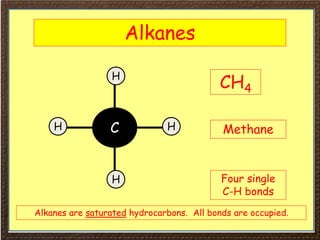
CH4
Methane
Four single
C-H bonds
Alkanes
C
H
H H
H
Alkanes
CH4
Methane
Four single
C-H bonds
Alkanes are saturated hydrocarbons. All bonds are occupied.
Alkanes
Name
Molecular
formula
Physical
state
Methane CH4 Gas
Ethane C2H6 Gas
Propane C3H8 Gas
Butane C4H10 Gas
Pentane C5H12 Gas
Hexane C6H14 Liquid
Alkanes
Name
Molecular
formula
Physical
state
Methane CH4 Gas
Ethane C2H6 Gas
Propane C3H8 Gas
Butane C4H10 Gas
Pentane C5H12 Gas
Hexane C6H14 Liquid
The Alkanes form
an homologous
series.
Each member
differs from the
next by the unit –
CH2
Alkanes
Name
Molecular
formula
Physical
state
Methane CH4 Gas
Ethane C2H6 Gas
Propane C3H8 Gas
Butane C4H10 Gas
Pentane C5H12 Gas
Hexane C6H14 Liquid
The homologous
series of alkanes
has the general
formula:
CnH2n+2
Alkanes
H
H
H C
H
C
H
H
H
H
C
H
H
H
C
H
H
H C
H
H
C
H
H
Propane
Ethane
Methane
Alkanes
H
C
H
H
H C
H
H
H
C
H
H
H C
H
H
C
H
H
C
H
H
C
H
H
C
H
H
C
H
H
Butane
Pentane
Alkanes and Isomerism
Compounds exhibit isomerism when they
have the same molecular formula but
different structural formulae.
All alkanes with more that three carbon
atoms have more than one structure.
Alkanes and Isomerism
H
C
H
H
H C
H
H
C
H
H
C
H
H
Butane, C4H10
H
C
H
H
H C
H
H
C
H
H
H C
H
2-Methylpropane, C4H10
Combustion of Alkanes
Alkanes burn in plentiful air to form carbon
dioxide and water:
Eg: Methane + Oxygen  Carbon dioxide + water
CH4(g) + 2O2(g)  CO2(g) + 2H2O(g)
This is known as complete combustion.
Combustion of Alkanes
Alkanes burn in limited air to form carbon
monoxide and water:
Eg: Methane + Oxygen  Carbon monoxide + water
2CH4(g) + 3O2(g)  2CO(g) + 4H2O(g)
This is known as incomplete combustion.
Alkanes and substitution
reactions
Alkanes and substitution
reactions
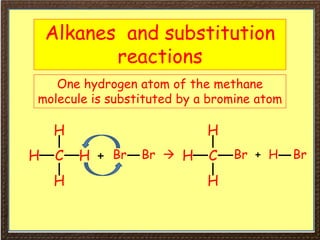
Alkanes, as saturated compounds, can
react by substitution. For example, when
a mixture of methane and bromine is
exposed to ultraviolet light – typically
sunlight – a substitution reaction occurs,
and the organic product is bromomethane.
CH4 + Br2  CH3Br + HBr
methane bromine bromomethane hydrogen
bromide
Alkanes and substitution
reactions
One hydrogen atom of the methane
molecule is substituted by a bromine atom
H
H
H C
H
+ Br Br 
H
H C
H
Br + H Br
Lesson 1
a) Introduction
b) Alkanes
a) Introduction
b) 3.1 explain the terms homologous series, hydrocarbon,
saturated, unsaturated, general formula and isomerism.
b) Alkanes
3.2 recall that alkanes have the general formula CnH2n+2
3.3 draw displayed formulae for alkanes with up to five
carbon atoms in a molecule, and name the straight-chain
isomers
3.4 recall the products of the complete and incomplete
combustion of alkanes
3.5 describe the substitution reaction of methane with
bromine to form bromomethane in the presence of UV
light.
End of Section 3 Lesson 1
In this lesson we have covered:
Introduction to Organic Chemistry
The Chemistry of Alkanes
organic (alkanes).ppt

organic (alkanes).ppt