RESERVOIR SIMULATION 
Assignment on 
1. History matching and prediction 
2. MBE with emphasis on Gas reservoir 
BY 
PARVEZ NOPHEL 
B.TECH APE UP (2011 - 15) 
R870211019 
500017479 
1
CONTENTS 
 WHAT IS RESERVOIR SIMULATION? 
 SIMULATOR AND ITS TYPES 
 HISTORY MATCHING AND PREDICTION 
 CASE STUDY 
 MBE 
 MBE FOR GAS RESERVOIR 
 EXAMPLE NUMERICAL ON GAS MBE 
2
WHAT IS RESERVIR SIMULATION: 
 A digital description of reservoir together combined 
with physical and mathematical equations along 
with good reservoir engineering which is used to 
predict the future performance of the reservoir and 
hence managing the asset is called reservoir 
simulation 
 Reservoir simulation deals with solving set of 
equations, a representative of reservoir, using 
computer programming called simulator. 
3
SIMULATOR AND ITS TYPES 
Simulator is nothing but mathematical equations 
solving by the execution of set of computer programs. 
 Black-oil model (IMEX) 
 Compositional model (GEM) 
 Thermal model (STARS) 
 Chemical 
 Miscible 
 Dual Porosity 
 Dual permeability 
4
HISTORY MATCHING AND PREDICTION 
 History matching is the process of building one or 
more sets of numerical models (representing a 
reservoir) which account for observed, measured 
data. 
 It is a part of Uncertainty quantification. 
 It matches the developed model with geospatial, 
geological and production data to create a perfect 
reservoir model. 
 The matched model is used for future performance 
of the reservoir. 
5
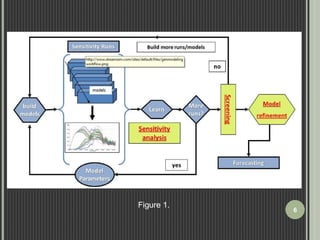
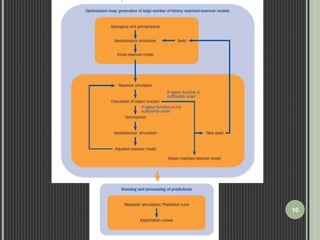
Figure 1. 
6
CASE STUDY 
Organization: TNO - 1996 
 As the History matching is a process of selection of 
appropriate model for the future prediction, it should 
be more accurate. 
 Proper parameterization of the stochastic process 
involved. 
 The model parameter is assigned as show in the 
figure 1 which is an iterative process. 
 The data consistent with many models. 
 Subjective decision was made by the reservoir 
engineer. 7
 The uncertainty in any prediction cannot be 
assessed from just one model. 
 One point selection / base case. 
 The study demonstrates how limited and biased 
that practice is. Yet, most long-term forecasts are 
still based on a single history-matched. 
 Sometimes the best matched results may be 
improper due to the reason that the statistical 
nature of history matching and the inherent bias in 
the history-matching workflow are ignored. 
8
TNO’S NEW METHOD: AN AUTOMATIC 
PROBABILISTIC HISTORY-MATCH PROCEDURE: 
 An automatic probabilistic history-match and 
prediction procedure has been implemented by 
TNO. 
 This procedure automatically generates many 
realisations of the reservoir reproducing the history 
data with satisfactory accuracy. 
 Using these realisations, predictions are derived 
and processed into an expectation curve. 
 Most of the theory behind this methodology has 
been developed and demonstrated on synthetic 
cases within the Production forecasting with 
Uncertainty Quantification project (PUNQ) 9
10
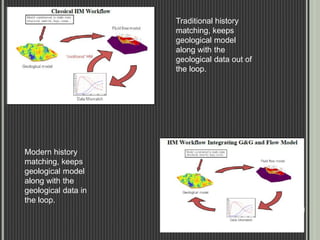
Traditional history 
matching, keeps 
geological model 
along with the 
geological data out of 
the loop. 
Modern history 
matching, keeps 
geological model 
along with the 
geological data in 
the loop. 
11
RESULTS OF TNO’S WORKS: 
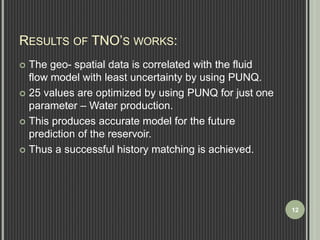
 The geo- spatial data is correlated with the fluid 
flow model with least uncertainty by using PUNQ. 
 25 values are optimized by using PUNQ for just one 
parameter – Water production. 
 This produces accurate model for the future 
prediction of the reservoir. 
 Thus a successful history matching is achieved. 
12
MBE: 
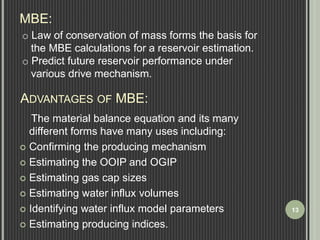
o Law of conservation of mass forms the basis for 
the MBE calculations for a reservoir estimation. 
o Predict future reservoir performance under 
various drive mechanism. 
ADVANTAGES OF MBE: 
The material balance equation and its many 
different forms have many uses including: 
 Confirming the producing mechanism 
 Estimating the OOIP and OGIP 
 Estimating gas cap sizes 
 Estimating water influx volumes 
 Identifying water influx model parameters 
 Estimating producing indices. 
13
MBE FOR GAS RESERVOIR 
([Solution gas present in 
the 
reservoir initially(st. vol.) 
] + 
[Free gas present in the 
reservoir initially (st. 
vol.)] - [Gas produced 
(st. vol.) ] + 
[Gas injected (st. vol.)] ) 
([Solution gas 
present in the 
reservoir finally (st. 
vol.)] + 
[Free gas present in 
the reservoir finally 
(st. vol.)] ) 
= 
14
CONCEPT 
 COMPRESSIBILITY OF GAS IS VERY 
SIGNIFICANT DRIVE MECHNISM IN GAS 
RESERVOIRS AS COMAPRED TO RESERVOIR 
PORE VOLUME. 
 IF THERE IS NO WATER DRIVE IN THE 
RESVOIR, THE CHANGE IN PORE VOLUME 
WITH PRESSURE IS NEGLIGIBLE 
 EQUATION FOR THE VOLUME OF THE GAS IN 
RESERVOIR IS A FUNCTION OF PRTESSURE. 
15
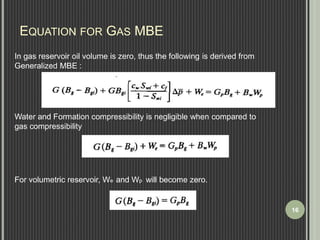
EQUATION FOR GAS MBE 
In gas reservoir oil volume is zero, thus the following is derived from 
Generalized MBE : 
Water and Formation compressibility is negligible when compared to 
gas compressibility 
For volumetric reservoir, We and Wp will become zero. 
16
REFERENCES: 
 “Principles of Applied Reservoir Simulation”, 
Second edition; Fanchi, R. John; Gulf Professional 
publishing, Elsevier, USA; 2001. 
 http://www.streamsim.com/technlogy/history-matching/ 
 http://www.streamsim.com/technology/sentivity-analysis- 
and-screening/ 
 “Production forecasting with uncertainty 
quantification” – TNO. – 
http://www.tno.nl/downloads%5C309beno.pdf 
17
18

Reservoir simulation

  • 1.
    RESERVOIR SIMULATION Assignmenton 1. History matching and prediction 2. MBE with emphasis on Gas reservoir BY PARVEZ NOPHEL B.TECH APE UP (2011 - 15) R870211019 500017479 1
  • 2.
    CONTENTS  WHATIS RESERVOIR SIMULATION?  SIMULATOR AND ITS TYPES  HISTORY MATCHING AND PREDICTION  CASE STUDY  MBE  MBE FOR GAS RESERVOIR  EXAMPLE NUMERICAL ON GAS MBE 2
  • 3.
    WHAT IS RESERVIRSIMULATION:  A digital description of reservoir together combined with physical and mathematical equations along with good reservoir engineering which is used to predict the future performance of the reservoir and hence managing the asset is called reservoir simulation  Reservoir simulation deals with solving set of equations, a representative of reservoir, using computer programming called simulator. 3
  • 4.
    SIMULATOR AND ITSTYPES Simulator is nothing but mathematical equations solving by the execution of set of computer programs.  Black-oil model (IMEX)  Compositional model (GEM)  Thermal model (STARS)  Chemical  Miscible  Dual Porosity  Dual permeability 4
  • 5.
    HISTORY MATCHING ANDPREDICTION  History matching is the process of building one or more sets of numerical models (representing a reservoir) which account for observed, measured data.  It is a part of Uncertainty quantification.  It matches the developed model with geospatial, geological and production data to create a perfect reservoir model.  The matched model is used for future performance of the reservoir. 5
  • 6.
  • 7.
    CASE STUDY Organization:TNO - 1996  As the History matching is a process of selection of appropriate model for the future prediction, it should be more accurate.  Proper parameterization of the stochastic process involved.  The model parameter is assigned as show in the figure 1 which is an iterative process.  The data consistent with many models.  Subjective decision was made by the reservoir engineer. 7
  • 8.
     The uncertaintyin any prediction cannot be assessed from just one model.  One point selection / base case.  The study demonstrates how limited and biased that practice is. Yet, most long-term forecasts are still based on a single history-matched.  Sometimes the best matched results may be improper due to the reason that the statistical nature of history matching and the inherent bias in the history-matching workflow are ignored. 8
  • 9.
    TNO’S NEW METHOD:AN AUTOMATIC PROBABILISTIC HISTORY-MATCH PROCEDURE:  An automatic probabilistic history-match and prediction procedure has been implemented by TNO.  This procedure automatically generates many realisations of the reservoir reproducing the history data with satisfactory accuracy.  Using these realisations, predictions are derived and processed into an expectation curve.  Most of the theory behind this methodology has been developed and demonstrated on synthetic cases within the Production forecasting with Uncertainty Quantification project (PUNQ) 9
  • 10.
  • 11.
    Traditional history matching,keeps geological model along with the geological data out of the loop. Modern history matching, keeps geological model along with the geological data in the loop. 11
  • 12.
    RESULTS OF TNO’SWORKS:  The geo- spatial data is correlated with the fluid flow model with least uncertainty by using PUNQ.  25 values are optimized by using PUNQ for just one parameter – Water production.  This produces accurate model for the future prediction of the reservoir.  Thus a successful history matching is achieved. 12
  • 13.
    MBE: o Lawof conservation of mass forms the basis for the MBE calculations for a reservoir estimation. o Predict future reservoir performance under various drive mechanism. ADVANTAGES OF MBE: The material balance equation and its many different forms have many uses including:  Confirming the producing mechanism  Estimating the OOIP and OGIP  Estimating gas cap sizes  Estimating water influx volumes  Identifying water influx model parameters  Estimating producing indices. 13
  • 14.
    MBE FOR GASRESERVOIR ([Solution gas present in the reservoir initially(st. vol.) ] + [Free gas present in the reservoir initially (st. vol.)] - [Gas produced (st. vol.) ] + [Gas injected (st. vol.)] ) ([Solution gas present in the reservoir finally (st. vol.)] + [Free gas present in the reservoir finally (st. vol.)] ) = 14
  • 15.
    CONCEPT  COMPRESSIBILITYOF GAS IS VERY SIGNIFICANT DRIVE MECHNISM IN GAS RESERVOIRS AS COMAPRED TO RESERVOIR PORE VOLUME.  IF THERE IS NO WATER DRIVE IN THE RESVOIR, THE CHANGE IN PORE VOLUME WITH PRESSURE IS NEGLIGIBLE  EQUATION FOR THE VOLUME OF THE GAS IN RESERVOIR IS A FUNCTION OF PRTESSURE. 15
  • 16.
    EQUATION FOR GASMBE In gas reservoir oil volume is zero, thus the following is derived from Generalized MBE : Water and Formation compressibility is negligible when compared to gas compressibility For volumetric reservoir, We and Wp will become zero. 16
  • 17.
    REFERENCES:  “Principlesof Applied Reservoir Simulation”, Second edition; Fanchi, R. John; Gulf Professional publishing, Elsevier, USA; 2001.  http://www.streamsim.com/technlogy/history-matching/  http://www.streamsim.com/technology/sentivity-analysis- and-screening/  “Production forecasting with uncertainty quantification” – TNO. – http://www.tno.nl/downloads%5C309beno.pdf 17
  • 18.

Editor's Notes

  • #9 One point selection – when model is being run, the reservoir engineer is able to obtain any point as a base case for the future prediction since only one model was used in traditional history matching. This is disadvantageous.