EOR Thermal Methods
[Heavy , viscous crude]
Target : Increase reservoir temperature
of the oil and reduce its viscosity.
Agenda
Introduction to EOR Thermal Methods
Basics of EOR Thermal Methods
Basic mechanisms of steam and air injection
Brief Summary of Screening Criteria for EOR Thermal
Overview of EOR Thermal Methods
Field Case: HPAI in Cedar Hills
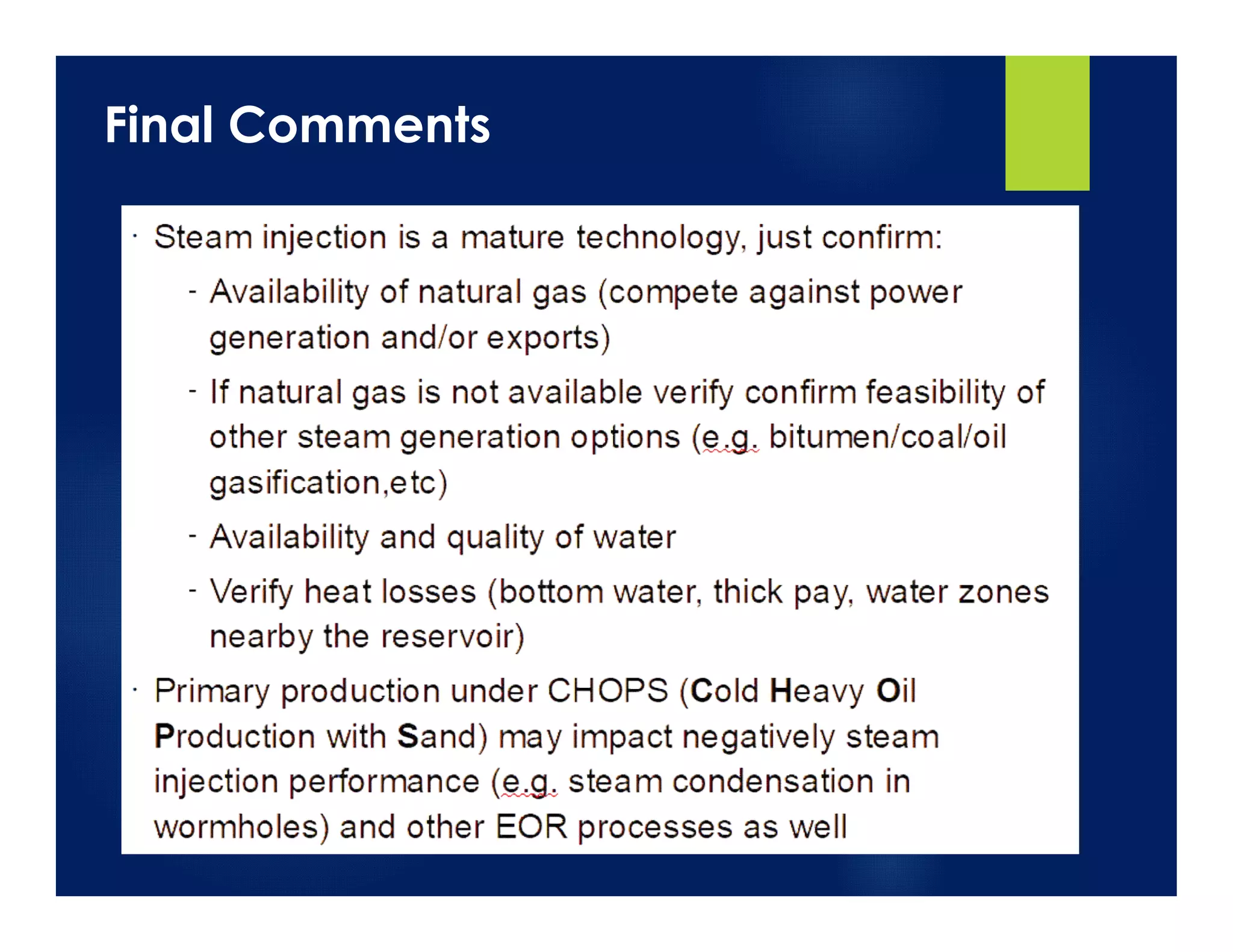
Final Comments
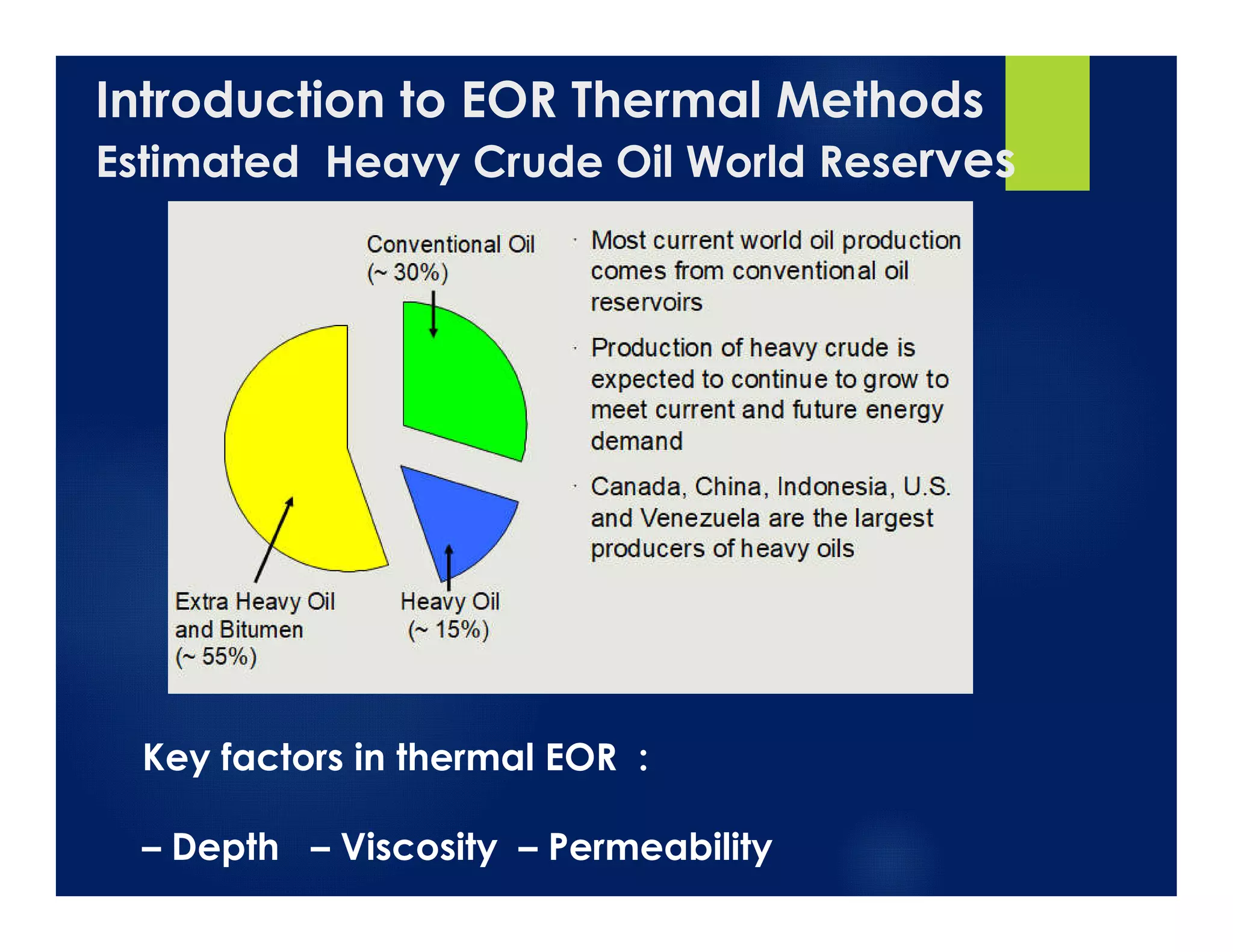
Introduction to EOR Thermal Methods
Estimated Heavy Crude Oil World Reserves
Key factors in thermal EOR :
– Depth – Viscosity – Permeability
Comparison of Heavy Oil Data (some fields
Thermal Methods
Steam Flooding (SF) - Continue (paterns
- Alternate (same well used to inject and produce)
Hot Water Flooding (HWF) – reduction of oil viscosity
Steam Assisted Gravity Drainage (SAGD) - horizontal wells mainly
-one injector one producer
Combustion in Situ (CIS) – through air injection a combustion front and
chemical reactions that move oil to the producers
High Pressure Air Injection (HPAI) - interfacial tension changes, oil swelling
and reservoir re pressurization
Steam Flooding (SF) - Continue (patterns)
Rock and fluid properties, heterogeneities as directional l distribution of K
and porosity, lack of lateral continuity, etc are key factors to take in account.
• Some thermal energy is lost in heating the formation rock and water
• The steam moves through the reservoir and comes in contact with cold oil,
rock, and water, then it condenses and a hot water bank is formed. This hot
water bank acts as a water flood and pushes additional oil to the producers
Steam Flooding (SF) - Continue (patterns)
Mechanisms of this process
– include thermal expansion of the crude oil,
– viscosity reduction of the crude oil,
– changes in surface forces as the reservoi rtemperature increases,
– and steam distillation of the lighter portions of the crudeoil.
• This application is limited due to loss of heat energy. In deep wells,
steam will be converted to liquid water
•
Oil recoveries have ranged from 0.3 to 0.6 bbl of oil per barrel of
steam injected.(rule of thumb)
Steam Injection Calc
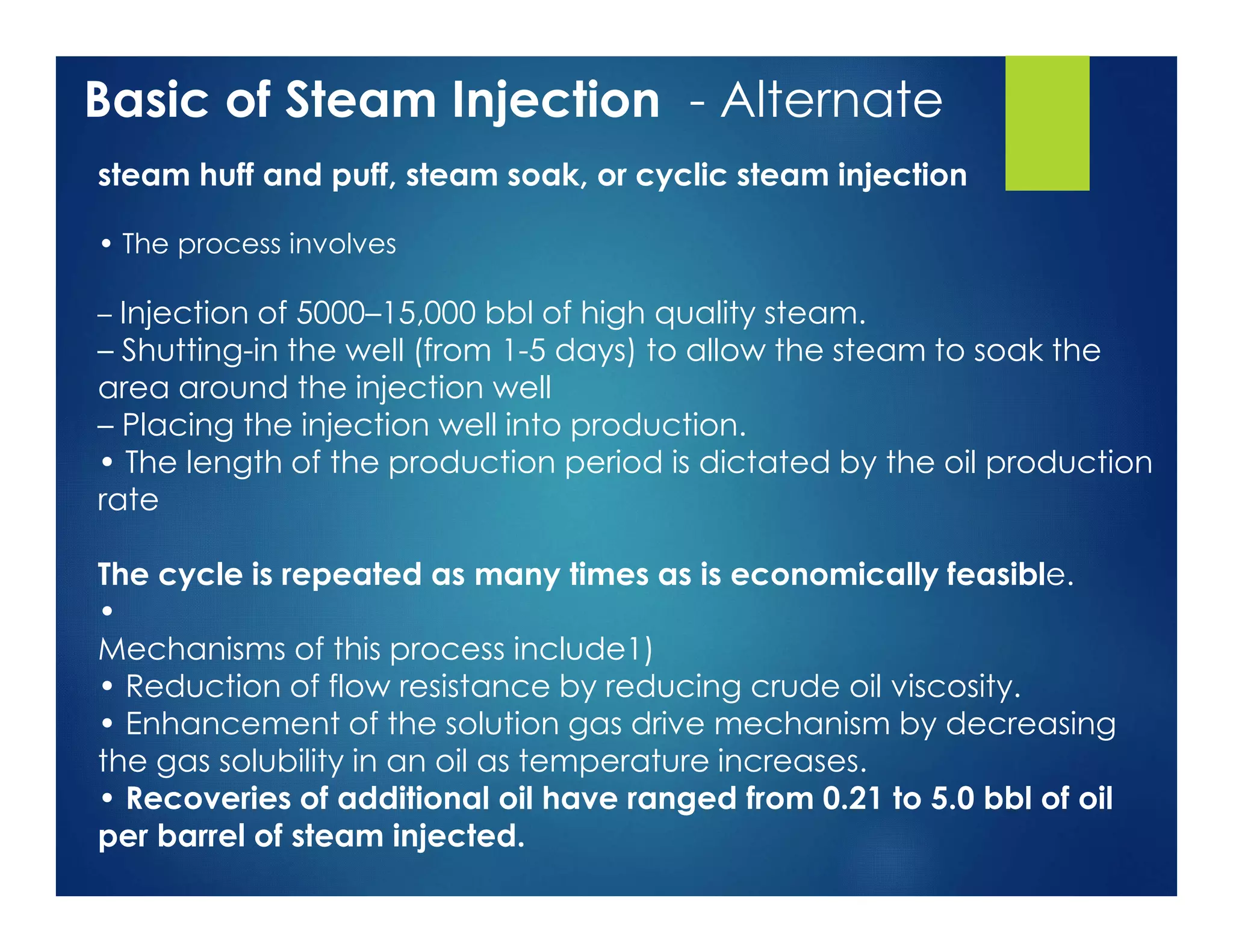
Basic of Steam Injection - Alternate
steam huff and puff, steam soak, or cyclic steam injection
• The process involves
– Injection of 5000–15,000 bbl of high quality steam.
– Shutting-in the well (from 1-5 days) to allow the steam to soak the
area around the injection well
– Placing the injection well into production.
• The length of the production period is dictated by the oil production
rate
The cycle is repeated as many times as is economically feasible.
•
Mechanisms of this process include1)
• Reduction of flow resistance by reducing crude oil viscosity.
• Enhancement of the solution gas drive mechanism by decreasing
the gas solubility in an oil as temperature increases.
• Recoveries of additional oil have ranged from 0.21 to 5.0 bbl of oil
per barrel of steam injected.
Basics of Steam Injection - Stages
Adapted from Chandran Udumbasseri
Basics of Steam Injection - Criteria
Values are not mandatory .
There are recommended values for key parameters.
Cyclic Steam Injection Calc
0
50
100
150
200
250
300
350
1
10
100
0 200 400 600 800
Temperature(F)
LiquidRate(bbl/day)
Time (days)
Cyclic Steam Results
Water Oil Temperature
Cycle 1 2
Steam injection rate per cycle (bbl/d , m3/d) 900 900
Duration of injection period per cycle (days) 7 7
Duration of soak period (days) 7 7
Downhole steam temperature (f or c) 350 350
Downhole steam quality (fraction) 0.50 0.50
Time limit of production per cycle (days) 120 120
Depletion index limit for each cycle 3 3
Initial bottomhole flowing pressure (psi or kpa) 110 110
Half life constant for bottomhole pressure decline (days) 5 5
Lower limit of bottomhole pressure (psi or kpa) 17 17
Maximum liquid production allowed per cycle (bbl/d or m3/d) 800 800
Downhole steam pressure (psi or kPa) 137.1 137.1
Oil viscosity at steam temp (cp) 3.9 3.9
Steam zone thickness (ft or m) 44.1 44.1
Steam zone volume (ft3 or m3) 174,529.4 190,677.4
Steam zone radius (ft or m) 17.7 18.6
Viscosity factor 1.0 1.0
Time since starting project (days) 121.0 246.0
Cumulative oil production (bbl) 1,335.0 1,829.4
Oil recovery this cycle (% OIP) 0.5 0.2
Total oil recovery (% OIP) 0.5 0.7
Cumulative water injected (bbl) x 6,300.0 12,600.0
Oil-steam ratio 0.2 0.1
Water remaining in reservoir (bbl) 82,094.4 69,953.5
Average reservoir temperature (deg F) 132.2 136.1
Heated zone radius (ft) x 17.7 18.6
Steam zone thickness (ft) x 44.1 44.1
Total heat injected (Btu) x 1.51E+09 1.51E+09
Heat remaining in heated zone (Btu) 1.31E+08 1.68E+08
Heat loss during injection (Btu) x 9.39E+07 9.39E+07
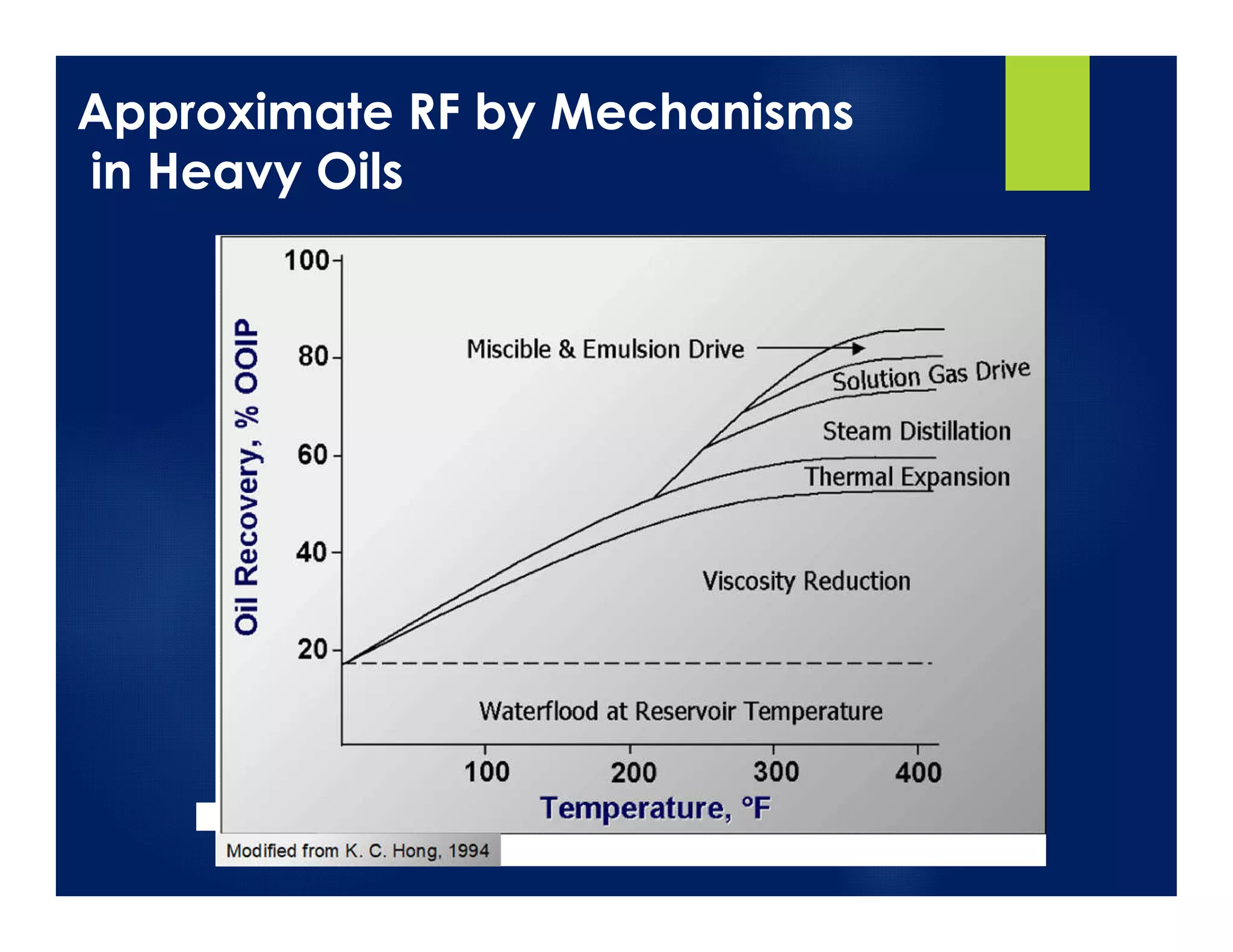
Approximate RF by Mechanisms
in Heavy Oils
Steam Assisted Gravity Drainage (SAGD)
SAGD Steam {Schematic} Chamber
Reduced viscosity and horizontal well allow practical rates without
steam production (no coning)
Steam replaces produced oil and raises pressure at top to allow
flow in same cases.
Main Reservoir Properties of International
SAGD Projects ( as of 2011)
(SAGD) Scheme
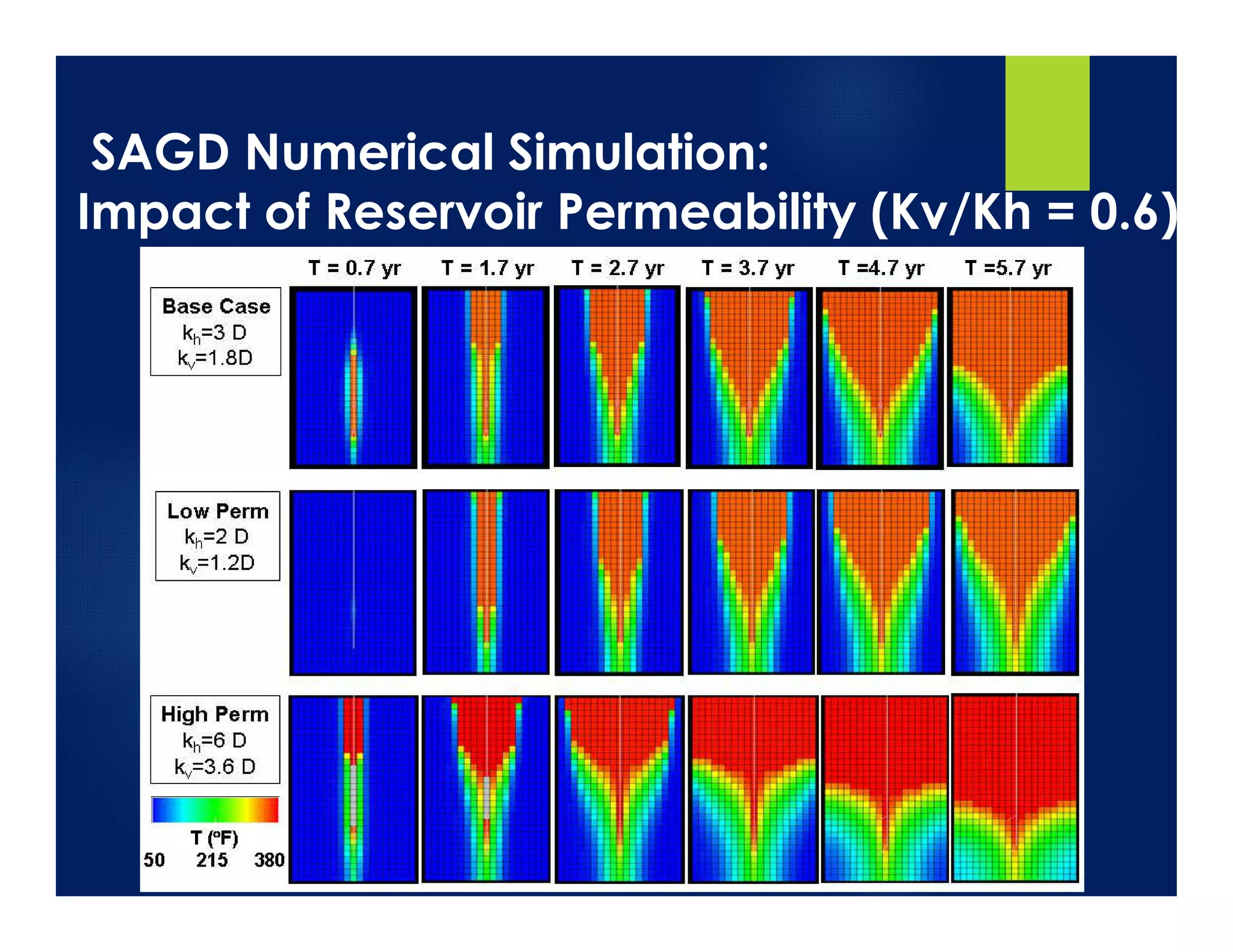
SAGD Numerical Simulation:
Impact of Reservoir Permeability (Kv/Kh = 0.6)
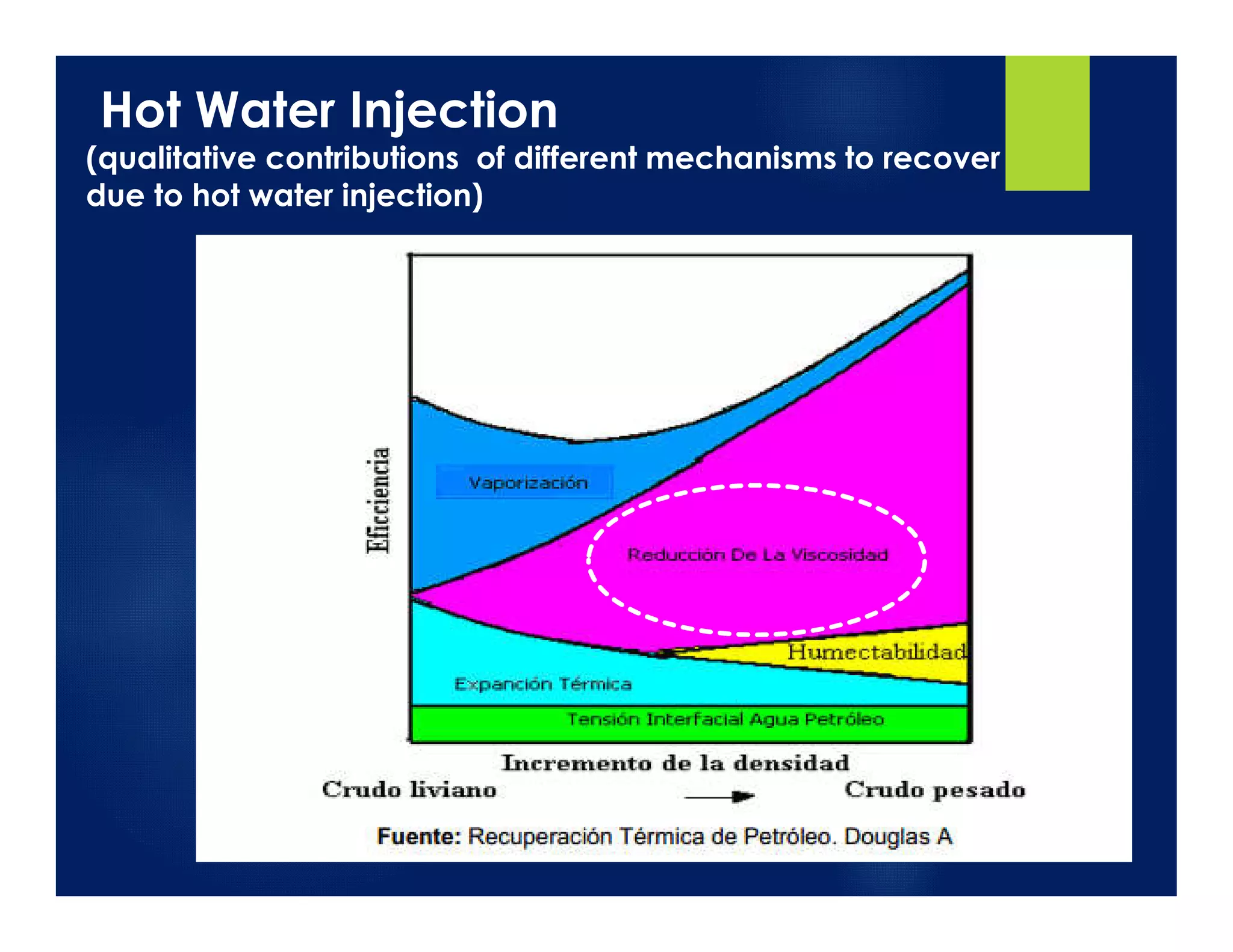
Hot Water Injection
(qualitative contributions of different mechanisms to recover
due to hot water injection)
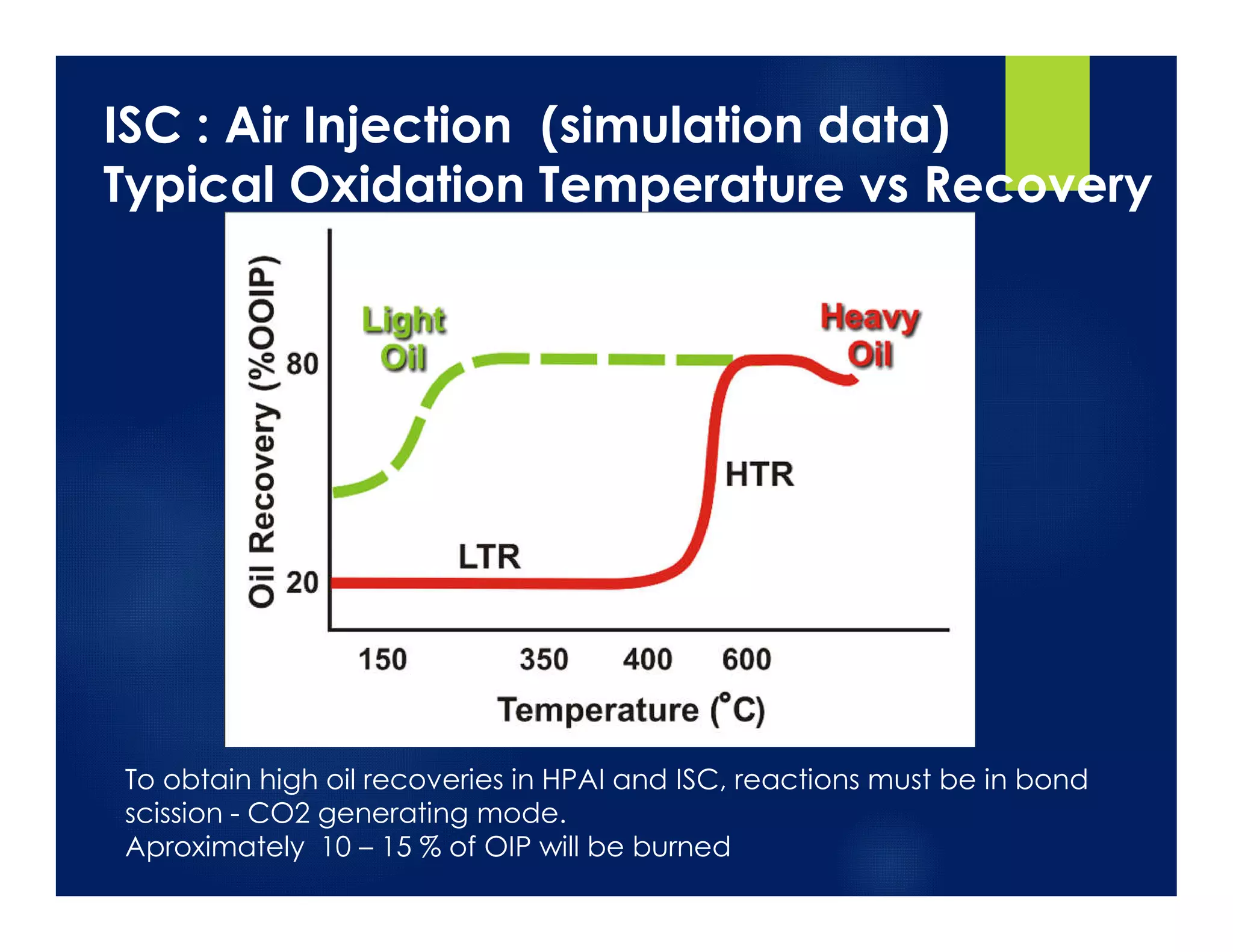
ISC : Air Injection (simulation data)
Typical Oxidation Temperature vs Recovery
To obtain high oil recoveries in HPAI and ISC, reactions must be in bond
scission - CO2 generating mode.
Aproximately 10 – 15 % of OIP will be burned
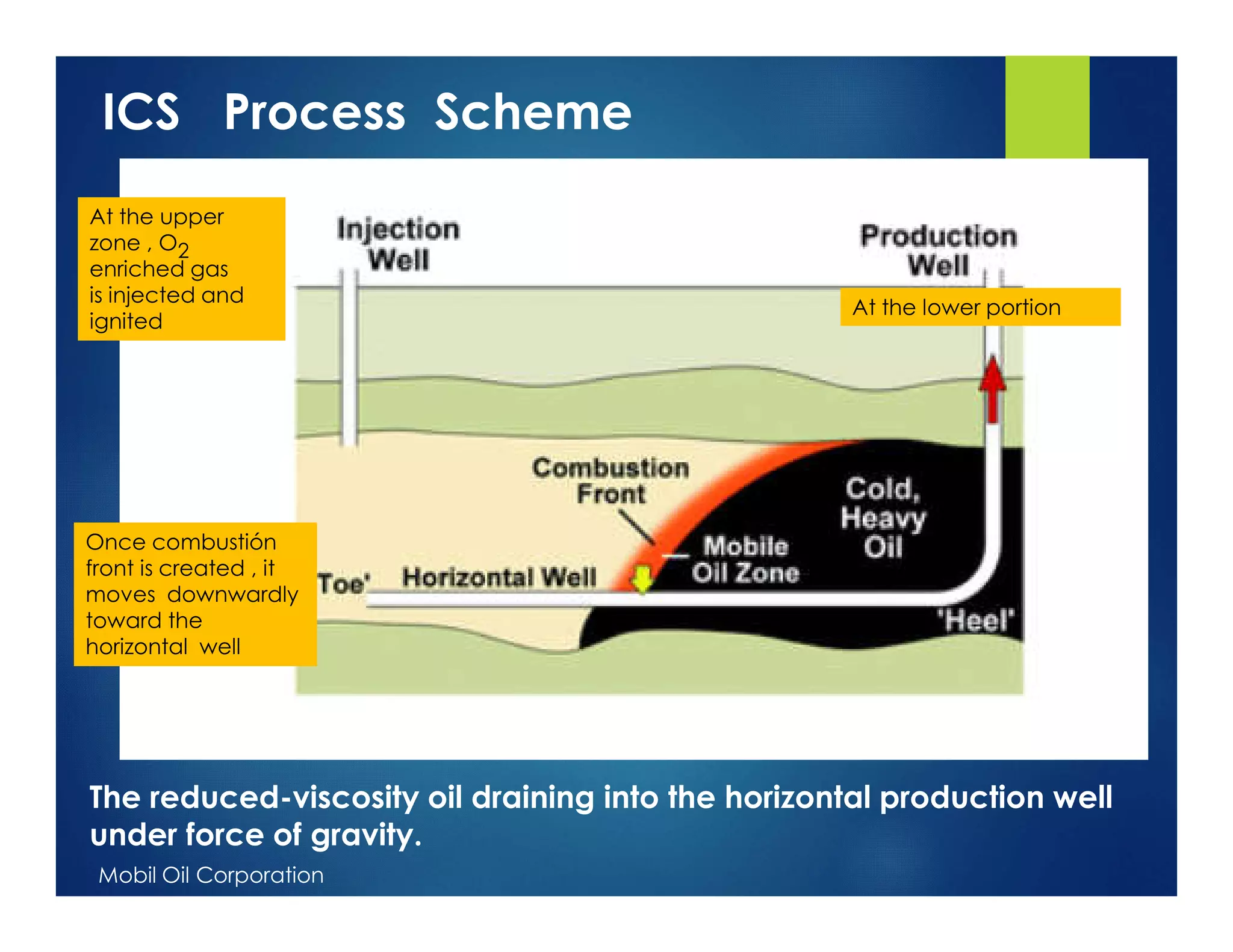
ICS Process Scheme
The reduced-viscosity oil draining into the horizontal production well
under force of gravity.
Mobil Oil Corporation
At the lower portion
At the upper
zone , O2
enriched gas
is injected and
ignited
Once combustión
front is created , it
moves downwardly
toward the
horizontal well
Scheme of Oxygen Consumption Profile
The process is typically used for deep, tight, relatively light-oil reservoirs
where water injectivity is low.
Screening of EOR Thermal Methods
Geologic Screening Criteria: Heterogeneity
possible
Adapted from Tyler & Finler
Screening Criteria for Steam Injection
Methods and Horizontal Wells
Overview of EOR Thermal Methods
Example of RDP under Steamflooding:
Mukhaizna Heavy Oil Field, Oman
Overview of EOR Thermal Methods SAGD
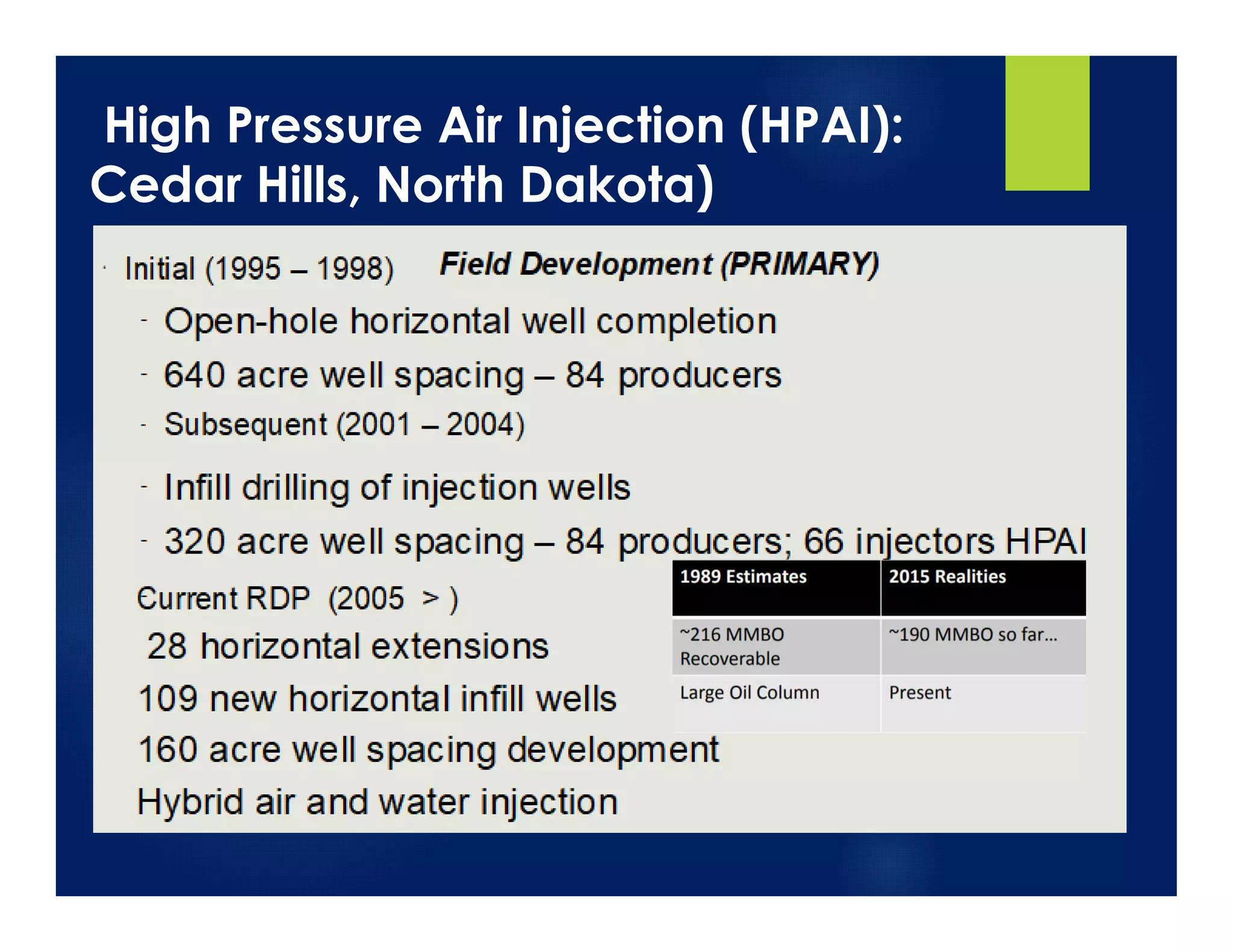
High Pressure Air Injection (HPAI):
Cedar Hills, North Dakota)
Why High Pressure Air Injection?
High Pressure Air Injection (HPAI):
Cedar Hills, North Dakota)
Final Comments
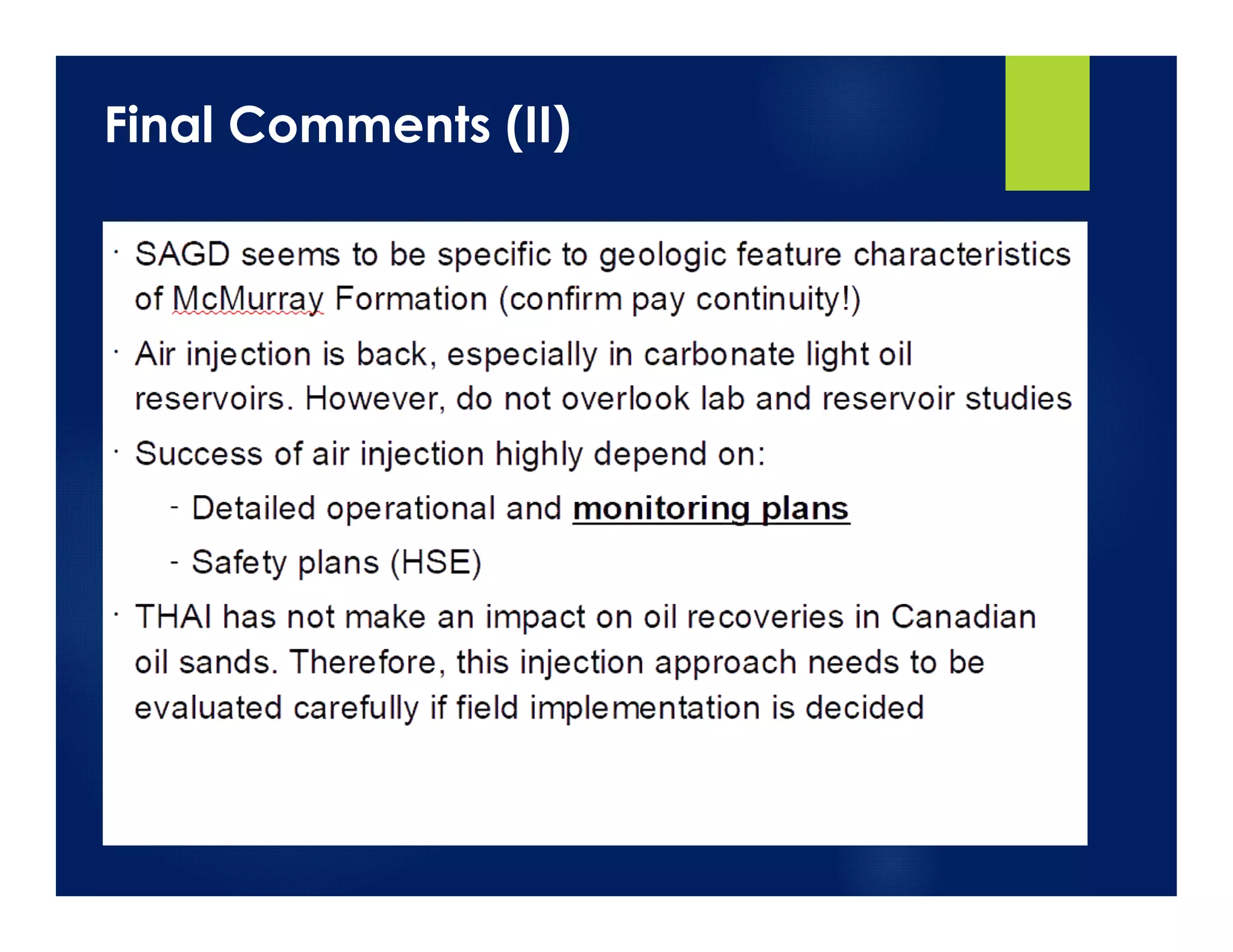
Final Comments (II)
Note
Data presented here were provided by C.
Norman mainly.
Other sources are lebeled in each slide

thermal methods for eor recovery

  • 1.
    EOR Thermal Methods [Heavy, viscous crude] Target : Increase reservoir temperature of the oil and reduce its viscosity.
  • 2.
    Agenda Introduction to EORThermal Methods Basics of EOR Thermal Methods Basic mechanisms of steam and air injection Brief Summary of Screening Criteria for EOR Thermal Overview of EOR Thermal Methods Field Case: HPAI in Cedar Hills Final Comments
  • 3.
    Introduction to EORThermal Methods Estimated Heavy Crude Oil World Reserves Key factors in thermal EOR : – Depth – Viscosity – Permeability
  • 4.
    Comparison of HeavyOil Data (some fields
  • 5.
    Thermal Methods Steam Flooding(SF) - Continue (paterns - Alternate (same well used to inject and produce) Hot Water Flooding (HWF) – reduction of oil viscosity Steam Assisted Gravity Drainage (SAGD) - horizontal wells mainly -one injector one producer Combustion in Situ (CIS) – through air injection a combustion front and chemical reactions that move oil to the producers High Pressure Air Injection (HPAI) - interfacial tension changes, oil swelling and reservoir re pressurization
  • 6.
    Steam Flooding (SF)- Continue (patterns) Rock and fluid properties, heterogeneities as directional l distribution of K and porosity, lack of lateral continuity, etc are key factors to take in account. • Some thermal energy is lost in heating the formation rock and water • The steam moves through the reservoir and comes in contact with cold oil, rock, and water, then it condenses and a hot water bank is formed. This hot water bank acts as a water flood and pushes additional oil to the producers
  • 7.
    Steam Flooding (SF)- Continue (patterns) Mechanisms of this process – include thermal expansion of the crude oil, – viscosity reduction of the crude oil, – changes in surface forces as the reservoi rtemperature increases, – and steam distillation of the lighter portions of the crudeoil. • This application is limited due to loss of heat energy. In deep wells, steam will be converted to liquid water • Oil recoveries have ranged from 0.3 to 0.6 bbl of oil per barrel of steam injected.(rule of thumb)
  • 8.
  • 9.
    Basic of SteamInjection - Alternate steam huff and puff, steam soak, or cyclic steam injection • The process involves – Injection of 5000–15,000 bbl of high quality steam. – Shutting-in the well (from 1-5 days) to allow the steam to soak the area around the injection well – Placing the injection well into production. • The length of the production period is dictated by the oil production rate The cycle is repeated as many times as is economically feasible. • Mechanisms of this process include1) • Reduction of flow resistance by reducing crude oil viscosity. • Enhancement of the solution gas drive mechanism by decreasing the gas solubility in an oil as temperature increases. • Recoveries of additional oil have ranged from 0.21 to 5.0 bbl of oil per barrel of steam injected.
  • 10.
    Basics of SteamInjection - Stages Adapted from Chandran Udumbasseri
  • 11.
    Basics of SteamInjection - Criteria Values are not mandatory . There are recommended values for key parameters.
  • 12.
    Cyclic Steam InjectionCalc 0 50 100 150 200 250 300 350 1 10 100 0 200 400 600 800 Temperature(F) LiquidRate(bbl/day) Time (days) Cyclic Steam Results Water Oil Temperature Cycle 1 2 Steam injection rate per cycle (bbl/d , m3/d) 900 900 Duration of injection period per cycle (days) 7 7 Duration of soak period (days) 7 7 Downhole steam temperature (f or c) 350 350 Downhole steam quality (fraction) 0.50 0.50 Time limit of production per cycle (days) 120 120 Depletion index limit for each cycle 3 3 Initial bottomhole flowing pressure (psi or kpa) 110 110 Half life constant for bottomhole pressure decline (days) 5 5 Lower limit of bottomhole pressure (psi or kpa) 17 17 Maximum liquid production allowed per cycle (bbl/d or m3/d) 800 800 Downhole steam pressure (psi or kPa) 137.1 137.1 Oil viscosity at steam temp (cp) 3.9 3.9 Steam zone thickness (ft or m) 44.1 44.1 Steam zone volume (ft3 or m3) 174,529.4 190,677.4 Steam zone radius (ft or m) 17.7 18.6 Viscosity factor 1.0 1.0 Time since starting project (days) 121.0 246.0 Cumulative oil production (bbl) 1,335.0 1,829.4 Oil recovery this cycle (% OIP) 0.5 0.2 Total oil recovery (% OIP) 0.5 0.7 Cumulative water injected (bbl) x 6,300.0 12,600.0 Oil-steam ratio 0.2 0.1 Water remaining in reservoir (bbl) 82,094.4 69,953.5 Average reservoir temperature (deg F) 132.2 136.1 Heated zone radius (ft) x 17.7 18.6 Steam zone thickness (ft) x 44.1 44.1 Total heat injected (Btu) x 1.51E+09 1.51E+09 Heat remaining in heated zone (Btu) 1.31E+08 1.68E+08 Heat loss during injection (Btu) x 9.39E+07 9.39E+07
  • 13.
    Approximate RF byMechanisms in Heavy Oils
  • 14.
    Steam Assisted GravityDrainage (SAGD)
  • 15.
    SAGD Steam {Schematic}Chamber Reduced viscosity and horizontal well allow practical rates without steam production (no coning) Steam replaces produced oil and raises pressure at top to allow flow in same cases.
  • 16.
    Main Reservoir Propertiesof International SAGD Projects ( as of 2011)
  • 17.
  • 18.
    SAGD Numerical Simulation: Impactof Reservoir Permeability (Kv/Kh = 0.6)
  • 20.
    Hot Water Injection (qualitativecontributions of different mechanisms to recover due to hot water injection)
  • 21.
    ISC : AirInjection (simulation data) Typical Oxidation Temperature vs Recovery To obtain high oil recoveries in HPAI and ISC, reactions must be in bond scission - CO2 generating mode. Aproximately 10 – 15 % of OIP will be burned
  • 22.
    ICS Process Scheme Thereduced-viscosity oil draining into the horizontal production well under force of gravity. Mobil Oil Corporation At the lower portion At the upper zone , O2 enriched gas is injected and ignited Once combustión front is created , it moves downwardly toward the horizontal well
  • 23.
    Scheme of OxygenConsumption Profile The process is typically used for deep, tight, relatively light-oil reservoirs where water injectivity is low.
  • 24.
    Screening of EORThermal Methods
  • 25.
    Geologic Screening Criteria:Heterogeneity possible Adapted from Tyler & Finler
  • 26.
    Screening Criteria forSteam Injection Methods and Horizontal Wells
  • 27.
    Overview of EORThermal Methods
  • 28.
    Example of RDPunder Steamflooding: Mukhaizna Heavy Oil Field, Oman
  • 29.
    Overview of EORThermal Methods SAGD
  • 30.
    High Pressure AirInjection (HPAI): Cedar Hills, North Dakota) Why High Pressure Air Injection?
  • 31.
    High Pressure AirInjection (HPAI): Cedar Hills, North Dakota)
  • 32.
  • 33.
  • 34.
    Note Data presented herewere provided by C. Norman mainly. Other sources are lebeled in each slide