EOR Gas Methods
Introduction to EOR Gas Methods
Basics of EOR Gas Methods
Screening Criteria for EOR Gas Methods(Basic)
Overview of EOR Gas Methods
Case Studies:
CO2-EOR and Storage in the U.S.
Economics of CO2-EOR & Storage (Summary Review)
Final Comments
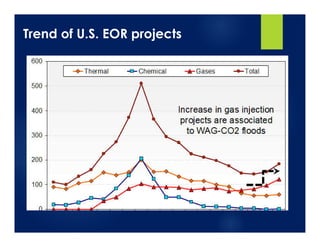
Trend of U.S. EOR projects
EOR Gas Injection Methods
Basically injection gas methods can divided in :
- Miscible process
- Immiscible process
Miscibility of two fluids can occur at one or multiple contacts.
That mean condensing or vaporizing gas drives
If the oil gravity is lower than 25 API the process is immiscible
displacement mainly.
However the miscibility in medium oil could be achieved in deep
reservoir due to high pressure and high temperature
Gas injection has been considered almost exclusively as a
pressure maintenance for light and medium crude oil
(generally > 25 API) reservoirs
Injection Strategies depends on
- geological structure of reservoir(
high dip angle : use up dip injection [gravity stable floods]
low dip angle : analyze completion strategy or use WAG
If Co2 or Nitrogen (N2) injection is possible, then gas could be
used to produce energy or gas market.
EOR Gas Methods
Natural Gas Injection
Sometimes known as cycling, is the reinjection of produced natural
gas.
As the pressure drops in a gas reservoir condensate separates from
the dry gas and block the pores.
The result is a high reduction of gas flow capacity
• Cycling is used to prevent the blocking ,
- the condensate is stripped from the natural gas at surface.
- The dry gas is then re-injected into the reservoir through
injection wells.
- This helps to maintain pressure in the reservoir
- Additionally, gas injection can serve as an economical way to
dispose gas production if there are limitations to produce and sale it
(San Sebastian field before subsea gas line between Tierra del Fuego
and continent).
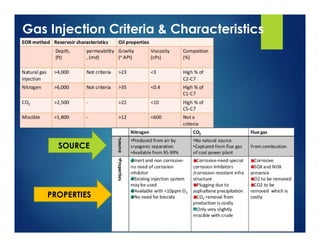
Gas Injection Criteria & Characteristics
SOURCE
PROPERTIES
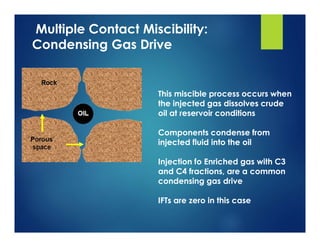
Multiple Contact Miscibility:
Condensing Gas Drive
This miscible process occurs when
the injected gas dissolves crude
oil at reservoir conditions
Components condense from
injected fluid into the oil
Injection fo Enriched gas with C3
and C4 fractions, are a common
condensing gas drive
IFTs are zero in this case
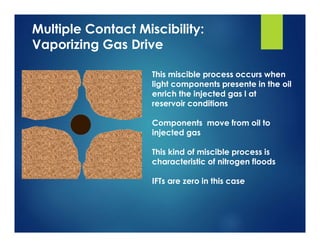
Multiple Contact Miscibility:
Vaporizing Gas Drive
This miscible process occurs when
light components presente in the oil
enrich the injected gas l at
reservoir conditions
Components move from oil to
injected gas
This kind of miscible process is
characteristic of nitrogen floods
IFTs are zero in this case
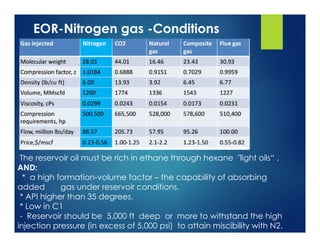
EOR-Nitrogen gas -Conditions
The reservoir oil must be rich in ethane through hexane "light oils“ .
AND:
* a high formation-volume factor – the capability of absorbing
added gas under reservoir conditions.
* API higher than 35 degrees.
* Low in C1
- Reservoir should be 5,000 ft deep or more to withstand the high
injection pressure (in excess of 5,000 psi) to attain miscibility with N2.
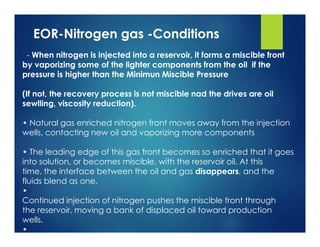
EOR-Nitrogen gas -Conditions
- When nitrogen is injected into a reservoir, it forms a miscible front
by vaporizing some of the lighter components from the oil if the
pressure is higher than the Minimun Miscible Pressure
(If not, the recovery process is not miscible nad the drives are oil
sewlling, viscosity reduction).
• Natural gas enriched nitrogen front moves away from the injection
wells, contacting new oil and vaporizing more components
• The leading edge of this gas front becomes so enriched that it goes
into solution, or becomes miscible, with the reservoir oil. At this
time, the interface between the oil and gas disappears, and the
fluids blend as one.
•
Continued injection of nitrogen pushes the miscible front through
the reservoir, moving a bank of displaced oil toward production
wells.
•
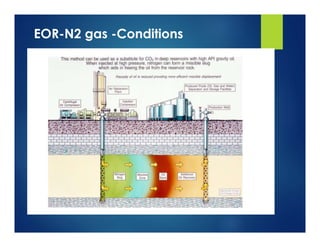
EOR-N2 gas -Conditions
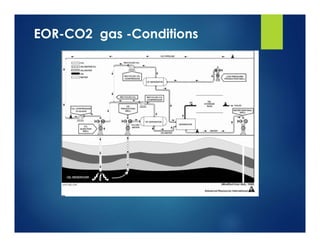
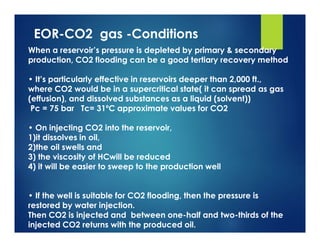
EOR-CO2 gas -Conditions
When a reservoir’s pressure is depleted by primary & secondary
production, CO2 flooding can be a good tertiary recovery method
• It’s particularly effective in reservoirs deeper than 2,000 ft.,
where CO2 would be in a supercritical state( it can spread as gas
(effusion), and dissolved substances as a liquid (solvent))
Pc = 75 bar Tc= 31ºC approximate values for CO2
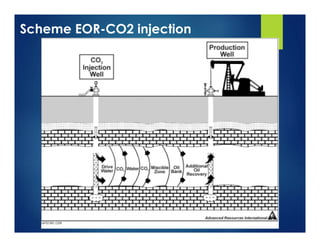
• On injecting CO2 into the reservoir,
1)it dissolves in oil,
2)the oil swells and
3) the viscosity of HCwill be reduced
4) it will be easier to sweep to the production well
• If the well is suitable for CO2 flooding, then the pressure is
restored by water injection.
Then CO2 is injected and between one-half and two-thirds of the
injected CO2 returns with the produced oil.
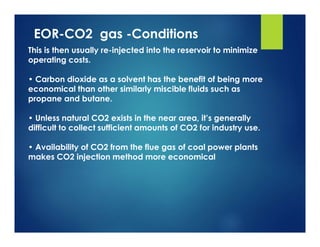
EOR-CO2 gas -Conditions
This is then usually re-injected into the reservoir to minimize
operating costs.
• Carbon dioxide as a solvent has the benefit of being more
economical than other similarly miscible fluids such as
propane and butane.
• Unless natural CO2 exists in the near area, it’s generally
difficult to collect sufficient amounts of CO2 for industry use.
• Availability of CO2 from the flue gas of coal power plants
makes CO2 injection method more economical
Scheme EOR-CO2 injection
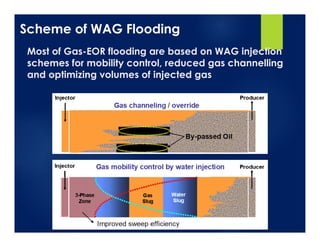
Most of Gas-EOR flooding are based on WAG injection
schemes for mobility control, reduced gas channelling
and optimizing volumes of injected gas
Scheme of WAG Flooding
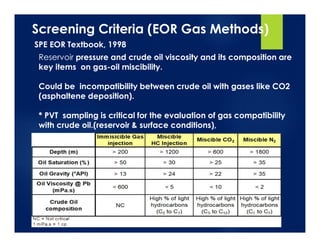
Screening Criteria (EOR Gas Methods)
SPE EOR Textbook, 1998
Reservoir pressure and crude oil viscosity and its composition are
key items on gas-oil miscibility.
Could be incompatibility between crude oil with gases like CO2
(asphaltene deposition).
* PVT sampling is critical for the evaluation of gas compatibility
with crude oil.(reservoir & surface conditions),
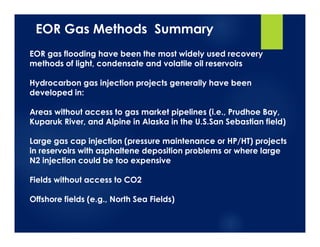
EOR Gas Methods Summary
EOR gas flooding have been the most widely used recovery
methods of light, condensate and volatile oil reservoirs
Hydrocarbon gas injection projects generally have been
developed in:
Areas without access to gas market pipelines (i.e., Prudhoe Bay,
Kuparuk River, and Alpine in Alaska in the U.S.San Sebastian field)
Large gas cap injection (pressure maintenance or HP/HT) projects
in reservoirs with asphaltene deposition problems or where large
N2 injection could be too expensive
Fields without access to CO2
Offshore fields (e.g., North Sea Fields)
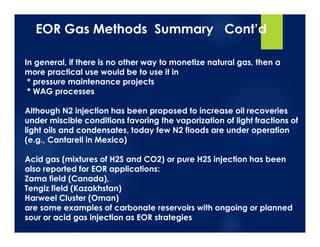
EOR Gas Methods Summary Cont’d
In general, if there is no other way to monetize natural gas, then a
more practical use would be to use it in
* pressure maintenance projects
* WAG processes
Although N2 injection has been proposed to increase oil recoveries
under miscible conditions favoring the vaporization of light fractions of
light oils and condensates, today few N2 floods are under operation
(e.g., Cantarell in Mexico)
Acid gas (mixtures of H2S and CO2) or pure H2S injection has been
also reported for EOR applications:
Zama field (Canada),
Tengiz field (Kazakhstan)
Harweel Cluster (Oman)
are some examples of carbonate reservoirs with ongoing or planned
sour or acid gas injection as EOR strategies
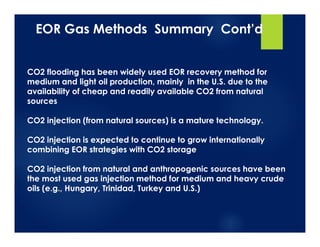
EOR Gas Methods Summary Cont’d
CO2 flooding has been widely used EOR recovery method for
medium and light oil production, mainly in the U.S. due to the
availability of cheap and readily available CO2 from natural
sources
CO2 injection (from natural sources) is a mature technology.
CO2 injection is expected to continue to grow internationally
combining EOR strategies with CO2 storage
CO2 injection from natural and anthropogenic sources have been
the most used gas injection method for medium and heavy crude
oils (e.g., Hungary, Trinidad, Turkey and U.S.)
EOR Gas Methods Summary Cont’d
Some examples of international CO2-EOR projects (Cont’d):
Hungary also reports more than four decades experience in CO2-
EOR floods:
CO2 projects at Budafa and Lovvaszi fields are well documented in
the literature
Szank oil field represents a more recent CO2-EOR flood in Hungary
using CO2 from a sweetening plant.
Trinidad also has more than three decades experience operating
CO2-EOR projects using CO2 from an ammonia plant nearby the
fields (9 active immiscible CO2 floods operating since mid 1970s)
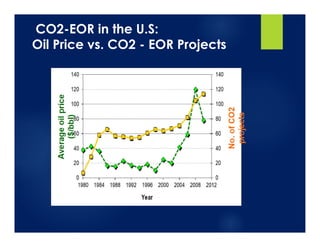
CO2-EOR in the U.S:
Oil Price vs. CO2 - EOR Projects
CO2 - Storage
Although CO2 can be stored safely in depleted oil and gas fields,
it is important to note that most CO2 needs to be disposed of into
deep saline aquifers
CO2 storage in offshore geologic formations seems to be easier
than storage in onshore fields (i.e. liability issues, land ownership,
mineral rights, well permits, monitoring, etc.)
CO2 storage in depleted oil and gas reservoirs or saline aquifers is
extremely complex onshore U.S.
Carbon Capture and Storage (CCS)
EU cost estimates for Carbon Capture & Storage (CCS) were
presented at the Offshore Aberdeen Conference (Carbon Capture
Journal, Sep. 12, 2007):
Cost estimates for CO2 capture from power generation and
storage using today's technologies can cost up to €70/tCO2 (≈
US$100/tCO2)
Technological improvements will likely reduce the costs of CCS
projects down to €20-30/tCO2 (≈ US$ 28-43/tCO2) by 2020
CCS in the UK has potential only if carbon prices are higher than
£25/tCO2 (> US$ 50/tCO2)
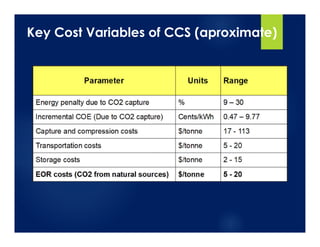
Key Cost Variables of CCS (aproximate)
Final Comments
Offshore EOR is still limited to gas and WAG injection schemes using
natural gas or until CO2 becomes available
CO2 - EOR / Storage shows larger potential in offshore reservoirs
Natural gas markets are competing against gas injection projects
and steam generation.
This may explain the growing number of CO2 floods and the
reduction of steam injection projects in the U.S.
No new N2 floods have been documented in the literature during
the last few years. and we do not foresee an increment in the
number of projects implementing this EOR gas flooding method
Final Comments
Large CO2 - EOR projects are expected continue to growth in the near
future, especially using CO2 from natural sources unless
anthropogenic sources are nearby fields candidates to CO2 flooding
CO2 - EOR potential is also limited (NOT ALL reservoirs are candidates
for CO2 flooding)
Reservoir pressure (miscible vs. immiscible) and mature waterflooded
(high water cuts) have strong impact on project economics. In other
words: Do not wait too long!
Saline aquifers shows the largest CO2 storage potential. However,
uncertainties associated to regulations, volatility of carbon markets
and liability issues are key areas needs to be addressed
Note
Data presented here were provided by C.
Norman mainly.
Other sources are lebeled in each slide

4 eor 4-gasmethods,

  • 1.
    EOR Gas Methods Introductionto EOR Gas Methods Basics of EOR Gas Methods Screening Criteria for EOR Gas Methods(Basic) Overview of EOR Gas Methods Case Studies: CO2-EOR and Storage in the U.S. Economics of CO2-EOR & Storage (Summary Review) Final Comments
  • 2.
    Trend of U.S.EOR projects
  • 3.
    EOR Gas InjectionMethods Basically injection gas methods can divided in : - Miscible process - Immiscible process Miscibility of two fluids can occur at one or multiple contacts. That mean condensing or vaporizing gas drives If the oil gravity is lower than 25 API the process is immiscible displacement mainly. However the miscibility in medium oil could be achieved in deep reservoir due to high pressure and high temperature
  • 4.
    Gas injection hasbeen considered almost exclusively as a pressure maintenance for light and medium crude oil (generally > 25 API) reservoirs Injection Strategies depends on - geological structure of reservoir( high dip angle : use up dip injection [gravity stable floods] low dip angle : analyze completion strategy or use WAG If Co2 or Nitrogen (N2) injection is possible, then gas could be used to produce energy or gas market. EOR Gas Methods
  • 5.
    Natural Gas Injection Sometimesknown as cycling, is the reinjection of produced natural gas. As the pressure drops in a gas reservoir condensate separates from the dry gas and block the pores. The result is a high reduction of gas flow capacity • Cycling is used to prevent the blocking , - the condensate is stripped from the natural gas at surface. - The dry gas is then re-injected into the reservoir through injection wells. - This helps to maintain pressure in the reservoir - Additionally, gas injection can serve as an economical way to dispose gas production if there are limitations to produce and sale it (San Sebastian field before subsea gas line between Tierra del Fuego and continent).
  • 6.
    Gas Injection Criteria& Characteristics SOURCE PROPERTIES
  • 7.
    Multiple Contact Miscibility: CondensingGas Drive This miscible process occurs when the injected gas dissolves crude oil at reservoir conditions Components condense from injected fluid into the oil Injection fo Enriched gas with C3 and C4 fractions, are a common condensing gas drive IFTs are zero in this case
  • 8.
    Multiple Contact Miscibility: VaporizingGas Drive This miscible process occurs when light components presente in the oil enrich the injected gas l at reservoir conditions Components move from oil to injected gas This kind of miscible process is characteristic of nitrogen floods IFTs are zero in this case
  • 9.
    EOR-Nitrogen gas -Conditions Thereservoir oil must be rich in ethane through hexane "light oils“ . AND: * a high formation-volume factor – the capability of absorbing added gas under reservoir conditions. * API higher than 35 degrees. * Low in C1 - Reservoir should be 5,000 ft deep or more to withstand the high injection pressure (in excess of 5,000 psi) to attain miscibility with N2.
  • 10.
    EOR-Nitrogen gas -Conditions -When nitrogen is injected into a reservoir, it forms a miscible front by vaporizing some of the lighter components from the oil if the pressure is higher than the Minimun Miscible Pressure (If not, the recovery process is not miscible nad the drives are oil sewlling, viscosity reduction). • Natural gas enriched nitrogen front moves away from the injection wells, contacting new oil and vaporizing more components • The leading edge of this gas front becomes so enriched that it goes into solution, or becomes miscible, with the reservoir oil. At this time, the interface between the oil and gas disappears, and the fluids blend as one. • Continued injection of nitrogen pushes the miscible front through the reservoir, moving a bank of displaced oil toward production wells. •
  • 11.
  • 12.
  • 13.
    EOR-CO2 gas -Conditions Whena reservoir’s pressure is depleted by primary & secondary production, CO2 flooding can be a good tertiary recovery method • It’s particularly effective in reservoirs deeper than 2,000 ft., where CO2 would be in a supercritical state( it can spread as gas (effusion), and dissolved substances as a liquid (solvent)) Pc = 75 bar Tc= 31ºC approximate values for CO2 • On injecting CO2 into the reservoir, 1)it dissolves in oil, 2)the oil swells and 3) the viscosity of HCwill be reduced 4) it will be easier to sweep to the production well • If the well is suitable for CO2 flooding, then the pressure is restored by water injection. Then CO2 is injected and between one-half and two-thirds of the injected CO2 returns with the produced oil.
  • 14.
    EOR-CO2 gas -Conditions Thisis then usually re-injected into the reservoir to minimize operating costs. • Carbon dioxide as a solvent has the benefit of being more economical than other similarly miscible fluids such as propane and butane. • Unless natural CO2 exists in the near area, it’s generally difficult to collect sufficient amounts of CO2 for industry use. • Availability of CO2 from the flue gas of coal power plants makes CO2 injection method more economical
  • 15.
  • 16.
    Most of Gas-EORflooding are based on WAG injection schemes for mobility control, reduced gas channelling and optimizing volumes of injected gas Scheme of WAG Flooding
  • 17.
    Screening Criteria (EORGas Methods) SPE EOR Textbook, 1998 Reservoir pressure and crude oil viscosity and its composition are key items on gas-oil miscibility. Could be incompatibility between crude oil with gases like CO2 (asphaltene deposition). * PVT sampling is critical for the evaluation of gas compatibility with crude oil.(reservoir & surface conditions),
  • 18.
    EOR Gas MethodsSummary EOR gas flooding have been the most widely used recovery methods of light, condensate and volatile oil reservoirs Hydrocarbon gas injection projects generally have been developed in: Areas without access to gas market pipelines (i.e., Prudhoe Bay, Kuparuk River, and Alpine in Alaska in the U.S.San Sebastian field) Large gas cap injection (pressure maintenance or HP/HT) projects in reservoirs with asphaltene deposition problems or where large N2 injection could be too expensive Fields without access to CO2 Offshore fields (e.g., North Sea Fields)
  • 19.
    EOR Gas MethodsSummary Cont’d In general, if there is no other way to monetize natural gas, then a more practical use would be to use it in * pressure maintenance projects * WAG processes Although N2 injection has been proposed to increase oil recoveries under miscible conditions favoring the vaporization of light fractions of light oils and condensates, today few N2 floods are under operation (e.g., Cantarell in Mexico) Acid gas (mixtures of H2S and CO2) or pure H2S injection has been also reported for EOR applications: Zama field (Canada), Tengiz field (Kazakhstan) Harweel Cluster (Oman) are some examples of carbonate reservoirs with ongoing or planned sour or acid gas injection as EOR strategies
  • 20.
    EOR Gas MethodsSummary Cont’d CO2 flooding has been widely used EOR recovery method for medium and light oil production, mainly in the U.S. due to the availability of cheap and readily available CO2 from natural sources CO2 injection (from natural sources) is a mature technology. CO2 injection is expected to continue to grow internationally combining EOR strategies with CO2 storage CO2 injection from natural and anthropogenic sources have been the most used gas injection method for medium and heavy crude oils (e.g., Hungary, Trinidad, Turkey and U.S.)
  • 21.
    EOR Gas MethodsSummary Cont’d Some examples of international CO2-EOR projects (Cont’d): Hungary also reports more than four decades experience in CO2- EOR floods: CO2 projects at Budafa and Lovvaszi fields are well documented in the literature Szank oil field represents a more recent CO2-EOR flood in Hungary using CO2 from a sweetening plant. Trinidad also has more than three decades experience operating CO2-EOR projects using CO2 from an ammonia plant nearby the fields (9 active immiscible CO2 floods operating since mid 1970s)
  • 22.
    CO2-EOR in theU.S: Oil Price vs. CO2 - EOR Projects
  • 23.
    CO2 - Storage AlthoughCO2 can be stored safely in depleted oil and gas fields, it is important to note that most CO2 needs to be disposed of into deep saline aquifers CO2 storage in offshore geologic formations seems to be easier than storage in onshore fields (i.e. liability issues, land ownership, mineral rights, well permits, monitoring, etc.) CO2 storage in depleted oil and gas reservoirs or saline aquifers is extremely complex onshore U.S.
  • 24.
    Carbon Capture andStorage (CCS) EU cost estimates for Carbon Capture & Storage (CCS) were presented at the Offshore Aberdeen Conference (Carbon Capture Journal, Sep. 12, 2007): Cost estimates for CO2 capture from power generation and storage using today's technologies can cost up to €70/tCO2 (≈ US$100/tCO2) Technological improvements will likely reduce the costs of CCS projects down to €20-30/tCO2 (≈ US$ 28-43/tCO2) by 2020 CCS in the UK has potential only if carbon prices are higher than £25/tCO2 (> US$ 50/tCO2)
  • 25.
    Key Cost Variablesof CCS (aproximate)
  • 26.
    Final Comments Offshore EORis still limited to gas and WAG injection schemes using natural gas or until CO2 becomes available CO2 - EOR / Storage shows larger potential in offshore reservoirs Natural gas markets are competing against gas injection projects and steam generation. This may explain the growing number of CO2 floods and the reduction of steam injection projects in the U.S. No new N2 floods have been documented in the literature during the last few years. and we do not foresee an increment in the number of projects implementing this EOR gas flooding method
  • 27.
    Final Comments Large CO2- EOR projects are expected continue to growth in the near future, especially using CO2 from natural sources unless anthropogenic sources are nearby fields candidates to CO2 flooding CO2 - EOR potential is also limited (NOT ALL reservoirs are candidates for CO2 flooding) Reservoir pressure (miscible vs. immiscible) and mature waterflooded (high water cuts) have strong impact on project economics. In other words: Do not wait too long! Saline aquifers shows the largest CO2 storage potential. However, uncertainties associated to regulations, volatility of carbon markets and liability issues are key areas needs to be addressed
  • 28.
    Note Data presented herewere provided by C. Norman mainly. Other sources are lebeled in each slide