Reservoir Engineering 1 Course (1st Ed.)
1.
2.
3.
4.
5.

Oil Recovery
Waterflooding Considerations
Primary Reservoir Driving Mechanisms
Secondary Recovery Project
Flooding Patterns
1.
2.
3.
4.

Recovery Efficiency
Displacement Efficiency
Frontal Displacement
Fractional Flow Equation
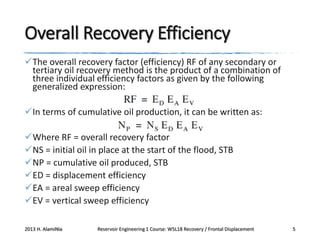
Overall Recovery Efficiency
The overall recovery factor (efficiency) RF of any secondary or
tertiary oil recovery method is the product of a combination of
three individual efficiency factors as given by the following
generalized expression:
In terms of cumulative oil production, it can be written as:

Where RF = overall recovery factor
NS = initial oil in place at the start of the flood, STB
NP = cumulative oil produced, STB
ED = displacement efficiency
EA = areal sweep efficiency
EV = vertical sweep efficiency
2013 H. AlamiNia

Reservoir Engineering 1 Course: W5L18 Recovery / Frontal Displacement

5
Displacement Efficiency
Displacement efficiency
The displacement efficiency ED is the fraction of
movable oil that has been displaced from the swept zone
at any given time or pore volume injected.
Because an immiscible gas injection or waterflood will always
leave behind some residual oil, ED will always be less than 1.0.

2013 H. AlamiNia

Reservoir Engineering 1 Course: W5L18 Recovery / Frontal Displacement

6
Areal Sweep Efficiency
Areal sweep efficiency
The areal sweep efficiency EA is the fractional area of
the pattern that is swept by the displacing fluid.
The major factors determining areal sweep are:
Fluid mobilities
Pattern type
Areal heterogeneity
Total volume of fluid injected

2013 H. AlamiNia

Reservoir Engineering 1 Course: W5L18 Recovery / Frontal Displacement

7
Vertical Sweep Efficiency
The vertical sweep efficiency EV is the fraction of
the vertical section of the pay zone that is
contacted by injected fluids.
The vertical sweep efficiency is primarily a function of:
Vertical heterogeneity
Degree of gravity segregation
Fluid mobilities
Total volume injection

2013 H. AlamiNia

Reservoir Engineering 1 Course: W5L18 Recovery / Frontal Displacement

8
Volumetric Sweep Efficiency
Note that the product of EA EV is called the
volumetric sweep efficiency and
Represents the overall fraction of the flood pattern that
is contacted by the injected fluid.

2013 H. AlamiNia

Reservoir Engineering 1 Course: W5L18 Recovery / Frontal Displacement

9
Reservoir Heterogeneity
In general, reservoir heterogeneity probably has
more influence than any other factor on the
performance of a secondary or tertiary injection
project.
The most important two types of heterogeneity
affecting sweep efficiencies, EA and EV, are the
reservoir vertical heterogeneity and areal
heterogeneity.

2013 H. AlamiNia

Reservoir Engineering 1 Course: W5L18 Recovery / Frontal Displacement

10
Vertical Heterogeneity
Vertical heterogeneity is by far the most significant
parameter influencing the vertical sweep and in
particular its degree of variation in the vertical
direction.
A reservoir may exhibit many different layers in the
vertical section that have highly contrasting
properties.
This stratification can result from many factors, including
change in depositional environment, change in
depositional source, or particle segregation.

2013 H. AlamiNia

Reservoir Engineering 1 Course: W5L18 Recovery / Frontal Displacement

11
Vertical Heterogeneity (Cont.)
Water injected into a stratified system will
preferentially enter the layers of highest
permeability and will move at a higher velocity.
Consequently, at the time of water breakthrough in
higher-permeability zones, a significant fraction of the
less-permeable zones will remain unflooded.
Although a flood will generally continue beyond
breakthrough, the economic limit is often reached at an
earlier time.

2013 H. AlamiNia

Reservoir Engineering 1 Course: W5L18 Recovery / Frontal Displacement

12
Areal Heterogeneity
Areal heterogeneity includes
Areal variation in formation properties (e.g., h, k, ϕ,
Swc),
Geometrical factors such as the position, any sealing
nature of faults, and
Boundary conditions due to the presence of an aquifer
or gas cap.

2013 H. AlamiNia

Reservoir Engineering 1 Course: W5L18 Recovery / Frontal Displacement

13
Vertical vs. Areal Heterogeneity
Operators spend millions of dollars coring, logging,
and listing appraisal wells, all of which permits
direct observation of vertical heterogeneity.
Therefore, if the data are interpreted correctly, it should
be possible to quantify the vertical sweep, EV, quite
accurately.

Areally, of course, matters are much more
uncertain since methods of defining heterogeneity
are indirect, such as attempting to locate faults
from well testing analysis.
Consequently, the areal sweep efficiency is to be
regarded as the unknown in reservoir-development
studies.
2013 H. AlamiNia

Reservoir Engineering 1 Course: W5L18 Recovery / Frontal Displacement

14
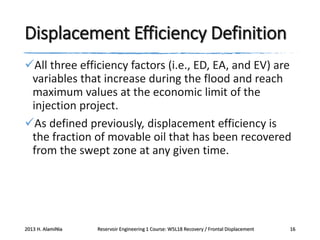
Displacement Efficiency Definition
All three efficiency factors (i.e., ED, EA, and EV) are
variables that increase during the flood and reach
maximum values at the economic limit of the
injection project.
As defined previously, displacement efficiency is
the fraction of movable oil that has been recovered
from the swept zone at any given time.

2013 H. AlamiNia

Reservoir Engineering 1 Course: W5L18 Recovery / Frontal Displacement

16
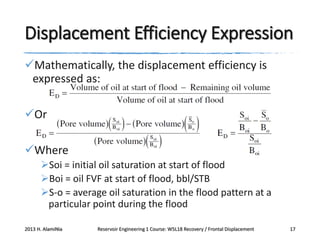
Displacement Efficiency Expression
Mathematically, the displacement efficiency is
expressed as:
Or
Where
Soi = initial oil saturation at start of flood
Boi = oil FVF at start of flood, bbl/STB
S-o = average oil saturation in the flood pattern at a
particular point during the flood
2013 H. AlamiNia

Reservoir Engineering 1 Course: W5L18 Recovery / Frontal Displacement

17
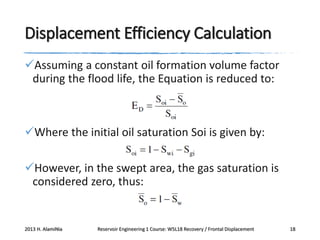
Displacement Efficiency Calculation
Assuming a constant oil formation volume factor
during the flood life, the Equation is reduced to:

Where the initial oil saturation Soi is given by:
However, in the swept area, the gas saturation is
considered zero, thus:

2013 H. AlamiNia

Reservoir Engineering 1 Course: W5L18 Recovery / Frontal Displacement

18
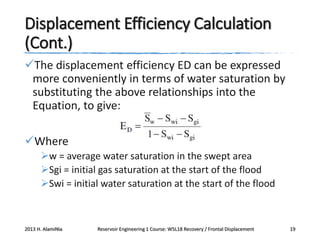
Displacement Efficiency Calculation
(Cont.)
The displacement efficiency ED can be expressed
more conveniently in terms of water saturation by
substituting the above relationships into the
Equation, to give:
Where
w = average water saturation in the swept area
Sgi = initial gas saturation at the start of the flood
Swi = initial water saturation at the start of the flood

2013 H. AlamiNia

Reservoir Engineering 1 Course: W5L18 Recovery / Frontal Displacement

19
Displacement Efficiency Calculation
(Cont.)
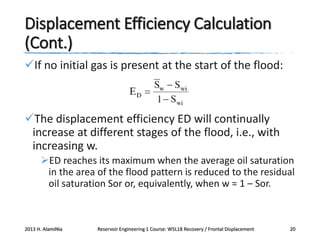
If no initial gas is present at the start of the flood:

The displacement efficiency ED will continually
increase at different stages of the flood, i.e., with
increasing w.
ED reaches its maximum when the average oil saturation
in the area of the flood pattern is reduced to the residual
oil saturation Sor or, equivalently, when w = 1 – Sor.

2013 H. AlamiNia

Reservoir Engineering 1 Course: W5L18 Recovery / Frontal Displacement

20
Average Water Saturation
in the Swept Area
ED will continually increase with increasing water
saturation in the reservoir.
The problem, of course, lies with developing an
approach for determining the increase in the average
water saturation in the swept area as a function of
cumulative water injected (or injection time).

2013 H. AlamiNia

Reservoir Engineering 1 Course: W5L18 Recovery / Frontal Displacement

23
Frontal Displacement Theory
Buckley and Leverett (1942) developed a wellestablished theory, called the frontal displacement
theory, which provides the basis for establishing
such a relationship. This classic theory consists of
two equations:
Fractional flow equation
Frontal advance equation

2013 H. AlamiNia

Reservoir Engineering 1 Course: W5L18 Recovery / Frontal Displacement

24
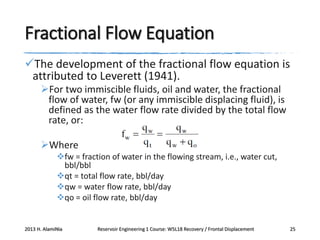
Fractional Flow Equation
The development of the fractional flow equation is
attributed to Leverett (1941).
For two immiscible fluids, oil and water, the fractional
flow of water, fw (or any immiscible displacing fluid), is
defined as the water flow rate divided by the total flow
rate, or:
Where
fw = fraction of water in the flowing stream, i.e., water cut,
bbl/bbl
qt = total flow rate, bbl/day
qw = water flow rate, bbl/day
qo = oil flow rate, bbl/day

2013 H. AlamiNia

Reservoir Engineering 1 Course: W5L18 Recovery / Frontal Displacement

25
Flash Back:
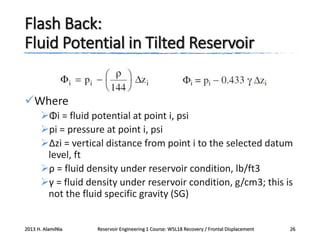
Fluid Potential in Tilted Reservoir
Where
Φi = fluid potential at point i, psi
pi = pressure at point i, psi
Δzi = vertical distance from point i to the selected datum
level, ft
ρ = fluid density under reservoir condition, lb/ft3
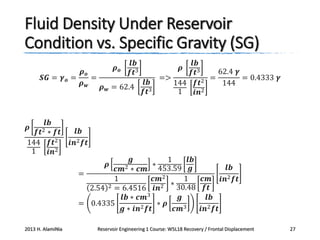
γ = fluid density under reservoir condition, g/cm3; this is
not the fluid specific gravity (SG)

2013 H. AlamiNia

Reservoir Engineering 1 Course: W5L18 Recovery / Frontal Displacement

26
Fluid Density Under Reservoir
Condition vs. Specific Gravity (SG)
𝝆𝒐

𝒍𝒃
𝒇𝒕3

𝝆𝒐
𝑺𝑮 = 𝜸 𝒐 =
=
𝝆𝒘
𝝆 𝒘 = 62.4

𝒍𝒃
𝒇𝒕2 ∗ 𝒇𝒕
144 𝒇𝒕2
1
𝒊𝒏2
𝝆

𝒍𝒃
62.4 𝜸
𝒇𝒕3
=>
=
= 0.4333 𝜸
144 𝒇𝒕2
144
1
𝒊𝒏2
𝝆

𝒍𝒃
𝒇𝒕3

𝒍𝒃
𝒊𝒏2 𝒇𝒕
𝒈
1
𝒍𝒃
∗
𝒍𝒃
𝒄𝒎2 ∗ 𝒄𝒎 453.59 𝒈
=
1
𝒄𝒎2
1
𝒄𝒎 𝒊𝒏2 𝒇𝒕
∗ 30.48
𝒇𝒕
2.54 2 = 6.4516 𝒊𝒏2
𝒍𝒃 ∗ 𝒄𝒎3
𝒈
𝒍𝒃
= 0.4335
∗ 𝝆
𝒈 ∗ 𝒊𝒏2 𝒇𝒕
𝒄𝒎3
𝒊𝒏2 𝒇𝒕

𝝆

2013 H. AlamiNia

Reservoir Engineering 1 Course: W5L18 Recovery / Frontal Displacement

27
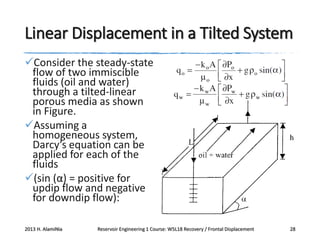
Linear Displacement in a Tilted System
Consider the steady-state
flow of two immiscible
fluids (oil and water)
through a tilted-linear
porous media as shown
in Figure.
Assuming a
homogeneous system,
Darcy’s equation can be
applied for each of the
fluids
(sin (α) = positive for
updip flow and negative
for downdip flow):
2013 H. AlamiNia

Reservoir Engineering 1 Course: W5L18 Recovery / Frontal Displacement

28
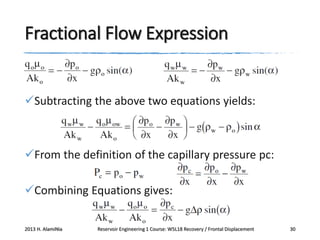
Fractional Flow Expression

Subtracting the above two equations yields:

From the definition of the capillary pressure pc:
Combining Equations gives:
2013 H. AlamiNia

Reservoir Engineering 1 Course: W5L18 Recovery / Frontal Displacement

30
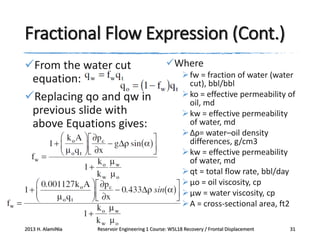
Fractional Flow Expression (Cont.)
From the water cut
equation:
Replacing qo and qw in
previous slide with
above Equations gives:

2013 H. AlamiNia

Where
 fw = fraction of water (water
cut), bbl/bbl
 ko = effective permeability of
oil, md
 kw = effective permeability
of water, md
 Δρ= water–oil density
differences, g/cm3
 kw = effective permeability
of water, md
 qt = total flow rate, bbl/day
 μo = oil viscosity, cp
 μw = water viscosity, cp
 A = cross-sectional area, ft2

Reservoir Engineering 1 Course: W5L18 Recovery / Frontal Displacement

31
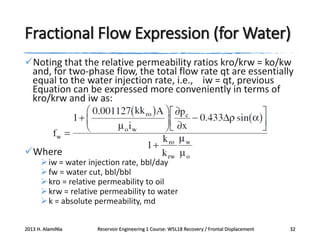
Fractional Flow Expression (for Water)
Noting that the relative permeability ratios kro/krw = ko/kw
and, for two-phase flow, the total flow rate qt are essentially
equal to the water injection rate, i.e., iw = qt, previous
Equation can be expressed more conveniently in terms of
kro/krw and iw as:

Where

 iw = water injection rate, bbl/day
 fw = water cut, bbl/bbl
 kro = relative permeability to oil
 krw = relative permeability to water
 k = absolute permeability, md

2013 H. AlamiNia

Reservoir Engineering 1 Course: W5L18 Recovery / Frontal Displacement

32
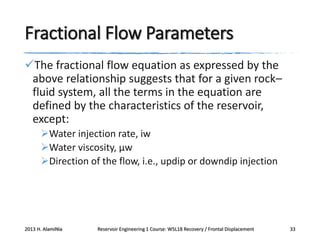
Fractional Flow Parameters
The fractional flow equation as expressed by the
above relationship suggests that for a given rock–
fluid system, all the terms in the equation are
defined by the characteristics of the reservoir,
except:
Water injection rate, iw
Water viscosity, μw
Direction of the flow, i.e., updip or downdip injection

2013 H. AlamiNia

Reservoir Engineering 1 Course: W5L18 Recovery / Frontal Displacement

33
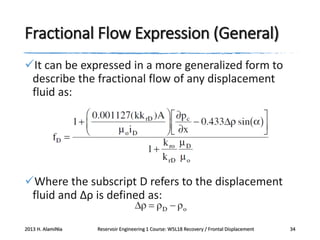
Fractional Flow Expression (General)
It can be expressed in a more generalized form to
describe the fractional flow of any displacement
fluid as:

Where the subscript D refers to the displacement
fluid and Δρ is defined as:
2013 H. AlamiNia

Reservoir Engineering 1 Course: W5L18 Recovery / Frontal Displacement

34
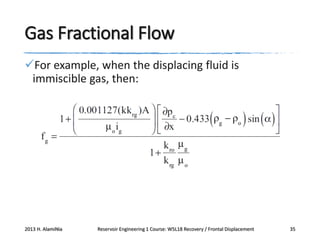
Gas Fractional Flow
For example, when the displacing fluid is
immiscible gas, then:

2013 H. AlamiNia

Reservoir Engineering 1 Course: W5L18 Recovery / Frontal Displacement

35
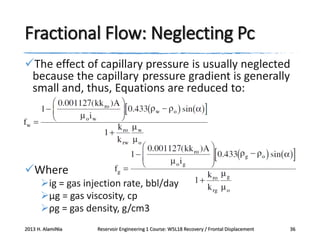
Fractional Flow: Neglecting Pc
The effect of capillary pressure is usually neglected
because the capillary pressure gradient is generally
small and, thus, Equations are reduced to:

Where
ig = gas injection rate, bbl/day
μg = gas viscosity, cp
ρg = gas density, g/cm3
2013 H. AlamiNia

Reservoir Engineering 1 Course: W5L18 Recovery / Frontal Displacement

36
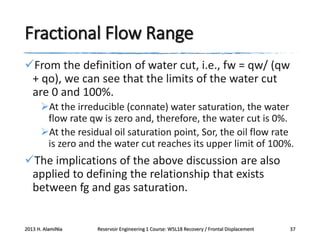
Fractional Flow Range
From the definition of water cut, i.e., fw = qw/ (qw
+ qo), we can see that the limits of the water cut
are 0 and 100%.
At the irreducible (connate) water saturation, the water
flow rate qw is zero and, therefore, the water cut is 0%.
At the residual oil saturation point, Sor, the oil flow rate
is zero and the water cut reaches its upper limit of 100%.

The implications of the above discussion are also
applied to defining the relationship that exists
between fg and gas saturation.

2013 H. AlamiNia

Reservoir Engineering 1 Course: W5L18 Recovery / Frontal Displacement

37
Fractional Flow Curves
a Function of Saturations
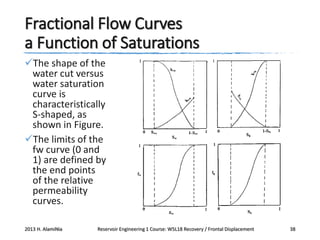
The shape of the
water cut versus
water saturation
curve is
characteristically
S-shaped, as
shown in Figure.
The limits of the
fw curve (0 and
1) are defined by
the end points
of the relative
permeability
curves.
2013 H. AlamiNia

Reservoir Engineering 1 Course: W5L18 Recovery / Frontal Displacement

38
Effects of Displacement Efficiency
Note that, in general, any influences that cause the
fractional flow curve to shift upward (i.e., increase
in fw or fg) will result in a less efficient
displacement process.
It is essential, therefore, to determine the effect of
various component parts of the fractional flow equation
on the displacement efficiency.

2013 H. AlamiNia

Reservoir Engineering 1 Course: W5L18 Recovery / Frontal Displacement

39
Relation between fo & fw
Note that for any two immiscible fluids, e.g., water
and oil, the fraction of the oil (oil cut) fo flowing at
any point in the reservoir is given by:
fo + fw = 1 or fo = 1− fw
The above expression indicates that during the displacement of
oil by waterflood, an increase in fw at any point in the reservoir
will cause a proportional decrease in fo and oil mobility.

2013 H. AlamiNia

Reservoir Engineering 1 Course: W5L18 Recovery / Frontal Displacement

40
1. Ahmed, T. (2006). Reservoir engineering
handbook (Gulf Professional Publishing). Ch14
1.
2.
3.
4.
5.
6.

Water Fractional Flow Curve
Effect of Dip Angle and Injection Rate on Fw
Reservoir Water Cut and the Water–Oil Ratio
Frontal Advance Equation
Capillary Effect
Water Saturation Profile
Q913 re1 w5 lec 18

Q913 re1 w5 lec 18

  • 1.
    Reservoir Engineering 1Course (1st Ed.)
  • 2.
    1. 2. 3. 4. 5. Oil Recovery Waterflooding Considerations PrimaryReservoir Driving Mechanisms Secondary Recovery Project Flooding Patterns
  • 3.
  • 5.
    Overall Recovery Efficiency Theoverall recovery factor (efficiency) RF of any secondary or tertiary oil recovery method is the product of a combination of three individual efficiency factors as given by the following generalized expression: In terms of cumulative oil production, it can be written as: Where RF = overall recovery factor NS = initial oil in place at the start of the flood, STB NP = cumulative oil produced, STB ED = displacement efficiency EA = areal sweep efficiency EV = vertical sweep efficiency 2013 H. AlamiNia Reservoir Engineering 1 Course: W5L18 Recovery / Frontal Displacement 5
  • 6.
    Displacement Efficiency Displacement efficiency Thedisplacement efficiency ED is the fraction of movable oil that has been displaced from the swept zone at any given time or pore volume injected. Because an immiscible gas injection or waterflood will always leave behind some residual oil, ED will always be less than 1.0. 2013 H. AlamiNia Reservoir Engineering 1 Course: W5L18 Recovery / Frontal Displacement 6
  • 7.
    Areal Sweep Efficiency Arealsweep efficiency The areal sweep efficiency EA is the fractional area of the pattern that is swept by the displacing fluid. The major factors determining areal sweep are: Fluid mobilities Pattern type Areal heterogeneity Total volume of fluid injected 2013 H. AlamiNia Reservoir Engineering 1 Course: W5L18 Recovery / Frontal Displacement 7
  • 8.
    Vertical Sweep Efficiency Thevertical sweep efficiency EV is the fraction of the vertical section of the pay zone that is contacted by injected fluids. The vertical sweep efficiency is primarily a function of: Vertical heterogeneity Degree of gravity segregation Fluid mobilities Total volume injection 2013 H. AlamiNia Reservoir Engineering 1 Course: W5L18 Recovery / Frontal Displacement 8
  • 9.
    Volumetric Sweep Efficiency Notethat the product of EA EV is called the volumetric sweep efficiency and Represents the overall fraction of the flood pattern that is contacted by the injected fluid. 2013 H. AlamiNia Reservoir Engineering 1 Course: W5L18 Recovery / Frontal Displacement 9
  • 10.
    Reservoir Heterogeneity In general,reservoir heterogeneity probably has more influence than any other factor on the performance of a secondary or tertiary injection project. The most important two types of heterogeneity affecting sweep efficiencies, EA and EV, are the reservoir vertical heterogeneity and areal heterogeneity. 2013 H. AlamiNia Reservoir Engineering 1 Course: W5L18 Recovery / Frontal Displacement 10
  • 11.
    Vertical Heterogeneity Vertical heterogeneityis by far the most significant parameter influencing the vertical sweep and in particular its degree of variation in the vertical direction. A reservoir may exhibit many different layers in the vertical section that have highly contrasting properties. This stratification can result from many factors, including change in depositional environment, change in depositional source, or particle segregation. 2013 H. AlamiNia Reservoir Engineering 1 Course: W5L18 Recovery / Frontal Displacement 11
  • 12.
    Vertical Heterogeneity (Cont.) Waterinjected into a stratified system will preferentially enter the layers of highest permeability and will move at a higher velocity. Consequently, at the time of water breakthrough in higher-permeability zones, a significant fraction of the less-permeable zones will remain unflooded. Although a flood will generally continue beyond breakthrough, the economic limit is often reached at an earlier time. 2013 H. AlamiNia Reservoir Engineering 1 Course: W5L18 Recovery / Frontal Displacement 12
  • 13.
    Areal Heterogeneity Areal heterogeneityincludes Areal variation in formation properties (e.g., h, k, ϕ, Swc), Geometrical factors such as the position, any sealing nature of faults, and Boundary conditions due to the presence of an aquifer or gas cap. 2013 H. AlamiNia Reservoir Engineering 1 Course: W5L18 Recovery / Frontal Displacement 13
  • 14.
    Vertical vs. ArealHeterogeneity Operators spend millions of dollars coring, logging, and listing appraisal wells, all of which permits direct observation of vertical heterogeneity. Therefore, if the data are interpreted correctly, it should be possible to quantify the vertical sweep, EV, quite accurately. Areally, of course, matters are much more uncertain since methods of defining heterogeneity are indirect, such as attempting to locate faults from well testing analysis. Consequently, the areal sweep efficiency is to be regarded as the unknown in reservoir-development studies. 2013 H. AlamiNia Reservoir Engineering 1 Course: W5L18 Recovery / Frontal Displacement 14
  • 16.
    Displacement Efficiency Definition Allthree efficiency factors (i.e., ED, EA, and EV) are variables that increase during the flood and reach maximum values at the economic limit of the injection project. As defined previously, displacement efficiency is the fraction of movable oil that has been recovered from the swept zone at any given time. 2013 H. AlamiNia Reservoir Engineering 1 Course: W5L18 Recovery / Frontal Displacement 16
  • 17.
    Displacement Efficiency Expression Mathematically,the displacement efficiency is expressed as: Or Where Soi = initial oil saturation at start of flood Boi = oil FVF at start of flood, bbl/STB S-o = average oil saturation in the flood pattern at a particular point during the flood 2013 H. AlamiNia Reservoir Engineering 1 Course: W5L18 Recovery / Frontal Displacement 17
  • 18.
    Displacement Efficiency Calculation Assuminga constant oil formation volume factor during the flood life, the Equation is reduced to: Where the initial oil saturation Soi is given by: However, in the swept area, the gas saturation is considered zero, thus: 2013 H. AlamiNia Reservoir Engineering 1 Course: W5L18 Recovery / Frontal Displacement 18
  • 19.
    Displacement Efficiency Calculation (Cont.) Thedisplacement efficiency ED can be expressed more conveniently in terms of water saturation by substituting the above relationships into the Equation, to give: Where w = average water saturation in the swept area Sgi = initial gas saturation at the start of the flood Swi = initial water saturation at the start of the flood 2013 H. AlamiNia Reservoir Engineering 1 Course: W5L18 Recovery / Frontal Displacement 19
  • 20.
    Displacement Efficiency Calculation (Cont.) Ifno initial gas is present at the start of the flood: The displacement efficiency ED will continually increase at different stages of the flood, i.e., with increasing w. ED reaches its maximum when the average oil saturation in the area of the flood pattern is reduced to the residual oil saturation Sor or, equivalently, when w = 1 – Sor. 2013 H. AlamiNia Reservoir Engineering 1 Course: W5L18 Recovery / Frontal Displacement 20
  • 23.
    Average Water Saturation inthe Swept Area ED will continually increase with increasing water saturation in the reservoir. The problem, of course, lies with developing an approach for determining the increase in the average water saturation in the swept area as a function of cumulative water injected (or injection time). 2013 H. AlamiNia Reservoir Engineering 1 Course: W5L18 Recovery / Frontal Displacement 23
  • 24.
    Frontal Displacement Theory Buckleyand Leverett (1942) developed a wellestablished theory, called the frontal displacement theory, which provides the basis for establishing such a relationship. This classic theory consists of two equations: Fractional flow equation Frontal advance equation 2013 H. AlamiNia Reservoir Engineering 1 Course: W5L18 Recovery / Frontal Displacement 24
  • 25.
    Fractional Flow Equation Thedevelopment of the fractional flow equation is attributed to Leverett (1941). For two immiscible fluids, oil and water, the fractional flow of water, fw (or any immiscible displacing fluid), is defined as the water flow rate divided by the total flow rate, or: Where fw = fraction of water in the flowing stream, i.e., water cut, bbl/bbl qt = total flow rate, bbl/day qw = water flow rate, bbl/day qo = oil flow rate, bbl/day 2013 H. AlamiNia Reservoir Engineering 1 Course: W5L18 Recovery / Frontal Displacement 25
  • 26.
    Flash Back: Fluid Potentialin Tilted Reservoir Where Φi = fluid potential at point i, psi pi = pressure at point i, psi Δzi = vertical distance from point i to the selected datum level, ft ρ = fluid density under reservoir condition, lb/ft3 γ = fluid density under reservoir condition, g/cm3; this is not the fluid specific gravity (SG) 2013 H. AlamiNia Reservoir Engineering 1 Course: W5L18 Recovery / Frontal Displacement 26
  • 27.
    Fluid Density UnderReservoir Condition vs. Specific Gravity (SG) 𝝆𝒐 𝒍𝒃 𝒇𝒕3 𝝆𝒐 𝑺𝑮 = 𝜸 𝒐 = = 𝝆𝒘 𝝆 𝒘 = 62.4 𝒍𝒃 𝒇𝒕2 ∗ 𝒇𝒕 144 𝒇𝒕2 1 𝒊𝒏2 𝝆 𝒍𝒃 62.4 𝜸 𝒇𝒕3 => = = 0.4333 𝜸 144 𝒇𝒕2 144 1 𝒊𝒏2 𝝆 𝒍𝒃 𝒇𝒕3 𝒍𝒃 𝒊𝒏2 𝒇𝒕 𝒈 1 𝒍𝒃 ∗ 𝒍𝒃 𝒄𝒎2 ∗ 𝒄𝒎 453.59 𝒈 = 1 𝒄𝒎2 1 𝒄𝒎 𝒊𝒏2 𝒇𝒕 ∗ 30.48 𝒇𝒕 2.54 2 = 6.4516 𝒊𝒏2 𝒍𝒃 ∗ 𝒄𝒎3 𝒈 𝒍𝒃 = 0.4335 ∗ 𝝆 𝒈 ∗ 𝒊𝒏2 𝒇𝒕 𝒄𝒎3 𝒊𝒏2 𝒇𝒕 𝝆 2013 H. AlamiNia Reservoir Engineering 1 Course: W5L18 Recovery / Frontal Displacement 27
  • 28.
    Linear Displacement ina Tilted System Consider the steady-state flow of two immiscible fluids (oil and water) through a tilted-linear porous media as shown in Figure. Assuming a homogeneous system, Darcy’s equation can be applied for each of the fluids (sin (α) = positive for updip flow and negative for downdip flow): 2013 H. AlamiNia Reservoir Engineering 1 Course: W5L18 Recovery / Frontal Displacement 28
  • 30.
    Fractional Flow Expression Subtractingthe above two equations yields: From the definition of the capillary pressure pc: Combining Equations gives: 2013 H. AlamiNia Reservoir Engineering 1 Course: W5L18 Recovery / Frontal Displacement 30
  • 31.
    Fractional Flow Expression(Cont.) From the water cut equation: Replacing qo and qw in previous slide with above Equations gives: 2013 H. AlamiNia Where  fw = fraction of water (water cut), bbl/bbl  ko = effective permeability of oil, md  kw = effective permeability of water, md  Δρ= water–oil density differences, g/cm3  kw = effective permeability of water, md  qt = total flow rate, bbl/day  μo = oil viscosity, cp  μw = water viscosity, cp  A = cross-sectional area, ft2 Reservoir Engineering 1 Course: W5L18 Recovery / Frontal Displacement 31
  • 32.
    Fractional Flow Expression(for Water) Noting that the relative permeability ratios kro/krw = ko/kw and, for two-phase flow, the total flow rate qt are essentially equal to the water injection rate, i.e., iw = qt, previous Equation can be expressed more conveniently in terms of kro/krw and iw as: Where  iw = water injection rate, bbl/day  fw = water cut, bbl/bbl  kro = relative permeability to oil  krw = relative permeability to water  k = absolute permeability, md 2013 H. AlamiNia Reservoir Engineering 1 Course: W5L18 Recovery / Frontal Displacement 32
  • 33.
    Fractional Flow Parameters Thefractional flow equation as expressed by the above relationship suggests that for a given rock– fluid system, all the terms in the equation are defined by the characteristics of the reservoir, except: Water injection rate, iw Water viscosity, μw Direction of the flow, i.e., updip or downdip injection 2013 H. AlamiNia Reservoir Engineering 1 Course: W5L18 Recovery / Frontal Displacement 33
  • 34.
    Fractional Flow Expression(General) It can be expressed in a more generalized form to describe the fractional flow of any displacement fluid as: Where the subscript D refers to the displacement fluid and Δρ is defined as: 2013 H. AlamiNia Reservoir Engineering 1 Course: W5L18 Recovery / Frontal Displacement 34
  • 35.
    Gas Fractional Flow Forexample, when the displacing fluid is immiscible gas, then: 2013 H. AlamiNia Reservoir Engineering 1 Course: W5L18 Recovery / Frontal Displacement 35
  • 36.
    Fractional Flow: NeglectingPc The effect of capillary pressure is usually neglected because the capillary pressure gradient is generally small and, thus, Equations are reduced to: Where ig = gas injection rate, bbl/day μg = gas viscosity, cp ρg = gas density, g/cm3 2013 H. AlamiNia Reservoir Engineering 1 Course: W5L18 Recovery / Frontal Displacement 36
  • 37.
    Fractional Flow Range Fromthe definition of water cut, i.e., fw = qw/ (qw + qo), we can see that the limits of the water cut are 0 and 100%. At the irreducible (connate) water saturation, the water flow rate qw is zero and, therefore, the water cut is 0%. At the residual oil saturation point, Sor, the oil flow rate is zero and the water cut reaches its upper limit of 100%. The implications of the above discussion are also applied to defining the relationship that exists between fg and gas saturation. 2013 H. AlamiNia Reservoir Engineering 1 Course: W5L18 Recovery / Frontal Displacement 37
  • 38.
    Fractional Flow Curves aFunction of Saturations The shape of the water cut versus water saturation curve is characteristically S-shaped, as shown in Figure. The limits of the fw curve (0 and 1) are defined by the end points of the relative permeability curves. 2013 H. AlamiNia Reservoir Engineering 1 Course: W5L18 Recovery / Frontal Displacement 38
  • 39.
    Effects of DisplacementEfficiency Note that, in general, any influences that cause the fractional flow curve to shift upward (i.e., increase in fw or fg) will result in a less efficient displacement process. It is essential, therefore, to determine the effect of various component parts of the fractional flow equation on the displacement efficiency. 2013 H. AlamiNia Reservoir Engineering 1 Course: W5L18 Recovery / Frontal Displacement 39
  • 40.
    Relation between fo& fw Note that for any two immiscible fluids, e.g., water and oil, the fraction of the oil (oil cut) fo flowing at any point in the reservoir is given by: fo + fw = 1 or fo = 1− fw The above expression indicates that during the displacement of oil by waterflood, an increase in fw at any point in the reservoir will cause a proportional decrease in fo and oil mobility. 2013 H. AlamiNia Reservoir Engineering 1 Course: W5L18 Recovery / Frontal Displacement 40
  • 41.
    1. Ahmed, T.(2006). Reservoir engineering handbook (Gulf Professional Publishing). Ch14
  • 42.
    1. 2. 3. 4. 5. 6. Water Fractional FlowCurve Effect of Dip Angle and Injection Rate on Fw Reservoir Water Cut and the Water–Oil Ratio Frontal Advance Equation Capillary Effect Water Saturation Profile