Fundamentals of Cellular
Engineering
Prepared By :
Pratik R. Detroja
Outline
 Introduction to cellular system
 Concept of frequency reuse
 Channel Assignment Strategies
 Handoff Process and Generation
 Handoff Priority
 Enhancing Capacity And Cell Coverage : The key Trade-off
 Cell Splitting
 Sectoring
 Microcell Zone Concept
 Reference
Introduction
 Goals of a Cellular System :
• High capacity
• Large coverage area
• Efficient use of limited spectrum
 Reuse of radio channel
 Enable a fix number of channels to serve an
arbitrarily large number of users by reusing
the channel throughout the coverage region
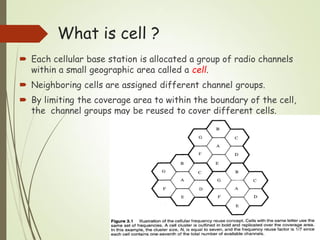
What is cell ?
 Each cellular base station is allocated a group of radio channels
within a small geographic area called a cell.
 Neighboring cells are assigned different channel groups.
 By limiting the coverage area to within the boundary of the cell,
the channel groups may be reused to cover different cells.
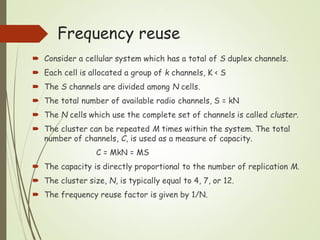
 Consider a cellular system which has a total of S duplex channels.
 Each cell is allocated a group of k channels, K < S
 The S channels are divided among N cells.
 The total number of available radio channels, S = kN
 The N cells which use the complete set of channels is called cluster.
 The cluster can be repeated M times within the system. The total
number of channels, C, is used as a measure of capacity.
C = MkN = MS
 The capacity is directly proportional to the number of replication M.
 The cluster size, N, is typically equal to 4, 7, or 12.
 The frequency reuse factor is given by 1/N.
Frequency reuse
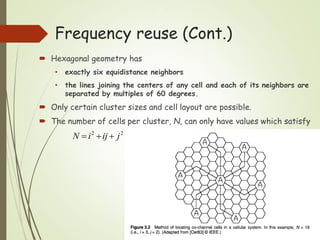
 Hexagonal geometry has
• exactly six equidistance neighbors
• the lines joining the centers of any cell and each of its neighbors are
separated by multiples of 60 degrees.
 Only certain cluster sizes and cell layout are possible.
 The number of cells per cluster, N, can only have values which satisfy
22
jijiN 
Frequency reuse (Cont.)
Channel Assignment Strategies
 Goal is to minimize interference & maximize use of capacity.
 One of the Channel assignment strategies is
1. Fixed Channel Assignment :
 Channels are divided in sets.
 A set of channels is permanently allocated to each cell in the
network. Same set of channels must be assigned to cells
separated by a certain distance to reduce co-channel
interference.
 Any call attempt within the cell can only be served by the
unused channels in that particular cell. The service is blocked
if all channels have used up
 Most easiest to implement but least flexibility.
 An modification to this is ‘borrowing scheme’. Cell (acceptor cell) tha
has used all its nominal channels can borrow free channels from its
neighboring cell (donor cell) to accommodate new calls.
 Borrowing can be done in a few ways: borrowing from the adjacent cell
which has largest number of free channels, select the first free
channel found, etc.
 To be available for borrowing, the channel must not interfere with
existing calls. The borrowed channel should be returned once the
channel becomes free.
FCA(cont.)
2. Dynamic Channel Allocation (DCA) :
 Voice channels are not allocated to any cell permanently. All channels
are kept in a central pool and are assigned dynamically to new calls as
they arrive in the system.
 Each time a call request is made, the serving BS requests a channel
from the MSC. It then allocates a channel to the requested cell
following an algorithm that takes into acount the likelihood of future
blocking within the cell, the reuse distance of the channel and other
cost functions ⇒ increase in complexity
 Centralized DCA scheme involves a single controller selecting a
channel for each cell. Distributed DCA scheme involves a number of
controllers scattered across the network.
 For a new call, a free channel from central pool is selected based
on either the co-channel distance, signal strength or signal to noise
interference ratio.
DCA(cont.)
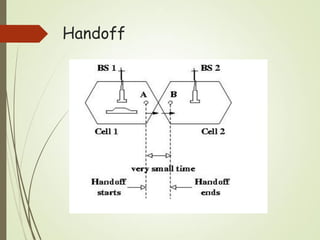
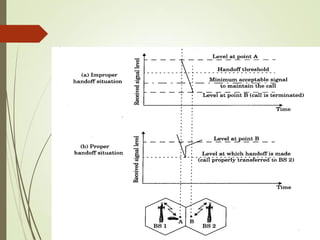
 Handoff :
when a mobile unit moves from one cell to another while a call is in
progress, the MSC must transfer (handoff) the call to a new
channel belonging to a new base station
 very important task → often given higher priority than new call
 It is worse to drop an in-progress call than to deny a new one
 Handoff operation :
• identifying a new base station
• re-allocating the voice and control channels with the new base
station.
What is Handoff ?
Handoff
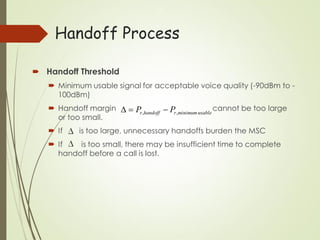
Handoff Process
 Handoff Threshold
 Minimum usable signal for acceptable voice quality (-90dBm to -
100dBm)
 Handoff margin cannot be too large
or too small.
 If is too large, unnecessary handoffs burden the MSC
 If is too small, there may be insufficient time to complete
handoff before a call is lost.
usableminimum,, rhandoffr PP 
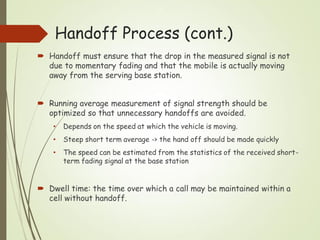
 Handoff must ensure that the drop in the measured signal is not
due to momentary fading and that the mobile is actually moving
away from the serving base station.
 Running average measurement of signal strength should be
optimized so that unnecessary handoffs are avoided.
• Depends on the speed at which the vehicle is moving.
• Steep short term average -> the hand off should be made quickly
• The speed can be estimated from the statistics of the received short-
term fading signal at the base station
 Dwell time: the time over which a call may be maintained within a
cell without handoff.
Handoff Process (cont.)
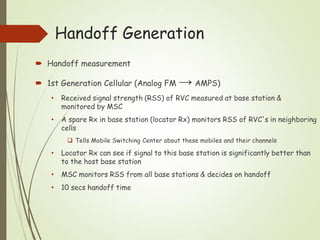
Handoff Generation
 Handoff measurement
 1st Generation Cellular (Analog FM → AMPS)
• Received signal strength (RSS) of RVC measured at base station &
monitored by MSC
• A spare Rx in base station (locator Rx) monitors RSS of RVC's in neighboring
cells
 Tells Mobile Switching Center about these mobiles and their channels
• Locator Rx can see if signal to this base station is significantly better than
to the host base station
• MSC monitors RSS from all base stations & decides on handoff
• 10 secs handoff time
Handoff Generation (Cont.)
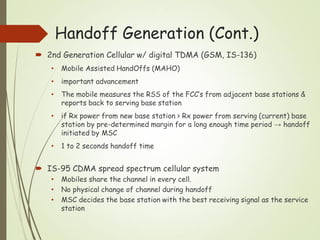
 2nd Generation Cellular w/ digital TDMA (GSM, IS-136)
• Mobile Assisted HandOffs (MAHO)
• important advancement
• The mobile measures the RSS of the FCC’s from adjacent base stations &
reports back to serving base station
• if Rx power from new base station > Rx power from serving (current) base
station by pre-determined margin for a long enough time period → handoff
initiated by MSC
• 1 to 2 seconds handoff time
 IS-95 CDMA spread spectrum cellular system
• Mobiles share the channel in every cell.
• No physical change of channel during handoff
• MSC decides the base station with the best receiving signal as the service
station
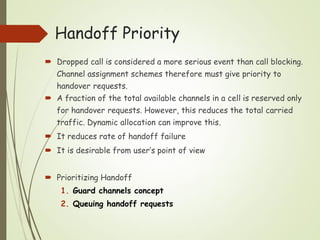
 Dropped call is considered a more serious event than call blocking.
Channel assignment schemes therefore must give priority to
handover requests.
 A fraction of the total available channels in a cell is reserved only
for handover requests. However, this reduces the total carried
traffic. Dynamic allocation can improve this.
 It reduces rate of handoff failure
 It is desirable from user’s point of view
 Prioritizing Handoff
1. Guard channels concept
2. Queuing handoff requests
Handoff Priority
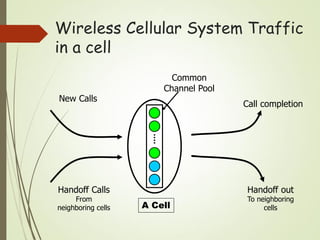
A Cell
New Calls
Handoff Calls
From
neighboring cells
Common
Channel Pool
Call completion
Handoff out
To neighboring
cells
Wireless Cellular System Traffic
in a cell
Guard Channel Method
A fraction of available channels is reserved exclusively for
handoff requests
It has disadvantage of reducing total carried traffic
It Offers efficient spectrum utilization when dynamic channel
assignment strategies by minimizing number of required guard
channels
It reduces number of blocked handoffs
It reduces system capacity
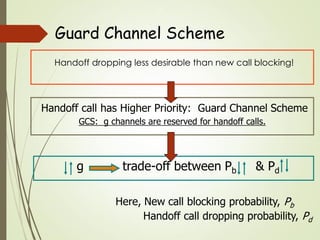
Handoff dropping less desirable than new call blocking!
Handoff call has Higher Priority: Guard Channel Scheme
GCS: g channels are reserved for handoff calls.
g trade-off between Pb & Pd
Here, New call blocking probability, Pb
Handoff call dropping probability, Pd
Guard Channel Scheme
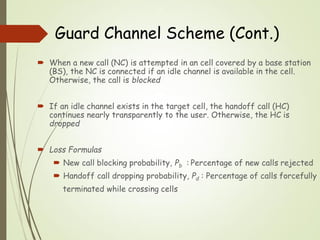
 When a new call (NC) is attempted in an cell covered by a base station
(BS), the NC is connected if an idle channel is available in the cell.
Otherwise, the call is blocked
 If an idle channel exists in the target cell, the handoff call (HC)
continues nearly transparently to the user. Otherwise, the HC is
dropped
 Loss Formulas
 New call blocking probability, Pb : Percentage of new calls rejected
 Handoff call dropping probability, Pd : Percentage of calls forcefully
terminated while crossing cells
Guard Channel Scheme (Cont.)
Queuing Handoff Requests
 First, Put handoff requests in a queue
 Then Serves handoffs on a FCFS basis
 It reduces number of failed handoffs
 It reduces system capacity
Queuing Handoff Requests (Cont.)
 Possible due to time interval elapsed when the signal level drops
below to threshold until minimum signal level
 Decrease probability of forced termination due to lack of
available channels
 Tradeoff between decrease in probability of forced termination
and total traffic
 The delay time and queue size is determined from traffic pattern
 Queuing does not guarantee zero probability of call termination
since large delays will signal level to drop min
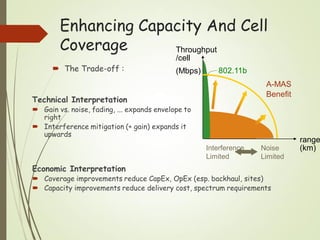
 The Trade-off :
Enhancing Capacity And Cell
Coverage
range
(km)
Throughput
/cell
(Mbps) 802.11b
Noise
Limited
Interference
Limited
A-MAS
Benefit
Technical Interpretation
 Gain vs. noise, fading, ... expands envelope to
right
 Interference mitigation (+ gain) expands it
upwards
Economic Interpretation
 Coverage improvements reduce CapEx, OpEx (esp. backhaul, sites)
 Capacity improvements reduce delivery cost, spectrum requirements
 The number of channels available to customers (equivalently,
the channel density per square kilometer) could be increased
by decreasing the cluster size.
 It might be that an increase in channel density is required only
in specific parts of the system to support an increased demand
in those areas.
 Cell-splitting is a technique which has the capability to add new
smaller cells in specific areas of the system.
 Sectoring is basically a technique which can increase the SIR
without necessitating an increase in the cluster size.
 Microcell zone
Trade-off
Introduction
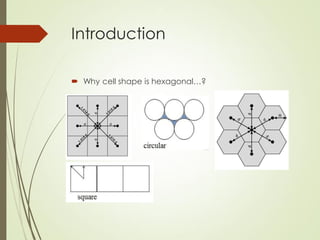
 Why cell shape is hexagonal…?
Cont…
 Why Cell Splitting , Sectoring and Microcell zone…..?
 As users increases per cell the channel capacity
decreases
 Techniques needed to provide extra channel
 Cell Splitting, Sectoring and Microcell zone increases the
capacity
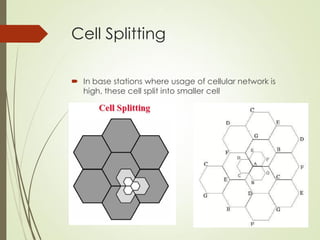
Cell Splitting
 In base stations where usage of cellular network is
high, these cell split into smaller cell
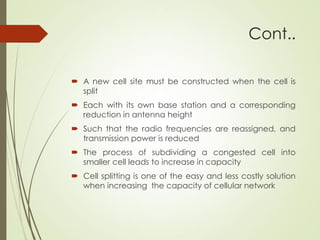
Cont..
 A new cell site must be constructed when the cell is
split
 Each with its own base station and a corresponding
reduction in antenna height
 Such that the radio frequencies are reassigned, and
transmission power is reduced
 The process of subdividing a congested cell into
smaller cell leads to increase in capacity
 Cell splitting is one of the easy and less costly solution
when increasing the capacity of cellular network
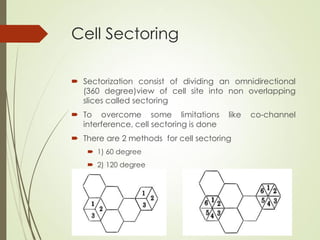
Cell Sectoring
 Sectorization consist of dividing an omnidirectional
(360 degree)view of cell site into non overlapping
slices called sectoring
 To overcome some limitations like co-channel
interference, cell sectoring is done
 There are 2 methods for cell sectoring
 1) 60 degree
 2) 120 degree
Cont…
 Replacing a single omnidirectional antenna at base
station with several directional antenna achieves
capacity improvement by essentially rescaling the
system
 Advantages
 It reduces interference which increases capacity
 It enables to reduce the cluster size and provides an
additional freedom in assigning channels
 Limitations
 Increased number of antennas at each base station
 Loss of traffic
 Since sectoring reduces the coverage area of a
particular group of channels, the number of handoffs
increases as well
Microcell
 As the splitting of cell idea evolves, the usage of
smaller cell becomes efficient and it leads the
creation of microcell
 The aim of creating a microcell are increasing the
capacity of cellular networks in areas where
population is very high
Microcell Zone Concept
 By the use of sectorization technique, we can increase
the system performance but there will be a large
increment of handoffs which results in the increment of
load on the switching and control link elements of the
mobile system
 So a Microcell Zone Concept is introduced which
leads to an increased capacity without any
degradation in trunking efficiency caused by
sectoring
 Large control base system is replaced by several lower
powered transmitters on the edge of the cell
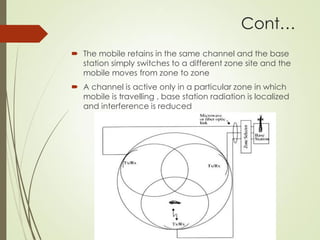
Cont…
 The mobile retains in the same channel and the base
station simply switches to a different zone site and the
mobile moves from zone to zone
 A channel is active only in a particular zone in which
mobile is travelling , base station radiation is localized
and interference is reduced
Reference
 Ray, S; Pawlikowski, K; Sirisena, H; , ”Handover in Mobile WiMAX
Networks: The State of Art and Research Issues,” IEEE Commun.
Surveys & Tutorials , vol.PP, no.99, pp.1-24, 2010
 Channel assignment strategies; Srilasak , Wongthavarawat,
Limmongkol; wireless Innovation & security Lab., Nat. Electron,.&
Comput. Technol. Center, Pathymthani, Thailand..
 Adaptive cell sectoring using fixed overlapping sectors in CDMA
networks; alagan S. Anpalagan elvino S. Sousa; Department of
electrical and computer engineering; University of toronto.
 Evolved universal terrestrial radio access (E-UTRA), physical
channelsand modulation.3GPP TR 36.211, V.8.5.0, 2008.

Fundamental of cellular system

  • 1.
  • 2.
    Outline  Introduction tocellular system  Concept of frequency reuse  Channel Assignment Strategies  Handoff Process and Generation  Handoff Priority  Enhancing Capacity And Cell Coverage : The key Trade-off  Cell Splitting  Sectoring  Microcell Zone Concept  Reference
  • 3.
    Introduction  Goals ofa Cellular System : • High capacity • Large coverage area • Efficient use of limited spectrum  Reuse of radio channel  Enable a fix number of channels to serve an arbitrarily large number of users by reusing the channel throughout the coverage region
  • 4.
    What is cell?  Each cellular base station is allocated a group of radio channels within a small geographic area called a cell.  Neighboring cells are assigned different channel groups.  By limiting the coverage area to within the boundary of the cell, the channel groups may be reused to cover different cells.
  • 5.
     Consider acellular system which has a total of S duplex channels.  Each cell is allocated a group of k channels, K < S  The S channels are divided among N cells.  The total number of available radio channels, S = kN  The N cells which use the complete set of channels is called cluster.  The cluster can be repeated M times within the system. The total number of channels, C, is used as a measure of capacity. C = MkN = MS  The capacity is directly proportional to the number of replication M.  The cluster size, N, is typically equal to 4, 7, or 12.  The frequency reuse factor is given by 1/N. Frequency reuse
  • 6.
     Hexagonal geometryhas • exactly six equidistance neighbors • the lines joining the centers of any cell and each of its neighbors are separated by multiples of 60 degrees.  Only certain cluster sizes and cell layout are possible.  The number of cells per cluster, N, can only have values which satisfy 22 jijiN  Frequency reuse (Cont.)
  • 7.
    Channel Assignment Strategies Goal is to minimize interference & maximize use of capacity.  One of the Channel assignment strategies is 1. Fixed Channel Assignment :  Channels are divided in sets.  A set of channels is permanently allocated to each cell in the network. Same set of channels must be assigned to cells separated by a certain distance to reduce co-channel interference.  Any call attempt within the cell can only be served by the unused channels in that particular cell. The service is blocked if all channels have used up
  • 8.
     Most easiestto implement but least flexibility.  An modification to this is ‘borrowing scheme’. Cell (acceptor cell) tha has used all its nominal channels can borrow free channels from its neighboring cell (donor cell) to accommodate new calls.  Borrowing can be done in a few ways: borrowing from the adjacent cell which has largest number of free channels, select the first free channel found, etc.  To be available for borrowing, the channel must not interfere with existing calls. The borrowed channel should be returned once the channel becomes free. FCA(cont.)
  • 9.
    2. Dynamic ChannelAllocation (DCA) :  Voice channels are not allocated to any cell permanently. All channels are kept in a central pool and are assigned dynamically to new calls as they arrive in the system.  Each time a call request is made, the serving BS requests a channel from the MSC. It then allocates a channel to the requested cell following an algorithm that takes into acount the likelihood of future blocking within the cell, the reuse distance of the channel and other cost functions ⇒ increase in complexity
  • 10.
     Centralized DCAscheme involves a single controller selecting a channel for each cell. Distributed DCA scheme involves a number of controllers scattered across the network.  For a new call, a free channel from central pool is selected based on either the co-channel distance, signal strength or signal to noise interference ratio. DCA(cont.)
  • 11.
     Handoff : whena mobile unit moves from one cell to another while a call is in progress, the MSC must transfer (handoff) the call to a new channel belonging to a new base station  very important task → often given higher priority than new call  It is worse to drop an in-progress call than to deny a new one  Handoff operation : • identifying a new base station • re-allocating the voice and control channels with the new base station. What is Handoff ?
  • 12.
  • 13.
    Handoff Process  HandoffThreshold  Minimum usable signal for acceptable voice quality (-90dBm to - 100dBm)  Handoff margin cannot be too large or too small.  If is too large, unnecessary handoffs burden the MSC  If is too small, there may be insufficient time to complete handoff before a call is lost. usableminimum,, rhandoffr PP 
  • 15.
     Handoff mustensure that the drop in the measured signal is not due to momentary fading and that the mobile is actually moving away from the serving base station.  Running average measurement of signal strength should be optimized so that unnecessary handoffs are avoided. • Depends on the speed at which the vehicle is moving. • Steep short term average -> the hand off should be made quickly • The speed can be estimated from the statistics of the received short- term fading signal at the base station  Dwell time: the time over which a call may be maintained within a cell without handoff. Handoff Process (cont.)
  • 16.
    Handoff Generation  Handoffmeasurement  1st Generation Cellular (Analog FM → AMPS) • Received signal strength (RSS) of RVC measured at base station & monitored by MSC • A spare Rx in base station (locator Rx) monitors RSS of RVC's in neighboring cells  Tells Mobile Switching Center about these mobiles and their channels • Locator Rx can see if signal to this base station is significantly better than to the host base station • MSC monitors RSS from all base stations & decides on handoff • 10 secs handoff time
  • 17.
    Handoff Generation (Cont.) 2nd Generation Cellular w/ digital TDMA (GSM, IS-136) • Mobile Assisted HandOffs (MAHO) • important advancement • The mobile measures the RSS of the FCC’s from adjacent base stations & reports back to serving base station • if Rx power from new base station > Rx power from serving (current) base station by pre-determined margin for a long enough time period → handoff initiated by MSC • 1 to 2 seconds handoff time  IS-95 CDMA spread spectrum cellular system • Mobiles share the channel in every cell. • No physical change of channel during handoff • MSC decides the base station with the best receiving signal as the service station
  • 18.
     Dropped callis considered a more serious event than call blocking. Channel assignment schemes therefore must give priority to handover requests.  A fraction of the total available channels in a cell is reserved only for handover requests. However, this reduces the total carried traffic. Dynamic allocation can improve this.  It reduces rate of handoff failure  It is desirable from user’s point of view  Prioritizing Handoff 1. Guard channels concept 2. Queuing handoff requests Handoff Priority
  • 19.
    A Cell New Calls HandoffCalls From neighboring cells Common Channel Pool Call completion Handoff out To neighboring cells Wireless Cellular System Traffic in a cell
  • 20.
    Guard Channel Method Afraction of available channels is reserved exclusively for handoff requests It has disadvantage of reducing total carried traffic It Offers efficient spectrum utilization when dynamic channel assignment strategies by minimizing number of required guard channels It reduces number of blocked handoffs It reduces system capacity
  • 21.
    Handoff dropping lessdesirable than new call blocking! Handoff call has Higher Priority: Guard Channel Scheme GCS: g channels are reserved for handoff calls. g trade-off between Pb & Pd Here, New call blocking probability, Pb Handoff call dropping probability, Pd Guard Channel Scheme
  • 22.
     When anew call (NC) is attempted in an cell covered by a base station (BS), the NC is connected if an idle channel is available in the cell. Otherwise, the call is blocked  If an idle channel exists in the target cell, the handoff call (HC) continues nearly transparently to the user. Otherwise, the HC is dropped  Loss Formulas  New call blocking probability, Pb : Percentage of new calls rejected  Handoff call dropping probability, Pd : Percentage of calls forcefully terminated while crossing cells Guard Channel Scheme (Cont.)
  • 23.
    Queuing Handoff Requests First, Put handoff requests in a queue  Then Serves handoffs on a FCFS basis  It reduces number of failed handoffs  It reduces system capacity
  • 24.
    Queuing Handoff Requests(Cont.)  Possible due to time interval elapsed when the signal level drops below to threshold until minimum signal level  Decrease probability of forced termination due to lack of available channels  Tradeoff between decrease in probability of forced termination and total traffic  The delay time and queue size is determined from traffic pattern  Queuing does not guarantee zero probability of call termination since large delays will signal level to drop min
  • 25.
     The Trade-off: Enhancing Capacity And Cell Coverage range (km) Throughput /cell (Mbps) 802.11b Noise Limited Interference Limited A-MAS Benefit Technical Interpretation  Gain vs. noise, fading, ... expands envelope to right  Interference mitigation (+ gain) expands it upwards Economic Interpretation  Coverage improvements reduce CapEx, OpEx (esp. backhaul, sites)  Capacity improvements reduce delivery cost, spectrum requirements
  • 26.
     The numberof channels available to customers (equivalently, the channel density per square kilometer) could be increased by decreasing the cluster size.  It might be that an increase in channel density is required only in specific parts of the system to support an increased demand in those areas.  Cell-splitting is a technique which has the capability to add new smaller cells in specific areas of the system.  Sectoring is basically a technique which can increase the SIR without necessitating an increase in the cluster size.  Microcell zone Trade-off
  • 27.
    Introduction  Why cellshape is hexagonal…?
  • 28.
    Cont…  Why CellSplitting , Sectoring and Microcell zone…..?  As users increases per cell the channel capacity decreases  Techniques needed to provide extra channel  Cell Splitting, Sectoring and Microcell zone increases the capacity
  • 29.
    Cell Splitting  Inbase stations where usage of cellular network is high, these cell split into smaller cell
  • 30.
    Cont..  A newcell site must be constructed when the cell is split  Each with its own base station and a corresponding reduction in antenna height  Such that the radio frequencies are reassigned, and transmission power is reduced  The process of subdividing a congested cell into smaller cell leads to increase in capacity  Cell splitting is one of the easy and less costly solution when increasing the capacity of cellular network
  • 31.
    Cell Sectoring  Sectorizationconsist of dividing an omnidirectional (360 degree)view of cell site into non overlapping slices called sectoring  To overcome some limitations like co-channel interference, cell sectoring is done  There are 2 methods for cell sectoring  1) 60 degree  2) 120 degree
  • 32.
    Cont…  Replacing asingle omnidirectional antenna at base station with several directional antenna achieves capacity improvement by essentially rescaling the system  Advantages  It reduces interference which increases capacity  It enables to reduce the cluster size and provides an additional freedom in assigning channels  Limitations  Increased number of antennas at each base station  Loss of traffic  Since sectoring reduces the coverage area of a particular group of channels, the number of handoffs increases as well
  • 33.
    Microcell  As thesplitting of cell idea evolves, the usage of smaller cell becomes efficient and it leads the creation of microcell  The aim of creating a microcell are increasing the capacity of cellular networks in areas where population is very high
  • 34.
    Microcell Zone Concept By the use of sectorization technique, we can increase the system performance but there will be a large increment of handoffs which results in the increment of load on the switching and control link elements of the mobile system  So a Microcell Zone Concept is introduced which leads to an increased capacity without any degradation in trunking efficiency caused by sectoring  Large control base system is replaced by several lower powered transmitters on the edge of the cell
  • 35.
    Cont…  The mobileretains in the same channel and the base station simply switches to a different zone site and the mobile moves from zone to zone  A channel is active only in a particular zone in which mobile is travelling , base station radiation is localized and interference is reduced
  • 36.
    Reference  Ray, S;Pawlikowski, K; Sirisena, H; , ”Handover in Mobile WiMAX Networks: The State of Art and Research Issues,” IEEE Commun. Surveys & Tutorials , vol.PP, no.99, pp.1-24, 2010  Channel assignment strategies; Srilasak , Wongthavarawat, Limmongkol; wireless Innovation & security Lab., Nat. Electron,.& Comput. Technol. Center, Pathymthani, Thailand..  Adaptive cell sectoring using fixed overlapping sectors in CDMA networks; alagan S. Anpalagan elvino S. Sousa; Department of electrical and computer engineering; University of toronto.  Evolved universal terrestrial radio access (E-UTRA), physical channelsand modulation.3GPP TR 36.211, V.8.5.0, 2008.