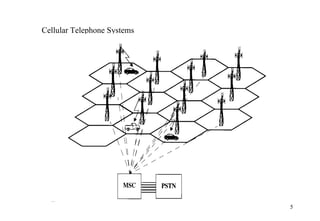
• Transmitting andreceiving voice and data using electromagnetic
waves in open space – wireless communication
• Information from sender to receiver is carried over well defined
frequency band – channel
• Guard band
• Multiple access scenario – FDMA TDMA CDMA
2
4
• In FDD,
*a device, called a duplexer, is used inside the subscriber unit to enable the
same antenna to be used for simultaneous transmission and reception.
* to facilitate FDD, it is necessary to separate the transmitted and received
frequencies by about 5% of the nominal RF frequency, so that the
duplexer can provide sufficient isolation while being inexpensively
manufactured.
• In TDD,
* only possible with digital transmission format and digital modulation.
* very sensitive to timing. Consequently, only used for indoor or small area
wireless applications.
6
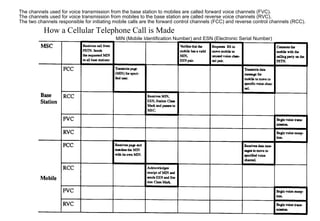
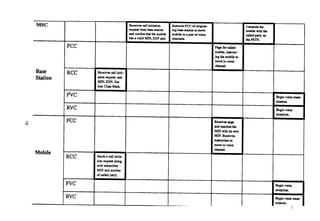
How a CellularTelephone Call is Made
The channels used for voice transmission from the base station to mobiles are called forward voice channels (FVC).
The channels used for voice transmission from mobiles to the base station are called reverse voice channels (RVC).
The two channels responsible for initiating mobile calls are the forward control channels (FCC) and reverse control channels (RCC).
MIN (Mobile Identification Number) and ESN (Electronic Serial Number)
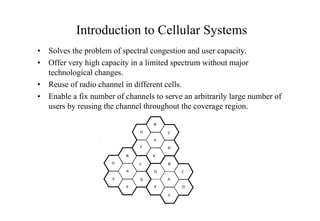
Introduction to CellularSystems
• Solves the problem of spectral congestion and user capacity.
• Offer very high capacity in a limited spectrum without major
technological changes.
• Reuse of radio channel in different cells.
• Enable a fix number of channels to serve an arbitrarily large number of
users by reusing the channel throughout the coverage region.
9.
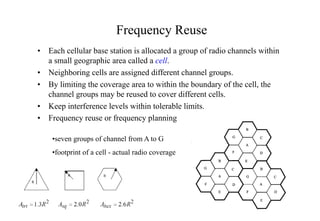
Frequency Reuse
• Eachcellular base station is allocated a group of radio channels within
a small geographic area called a cell.
• Neighboring cells are assigned different channel groups.
• By limiting the coverage area to within the boundary of the cell, the
channel groups may be reused to cover different cells.
• Keep interference levels within tolerable limits.
• Frequency reuse or frequency planning
•seven groups of channel from A to G
•footprint of a cell - actual radio coverage
10.
Frequency Reuse
• Replacinga single, high power transmitter with many low
power transmitters, each providing coverage to only a small
area.
• Neighboring cells are assigned different groups of channels in
order to minimize interference.
• The same set of channels is then reused at different geographical
locations.
11.
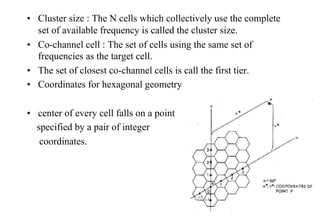
• Cluster size: The N cells which collectively use the complete
set of available frequency is called the cluster size.
• Co-channel cell : The set of cells using the same set of
frequencies as the target cell.
• The set of closest co-channel cells is call the first tier.
• Coordinates for hexagonal geometry
• center of every cell falls on a point
specified by a pair of integer
coordinates.
11
12.
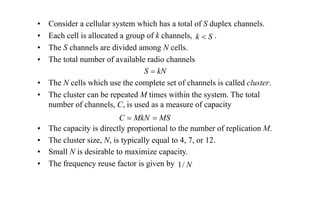
• Consider acellular system which has a total of S duplex channels.
• Each cell is allocated a group of k channels, .
• The S channels are divided among N cells.
• The total number of available radio channels
• The N cells which use the complete set of channels is called cluster.
• The cluster can be repeated M times within the system. The total
number of channels, C, is used as a measure of capacity
• The capacity is directly proportional to the number of replication M.
• The cluster size, N, is typically equal to 4, 7, or 12.
• Small N is desirable to maximize capacity.
• The frequency reuse factor is given by
S
k <
kN
S =
MS
MkN
C =
=
N
/
1
Question If a total of 33 MHz of bandwidth is allocated to a particular FDD cellular telephone system which uses two 25 kHz simplex
channels to provide full duplex voice and control channels, compute the number of channels available per cell if a system uses (a) four-
cell reuse, (b) seven-cell reuse, and (c) 12-cell reuse. If 1 MHz of the allocated spectrum is dedicated to control channels, determine an
equitable distribution of control channels and voice channels in each cell for each of the three systems.
13.
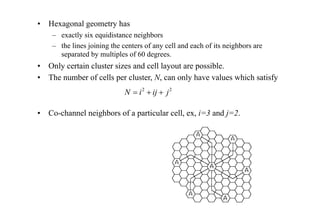
• Hexagonal geometryhas
– exactly six equidistance neighbors
– the lines joining the centers of any cell and each of its neighbors are
separated by multiples of 60 degrees.
• Only certain cluster sizes and cell layout are possible.
• The number of cells per cluster, N, can only have values which satisfy
• Co-channel neighbors of a particular cell, ex, i=3 and j=2.
2
2
j
ij
i
N +
+
=
14.
Channel Assignment Strategies
•Frequency reuse scheme
– increases capacity
– minimize interference
• Channel assignment strategy
– fixed channel assignment
– dynamic channel assignment
• Fixed channel assignment
– each cell is allocated a predetermined set of voice channel
– any new call attempt can only be served by the unused channels
– the call will be blocked if all channels in that cell are occupied
• Dynamic channel assignment
– channels are not allocated to cells permanently.
– allocate channels based on request.
– reduce the likelihood of blocking, increase capacity.
15.
Handoff Strategies
• Whena mobile moves into a different cell while a conversation is in
progress, the MSC automatically transfers the call to a new channel
belonging to the new base station.
• Handoff operation
– identifying a new base station
– re-allocating the voice and control channels with the new base station.
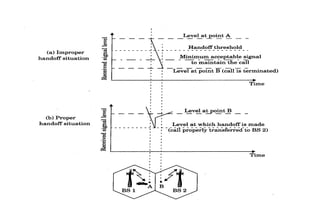
• Handoff Threshold
– Minimum usable signal for acceptable voice quality
– Handoff margin cannot be too large or too
small.
– If too large, unnecessary handoffs burden the MSC
– If too small, there may be insufficient time to complete handoff before
a call is lost.
usable
minimum
,
, r
handoff
r P
P -
=
D
D
D
17.
• Handoff mustensure that the drop in the measured signal is not due to
momentary fading and that the mobile is actually moving away from
the serving base station.
• Running average measurement of signal strength should be optimized
so that unnecessary handoffs are avoided.
– Depends on the speed at which the vehicle is moving.
– Steep short term average -> the hand off should be made quickly
– The speed can be estimated from the statistics of the received short-term
fading signal at the base station
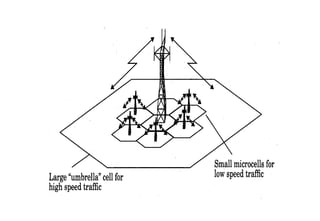
• Intersystem handoff: If a mobile moves from one cellular system to a
different cellular system controlled by a different MSC.
• Handoff requests is much important than handling a new call.
19.
Interference and SystemCapacity
• Sources of interference
– another mobile in the same cell
– a call in progress in the neighboring cell
– other base stations operating in the same frequency band
– noncellular system leaks energy into the cellular frequency band
• Two major cellular interference
– co-channel interference
– adjacent channel interference
20.
Co-channel Interference andSystem Capacity
• Frequency reuse - there are several cells that use the same set of
frequencies
– co-channel cells
– co-channel interference
• To reduce co-channel interference, co-channel cell must be separated
by a minimum distance.
• When the size of the cell is approximately the same
– co-channel interference is independent of the transmitted power
– co-channel interference is a function of
• R: Radius of the cell
• D: distance to the center of the nearest co-channel cell
• Increasing the ratio Q=D/R, the interference is reduced.
• Q is called the co-channel reuse ratio
21.
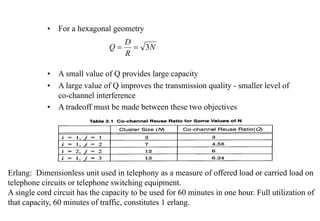
• For ahexagonal geometry
• A small value of Q provides large capacity
• A large value of Q improves the transmission quality - smaller level of
co-channel interference
• A tradeoff must be made between these two objectives
N
R
D
Q 3
=
=
Erlang: Dimensionless unit used in telephony as a measure of offered load or carried load on
telephone circuits or telephone switching equipment.
A single cord circuit has the capacity to be used for 60 minutes in one hour. Full utilization of
that capacity, 60 minutes of traffic, constitutes 1 erlang.
22.
22
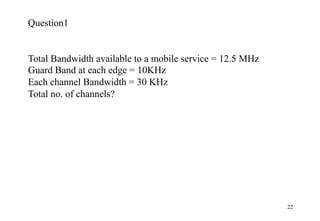
Question1
Total Bandwidth availableto a mobile service = 12.5 MHz
Guard Band at each edge = 10KHz
Each channel Bandwidth = 30 KHz
Total no. of channels?
23.
23
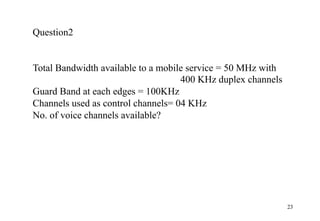
Question2
Total Bandwidth availableto a mobile service = 50 MHz with
400 KHz duplex channels
Guard Band at each edges = 100KHz
Channels used as control channels= 04 KHz
No. of voice channels available?
24.
24
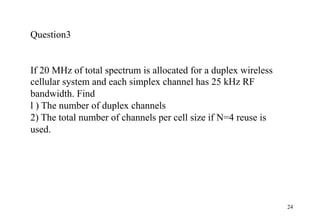
Question3
If 20 MHzof total spectrum is allocated for a duplex wireless
cellular system and each simplex channel has 25 kHz RF
bandwidth. Find
l ) The number of duplex channels
2) The total number of channels per cell size if N=4 reuse is
used.
25.
25
Question4
Consider a cellularsystem in which total available voice
channels to handle the traffic are 960. The area of each cell is
6km2 and the total coverage is 2000km2 . Find he system
capacity if the cluster size is N=4. Find the system capacity if
the cluster size is N=7.
26.
26
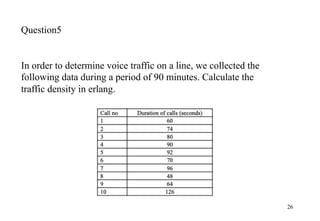
Question5
In order todetermine voice traffic on a line, we collected the
following data during a period of 90 minutes. Calculate the
traffic density in erlang.
27.
27
Question6
The average mobileuser has 500 minutes of use per month; 90% of
traffic occurs during work days. There are 20 week days per month.
Assuming that in a given day, 10% of traffic occurs during the busy
hour (BH), determine the traffic per subscriber per BH.