Functions
Prepared by:
Arriesgado, Anna Marie M.
Pilapil, Maria Lindy M.
Rodrigo, Jailah Dale G.
Objectives
At the end of this lesson, I can:
•Determine the domain and range of a
function
•Use function notation and evaluate
functions
•Perform operations with functions
Functions
and
Relations
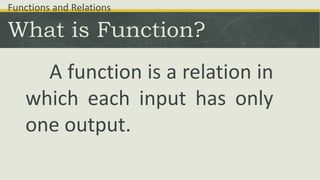
What is Function?
A function is a relation in
which each input has only
one output.
Functions and Relations
How about Relation?
A relation is a set of inputs
and outputs, often written
as ordered pairs (input,
output).
Function and Relation
There are two components in an
ordered pair. The set of all first
components of the ordered pairs is
called the domain of the relation, and
the set of all second components is
called the range.
Function and Relation
Example 1:
Function and Relation
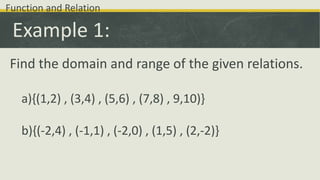
Find the domain and range of the given relations.
a){(1,2) , (3,4) , (5,6) , (7,8) , 9,10)}
b){(-2,4) , (-1,1) , (-2,0) , (1,5) , (2,-2)}
Answer:
Function and Relation
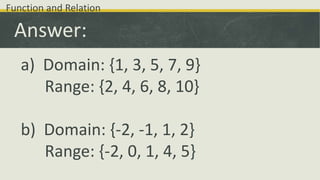
a) Domain: {1, 3, 5, 7, 9}
Range: {2, 4, 6, 8, 10}
b) Domain: {-2, -1, 1, 2}
Range: {-2, 0, 1, 4, 5}
Example 2:
Function and Relation
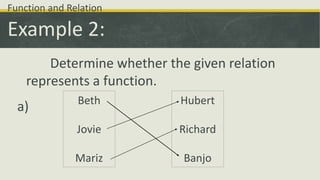
Determine whether the given relation
represents a function.
Beth
Jovie
Mariz
Hubert
Richard
Banjo
a)
b) Beth
Jovie
Marivic
Joey
Glen
27
28
25
30
Function and Relation
Answers:
a) The relation is a function because each
element in the domain corresponds to a
unique element in the range.
b) The relation is a function because each
element in the domain corresponds to a
unique element in the range.
Note:
Function and Relation
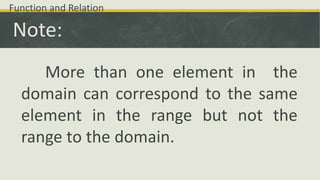
More than one element in the
domain can correspond to the same
element in the range but not the
range to the domain.
Function Notation
Function Notation
Functions are usually given
in terms of equation, rather
than sets of ordered pairs.
These equations are expressed
in a special notation.
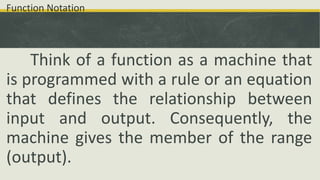
Think of a function as a machine that
is programmed with a rule or an equation
that defines the relationship between
input and output. Consequently, the
machine gives the member of the range
(output).
Function Notation
Function Notation
As in the figure, the letter f is
used to name functions. The
input is represented by x and the
output by f(x). The special
notation f(x), read “f of x” or “f at
x”, represents the value of the
functions at x.
Example:
f(x) = 5x + 8
Find f(3).
Function Notation
Answer:
f(x) = 5x + 8
f(3) = 5(3) + 8
= 15 + 8
= 23
Note:
The function f(x) = 5x + 8 can also be expressed
as y = 5x + 8, replacing f(x) by y. The variable x is
called the independent variable because it can be
any of the permissible numbers from the domain.
The variable y is called the dependent variable
because its value depends on x.
Function Notation
Example 3:
For the function h defined by h(x) = 4x2 – x + 7,
evaluate:
a) h(0)
b) h(-3)
c) h(2)
Function Notation
Answers:
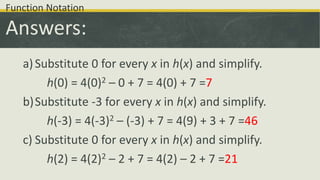
a)Substitute 0 for every x in h(x) and simplify.
h(0) = 4(0)2 – 0 + 7 = 4(0) + 7 =7
b)Substitute -3 for every x in h(x) and simplify.
h(-3) = 4(-3)2 – (-3) + 7 = 4(9) + 3 + 7 =46
c) Substitute 0 for every x in h(x) and simplify.
h(2) = 4(2)2 – 2 + 7 = 4(2) – 2 + 7 =21
Function Notation
Operations with
Functions
Just as two real numbers can be
combined by the operations of addition,
subtraction, multiplication and division to
form other real numbers, two functions
can be combined to create a new one.
Operations with Functions
For example: f(x) = x2 – 5x + 2 and g(x) = 2x + 7
f(x) + g(x) = (x2 – 5x + 2) + (2x + 7) = x2 – 3x + 9 Sum
f(x) - g(x) = (x2 – 5x + 2) - (2x + 7) = x2 – 7x – 5 Difference
f(x) * g(x) = (x2 – 5x + 2) * (2x + 7) Product
=2x3 – 3x2 – 31x + 14
f(x) / g(x) = (x2 – 5x + 2) / (2x + 7) =
𝑥2− 5𝑥 +2
2𝑥 +7
Quotient
Operations with Functions
Evaluation
Good luck and God Bless!!
I. Find the domain and range of the given relations and identify whether
the relation is function or just merely relation.
1. {(2, 1) , (12, 2) , (2, 8) , (3, 11) ,(11, 12)}
2. {(3, 77) , (5, 79) , (9, 83) , (12, 87) , (15, 90) , (16, 95)}
3. {(-2, 16) , (-4, 4) , (-3, 3) , (2, 12) , (-4, 0)}
4. {(-1, -5) , (0, 0) , (1, 3) , (2, 4) , (3, 3) , (4, 0) , (5, -5)}
5. {(2, 2), (3, 1) , (4, 0) , (5, 1) , (6, 2)}
II. For the function j defined by j(x) = 5x3 + 8x2 – 22, evaluate:
a)h(2)
b)h(-2)
c) h(7)
d)h(5)
e)h(-4)
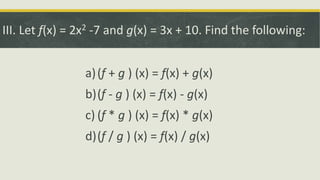
III. Let f(x) = 2x2 -7 and g(x) = 3x + 10. Find the following:
a)(f + g ) (x) = f(x) + g(x)
b)(f - g ) (x) = f(x) - g(x)
c) (f * g ) (x) = f(x) * g(x)
d)(f / g ) (x) = f(x) / g(x)

Functions and Relations

  • 1.
    Functions Prepared by: Arriesgado, AnnaMarie M. Pilapil, Maria Lindy M. Rodrigo, Jailah Dale G.
  • 2.
    Objectives At the endof this lesson, I can: •Determine the domain and range of a function •Use function notation and evaluate functions •Perform operations with functions
  • 3.
  • 4.
    What is Function? Afunction is a relation in which each input has only one output. Functions and Relations
  • 5.
    How about Relation? Arelation is a set of inputs and outputs, often written as ordered pairs (input, output). Function and Relation
  • 6.
    There are twocomponents in an ordered pair. The set of all first components of the ordered pairs is called the domain of the relation, and the set of all second components is called the range. Function and Relation
  • 7.
    Example 1: Function andRelation Find the domain and range of the given relations. a){(1,2) , (3,4) , (5,6) , (7,8) , 9,10)} b){(-2,4) , (-1,1) , (-2,0) , (1,5) , (2,-2)}
  • 8.
    Answer: Function and Relation a)Domain: {1, 3, 5, 7, 9} Range: {2, 4, 6, 8, 10} b) Domain: {-2, -1, 1, 2} Range: {-2, 0, 1, 4, 5}
  • 9.
    Example 2: Function andRelation Determine whether the given relation represents a function. Beth Jovie Mariz Hubert Richard Banjo a)
  • 10.
  • 11.
    Function and Relation Answers: a)The relation is a function because each element in the domain corresponds to a unique element in the range. b) The relation is a function because each element in the domain corresponds to a unique element in the range.
  • 12.
    Note: Function and Relation Morethan one element in the domain can correspond to the same element in the range but not the range to the domain.
  • 13.
  • 14.
    Function Notation Functions areusually given in terms of equation, rather than sets of ordered pairs. These equations are expressed in a special notation.
  • 15.
    Think of afunction as a machine that is programmed with a rule or an equation that defines the relationship between input and output. Consequently, the machine gives the member of the range (output). Function Notation
  • 16.
    Function Notation As inthe figure, the letter f is used to name functions. The input is represented by x and the output by f(x). The special notation f(x), read “f of x” or “f at x”, represents the value of the functions at x.
  • 17.
    Example: f(x) = 5x+ 8 Find f(3). Function Notation Answer: f(x) = 5x + 8 f(3) = 5(3) + 8 = 15 + 8 = 23
  • 18.
    Note: The function f(x)= 5x + 8 can also be expressed as y = 5x + 8, replacing f(x) by y. The variable x is called the independent variable because it can be any of the permissible numbers from the domain. The variable y is called the dependent variable because its value depends on x. Function Notation
  • 19.
    Example 3: For thefunction h defined by h(x) = 4x2 – x + 7, evaluate: a) h(0) b) h(-3) c) h(2) Function Notation
  • 20.
    Answers: a)Substitute 0 forevery x in h(x) and simplify. h(0) = 4(0)2 – 0 + 7 = 4(0) + 7 =7 b)Substitute -3 for every x in h(x) and simplify. h(-3) = 4(-3)2 – (-3) + 7 = 4(9) + 3 + 7 =46 c) Substitute 0 for every x in h(x) and simplify. h(2) = 4(2)2 – 2 + 7 = 4(2) – 2 + 7 =21 Function Notation
  • 21.
  • 22.
    Just as tworeal numbers can be combined by the operations of addition, subtraction, multiplication and division to form other real numbers, two functions can be combined to create a new one. Operations with Functions
  • 23.
    For example: f(x)= x2 – 5x + 2 and g(x) = 2x + 7 f(x) + g(x) = (x2 – 5x + 2) + (2x + 7) = x2 – 3x + 9 Sum f(x) - g(x) = (x2 – 5x + 2) - (2x + 7) = x2 – 7x – 5 Difference f(x) * g(x) = (x2 – 5x + 2) * (2x + 7) Product =2x3 – 3x2 – 31x + 14 f(x) / g(x) = (x2 – 5x + 2) / (2x + 7) = 𝑥2− 5𝑥 +2 2𝑥 +7 Quotient Operations with Functions
  • 24.
  • 25.
    I. Find thedomain and range of the given relations and identify whether the relation is function or just merely relation. 1. {(2, 1) , (12, 2) , (2, 8) , (3, 11) ,(11, 12)} 2. {(3, 77) , (5, 79) , (9, 83) , (12, 87) , (15, 90) , (16, 95)} 3. {(-2, 16) , (-4, 4) , (-3, 3) , (2, 12) , (-4, 0)} 4. {(-1, -5) , (0, 0) , (1, 3) , (2, 4) , (3, 3) , (4, 0) , (5, -5)} 5. {(2, 2), (3, 1) , (4, 0) , (5, 1) , (6, 2)}
  • 26.
    II. For thefunction j defined by j(x) = 5x3 + 8x2 – 22, evaluate: a)h(2) b)h(-2) c) h(7) d)h(5) e)h(-4)
  • 27.
    III. Let f(x)= 2x2 -7 and g(x) = 3x + 10. Find the following: a)(f + g ) (x) = f(x) + g(x) b)(f - g ) (x) = f(x) - g(x) c) (f * g ) (x) = f(x) * g(x) d)(f / g ) (x) = f(x) / g(x)