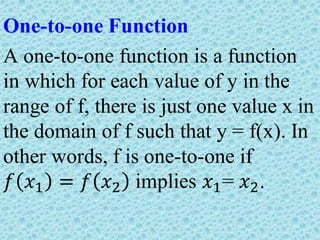
Relations
and
Functions
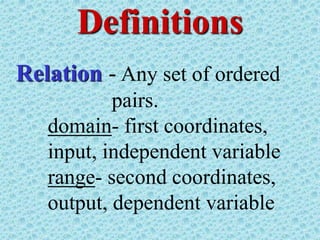
Relation - Any set of ordered
pairs.
domain- first coordinates,
input, independent variable
range- second coordinates,
output, dependent variable
Definitions
Example
• People and their heights
• Grades in General Mathematics
Example
Names
Peter
Krisha
Fay
Abby
Earl
Clara
Job
Karl
Audrey
Grades
95
94
93
92
95
97
94
90
98
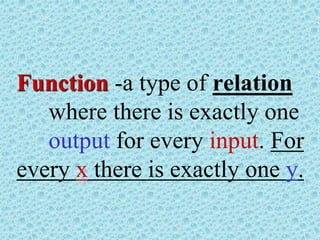
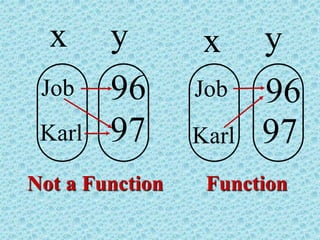
Function -a type of relation
where there is exactly one
output for every input. For
every x there is exactly one y.
x y
Job
Karl
96
97
x y
Job
Karl
96
97
Not a Function Function
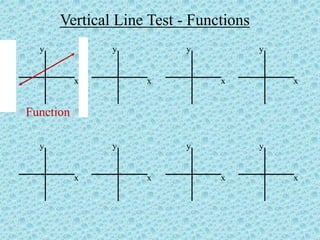
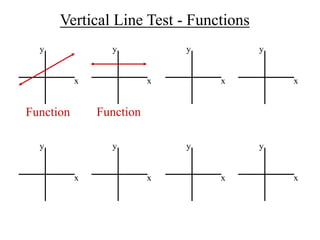
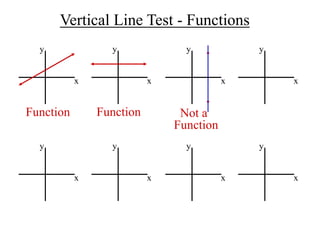
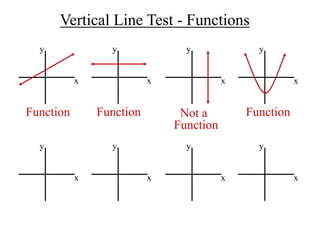
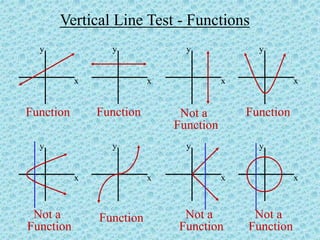
Vertical Line Test - Functions
x
y
x
y
x
y
x
y
x
y
x
y
x
y
x
y
Function
Vertical Line Test - Functions
x
y
x
y
x
y
x
y
x
y
x
y
x
y
x
y
Function Function
Vertical Line Test - Functions
x
y
x
y
x
y
x
y
x
y
x
y
x
y
x
y
Function Function Not a
Function
Vertical Line Test - Functions
x
y
x
y
x
y
x
y
x
y
x
y
x
y
x
y
Function Function Not a
Function
Function
Vertical Line Test - Functions
x
y
x
y
x
y
x
y
x
y
x
y
x
y
x
y
Function Function Not a
Function
Function
Not a
Function
Function Not a
Function
Not a
Function
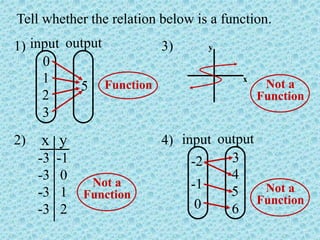
Tell whether the relation below is a function.
1)
2)
3)
4)
input output
0
1
5
2
3
y
x
-3
-3
-3
-3
-1
0
1
2
x
y
Function
Not a
Function
Not a
Function
input output
-2
-1
0
3
4
5
6
Not a
Function
Conclusion and Definition
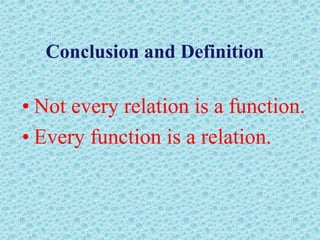
• Not every relation is a function.
• Every function is a relation.
TYPES OF FUNCTIONS
LINEAR FUNCTION
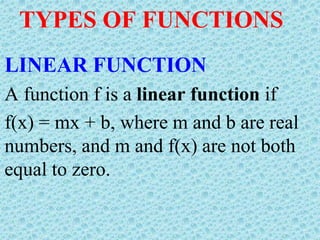
A function f is a linear function if
f(x) = mx + b, where m and b are real
numbers, and m and f(x) are not both
equal to zero.
y
x
-2
-1
0
1
2
-4
-2
0
2
4
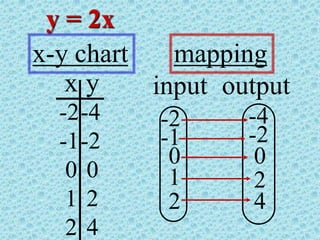
y = 2x
input output
-2
-1
-4
-2
0
1
0
2
2 4
x-y chart mapping
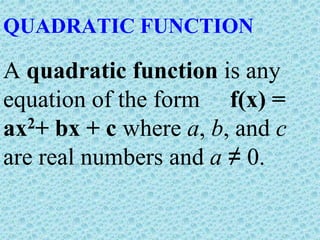
QUADRATIC FUNCTION
A quadratic function is any
equation of the form f(x) =
ax2+ bx + c where a, b, and c
are real numbers and a ≠ 0.
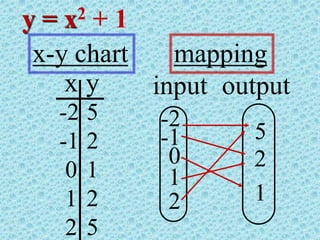
y = x2 + 1
y
x
-2
-1
0
1
2
5
2
1
2
5
input output
-2
-1 5
2
0
1
1
2
x-y chart mapping
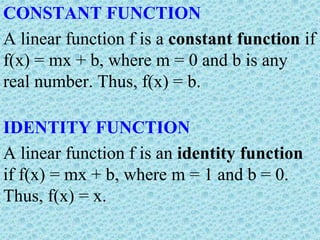
CONSTANT FUNCTION
A linear function f is a constant function if
f(x) = mx + b, where m = 0 and b is any
real number. Thus, f(x) = b.
IDENTITY FUNCTION
A linear function f is an identity function
if f(x) = mx + b, where m = 1 and b = 0.
Thus, f(x) = x.
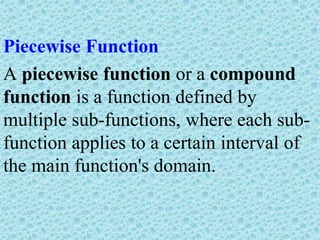
Piecewise Function
A piecewise function or a compound
function is a function defined by
multiple sub-functions, where each sub-
function applies to a certain interval of
the main function's domain.
y
x
-2
-1
0
1
2
-4
-2
0
2
4
y = 2x
input output
-2
-1
-4
-2
0
1
0
2
2 4
x-y chart mapping
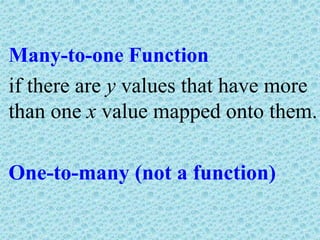
Many-to-one Function
if there are y values that have more
than one x value mapped onto them.
One-to-many (not a function)
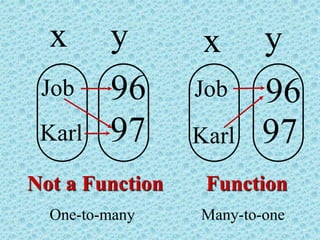
x y
Job
Karl
96
97
x y
Job
Karl
96
97
Not a Function Function
One-to-many Many-to-one
Lesson 2 EVALUATION OF FUNCTIONS
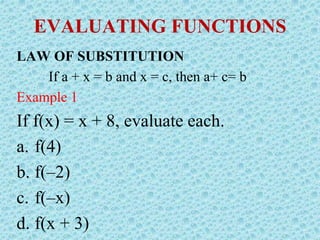
EVALUATING FUNCTIONS
LAW OF SUBSTITUTION
If a + x = b and x = c, then a+ c= b
Example 1
If f(x) = x + 8, evaluate each.
a. f(4)
b. f(–2)
c. f(–x)
d. f(x + 3)
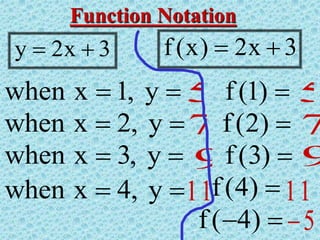
Function Notation
y 2x 3
  f (x) 2x 3
 
when x 1, y
 5
when x 2, y
 7
when x 3, y
  9
when x 4, y
 11
f (1)  5
f(2)  7
f (3)  9
f(4) 11
f( 4)
  5

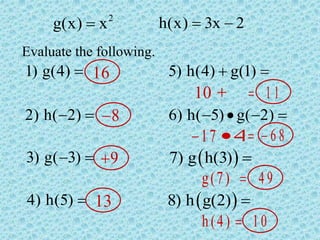
2
g(x) x
 h(x) 3x 2
 
Evaluate the following.
1) g(4) 
2) h( 2)
 
3) g( 3)
 
4) h(5) 
5) h(4) g(1)
 
6) h( 5) g( 2)
   
 
7) g h(3) 
 
8) h g(2) 
16
8

9

13
10  1 1

17
 4 6 8
 
g(7) 4 9

h(4) 10

Lesson 3 OPERATIONS ON FUNCTIONS
Lesson Objectives
At the end of the lesson, the students must
be able to:
• find the sum of functions;
• determine the difference between
functions;
• identify the product of functions;
• find the quotient between functions; and
• determine the composite of a function.
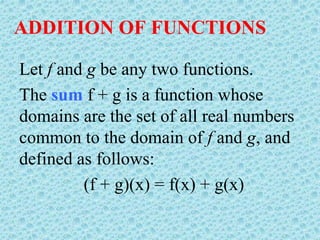
ADDITION OF FUNCTIONS
Let f and g be any two functions.
The sum f + g is a function whose
domains are the set of all real numbers
common to the domain of f and g, and
defined as follows:
(f + g)(x) = f(x) + g(x)
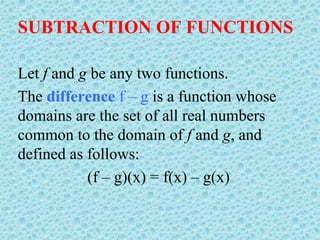
SUBTRACTION OF FUNCTIONS
Let f and g be any two functions.
The difference f – g is a function whose
domains are the set of all real numbers
common to the domain of f and g, and
defined as follows:
(f – g)(x) = f(x) – g(x)
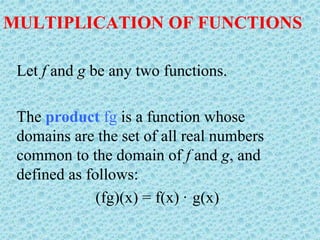
MULTIPLICATION OF FUNCTIONS
Let f and g be any two functions.
The product fg is a function whose
domains are the set of all real numbers
common to the domain of f and g, and
defined as follows:
(fg)(x) = f(x) · g(x)
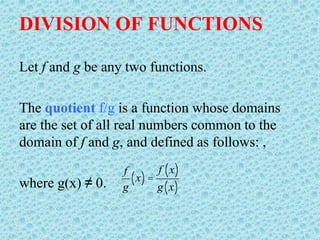
DIVISION OF FUNCTIONS
Let f and g be any two functions.
The quotient f/g is a function whose domains
are the set of all real numbers common to the
domain of f and g, and defined as follows: ,
where g(x) ≠ 0.
f
g
x
( ) =
f x
( )
g x
( )
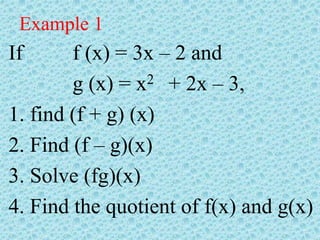
Example 1
If f (x) = 3x – 2 and
g (x) = x2 + 2x – 3,
1. find (f + g) (x)
2. Find (f – g)(x)
3. Solve (fg)(x)
4. Find the quotient of f(x) and g(x)

LESSONS 1-3 Gen Math. functions and relationsppt

  • 2.
  • 3.
    Relation - Anyset of ordered pairs. domain- first coordinates, input, independent variable range- second coordinates, output, dependent variable Definitions
  • 4.
    Example • People andtheir heights • Grades in General Mathematics
  • 5.
  • 6.
    Function -a typeof relation where there is exactly one output for every input. For every x there is exactly one y.
  • 7.
  • 8.
    Vertical Line Test- Functions x y x y x y x y x y x y x y x y Function
  • 9.
    Vertical Line Test- Functions x y x y x y x y x y x y x y x y Function Function
  • 10.
    Vertical Line Test- Functions x y x y x y x y x y x y x y x y Function Function Not a Function
  • 11.
    Vertical Line Test- Functions x y x y x y x y x y x y x y x y Function Function Not a Function Function
  • 12.
    Vertical Line Test- Functions x y x y x y x y x y x y x y x y Function Function Not a Function Function Not a Function Function Not a Function Not a Function
  • 13.
    Tell whether therelation below is a function. 1) 2) 3) 4) input output 0 1 5 2 3 y x -3 -3 -3 -3 -1 0 1 2 x y Function Not a Function Not a Function input output -2 -1 0 3 4 5 6 Not a Function
  • 14.
    Conclusion and Definition •Not every relation is a function. • Every function is a relation.
  • 15.
    TYPES OF FUNCTIONS LINEARFUNCTION A function f is a linear function if f(x) = mx + b, where m and b are real numbers, and m and f(x) are not both equal to zero.
  • 16.
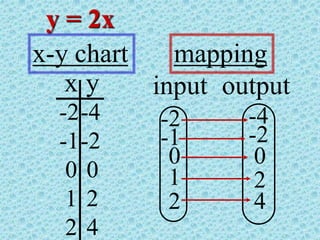
    y x -2 -1 0 1 2 -4 -2 0 2 4 y = 2x inputoutput -2 -1 -4 -2 0 1 0 2 2 4 x-y chart mapping
  • 17.
    QUADRATIC FUNCTION A quadraticfunction is any equation of the form f(x) = ax2+ bx + c where a, b, and c are real numbers and a ≠ 0.
  • 18.
    y = x2+ 1 y x -2 -1 0 1 2 5 2 1 2 5 input output -2 -1 5 2 0 1 1 2 x-y chart mapping
  • 19.
    CONSTANT FUNCTION A linearfunction f is a constant function if f(x) = mx + b, where m = 0 and b is any real number. Thus, f(x) = b. IDENTITY FUNCTION A linear function f is an identity function if f(x) = mx + b, where m = 1 and b = 0. Thus, f(x) = x.
  • 20.
    Piecewise Function A piecewisefunction or a compound function is a function defined by multiple sub-functions, where each sub- function applies to a certain interval of the main function's domain.
  • 22.
    y x -2 -1 0 1 2 -4 -2 0 2 4 y = 2x inputoutput -2 -1 -4 -2 0 1 0 2 2 4 x-y chart mapping
  • 23.
    Many-to-one Function if thereare y values that have more than one x value mapped onto them. One-to-many (not a function)
  • 24.
    x y Job Karl 96 97 x y Job Karl 96 97 Nota Function Function One-to-many Many-to-one
  • 25.
    Lesson 2 EVALUATIONOF FUNCTIONS
  • 26.
    EVALUATING FUNCTIONS LAW OFSUBSTITUTION If a + x = b and x = c, then a+ c= b Example 1 If f(x) = x + 8, evaluate each. a. f(4) b. f(–2) c. f(–x) d. f(x + 3)
  • 27.
    Function Notation y 2x3   f (x) 2x 3   when x 1, y  5 when x 2, y  7 when x 3, y   9 when x 4, y  11 f (1)  5 f(2)  7 f (3)  9 f(4) 11 f( 4)   5 
  • 28.
    2 g(x) x  h(x)3x 2   Evaluate the following. 1) g(4)  2) h( 2)   3) g( 3)   4) h(5)  5) h(4) g(1)   6) h( 5) g( 2)       7) g h(3)    8) h g(2)  16 8  9  13 10  1 1  17  4 6 8   g(7) 4 9  h(4) 10 
  • 29.
    Lesson 3 OPERATIONSON FUNCTIONS
  • 30.
    Lesson Objectives At theend of the lesson, the students must be able to: • find the sum of functions; • determine the difference between functions; • identify the product of functions; • find the quotient between functions; and • determine the composite of a function.
  • 31.
    ADDITION OF FUNCTIONS Letf and g be any two functions. The sum f + g is a function whose domains are the set of all real numbers common to the domain of f and g, and defined as follows: (f + g)(x) = f(x) + g(x)
  • 32.
    SUBTRACTION OF FUNCTIONS Letf and g be any two functions. The difference f – g is a function whose domains are the set of all real numbers common to the domain of f and g, and defined as follows: (f – g)(x) = f(x) – g(x)
  • 33.
    MULTIPLICATION OF FUNCTIONS Letf and g be any two functions. The product fg is a function whose domains are the set of all real numbers common to the domain of f and g, and defined as follows: (fg)(x) = f(x) · g(x)
  • 34.
    DIVISION OF FUNCTIONS Letf and g be any two functions. The quotient f/g is a function whose domains are the set of all real numbers common to the domain of f and g, and defined as follows: , where g(x) ≠ 0. f g x ( ) = f x ( ) g x ( )
  • 35.
    Example 1 If f(x) = 3x – 2 and g (x) = x2 + 2x – 3, 1. find (f + g) (x) 2. Find (f – g)(x) 3. Solve (fg)(x) 4. Find the quotient of f(x) and g(x)