REVIEW ON FUNCTIONS
Module 1
GENERAL MATHEMATICS
What is a function?
Definition of a Function:
• It is a relation define as a set of ordered
pairs (x, y) where no two or more distinct
ordered pairs have the same first element
(x).
• Every value of x corresponds to a unique
value of y
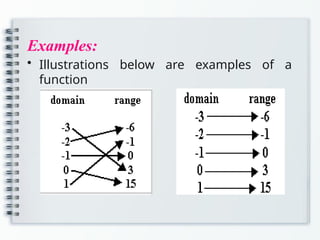
Examples:
• Illustrations below are examples of a
function
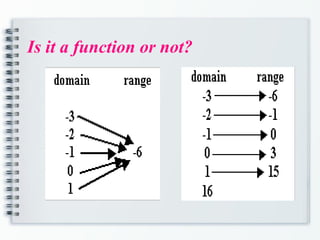
Is it a function or not?
What is the difference
between a function and a
relation?
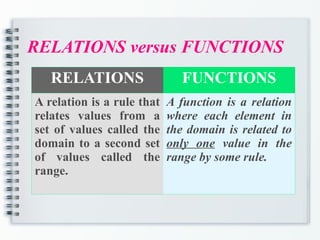
RELATIONS versus FUNCTIONS
RELATIONS FUNCTIONS
A relation is a rule that
relates values from a
set of values called the
domain to a second set
of values called the
range.
A function is a relation
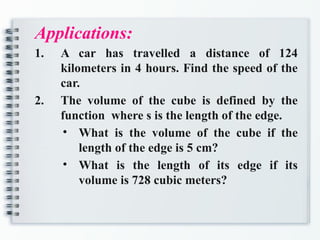
where each element in
the domain is related to
only one value in the
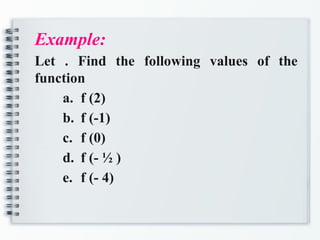
range by some rule.
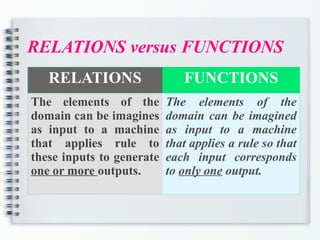
RELATIONS versus FUNCTIONS
RELATIONS FUNCTIONS
The elements of the
domain can be imagines
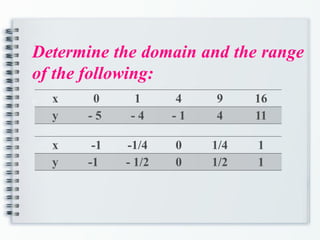
as input to a machine
that applies rule to
these inputs to generate
one or more outputs.
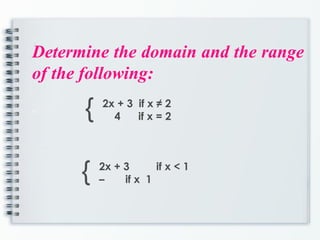
The elements of the
domain can be imagined
as input to a machine
that applies a rule so that
each input corresponds
to only one output.
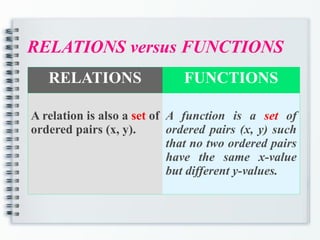
RELATIONS versus FUNCTIONS
RELATIONS FUNCTIONS
A relation is also a set of
ordered pairs (x, y).
A function is a set of
ordered pairs (x, y) such
that no two ordered pairs
have the same x-value
but different y-values.
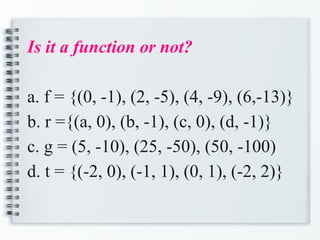
Is it a function or not?
a. f = {(0, -1), (2, -5), (4, -9), (6,-13)}
b. r ={(a, 0), (b, -1), (c, 0), (d, -1)}
c. g = (5, -10), (25, -50), (50, -100)
d. t = {(-2, 0), (-1, 1), (0, 1), (-2, 2)}
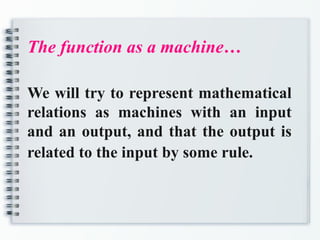
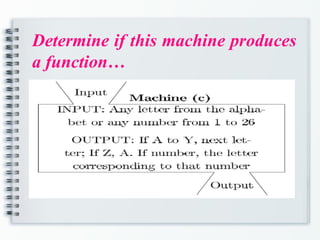
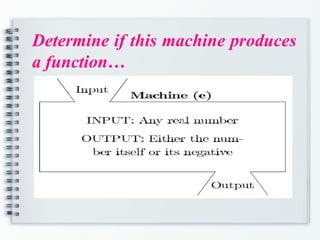
The function as a machine…
We will try to represent mathematical
relations as machines with an input
and an output, and that the output is
related to the input by some rule.
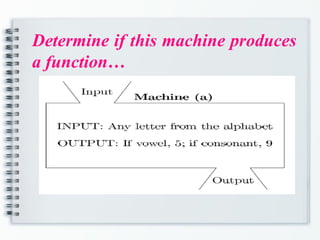
Determine if this machine produces
a function…
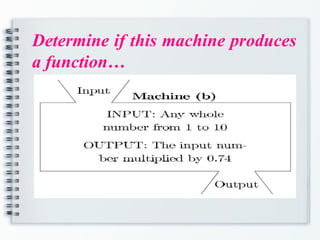
Determine if this machine produces
a function…
Determine if this machine produces
a function…
Determine if this machine produces
a function…
What is a table of
values?
Table of Values
a
• A table of values is commonly
observed when describing a function.
• This shows the correspondence
between a set of values of x and a set
of values of y in a tabular form.
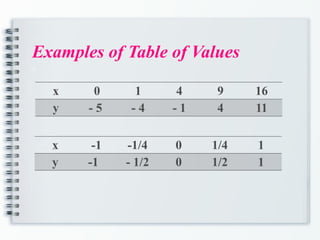
Examples of Table of Values
a
x 0 1 4 9 16
y - 5 - 4 - 1 4 11
x -1 -1/4 0 1/4 1
y -1 - 1/2 0 1/2 1
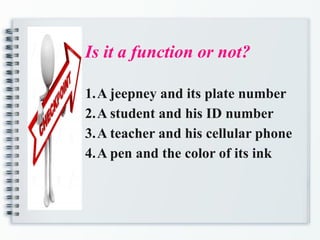
Is it a function or not?
1.A jeepney and its plate number
2.A student and his ID number
3.A teacher and his cellular phone
4.A pen and the color of its ink
What is a vertical line
test?
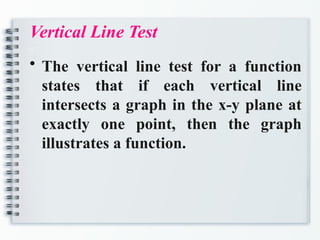
Vertical Line Test
a
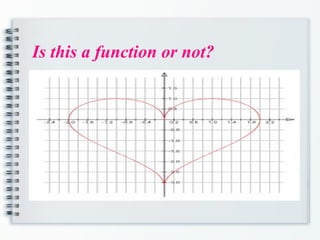
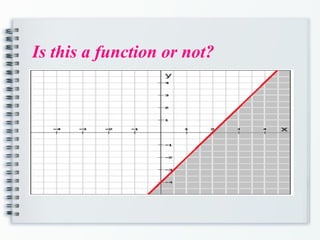
• The vertical line test for a function
states that if each vertical line
intersects a graph in the x-y plane at
exactly one point, then the graph
illustrates a function.
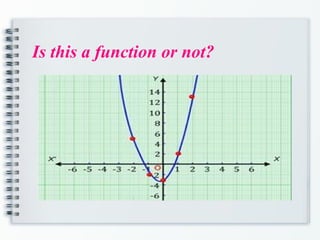
Is this a function or not?
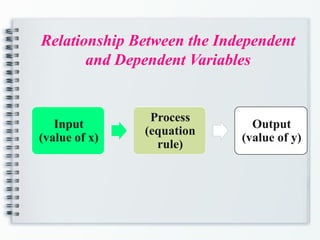
Relationship Between the Independent
and Dependent Variables
Input
(value of x)
Process
(equation
rule)
Output
(value of y)
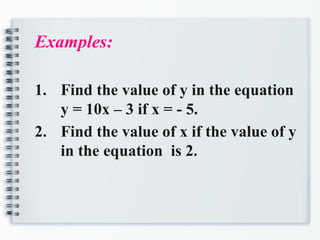
Examples:
1. Find the value of y in the equation
y = 10x – 3 if x = - 5.
2. Find the value of x if the value of y
in the equation is 2.
Applications:
1. A car has travelled a distance of 124
kilometers in 4 hours. Find the speed of the
car.
2. The volume of the cube is defined by the
function where s is the length of the edge.
• What is the volume of the cube if the
length of the edge is 5 cm?
• What is the length of its edge if its
volume is 728 cubic meters?
REVIEW ON FUNCTIONS
Module 1
EVALUATING FUNCTIONS
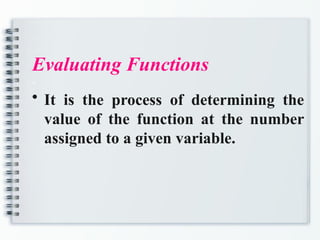
Evaluating Functions
a
• It is the process of determining the
value of the function at the number
assigned to a given variable.
Example:
Let . Find the following values of the
function
a. f (2)
b. f (-1)
c. f (0)
d. f (- ½ )
e. f (- 4)
Example:
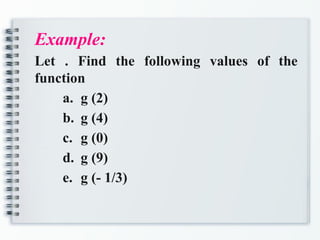
Let . Find the following values of the
function
a. g (2)
b. g (4)
c. g (0)
d. g (9)
e. g (- 1/3)
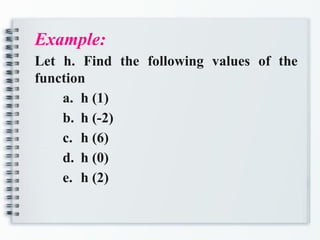
Example:
Let h. Find the following values of the
function
a. h (1)
b. h (-2)
c. h (6)
d. h (0)
e. h (2)
REVIEW ON FUNCTIONS
Module 1
DOMAIN AND RANGE OF
FUNCTIONS
Domain D of a Function
a
• It is the set of all x-coordinates in the
set of ordered pairs.
Range R of a Function
a
• It is the set of all y-coordinates in the
set of ordered pairs.
Determine the domain and the range
of the following:
a x 0 1 4 9 16
y - 5 - 4 - 1 4 11
x -1 -1/4 0 1/4 1
y -1 - 1/2 0 1/2 1
More on Independent Variables
a
• There are instances in which not all
values of the independent variables
are permissible.
• That is, some functions have
restrictions.
Determine the domain and the range
of the following:
a
Piece-wise Functions
a
• These are functions which are defined
in defined in different domains since
they are determined by several
equations.
Determine the domain and the range
of the following:
a { 2x + 3 if x ≠ 2
4 if x = 2
{ 2x + 3 if x < 1
– if x 1
REVIEW ON FUNCTIONS
Module 1
OPERATIONS ON
FUNCTIONS
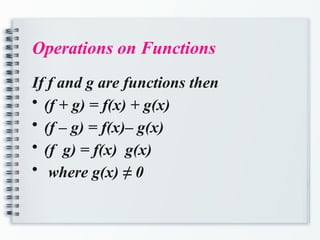
Operations on Functions
If f and g are functions then
• (f + g) = f(x) + g(x)
• (f – g) = f(x)– g(x)
• (f g) = f(x) g(x)
• where g(x) ≠ 0
Example
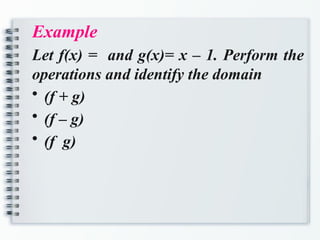
Let f(x) = and g(x)= x – 1. Perform the
operations and identify the domain
• (f + g)
• (f – g)
• (f g)
Example
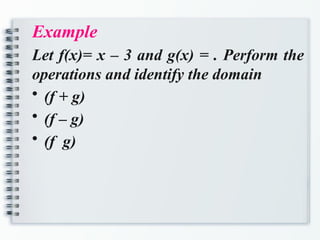
Let f(x)= x – 3 and g(x) = . Perform the
operations and identify the domain
• (f + g)
• (f – g)
• (f g)
REVIEW ON FUNCTIONS
Module 1
COMPOSITE FUNCTIONS
Operations on Functions
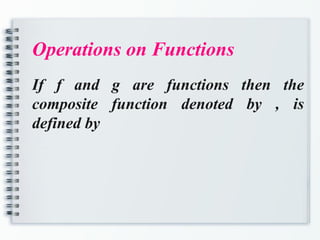
If f and g are functions then the
composite function denoted by , is
defined by
Operations on Functions
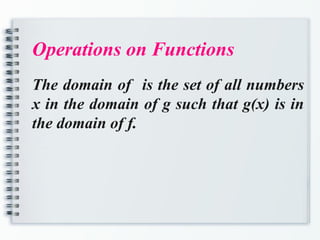
The domain of is the set of all numbers
x in the domain of g such that g(x) is in
the domain of f.
Example
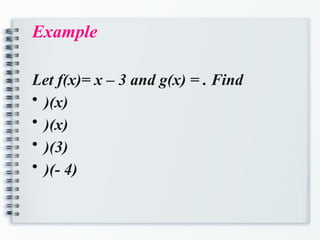
Let f(x)= x – 3 and g(x) = . Find
• )(x)
• )(x)
• )(3)
• )(- 4)
REVIEW ON FUNCTIONS
Module 1
EVEN AND ODD
FUNCTIONS
Even and Odd Functions
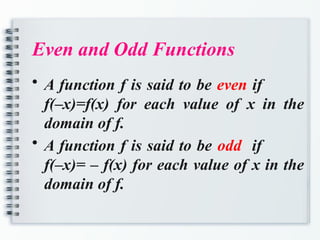
• A function f is said to be even if
f(–x)=f(x) for each value of x in the
domain of f.
• A function f is said to be odd if
f(–x)= – f(x) for each value of x in the
domain of f.
Example
Determine whether each of the following
functions is even, odd or neither

General Mathematics 11 -review on functions

  • 1.
    REVIEW ON FUNCTIONS Module1 GENERAL MATHEMATICS
  • 2.
    What is afunction?
  • 3.
    Definition of aFunction: • It is a relation define as a set of ordered pairs (x, y) where no two or more distinct ordered pairs have the same first element (x). • Every value of x corresponds to a unique value of y
  • 4.
    Examples: • Illustrations beloware examples of a function
  • 5.
    Is it afunction or not?
  • 6.
    What is thedifference between a function and a relation?
  • 7.
    RELATIONS versus FUNCTIONS RELATIONSFUNCTIONS A relation is a rule that relates values from a set of values called the domain to a second set of values called the range. A function is a relation where each element in the domain is related to only one value in the range by some rule.
  • 8.
    RELATIONS versus FUNCTIONS RELATIONSFUNCTIONS The elements of the domain can be imagines as input to a machine that applies rule to these inputs to generate one or more outputs. The elements of the domain can be imagined as input to a machine that applies a rule so that each input corresponds to only one output.
  • 9.
    RELATIONS versus FUNCTIONS RELATIONSFUNCTIONS A relation is also a set of ordered pairs (x, y). A function is a set of ordered pairs (x, y) such that no two ordered pairs have the same x-value but different y-values.
  • 10.
    Is it afunction or not? a. f = {(0, -1), (2, -5), (4, -9), (6,-13)} b. r ={(a, 0), (b, -1), (c, 0), (d, -1)} c. g = (5, -10), (25, -50), (50, -100) d. t = {(-2, 0), (-1, 1), (0, 1), (-2, 2)}
  • 11.
    The function asa machine… We will try to represent mathematical relations as machines with an input and an output, and that the output is related to the input by some rule.
  • 12.
    Determine if thismachine produces a function…
  • 13.
    Determine if thismachine produces a function…
  • 14.
    Determine if thismachine produces a function…
  • 15.
    Determine if thismachine produces a function…
  • 16.
    What is atable of values?
  • 17.
    Table of Values a •A table of values is commonly observed when describing a function. • This shows the correspondence between a set of values of x and a set of values of y in a tabular form.
  • 18.
    Examples of Tableof Values a x 0 1 4 9 16 y - 5 - 4 - 1 4 11 x -1 -1/4 0 1/4 1 y -1 - 1/2 0 1/2 1
  • 19.
    Is it afunction or not? 1.A jeepney and its plate number 2.A student and his ID number 3.A teacher and his cellular phone 4.A pen and the color of its ink
  • 20.
    What is avertical line test?
  • 21.
    Vertical Line Test a •The vertical line test for a function states that if each vertical line intersects a graph in the x-y plane at exactly one point, then the graph illustrates a function.
  • 22.
    Is this afunction or not?
  • 23.
    Is this afunction or not?
  • 24.
    Is this afunction or not?
  • 25.
    Relationship Between theIndependent and Dependent Variables Input (value of x) Process (equation rule) Output (value of y)
  • 26.
    Examples: 1. Find thevalue of y in the equation y = 10x – 3 if x = - 5. 2. Find the value of x if the value of y in the equation is 2.
  • 27.
    Applications: 1. A carhas travelled a distance of 124 kilometers in 4 hours. Find the speed of the car. 2. The volume of the cube is defined by the function where s is the length of the edge. • What is the volume of the cube if the length of the edge is 5 cm? • What is the length of its edge if its volume is 728 cubic meters?
  • 28.
    REVIEW ON FUNCTIONS Module1 EVALUATING FUNCTIONS
  • 29.
    Evaluating Functions a • Itis the process of determining the value of the function at the number assigned to a given variable.
  • 30.
    Example: Let . Findthe following values of the function a. f (2) b. f (-1) c. f (0) d. f (- ½ ) e. f (- 4)
  • 31.
    Example: Let . Findthe following values of the function a. g (2) b. g (4) c. g (0) d. g (9) e. g (- 1/3)
  • 32.
    Example: Let h. Findthe following values of the function a. h (1) b. h (-2) c. h (6) d. h (0) e. h (2)
  • 33.
    REVIEW ON FUNCTIONS Module1 DOMAIN AND RANGE OF FUNCTIONS
  • 34.
    Domain D ofa Function a • It is the set of all x-coordinates in the set of ordered pairs. Range R of a Function a • It is the set of all y-coordinates in the set of ordered pairs.
  • 35.
    Determine the domainand the range of the following: a x 0 1 4 9 16 y - 5 - 4 - 1 4 11 x -1 -1/4 0 1/4 1 y -1 - 1/2 0 1/2 1
  • 36.
    More on IndependentVariables a • There are instances in which not all values of the independent variables are permissible. • That is, some functions have restrictions.
  • 37.
    Determine the domainand the range of the following: a
  • 38.
    Piece-wise Functions a • Theseare functions which are defined in defined in different domains since they are determined by several equations.
  • 39.
    Determine the domainand the range of the following: a { 2x + 3 if x ≠ 2 4 if x = 2 { 2x + 3 if x < 1 – if x 1
  • 40.
    REVIEW ON FUNCTIONS Module1 OPERATIONS ON FUNCTIONS
  • 41.
    Operations on Functions Iff and g are functions then • (f + g) = f(x) + g(x) • (f – g) = f(x)– g(x) • (f g) = f(x) g(x) • where g(x) ≠ 0
  • 42.
    Example Let f(x) =and g(x)= x – 1. Perform the operations and identify the domain • (f + g) • (f – g) • (f g)
  • 43.
    Example Let f(x)= x– 3 and g(x) = . Perform the operations and identify the domain • (f + g) • (f – g) • (f g)
  • 44.
    REVIEW ON FUNCTIONS Module1 COMPOSITE FUNCTIONS
  • 45.
    Operations on Functions Iff and g are functions then the composite function denoted by , is defined by
  • 46.
    Operations on Functions Thedomain of is the set of all numbers x in the domain of g such that g(x) is in the domain of f.
  • 47.
    Example Let f(x)= x– 3 and g(x) = . Find • )(x) • )(x) • )(3) • )(- 4)
  • 48.
    REVIEW ON FUNCTIONS Module1 EVEN AND ODD FUNCTIONS
  • 49.
    Even and OddFunctions • A function f is said to be even if f(–x)=f(x) for each value of x in the domain of f. • A function f is said to be odd if f(–x)= – f(x) for each value of x in the domain of f.
  • 50.
    Example Determine whether eachof the following functions is even, odd or neither