Permutation of
Distinguishable
Objects
Quarter 3 – Week 1
Objectives:
1. enumerate the different counting techniques;
2. find the number of outcomes of specified event;
3. find the permutation of distinguishable objects; and
4. solve word problems that involve permutation of
distinguishable objects.
Questions to ponder?
1.Are you fond of matching different outfits?
2.How to create passwords?
3.How do plate numbers created without
duplication?
4.How do we choose the dishes from the menu?
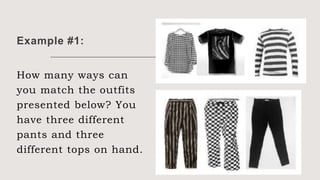
Example #1:
How many ways can
you match the outfits
presented below? You
have three different
pants and three
different tops on hand.
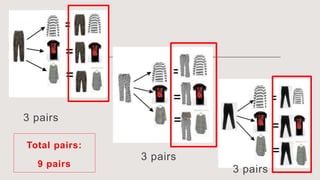
3 pairs
3 pairs
3 pairs
Total pairs:
9 pairs
Question?
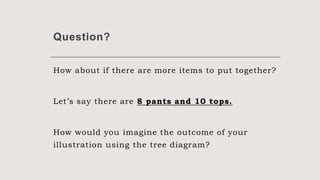
How about if there are more items to put together?
Let’s say there are 8 pants and 10 tops.
How would you imagine the outcome of your
illustration using the tree diagram?
F.C.P.
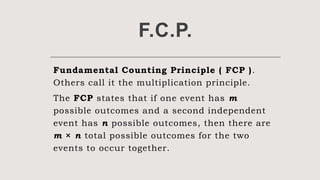
Fundamental Counting Principle ( FCP ).
Others call it the multiplication principle.
The FCP states that if one event has m
possible outcomes and a second independent
event has n possible outcomes, then there are
m × n total possible outcomes for the two
events to occur together.
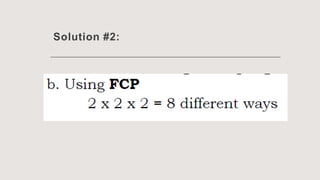
Example #2
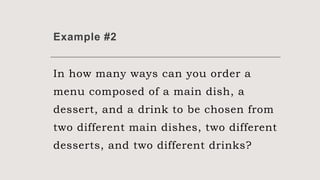
In how many ways can you order a
menu composed of a main dish, a
dessert, and a drink to be chosen from
two different main dishes, two different
desserts, and two different drinks?
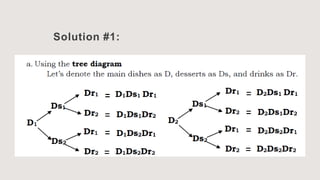
Solution #1:
Solution #2:
Quarter 3 - Week 1 - Math 10

Quarter 3 - Week 1 - Math 10

  • 1.
  • 2.
    Objectives: 1. enumerate thedifferent counting techniques; 2. find the number of outcomes of specified event; 3. find the permutation of distinguishable objects; and 4. solve word problems that involve permutation of distinguishable objects.
  • 3.
    Questions to ponder? 1.Areyou fond of matching different outfits? 2.How to create passwords? 3.How do plate numbers created without duplication? 4.How do we choose the dishes from the menu?
  • 4.
    Example #1: How manyways can you match the outfits presented below? You have three different pants and three different tops on hand.
  • 5.
    3 pairs 3 pairs 3pairs Total pairs: 9 pairs
  • 6.
    Question? How about ifthere are more items to put together? Let’s say there are 8 pants and 10 tops. How would you imagine the outcome of your illustration using the tree diagram?
  • 7.
    F.C.P. Fundamental Counting Principle( FCP ). Others call it the multiplication principle. The FCP states that if one event has m possible outcomes and a second independent event has n possible outcomes, then there are m × n total possible outcomes for the two events to occur together.
  • 8.
    Example #2 In howmany ways can you order a menu composed of a main dish, a dessert, and a drink to be chosen from two different main dishes, two different desserts, and two different drinks?
  • 9.
  • 10.