A Project Report On
Full Wave Rectifier
Submitted By
Sandeep yadav
Class : XII A
Under the Guidance of:-
Mr. Vidya kishore
PGT(Physics)
CERTIFICATE
This is to certify that SANDEEP YADAV Of Class XII A has prepared the
report on the Project entitled “Full Wave Rectifier”. The report is the result
ofhis efforts & endeavors.The reportis foundworthy ofacceptance as final
project report for the subject Physics of Class XII. He has prepared the
report under my guidance
Mr. Vidyakishore V.K.Yadav
PGT(Physics) Principal
.
KENDRIYA VIDYALAYA
SANGATHAN JANAKPURI
NEW DELHI ,110058
KENDRIYA VIDYALAYA
SANGATHAN JANAKPURI
NEW DELHI , 110058
DECLARATION
I hereby declare that the project work entitled “Full Wave Rectifier” ,
submitted to Department of Physics, Kendriya Vidyalaya , Janakpuri New
Delhi is prepared by me. All the coding are result of my personal efforts.
SANDEEP YADAV
CLASS XII A
ACKNOWLEDGMENT
I would like to express a deep sense of thanks & gratitude to my project
guide Mr. Vidya Kishore Sir for guiding me immensely through the course
of the project.He always evinced keen interest in my work. His constructive
advice & constant motivation have been responsible for the successful
completion of this project.
My sincere thanks goes to V. K .Yadav , Our principal sir, for his co-
ordination in extending every possible support for the completion of this
project.
I also thanks to my parents for their motivation & support. I must thanks to
my classmatesfor their timelyhelp & supportforcompilationofthis project.
Last but not the least, I would like to thank all those who had helped
directly or indirectly towards the completion of this project.
SANDEEP YADAV
CLASS : XII A
INDEX
AIM
MATERIAL REQUIRED
RRINCIPLE
WORKING
MERITS
DEMERITS
PRECAUTION
BIBLIOGRAPHY
AIM
To prepare a full wave
rectifier and show that
Alternating current is
converted into Direct
current.
MATERIAL REQUIRED
Connecting wires
Plug
A small box to place the mode
A transformer
A capacitor
A resistor
LED
P-N junction diode
Insulating tape
Soldering iron
PRINCIPLE
A rectifier which rectifies both
waves of the A.C input is called
a full wave rectifier.
It is based upon the principle
that a junction diode offers low
resistance during forward
biased and high resistance,
when reverse biased.
WORKING
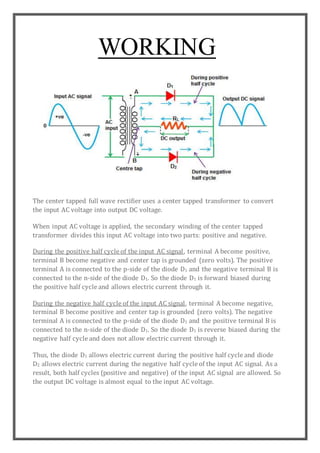
The center tapped full wave rectifier uses a center tapped transformer to convert
the input AC voltage into output DC voltage.
When input AC voltage is applied, the secondary winding of the center tapped
transformer divides this input AC voltage into two parts: positive and negative.
During the positive half cycle of the input AC signal, terminal A become positive,
terminal B become negative and center tap is grounded (zero volts). The positive
terminal A is connected to the p-side of the diode D1 and the negative terminal B is
connected to the n-side of the diode D1. So the diode D1 is forward biased during
the positive half cycle and allows electric current through it.
During the negative half cycle of the input AC signal, terminal A become negative,
terminal B become positive and center tap is grounded (zero volts). The negative
terminal A is connected to the p-side of the diode D1 and the positive terminal B is
connected to the n-side of the diode D1. So the diode D1 is reverse biased during the
negative half cycle and does not allow electric current through it.
Thus, the diode D1 allows electric current during the positive half cycle and diode
D2 allows electric current during the negative half cycle of the input AC signal. As a
result, both half cycles (positive and negative) of the input AC signal are allowed. So
the output DC voltage is almost equal to the input AC voltage.
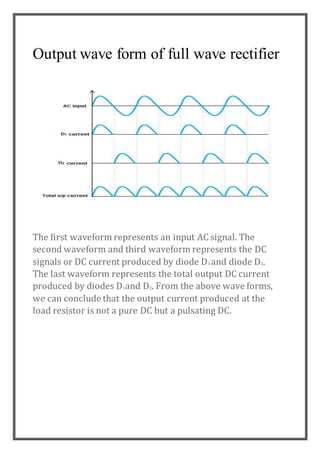
Output wave form of full wave rectifier
The first waveform represents an input AC signal. The
second waveform and third waveform represents the DC
signals or DC current produced by diode D1 and diode D2.
The last waveform represents the total output DC current
produced by diodes D1and D2. From the above wave forms,
we can conclude that the output current produced at the
load resistor is not a pure DC but a pulsating DC.
MERITS
 High rectifier efficiency
Full wave rectifier has high rectifier efficiency than the half
wave rectifier. That means the full wave rectifier converts
AC to DC more efficiently than the half wave rectifier.
 Low power loss
In a half wave rectifier, only half cycle (positive or negative
half cycle) is allowed and the remaining half cycleis
blocked. As a result, more than half of the voltage is wasted.
But in full wave rectifier, both half cycles (positive and
negative half cycles) are allowedat the same time. So no
signal is wasted in a full wave rectifier.
 Low ripples
The output DC signal in full wave rectifier has fewer ripples
than the half wave rectifier.
DEMERITS
 High cost
The center tapped transformersareexpensiveand occupy a large space.
PRECAUTIONS
 Keep safe yourself from
high voltage.
 Solder the wire safely.
 While soldering don’ t
touch the soldering tip.
 Solder under adult super
vision.
Bibliography
1 . https://en.wikipedia.org/
2 . https://slideshare.com/
3 . https://scribd.com/
4. Comprehensive Practical Physics

Physics project

  • 1.
    A Project ReportOn Full Wave Rectifier Submitted By Sandeep yadav Class : XII A Under the Guidance of:- Mr. Vidya kishore PGT(Physics)
  • 2.
    CERTIFICATE This is tocertify that SANDEEP YADAV Of Class XII A has prepared the report on the Project entitled “Full Wave Rectifier”. The report is the result ofhis efforts & endeavors.The reportis foundworthy ofacceptance as final project report for the subject Physics of Class XII. He has prepared the report under my guidance Mr. Vidyakishore V.K.Yadav PGT(Physics) Principal . KENDRIYA VIDYALAYA SANGATHAN JANAKPURI NEW DELHI ,110058 KENDRIYA VIDYALAYA SANGATHAN JANAKPURI NEW DELHI , 110058
  • 3.
    DECLARATION I hereby declarethat the project work entitled “Full Wave Rectifier” , submitted to Department of Physics, Kendriya Vidyalaya , Janakpuri New Delhi is prepared by me. All the coding are result of my personal efforts. SANDEEP YADAV CLASS XII A
  • 4.
    ACKNOWLEDGMENT I would liketo express a deep sense of thanks & gratitude to my project guide Mr. Vidya Kishore Sir for guiding me immensely through the course of the project.He always evinced keen interest in my work. His constructive advice & constant motivation have been responsible for the successful completion of this project. My sincere thanks goes to V. K .Yadav , Our principal sir, for his co- ordination in extending every possible support for the completion of this project. I also thanks to my parents for their motivation & support. I must thanks to my classmatesfor their timelyhelp & supportforcompilationofthis project. Last but not the least, I would like to thank all those who had helped directly or indirectly towards the completion of this project. SANDEEP YADAV CLASS : XII A
  • 5.
  • 6.
    AIM To prepare afull wave rectifier and show that Alternating current is converted into Direct current.
  • 7.
    MATERIAL REQUIRED Connecting wires Plug Asmall box to place the mode A transformer A capacitor A resistor LED P-N junction diode Insulating tape Soldering iron
  • 8.
    PRINCIPLE A rectifier whichrectifies both waves of the A.C input is called a full wave rectifier. It is based upon the principle that a junction diode offers low resistance during forward biased and high resistance, when reverse biased.
  • 9.
    WORKING The center tappedfull wave rectifier uses a center tapped transformer to convert the input AC voltage into output DC voltage. When input AC voltage is applied, the secondary winding of the center tapped transformer divides this input AC voltage into two parts: positive and negative. During the positive half cycle of the input AC signal, terminal A become positive, terminal B become negative and center tap is grounded (zero volts). The positive terminal A is connected to the p-side of the diode D1 and the negative terminal B is connected to the n-side of the diode D1. So the diode D1 is forward biased during the positive half cycle and allows electric current through it. During the negative half cycle of the input AC signal, terminal A become negative, terminal B become positive and center tap is grounded (zero volts). The negative terminal A is connected to the p-side of the diode D1 and the positive terminal B is connected to the n-side of the diode D1. So the diode D1 is reverse biased during the negative half cycle and does not allow electric current through it. Thus, the diode D1 allows electric current during the positive half cycle and diode D2 allows electric current during the negative half cycle of the input AC signal. As a result, both half cycles (positive and negative) of the input AC signal are allowed. So the output DC voltage is almost equal to the input AC voltage.
  • 10.
    Output wave formof full wave rectifier The first waveform represents an input AC signal. The second waveform and third waveform represents the DC signals or DC current produced by diode D1 and diode D2. The last waveform represents the total output DC current produced by diodes D1and D2. From the above wave forms, we can conclude that the output current produced at the load resistor is not a pure DC but a pulsating DC.
  • 11.
    MERITS  High rectifierefficiency Full wave rectifier has high rectifier efficiency than the half wave rectifier. That means the full wave rectifier converts AC to DC more efficiently than the half wave rectifier.  Low power loss In a half wave rectifier, only half cycle (positive or negative half cycle) is allowed and the remaining half cycleis blocked. As a result, more than half of the voltage is wasted. But in full wave rectifier, both half cycles (positive and negative half cycles) are allowedat the same time. So no signal is wasted in a full wave rectifier.  Low ripples The output DC signal in full wave rectifier has fewer ripples than the half wave rectifier. DEMERITS  High cost The center tapped transformersareexpensiveand occupy a large space.
  • 12.
    PRECAUTIONS  Keep safeyourself from high voltage.  Solder the wire safely.  While soldering don’ t touch the soldering tip.  Solder under adult super vision.
  • 13.
    Bibliography 1 . https://en.wikipedia.org/ 2. https://slideshare.com/ 3 . https://scribd.com/ 4. Comprehensive Practical Physics