Downloaded 36 times
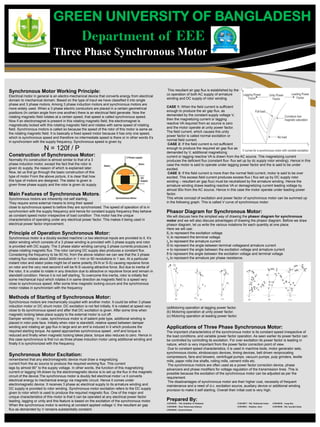
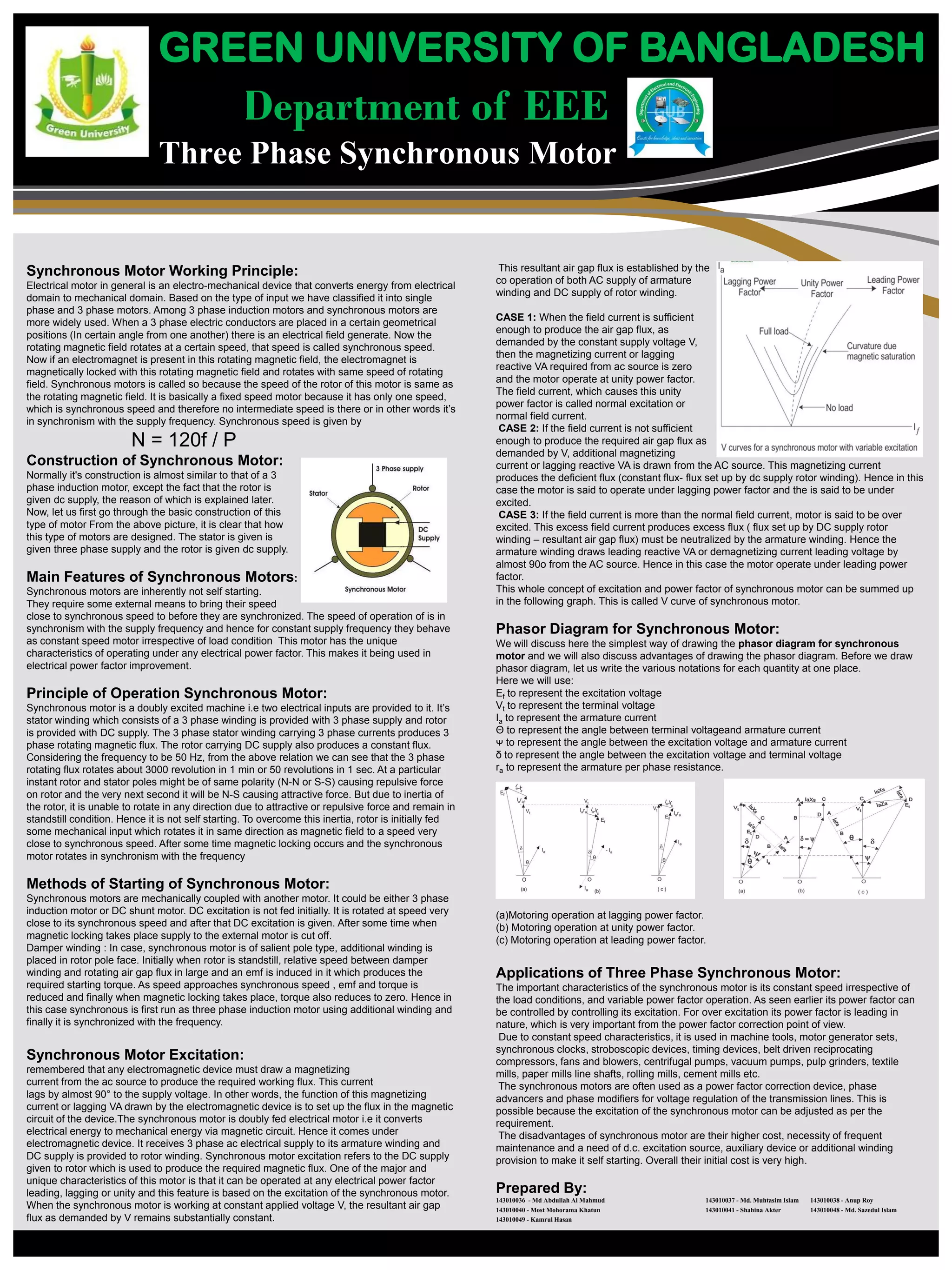

This document summarizes the key aspects of three phase synchronous motors. It discusses the working principle, construction, features, principle of operation, methods of starting, excitation, phasor diagram, applications, and disadvantages. Synchronous motors operate at a constant synchronous speed determined by supply frequency. They require an external starting mechanism and DC excitation of the rotor. The motor can operate at lagging, unity, or leading power factors depending on the level of excitation. Main applications are in machine tools and industrial machinery due to their constant speed characteristic. Disadvantages include higher cost and need for auxiliary starting components compared to induction motors.


