Fruit and NutsFruit and Nuts
© PDST Home Economics
NutsNuts
 A fruit of a plant that consists of a hard shellA fruit of a plant that consists of a hard shell
surrounding a soft kernelsurrounding a soft kernel
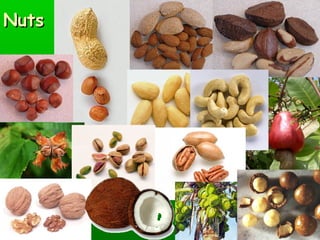
 Popular examples: Almonds, Brazil nuts, CashewPopular examples: Almonds, Brazil nuts, Cashew
nuts, Coconuts, Hazelnuts, Pecans, Pistachio nuts,nuts, Coconuts, Hazelnuts, Pecans, Pistachio nuts,
Peanuts (ground nuts/ monkey nuts), WalnutsPeanuts (ground nuts/ monkey nuts), Walnuts
NutsNuts
Nutritive Value of NutsNutritive Value of Nuts
 Protein: Good source of LBV proteinProtein: Good source of LBV protein
 Fat: High in polyunsaturated fats therefore high inFat: High in polyunsaturated fats therefore high in
caloriescalories
 Carbohydrates: Good source cellulose especiallyCarbohydrates: Good source cellulose especially
peanuts & hazelnutspeanuts & hazelnuts
 Vitamins: Small amount vitamins BVitamins: Small amount vitamins B
 Minerals: Contain Iron and CalciumMinerals: Contain Iron and Calcium
 Water: Low about 5%Water: Low about 5%
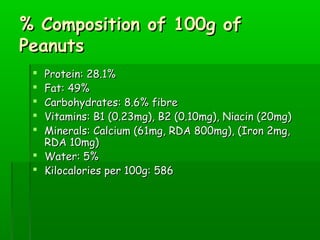
% Composition of 100g of% Composition of 100g of
PeanutsPeanuts
 Protein: 28.1%Protein: 28.1%
 Fat: 49%Fat: 49%
 Carbohydrates: 8.6% fibreCarbohydrates: 8.6% fibre
 Vitamins: B1 (0.23mg), B2 (0.10mg), Niacin (20mg)Vitamins: B1 (0.23mg), B2 (0.10mg), Niacin (20mg)
 Minerals: Calcium (61mg, RDA 800mg), (Iron 2mg,Minerals: Calcium (61mg, RDA 800mg), (Iron 2mg,
RDA 10mg)RDA 10mg)
 Water: 5%Water: 5%
 Kilocalories per 100g: 586Kilocalories per 100g: 586
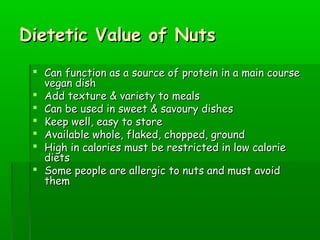
Dietetic Value of NutsDietetic Value of Nuts
 Can function as a source of protein in a main courseCan function as a source of protein in a main course
vegan dishvegan dish
 Add texture & variety to mealsAdd texture & variety to meals
 Can be used in sweet & savoury dishesCan be used in sweet & savoury dishes
 Keep well, easy to storeKeep well, easy to store
 Available whole, flaked, chopped, groundAvailable whole, flaked, chopped, ground
 High in calories must be restricted in low calorieHigh in calories must be restricted in low calorie
dietsdiets
 Some people are allergic to nuts and must avoidSome people are allergic to nuts and must avoid
themthem
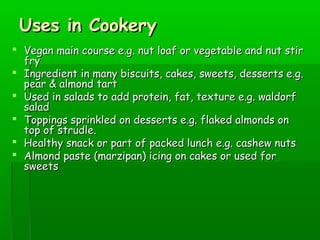
Uses in CookeryUses in Cookery
 Vegan main course e.g. nut loaf or vegetable and nut stirVegan main course e.g. nut loaf or vegetable and nut stir
fryfry
 Ingredient in many biscuits, cakes, sweets, desserts e.g.Ingredient in many biscuits, cakes, sweets, desserts e.g.
pear & almond tartpear & almond tart
 Used in salads to add protein, fat, texture e.g. waldorfUsed in salads to add protein, fat, texture e.g. waldorf
saladsalad
 Toppings sprinkled on desserts e.g. flaked almonds onToppings sprinkled on desserts e.g. flaked almonds on
top of strudle.top of strudle.
 Healthy snack or part of packed lunch e.g. cashew nutsHealthy snack or part of packed lunch e.g. cashew nuts
 Almond paste (marzipan) icing on cakes or used forAlmond paste (marzipan) icing on cakes or used for
sweetssweets
FruitsFruits
 Eaten for vitamins especially vitamin C, minerals,Eaten for vitamins especially vitamin C, minerals,
antioxidants, fibre, water, colour, flavour textureantioxidants, fibre, water, colour, flavour texture
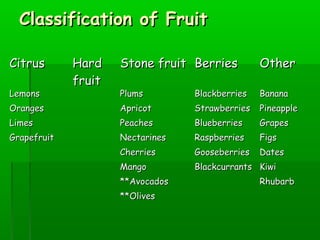
Classification of FruitClassification of Fruit
CitrusCitrus HardHard
fruitfruit
Stone fruitStone fruit BerriesBerries OtherOther
LemonsLemons
OrangesOranges
LimesLimes
GrapefruitGrapefruit
PlumsPlums
ApricotApricot
PeachesPeaches
NectarinesNectarines
CherriesCherries
MangoMango
**Avocados**Avocados
**Olives**Olives
BlackberriesBlackberries
StrawberriesStrawberries
BlueberriesBlueberries
RaspberriesRaspberries
GooseberriesGooseberries
BlackcurrantsBlackcurrants
BananaBanana
PineapplePineapple
GrapesGrapes
FigsFigs
DatesDates
KiwiKiwi
RhubarbRhubarb
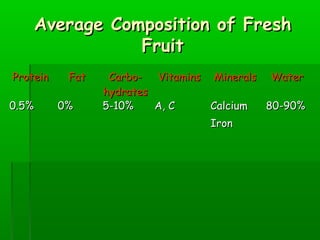
Average Composition of FreshAverage Composition of Fresh
FruitFruit
ProteinProtein FatFat Carbo-Carbo-
hydrateshydrates
VitaminsVitamins MineralsMinerals WaterWater
0.5%0.5% 0%0% 5-10%5-10% A, CA, C CalciumCalcium
IronIron
80-90%80-90%
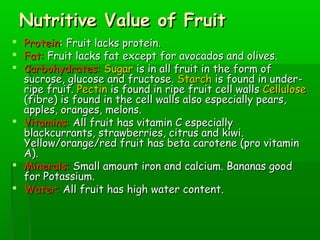
Nutritive Value of FruitNutritive Value of Fruit
 ProteinProtein: Fruit lacks protein.: Fruit lacks protein.
 Fat:Fat: Fruit lacks fat except for avocados and olives.Fruit lacks fat except for avocados and olives.
 Carbohydrates:Carbohydrates: SugarSugar is in all fruit in the form ofis in all fruit in the form of
sucrose, glucose and fructose.sucrose, glucose and fructose. StarchStarch is found in under-is found in under-
ripe fruit.ripe fruit. PectinPectin is found in ripe fruit cell wallsis found in ripe fruit cell walls CelluloseCellulose
(fibre) is found in the cell walls also especially pears,(fibre) is found in the cell walls also especially pears,
apples, oranges, melons.apples, oranges, melons.
 Vitamins:Vitamins: All fruit has vitamin C especiallyAll fruit has vitamin C especially
blackcurrants, strawberries, citrus and kiwi.blackcurrants, strawberries, citrus and kiwi.
Yellow/orange/red fruit has beta carotene (pro vitaminYellow/orange/red fruit has beta carotene (pro vitamin
A).A).
 Minerals:Minerals: Small amount iron and calcium. Bananas goodSmall amount iron and calcium. Bananas good
for Potassium.for Potassium.
 Water:Water: All fruit has high water content.All fruit has high water content.
Dietetic Value of FruitDietetic Value of Fruit
 Add greatly to the variety of colours, flavours andAdd greatly to the variety of colours, flavours and
textures in the diet.textures in the diet.
 Useful in low calorie diets, low cholesterol and highUseful in low calorie diets, low cholesterol and high
fibre diets because high in water & fibre and low in fat.fibre diets because high in water & fibre and low in fat.
 Anti-oxidants vitamin C and beta carotene help preventAnti-oxidants vitamin C and beta carotene help prevent
heart disease, cancer etc..heart disease, cancer etc..
 Can be eaten raw or cooked in a wide variety of sweetCan be eaten raw or cooked in a wide variety of sweet
and savoury dishes.and savoury dishes.
 Healthy snack, cheap and needs no preparation exceptHealthy snack, cheap and needs no preparation except
washing and perhaps peeling.washing and perhaps peeling.
Buying & Storing FruitBuying & Storing Fruit
BuyingBuying
 In seasonIn season
 Usable amountUsable amount
 Good quality, ripeGood quality, ripe
 Avoid pre-packedAvoid pre-packed
 Firm, good colour, noFirm, good colour, no
discolouration or moulddiscolouration or mould
StoringStoring
 Cool, dark, ventilatedCool, dark, ventilated
place.place.
 Use quicklyUse quickly
 Remove packagingRemove packaging
 Remove spoiled orRemove spoiled or
damaged fruitdamaged fruit
Preparing and effects of cookingPreparing and effects of cooking
Preparing.Preparing.
 Wash to removeWash to remove
chemicalschemicals
 Eat raw when possibleEat raw when possible
 Don’t peel or peel thinlyDon’t peel or peel thinly
 Avoid steeping in waterAvoid steeping in water
 Use sharp stainless steelUse sharp stainless steel
knifeknife
Effects of CookingEffects of Cooking
 Vitamin C destroyedVitamin C destroyed
 Minerals and vitaminsMinerals and vitamins
dissolve into coking liquiddissolve into coking liquid
 Cellulose & texture softensCellulose & texture softens
 Microbes killedMicrobes killed
 Enzymes destroyedEnzymes destroyed
 Absorb water and swellAbsorb water and swell
 Over cooking causes loss ofOver cooking causes loss of
colour, texture flavourcolour, texture flavour
Ripening of FruitRipening of Fruit
 Ripening begins during growth and continues afterRipening begins during growth and continues after
harvestingharvesting
 Unripe fruit is less palatable than ripeUnripe fruit is less palatable than ripe
Changes that happen during ripening:Changes that happen during ripening:
1.1. Enzymes change starch to sugar making fruit sweetEnzymes change starch to sugar making fruit sweet
and juicyand juicy
2.2. Insoluble pectose changes to soluble pectinInsoluble pectose changes to soluble pectin
3.3. Ethylene gas that helps ripening is made in some fruitEthylene gas that helps ripening is made in some fruit
(bananas)(bananas)
4.4. Fruit changes colour, texture and flavourFruit changes colour, texture and flavour
Decaying of FruitDecaying of Fruit
 Once ripe, fruit only stays good for a while, then itOnce ripe, fruit only stays good for a while, then it
decaysdecays
 Softer fruit with thin skin e.g. grapes, decay fasterSofter fruit with thin skin e.g. grapes, decay faster
than hard fruit with tougher skin e.g. pearsthan hard fruit with tougher skin e.g. pears
Changes during decay:Changes during decay:
1.1. Water loss and shrinkageWater loss and shrinkage
2.2. Bruises & soft spots developBruises & soft spots develop
3.3. Enzymes and microbes attack the fruitEnzymes and microbes attack the fruit
4.4. Juices released onto surface make mould and yeastJuices released onto surface make mould and yeast
grow, these rot the fruitgrow, these rot the fruit
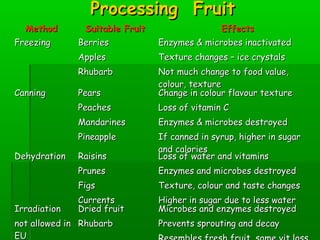
Processing FruitProcessing Fruit
MethodMethod Suitable FruitSuitable Fruit EffectsEffects
FreezingFreezing BerriesBerries
ApplesApples
RhubarbRhubarb
Enzymes & microbes inactivatedEnzymes & microbes inactivated
Texture changes – ice crystalsTexture changes – ice crystals
Not much change to food value,Not much change to food value,
colour, texturecolour, texture
CanningCanning PearsPears
PeachesPeaches
MandarinesMandarines
PineapplePineapple
Change in colour flavour textureChange in colour flavour texture
Loss of vitamin CLoss of vitamin C
Enzymes & microbes destroyedEnzymes & microbes destroyed
If canned in syrup, higher in sugarIf canned in syrup, higher in sugar
and caloriesand calories
DehydrationDehydration RaisinsRaisins
PrunesPrunes
FigsFigs
CurrentsCurrents
Loss of water and vitaminsLoss of water and vitamins
Enzymes and microbes destroyedEnzymes and microbes destroyed
Texture, colour and taste changesTexture, colour and taste changes
Higher in sugar due to less waterHigher in sugar due to less water
IrradiationIrradiation
not allowed innot allowed in
EUEU
Dried fruitDried fruit
RhubarbRhubarb
Microbes and enzymes destroyedMicrobes and enzymes destroyed
Prevents sprouting and decayPrevents sprouting and decay
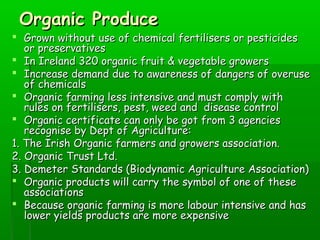
Organic ProduceOrganic Produce
 Grown without use of chemical fertilisers or pesticidesGrown without use of chemical fertilisers or pesticides
or preservativesor preservatives
 In Ireland 320 organic fruit & vegetable growersIn Ireland 320 organic fruit & vegetable growers
 Increase demand due to awareness of dangers of overuseIncrease demand due to awareness of dangers of overuse
of chemicalsof chemicals
 Organic farming less intensive and must comply withOrganic farming less intensive and must comply with
rules on fertilisers, pest, weed and disease controlrules on fertilisers, pest, weed and disease control
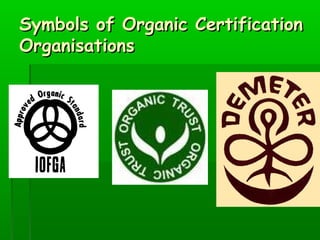
 Organic certificate can only be got from 3 agenciesOrganic certificate can only be got from 3 agencies
recognise by Dept of Agriculture:recognise by Dept of Agriculture:
1. The Irish Organic farmers and growers association.1. The Irish Organic farmers and growers association.
2. Organic Trust Ltd.2. Organic Trust Ltd.
3. Demeter Standards (Biodynamic Agriculture Association)3. Demeter Standards (Biodynamic Agriculture Association)
 Organic products will carry the symbol of one of theseOrganic products will carry the symbol of one of these
associationsassociations
 Because organic farming is more labour intensive and hasBecause organic farming is more labour intensive and has
lower yields products are more expensivelower yields products are more expensive
Symbols of Organic CertificationSymbols of Organic Certification
OrganisationsOrganisations

Fruit and nuts

  • 1.
    Fruit and NutsFruitand Nuts © PDST Home Economics
  • 2.
    NutsNuts  A fruitof a plant that consists of a hard shellA fruit of a plant that consists of a hard shell surrounding a soft kernelsurrounding a soft kernel  Popular examples: Almonds, Brazil nuts, CashewPopular examples: Almonds, Brazil nuts, Cashew nuts, Coconuts, Hazelnuts, Pecans, Pistachio nuts,nuts, Coconuts, Hazelnuts, Pecans, Pistachio nuts, Peanuts (ground nuts/ monkey nuts), WalnutsPeanuts (ground nuts/ monkey nuts), Walnuts
  • 3.
  • 4.
    Nutritive Value ofNutsNutritive Value of Nuts  Protein: Good source of LBV proteinProtein: Good source of LBV protein  Fat: High in polyunsaturated fats therefore high inFat: High in polyunsaturated fats therefore high in caloriescalories  Carbohydrates: Good source cellulose especiallyCarbohydrates: Good source cellulose especially peanuts & hazelnutspeanuts & hazelnuts  Vitamins: Small amount vitamins BVitamins: Small amount vitamins B  Minerals: Contain Iron and CalciumMinerals: Contain Iron and Calcium  Water: Low about 5%Water: Low about 5%
  • 5.
    % Composition of100g of% Composition of 100g of PeanutsPeanuts  Protein: 28.1%Protein: 28.1%  Fat: 49%Fat: 49%  Carbohydrates: 8.6% fibreCarbohydrates: 8.6% fibre  Vitamins: B1 (0.23mg), B2 (0.10mg), Niacin (20mg)Vitamins: B1 (0.23mg), B2 (0.10mg), Niacin (20mg)  Minerals: Calcium (61mg, RDA 800mg), (Iron 2mg,Minerals: Calcium (61mg, RDA 800mg), (Iron 2mg, RDA 10mg)RDA 10mg)  Water: 5%Water: 5%  Kilocalories per 100g: 586Kilocalories per 100g: 586
  • 6.
    Dietetic Value ofNutsDietetic Value of Nuts  Can function as a source of protein in a main courseCan function as a source of protein in a main course vegan dishvegan dish  Add texture & variety to mealsAdd texture & variety to meals  Can be used in sweet & savoury dishesCan be used in sweet & savoury dishes  Keep well, easy to storeKeep well, easy to store  Available whole, flaked, chopped, groundAvailable whole, flaked, chopped, ground  High in calories must be restricted in low calorieHigh in calories must be restricted in low calorie dietsdiets  Some people are allergic to nuts and must avoidSome people are allergic to nuts and must avoid themthem
  • 7.
    Uses in CookeryUsesin Cookery  Vegan main course e.g. nut loaf or vegetable and nut stirVegan main course e.g. nut loaf or vegetable and nut stir fryfry  Ingredient in many biscuits, cakes, sweets, desserts e.g.Ingredient in many biscuits, cakes, sweets, desserts e.g. pear & almond tartpear & almond tart  Used in salads to add protein, fat, texture e.g. waldorfUsed in salads to add protein, fat, texture e.g. waldorf saladsalad  Toppings sprinkled on desserts e.g. flaked almonds onToppings sprinkled on desserts e.g. flaked almonds on top of strudle.top of strudle.  Healthy snack or part of packed lunch e.g. cashew nutsHealthy snack or part of packed lunch e.g. cashew nuts  Almond paste (marzipan) icing on cakes or used forAlmond paste (marzipan) icing on cakes or used for sweetssweets
  • 8.
    FruitsFruits  Eaten forvitamins especially vitamin C, minerals,Eaten for vitamins especially vitamin C, minerals, antioxidants, fibre, water, colour, flavour textureantioxidants, fibre, water, colour, flavour texture
  • 9.
    Classification of FruitClassificationof Fruit CitrusCitrus HardHard fruitfruit Stone fruitStone fruit BerriesBerries OtherOther LemonsLemons OrangesOranges LimesLimes GrapefruitGrapefruit PlumsPlums ApricotApricot PeachesPeaches NectarinesNectarines CherriesCherries MangoMango **Avocados**Avocados **Olives**Olives BlackberriesBlackberries StrawberriesStrawberries BlueberriesBlueberries RaspberriesRaspberries GooseberriesGooseberries BlackcurrantsBlackcurrants BananaBanana PineapplePineapple GrapesGrapes FigsFigs DatesDates KiwiKiwi RhubarbRhubarb
  • 10.
    Average Composition ofFreshAverage Composition of Fresh FruitFruit ProteinProtein FatFat Carbo-Carbo- hydrateshydrates VitaminsVitamins MineralsMinerals WaterWater 0.5%0.5% 0%0% 5-10%5-10% A, CA, C CalciumCalcium IronIron 80-90%80-90%
  • 11.
    Nutritive Value ofFruitNutritive Value of Fruit  ProteinProtein: Fruit lacks protein.: Fruit lacks protein.  Fat:Fat: Fruit lacks fat except for avocados and olives.Fruit lacks fat except for avocados and olives.  Carbohydrates:Carbohydrates: SugarSugar is in all fruit in the form ofis in all fruit in the form of sucrose, glucose and fructose.sucrose, glucose and fructose. StarchStarch is found in under-is found in under- ripe fruit.ripe fruit. PectinPectin is found in ripe fruit cell wallsis found in ripe fruit cell walls CelluloseCellulose (fibre) is found in the cell walls also especially pears,(fibre) is found in the cell walls also especially pears, apples, oranges, melons.apples, oranges, melons.  Vitamins:Vitamins: All fruit has vitamin C especiallyAll fruit has vitamin C especially blackcurrants, strawberries, citrus and kiwi.blackcurrants, strawberries, citrus and kiwi. Yellow/orange/red fruit has beta carotene (pro vitaminYellow/orange/red fruit has beta carotene (pro vitamin A).A).  Minerals:Minerals: Small amount iron and calcium. Bananas goodSmall amount iron and calcium. Bananas good for Potassium.for Potassium.  Water:Water: All fruit has high water content.All fruit has high water content.
  • 12.
    Dietetic Value ofFruitDietetic Value of Fruit  Add greatly to the variety of colours, flavours andAdd greatly to the variety of colours, flavours and textures in the diet.textures in the diet.  Useful in low calorie diets, low cholesterol and highUseful in low calorie diets, low cholesterol and high fibre diets because high in water & fibre and low in fat.fibre diets because high in water & fibre and low in fat.  Anti-oxidants vitamin C and beta carotene help preventAnti-oxidants vitamin C and beta carotene help prevent heart disease, cancer etc..heart disease, cancer etc..  Can be eaten raw or cooked in a wide variety of sweetCan be eaten raw or cooked in a wide variety of sweet and savoury dishes.and savoury dishes.  Healthy snack, cheap and needs no preparation exceptHealthy snack, cheap and needs no preparation except washing and perhaps peeling.washing and perhaps peeling.
  • 13.
    Buying & StoringFruitBuying & Storing Fruit BuyingBuying  In seasonIn season  Usable amountUsable amount  Good quality, ripeGood quality, ripe  Avoid pre-packedAvoid pre-packed  Firm, good colour, noFirm, good colour, no discolouration or moulddiscolouration or mould StoringStoring  Cool, dark, ventilatedCool, dark, ventilated place.place.  Use quicklyUse quickly  Remove packagingRemove packaging  Remove spoiled orRemove spoiled or damaged fruitdamaged fruit
  • 14.
    Preparing and effectsof cookingPreparing and effects of cooking Preparing.Preparing.  Wash to removeWash to remove chemicalschemicals  Eat raw when possibleEat raw when possible  Don’t peel or peel thinlyDon’t peel or peel thinly  Avoid steeping in waterAvoid steeping in water  Use sharp stainless steelUse sharp stainless steel knifeknife Effects of CookingEffects of Cooking  Vitamin C destroyedVitamin C destroyed  Minerals and vitaminsMinerals and vitamins dissolve into coking liquiddissolve into coking liquid  Cellulose & texture softensCellulose & texture softens  Microbes killedMicrobes killed  Enzymes destroyedEnzymes destroyed  Absorb water and swellAbsorb water and swell  Over cooking causes loss ofOver cooking causes loss of colour, texture flavourcolour, texture flavour
  • 15.
    Ripening of FruitRipeningof Fruit  Ripening begins during growth and continues afterRipening begins during growth and continues after harvestingharvesting  Unripe fruit is less palatable than ripeUnripe fruit is less palatable than ripe Changes that happen during ripening:Changes that happen during ripening: 1.1. Enzymes change starch to sugar making fruit sweetEnzymes change starch to sugar making fruit sweet and juicyand juicy 2.2. Insoluble pectose changes to soluble pectinInsoluble pectose changes to soluble pectin 3.3. Ethylene gas that helps ripening is made in some fruitEthylene gas that helps ripening is made in some fruit (bananas)(bananas) 4.4. Fruit changes colour, texture and flavourFruit changes colour, texture and flavour
  • 16.
    Decaying of FruitDecayingof Fruit  Once ripe, fruit only stays good for a while, then itOnce ripe, fruit only stays good for a while, then it decaysdecays  Softer fruit with thin skin e.g. grapes, decay fasterSofter fruit with thin skin e.g. grapes, decay faster than hard fruit with tougher skin e.g. pearsthan hard fruit with tougher skin e.g. pears Changes during decay:Changes during decay: 1.1. Water loss and shrinkageWater loss and shrinkage 2.2. Bruises & soft spots developBruises & soft spots develop 3.3. Enzymes and microbes attack the fruitEnzymes and microbes attack the fruit 4.4. Juices released onto surface make mould and yeastJuices released onto surface make mould and yeast grow, these rot the fruitgrow, these rot the fruit
  • 17.
    Processing FruitProcessing Fruit MethodMethodSuitable FruitSuitable Fruit EffectsEffects FreezingFreezing BerriesBerries ApplesApples RhubarbRhubarb Enzymes & microbes inactivatedEnzymes & microbes inactivated Texture changes – ice crystalsTexture changes – ice crystals Not much change to food value,Not much change to food value, colour, texturecolour, texture CanningCanning PearsPears PeachesPeaches MandarinesMandarines PineapplePineapple Change in colour flavour textureChange in colour flavour texture Loss of vitamin CLoss of vitamin C Enzymes & microbes destroyedEnzymes & microbes destroyed If canned in syrup, higher in sugarIf canned in syrup, higher in sugar and caloriesand calories DehydrationDehydration RaisinsRaisins PrunesPrunes FigsFigs CurrentsCurrents Loss of water and vitaminsLoss of water and vitamins Enzymes and microbes destroyedEnzymes and microbes destroyed Texture, colour and taste changesTexture, colour and taste changes Higher in sugar due to less waterHigher in sugar due to less water IrradiationIrradiation not allowed innot allowed in EUEU Dried fruitDried fruit RhubarbRhubarb Microbes and enzymes destroyedMicrobes and enzymes destroyed Prevents sprouting and decayPrevents sprouting and decay
  • 18.
    Organic ProduceOrganic Produce Grown without use of chemical fertilisers or pesticidesGrown without use of chemical fertilisers or pesticides or preservativesor preservatives  In Ireland 320 organic fruit & vegetable growersIn Ireland 320 organic fruit & vegetable growers  Increase demand due to awareness of dangers of overuseIncrease demand due to awareness of dangers of overuse of chemicalsof chemicals  Organic farming less intensive and must comply withOrganic farming less intensive and must comply with rules on fertilisers, pest, weed and disease controlrules on fertilisers, pest, weed and disease control  Organic certificate can only be got from 3 agenciesOrganic certificate can only be got from 3 agencies recognise by Dept of Agriculture:recognise by Dept of Agriculture: 1. The Irish Organic farmers and growers association.1. The Irish Organic farmers and growers association. 2. Organic Trust Ltd.2. Organic Trust Ltd. 3. Demeter Standards (Biodynamic Agriculture Association)3. Demeter Standards (Biodynamic Agriculture Association)  Organic products will carry the symbol of one of theseOrganic products will carry the symbol of one of these associationsassociations  Because organic farming is more labour intensive and hasBecause organic farming is more labour intensive and has lower yields products are more expensivelower yields products are more expensive
  • 19.
    Symbols of OrganicCertificationSymbols of Organic Certification OrganisationsOrganisations