Food Additives
Substances intentionally added to food to
improve colour, flavour, keeping quality,
nutritive value or physical
condition(texture)
© PDST Home Economics.
Classification of additives
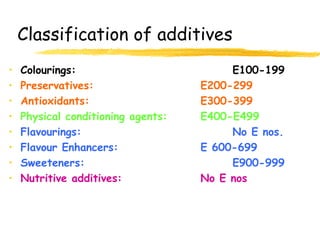
• Colourings: E100-199
• Preservatives: E200-299
• Antioxidants: E300-399
• Physical conditioning agents: E400-E499
• Flavourings: No E nos.
• Flavour Enhancers: E 600-699
• Sweeteners: E900-999
• Nutritive additives: No E nos
Colourings: E100-E199
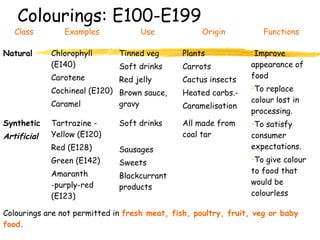
Class Examples Use Origin Functions
Natural Chlorophyll
(E140)
Carotene
Cochineal (E120)
Caramel
Tinned veg
Soft drinks
Red jelly
Brown sauce,
gravy
Plants
Carrots
Cactus insects
Heated carbs.-
Caramelisation
•Improve
appearance of
food
•To replace
colour lost in
processing.
•To satisfy
consumer
expectations.
•To give colour
to food that
would be
colourless
Synthetic
Artificial
Tartrazine -
Yellow (E120)
Red (E128)
Green (E142)
Amaranth
-purply-red
(E123)
Soft drinks
Sausages
Sweets
Blackcurrant
products
All made from
coal tar
Colourings are not permitted in fresh meat, fish, poultry, fruit, veg or baby
food.
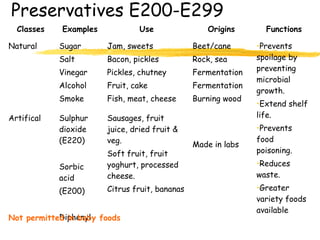
Preservatives E200-E299
Classes Examples Use Origins Functions
Natural Sugar
Salt
Vinegar
Alcohol
Smoke
Jam, sweets
Bacon, pickles
Pickles, chutney
Fruit, cake
Fish, meat, cheese
Beet/cane
Rock, sea
Fermentation
Fermentation
Burning wood
•Prevents
spoilage by
preventing
microbial
growth.
•Extend shelf
life.
•Prevents
food
poisoning.
•Reduces
waste.
•Greater
variety foods
available
Artifical Sulphur
dioxide
(E220)
Sorbic
acid
(E200)
Diphenyl
Sausages, fruit
juice, dried fruit &
veg.
Soft fruit, fruit
yoghurt, processed
cheese.
Citrus fruit, bananas
Made in labs
Not permitted in baby foods
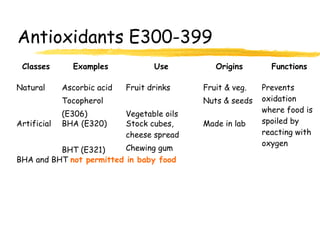
Antioxidants E300-399
Classes Examples Use Origins Functions
Natural Ascorbic acid
Tocopherol
(E306)
Fruit drinks
Vegetable oils
Fruit & veg.
Nuts & seeds
Prevents
oxidation
where food is
spoiled by
reacting with
oxygen
Artificial BHA (E320)
BHT (E321)
Stock cubes,
cheese spread
Chewing gum
Made in lab
BHA and BHT not permitted in baby food
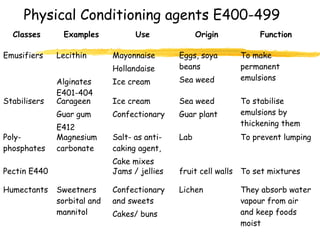
Physical Conditioning agents E400-499
Classes Examples Use Origin Function
Emusifiers Lecithin
Alginates
E401-404
Mayonnaise
Hollandaise
Ice cream
Eggs, soya
beans
Sea weed
To make
permanent
emulsions
Stabilisers Carageen
Guar gum
E412
Ice cream
Confectionary
Sea weed
Guar plant
To stabilise
emulsions by
thickening them
Poly-
phosphates
Magnesium
carbonate
Salt- as anti-
caking agent,
Cake mixes
Lab To prevent lumping
Pectin E440 Jams / jellies fruit cell walls To set mixtures
Humectants Sweetners
sorbital and
mannitol
Confectionary
and sweets
Cakes/ buns
Lichen They absorb water
vapour from air
and keep foods
moist
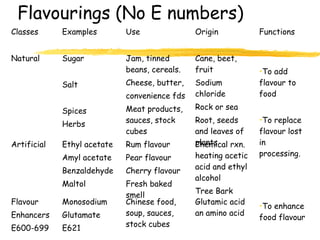
Flavourings (No E numbers)
Classes Examples Use Origin Functions
Natural Sugar
Salt
Spices
Herbs
Jam, tinned
beans, cereals.
Cheese, butter,
convenience fds
Meat products,
sauces, stock
cubes
Cane, beet,
fruit
Sodium
chloride
Rock or sea
Root, seeds
and leaves of
plants
•To add
flavour to
food
•To replace
flavour lost
in
processing.
•To enhance
food flavour
Artificial Ethyl acetate
Amyl acetate
Benzaldehyde
Maltol
Rum flavour
Pear flavour
Cherry flavour
Fresh baked
smell
Chemical rxn.
heating acetic
acid and ethyl
alcohol
Tree Bark
Flavour
Enhancers
E600-699
Monosodium
Glutamate
E621
Chinese food,
soup, sauces,
stock cubes
Glutamic acid
an amino acid
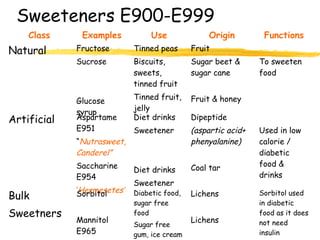
Sweeteners E900-E999
Class Examples Use Origin Functions
Natural Fructose
Sucrose
Glucose
syrup
Tinned peas
Biscuits,
sweets,
tinned fruit
Tinned fruit,
jelly
Fruit
Sugar beet &
sugar cane
Fruit & honey
To sweeten
food
Artificial Aspartame
E951
“Nutrasweet,
Canderel”
Saccharine
E954
‘Hermesetes’
Diet drinks
Sweetener
Diet drinks
Sweetener
Dipeptide
(aspartic acid+
phenyalanine)
Coal tar
Used in low
calorie /
diabetic
food &
drinks
Bulk
Sweetners
Sorbitol
Mannitol
E965
Diabetic food,
sugar free
food
Sugar free
gum, ice cream
Lichens
Lichens
Sorbitol used
in diabetic
food as it does
not need
insulin
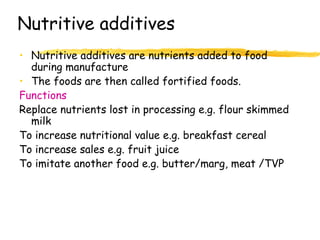
Nutritive additives
• Nutritive additives are nutrients added to food
during manufacture
• The foods are then called fortified foods.
Functions
Replace nutrients lost in processing e.g. flour skimmed
milk
To increase nutritional value e.g. breakfast cereal
To increase sales e.g. fruit juice
To imitate another food e.g. butter/marg, meat /TVP
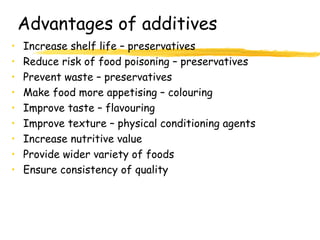
Advantages of additives
• Increase shelf life – preservatives
• Reduce risk of food poisoning – preservatives
• Prevent waste – preservatives
• Make food more appetising – colouring
• Improve taste – flavouring
• Improve texture – physical conditioning agents
• Increase nutritive value
• Provide wider variety of foods
• Ensure consistency of quality
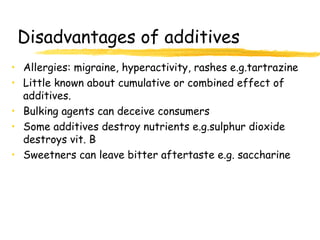
Disadvantages of additives
• Allergies: migraine, hyperactivity, rashes e.g.tartrazine
• Little known about cumulative or combined effect of
additives.
• Bulking agents can deceive consumers
• Some additives destroy nutrients e.g.sulphur dioxide
destroys vit. B
• Sweetners can leave bitter aftertaste e.g. saccharine
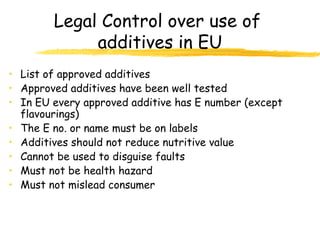
Legal Control over use of
additives in EU
• List of approved additives
• Approved additives have been well tested
• In EU every approved additive has E number (except
flavourings)
• The E no. or name must be on labels
• Additives should not reduce nutritive value
• Cannot be used to disguise faults
• Must not be health hazard
• Must not mislead consumer
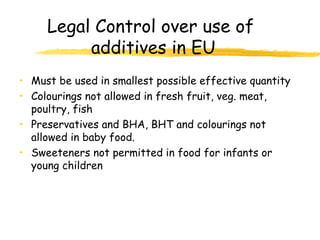
Legal Control over use of
additives in EU
• Must be used in smallest possible effective quantity
• Colourings not allowed in fresh fruit, veg. meat,
poultry, fish
• Preservatives and BHA, BHT and colourings not
allowed in baby food.
• Sweeteners not permitted in food for infants or
young children
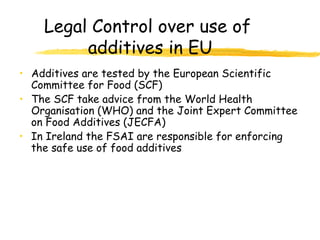
Legal Control over use of
additives in EU
• Additives are tested by the European Scientific
Committee for Food (SCF)
• The SCF take advice from the World Health
Organisation (WHO) and the Joint Expert Committee
on Food Additives (JECFA)
• In Ireland the FSAI are responsible for enforcing
the safe use of food additives
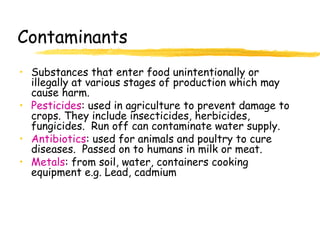
Contaminants
• Substances that enter food unintentionally or
illegally at various stages of production which may
cause harm.
• Pesticides: used in agriculture to prevent damage to
crops. They include insecticides, herbicides,
fungicides. Run off can contaminate water supply.
• Antibiotics: used for animals and poultry to cure
diseases. Passed on to humans in milk or meat.
• Metals: from soil, water, containers cooking
equipment e.g. Lead, cadmium
Contaminants
• Plastic chemicals from packaging
• Formaldehyde from treated paper packaging
• Foreign bodies; hair, glass, wire etc..
• Other Chemicals: growth promoters, carcinogens
from smoking and barbecuing, dioxins from burning
hydrocarbons
• Micro-organisms
Effects of Contaminants
Pesticides Respiratory problems. Heart and circulatory
problems. Damage to nervous system. Cancer.
Antibiotics Build up resistance to antibiotics. Allergies
develop.
Metals Stomach cramps. Damage to liver, kidneys,
immune system, nervous system.
Dioxins Cancer.
Contaminants
• Department of agriculture and food are responsible
for production of safe food.
• Samples are testing and comparisons made with EU
max permitted levels.
• People opt for organically grown food to avoid these
contaminants.

Food additives

  • 1.
    Food Additives Substances intentionallyadded to food to improve colour, flavour, keeping quality, nutritive value or physical condition(texture) © PDST Home Economics.
  • 2.
    Classification of additives •Colourings: E100-199 • Preservatives: E200-299 • Antioxidants: E300-399 • Physical conditioning agents: E400-E499 • Flavourings: No E nos. • Flavour Enhancers: E 600-699 • Sweeteners: E900-999 • Nutritive additives: No E nos
  • 3.
    Colourings: E100-E199 Class ExamplesUse Origin Functions Natural Chlorophyll (E140) Carotene Cochineal (E120) Caramel Tinned veg Soft drinks Red jelly Brown sauce, gravy Plants Carrots Cactus insects Heated carbs.- Caramelisation •Improve appearance of food •To replace colour lost in processing. •To satisfy consumer expectations. •To give colour to food that would be colourless Synthetic Artificial Tartrazine - Yellow (E120) Red (E128) Green (E142) Amaranth -purply-red (E123) Soft drinks Sausages Sweets Blackcurrant products All made from coal tar Colourings are not permitted in fresh meat, fish, poultry, fruit, veg or baby food.
  • 4.
    Preservatives E200-E299 Classes ExamplesUse Origins Functions Natural Sugar Salt Vinegar Alcohol Smoke Jam, sweets Bacon, pickles Pickles, chutney Fruit, cake Fish, meat, cheese Beet/cane Rock, sea Fermentation Fermentation Burning wood •Prevents spoilage by preventing microbial growth. •Extend shelf life. •Prevents food poisoning. •Reduces waste. •Greater variety foods available Artifical Sulphur dioxide (E220) Sorbic acid (E200) Diphenyl Sausages, fruit juice, dried fruit & veg. Soft fruit, fruit yoghurt, processed cheese. Citrus fruit, bananas Made in labs Not permitted in baby foods
  • 5.
    Antioxidants E300-399 Classes ExamplesUse Origins Functions Natural Ascorbic acid Tocopherol (E306) Fruit drinks Vegetable oils Fruit & veg. Nuts & seeds Prevents oxidation where food is spoiled by reacting with oxygen Artificial BHA (E320) BHT (E321) Stock cubes, cheese spread Chewing gum Made in lab BHA and BHT not permitted in baby food
  • 6.
    Physical Conditioning agentsE400-499 Classes Examples Use Origin Function Emusifiers Lecithin Alginates E401-404 Mayonnaise Hollandaise Ice cream Eggs, soya beans Sea weed To make permanent emulsions Stabilisers Carageen Guar gum E412 Ice cream Confectionary Sea weed Guar plant To stabilise emulsions by thickening them Poly- phosphates Magnesium carbonate Salt- as anti- caking agent, Cake mixes Lab To prevent lumping Pectin E440 Jams / jellies fruit cell walls To set mixtures Humectants Sweetners sorbital and mannitol Confectionary and sweets Cakes/ buns Lichen They absorb water vapour from air and keep foods moist
  • 7.
    Flavourings (No Enumbers) Classes Examples Use Origin Functions Natural Sugar Salt Spices Herbs Jam, tinned beans, cereals. Cheese, butter, convenience fds Meat products, sauces, stock cubes Cane, beet, fruit Sodium chloride Rock or sea Root, seeds and leaves of plants •To add flavour to food •To replace flavour lost in processing. •To enhance food flavour Artificial Ethyl acetate Amyl acetate Benzaldehyde Maltol Rum flavour Pear flavour Cherry flavour Fresh baked smell Chemical rxn. heating acetic acid and ethyl alcohol Tree Bark Flavour Enhancers E600-699 Monosodium Glutamate E621 Chinese food, soup, sauces, stock cubes Glutamic acid an amino acid
  • 8.
    Sweeteners E900-E999 Class ExamplesUse Origin Functions Natural Fructose Sucrose Glucose syrup Tinned peas Biscuits, sweets, tinned fruit Tinned fruit, jelly Fruit Sugar beet & sugar cane Fruit & honey To sweeten food Artificial Aspartame E951 “Nutrasweet, Canderel” Saccharine E954 ‘Hermesetes’ Diet drinks Sweetener Diet drinks Sweetener Dipeptide (aspartic acid+ phenyalanine) Coal tar Used in low calorie / diabetic food & drinks Bulk Sweetners Sorbitol Mannitol E965 Diabetic food, sugar free food Sugar free gum, ice cream Lichens Lichens Sorbitol used in diabetic food as it does not need insulin
  • 9.
    Nutritive additives • Nutritiveadditives are nutrients added to food during manufacture • The foods are then called fortified foods. Functions Replace nutrients lost in processing e.g. flour skimmed milk To increase nutritional value e.g. breakfast cereal To increase sales e.g. fruit juice To imitate another food e.g. butter/marg, meat /TVP
  • 10.
    Advantages of additives •Increase shelf life – preservatives • Reduce risk of food poisoning – preservatives • Prevent waste – preservatives • Make food more appetising – colouring • Improve taste – flavouring • Improve texture – physical conditioning agents • Increase nutritive value • Provide wider variety of foods • Ensure consistency of quality
  • 11.
    Disadvantages of additives •Allergies: migraine, hyperactivity, rashes e.g.tartrazine • Little known about cumulative or combined effect of additives. • Bulking agents can deceive consumers • Some additives destroy nutrients e.g.sulphur dioxide destroys vit. B • Sweetners can leave bitter aftertaste e.g. saccharine
  • 12.
    Legal Control overuse of additives in EU • List of approved additives • Approved additives have been well tested • In EU every approved additive has E number (except flavourings) • The E no. or name must be on labels • Additives should not reduce nutritive value • Cannot be used to disguise faults • Must not be health hazard • Must not mislead consumer
  • 13.
    Legal Control overuse of additives in EU • Must be used in smallest possible effective quantity • Colourings not allowed in fresh fruit, veg. meat, poultry, fish • Preservatives and BHA, BHT and colourings not allowed in baby food. • Sweeteners not permitted in food for infants or young children
  • 14.
    Legal Control overuse of additives in EU • Additives are tested by the European Scientific Committee for Food (SCF) • The SCF take advice from the World Health Organisation (WHO) and the Joint Expert Committee on Food Additives (JECFA) • In Ireland the FSAI are responsible for enforcing the safe use of food additives
  • 15.
    Contaminants • Substances thatenter food unintentionally or illegally at various stages of production which may cause harm. • Pesticides: used in agriculture to prevent damage to crops. They include insecticides, herbicides, fungicides. Run off can contaminate water supply. • Antibiotics: used for animals and poultry to cure diseases. Passed on to humans in milk or meat. • Metals: from soil, water, containers cooking equipment e.g. Lead, cadmium
  • 16.
    Contaminants • Plastic chemicalsfrom packaging • Formaldehyde from treated paper packaging • Foreign bodies; hair, glass, wire etc.. • Other Chemicals: growth promoters, carcinogens from smoking and barbecuing, dioxins from burning hydrocarbons • Micro-organisms
  • 17.
    Effects of Contaminants PesticidesRespiratory problems. Heart and circulatory problems. Damage to nervous system. Cancer. Antibiotics Build up resistance to antibiotics. Allergies develop. Metals Stomach cramps. Damage to liver, kidneys, immune system, nervous system. Dioxins Cancer.
  • 18.
    Contaminants • Department ofagriculture and food are responsible for production of safe food. • Samples are testing and comparisons made with EU max permitted levels. • People opt for organically grown food to avoid these contaminants.

Editor's Notes