FRUITS & VEGETABLES
S U P T A S A R K A R
H H M / 2 0 1 3 / 1 0
M . S C F N - 1 S T Y R
CONTENT:
1. STRUCTURE & COMPOSITION
OF CELL TISSUE
2. CHEMICAL COMPOSITION OF
PLANT MATERIAL
3. FRUITS
4. VEGETABLES
5. CASE STUDIES:
I. Retention of nutrients in green
leafy vegetables on dehydration
II. Evaporative cooling system for
storage of fruits & vegetables
- a review
STRUCTURE & COMPOSITION OF
CELL TISSUE
 Fruits & vegetables are composed of both
simple & complex cells
 Simple tissue:
-Dermal tissue
-Parenchyma tissue
 Complex tissue:
-Vascular tissue (Xylem & Phloem)
-Collenchyma tissue &
-Sclerenchyma supporting tissue
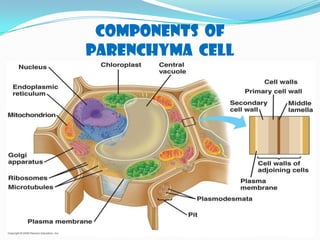
COMPONENTS OF
PARENCHYMA CELL
CHEMICAL COMPOSITION OF
PLANT MATERIAL
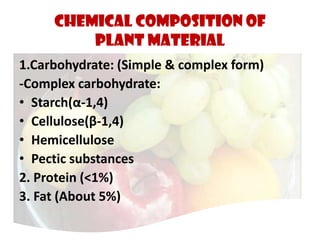
1.Carbohydrate: (Simple & complex form)
-Complex carbohydrate:
• Starch(α-1,4)
• Cellulose(β-1,4)
• Hemicellulose
• Pectic substances
2. Protein (<1%)
3. Fat (About 5%)
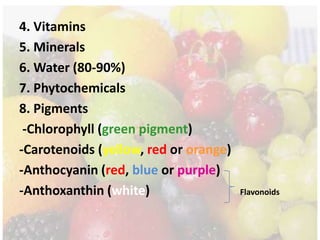
4. Vitamins
5. Minerals
6. Water (80-90%)
7. Phytochemicals
8. Pigments
-Chlorophyll (green pigment)
-Carotenoids (yellow, red or orange)
-Anthocyanin (red, blue or purple)
-Anthoxanthin (white) Flavonoids
9. Flavour compounds:
• Allium
• Brassica
• Organic acids (Citric acid, malic acid or tartaric
acid)
Sulphur containing
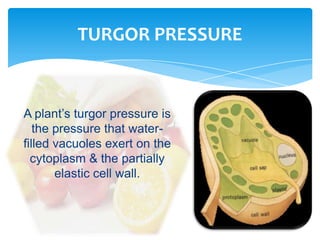
A plant’s turgor pressure is
the pressure that water-
filled vacuoles exert on the
cytoplasm & the partially
elastic cell wall.
TURGOR PRESSURE
FRUITS
FRUITS
• A fruit is a part of a flowering
plant that derives from
specific tissues of the flower, one or
more ovaries, and in some cases
accessory tissues.
• Fruits are the means by which
these plants disseminate seeds.
CLASSIFICATION
1. Berries
2. Citrus fruits
3. Drupes
4. Grapes
5. Melons
6. Pomes
7. Tropical & subtropical fruits
 Fruits are very poor source of protein & fat.
(Exception: Avocado)
 Contain high amount of moisture
 Good source of fibre
 Not very good sources of calories (Exception:
Banana)
 Higher percentage of sugar
 Generally poor source of iron
(Exception is watermelon,
Seethaphul)
 Mangoes are excellent source of
carotenes. Oranges are fairly
good source of carotene.
 Citrus fruits are good source of vitamin C.
 If fruits are bruised, peeled, cooked or exposed to
air, alkali or copper large amounts of vitamin
may be oxidised.
 Apples give fibre to the diet.
Pigments
Fruits contain different pigments:
1. Chlorophyll
2. Carotenoids
3. Anthocyanins
4. Anthoxanthins
Anthocyanins
 Enzymes like anthocyanase catalase reactions
that result in the loss of colour of
anthocyanins.
 In addition to heat & oxygen various metallic
ions can cause undesirable change in colour.
 The metal iron precipitates anthocyanin. This
reaction may cause ‘pin-holing’ of cans.
 Effect of canning or preserving: Colour deteriorate
on storage.
 Effect of sulphur dioxide: Antimicrobial
preservative Potassium metabisulphite at high
concentrations 1 – 1.5% causes total irreversible
bleaching.
Fruits: 70 to 90% water
Found in the vacuoles
Soluble substances: sugar, salts, organic
acids & water soluble pigments.
Water
• The framework of fruit is made of cellulose
• Forms the wall of plant cell
• Pectic substances are also found in cell walls &
between cells.
• Act as cementing substance.
• Pectic substances: protopectin, pectinic acid,
pectic acid.
CELLULOSE & PECTIC
SUBSTANCES
• Change in solubility is influenced by heat.
• Acid make structures more firm.
• Alkaline disintegrate the fibre.
 Volatile compounds: Esters, aldehydes, acids,
alcohols, ketones & ethers.
 Sugars, tannins, acids & mineral salts also affect
the flavour of fruits.
 Comprised of catechins, leuco-anthocyanins &
hydroxy acids.
 They are present in the tissues of those woody
plants while absent in herbaceous plants.
 Tannins affect the colour & flavour
 High amount: skin & seeds
EFFECTS OF POLYPHENOLS ON FRUIT QUALITY:
• Undesirable astringency in some fruits & desirable
astringency in ciders & wines.
• Brown discolouration due to oxidation .
• Undesirable dark coloured complexes with iron due to
sequestering action in canned food.
• Leucoanthocyanins cause development of pink to pinkish
brown colour.
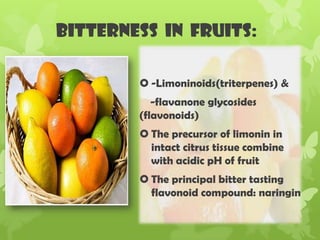
Bitterness in fruits:
 -Limoninoids(triterpenes) &
-flavanone glycosides
(flavonoids)
 The precursor of limonin in
intact citrus tissue combine
with acidic pH of fruit
 The principal bitter tasting
flavonoid compound: naringin
Post harvest changes & Storage
 All synthesis of organic compounds halts after harvest
but numerous physiological changes continue during
storage.
 Bulbs, roots, tubers & seeds become relatively dormant
during storage whereas fleshy tissues undergo ripening
after maturation & then continue to senescence.
 Certain biochemical activities occur.
• Respiration rate varies with stage of maturity.
• Based on the rate of respiration prior to
senescence fruits are classified as:
Climacteric & Non-climacteric fruits.
• Non-climacteric fruits are best when ripened
before harvesting.
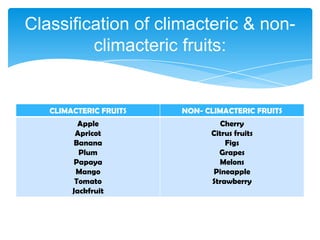
CLIMACTERIC FRUITS NON- CLIMACTERIC FRUITS
Apple
Apricot
Banana
Plum
Papaya
Mango
Tomato
Jackfruit
Cherry
Citrus fruits
Figs
Grapes
Melons
Pineapple
Strawberry
Classification of climacteric & non-
climacteric fruits:
• Cell wall components undergo changes
after harvest due to various enzymes
• Pectin degrade due to pectinesterases &
polygalacturonases.
• Other enzymes: cellulase & hemicellulases.
RIPENING OF FRUITS
• It is genetically programmed highly coordinated
physiological process
• Changes occur due to enzymes: lipase, pectic
enzymes, invertase, chlorophyllase &
peroxidase
• Breakdown of chlorophyll( colour changes from
green -> yellow or orange red)
• Softening of flesh ( protopectin -> pectin, & in
over ripe fruits: pectin ->pectic acid)
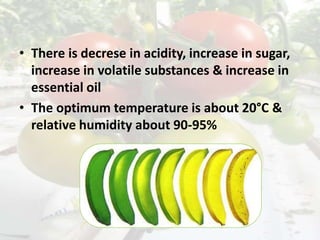
• There is decrese in acidity, increase in sugar,
increase in volatile substances & increase in
essential oil
• The optimum temperature is about 20°C &
relative humidity about 90-95%
 Each fruit must be stored at its own optimum
temperature
 Proper air circulation must be ensured
 Commercial storage: Low temperature close to 0°C &
relative humidity about 85% is preferred
 Home refrigerator: Ventilated covered containers
 Strong flavoured fruits can be stored in tight containers.
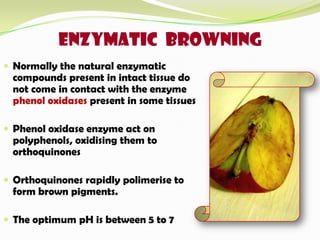
ENZYMATIC BROWNING
 Normally the natural enzymatic
compounds present in intact tissue do
not come in contact with the enzyme
phenol oxidases present in some tissues
 Phenol oxidase enzyme act on
polyphenols, oxidising them to
orthoquinones
 Orthoquinones rapidly polimerise to
form brown pigments.
 The optimum pH is between 5 to 7
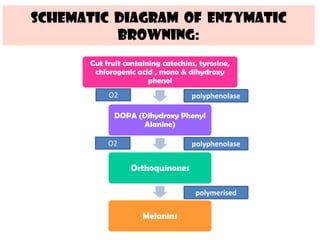
Schematic diagram of enzymatic
browning:
Cut fruit containing catechins, tyrosine,
chlorogenic acid , mono & dihydroxy
phenol
DOPA (Dihydroxy Phenyl
Alanine)
Orthoquinones
Melanins
polyphenolase
polyphenolase
polymerised
O2
O2
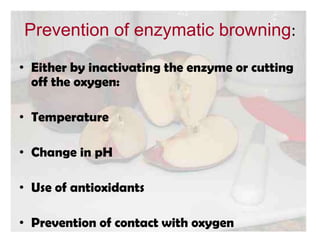
Prevention of enzymatic browning:
• Either by inactivating the enzyme or cutting
off the oxygen:
• Temperature
• Change in pH
• Use of antioxidants
• Prevention of contact with oxygen
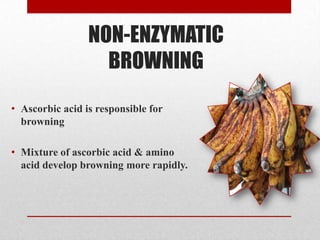
NON-ENZYMATIC
BROWNING
• Ascorbic acid is responsible for
browning
• Mixture of ascorbic acid & amino
acid develop browning more rapidly.
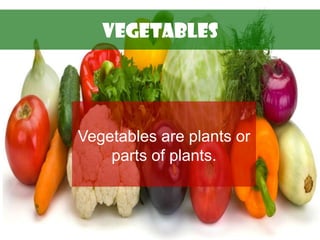
VEGETABLES
Vegetables are plants or
parts of plants.
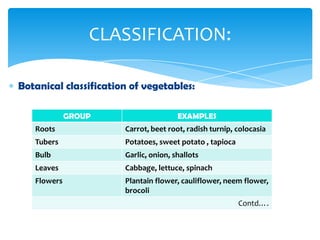
Botanical classification of vegetables:
CLASSIFICATION:
GROUP EXAMPLES
Roots Carrot, beet root, radish turnip, colocasia
Tubers Potatoes, sweet potato , tapioca
Bulb Garlic, onion, shallots
Leaves Cabbage, lettuce, spinach
Flowers Plantain flower, cauliflower, neem flower,
brocoli
Contd….
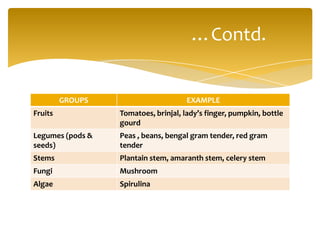
GROUPS EXAMPLE
Fruits Tomatoes, brinjal, lady’s finger, pumpkin, bottle
gourd
Legumes (pods &
seeds)
Peas , beans, bengal gram tender, red gram
tender
Stems Plantain stem, amaranth stem, celery stem
Fungi Mushroom
Algae Spirulina
…Contd.
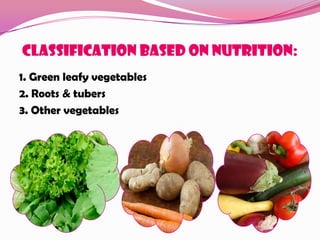
Classification based on nutrition:
1. Green leafy vegetables
2. Roots & tubers
3. Other vegetables
 Most of the pigments occur in plastids
 Some of the water soluble pigments are dissolved
in the vacuoles
 The chief pigments:
-Fat soluble
-Water soluble
WATER INSOLUBLE PIGMENTS
CHLOROPHYLL
• Present in chloroplasts
• 2 chlorophylls:
-Chlorophyll-a: Intense blue green
-Chlorophyll-b: Dull Yellow green
• Occurs in the ratio: 3a:1b
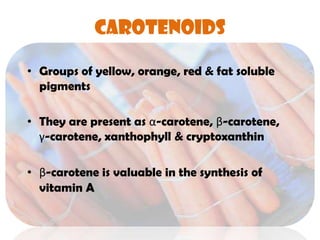
CAROTENOIDS
• Groups of yellow, orange, red & fat soluble
pigments
• They are present as α-carotene, β-carotene,
γ-carotene, xanthophyll & cryptoxanthin
• β-carotene is valuable in the synthesis of
vitamin A
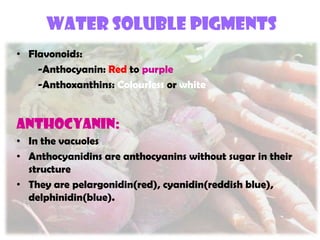
WATER SOLUBLE PIGMENTS
• Flavonoids:
-Anthocyanin: Red to purple
-Anthoxanthins: Colourless or white
ANTHOCYANIN:
• In the vacuoles
• Anthocyanidins are anthocyanins without sugar in their
structure
• They are pelargonidin(red), cyanidin(reddish blue),
delphinidin(blue).
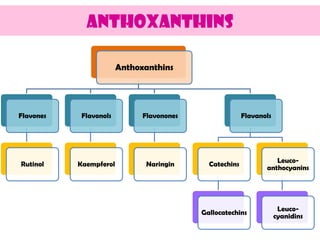
ANTHOXANTHINS
Anthoxanthins
Flavones
Rutinol
Flavonols
Kaempferol
Flavonones
Naringin
Flavanols
Catechins
Gallocatechins
Leuco-
anthocyanins
Leuco-
cyanidins
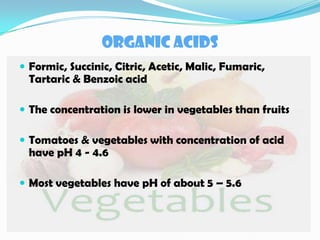
ORGANIC ACIDS
 Formic, Succinic, Citric, Acetic, Malic, Fumaric,
Tartaric & Benzoic acid
 The concentration is lower in vegetables than fruits
 Tomatoes & vegetables with concentration of acid
have pH 4 - 4.6
 Most vegetables have pH of about 5 – 5.6
ENZYMES
• Composed of protein
• Destroyed by heat & chemicals
• 2 types of enzymes:
-Hydrolytic enzymes
-Oxido Reductases
Example: Papain, Anthocyanase, Peroxidases,
Phenolases, Glycosidases
FLAVOUR COMPOUNDS
• The natural flavours of vegetables are due to
mixture of aldehydes, alcohol, ketones, organic
acids& sulphur compounds
• Astringent taste is due to phenolic compounds &
tannins.
• Strong flavour due to sulphur containing
compounds as in Allium & Cruciferae vegetables
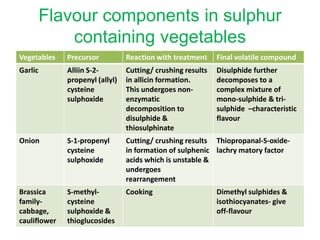
Flavour components in sulphur
containing vegetables
Vegetables Precursor Reaction with treatment Final volatile compound
Garlic Alliin S-2-
propenyl (allyl)
cysteine
sulphoxide
Cutting/ crushing results
in allicin formation.
This undergoes non-
enzymatic
decomposition to
disulphide &
thiosulphinate
Disulphide further
decomposes to a
complex mixture of
mono-sulphide & tri-
sulphide –characteristic
flavour
Onion S-1-propenyl
cysteine
sulphoxide
Cutting/ crushing results
in formation of sulphenic
acids which is unstable &
undergoes
rearrangement
Thiopropanal-S-oxide-
lachry matory factor
Brassica
family-
cabbage,
cauliflower
S-methyl-
cysteine
sulphoxide &
thioglucosides
Cooking Dimethyl sulphides &
isothiocyanates- give
off-flavour
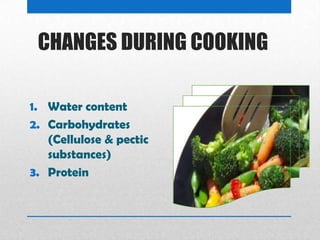
CHANGES DURING COOKING
1. Water content
2. Carbohydrates
(Cellulose & pectic
substances)
3. Protein
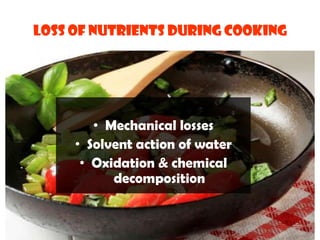
LOSS OF NUTRIENTS DURING COOKING
• Mechanical losses
• Solvent action of water
• Oxidation & chemical
decomposition
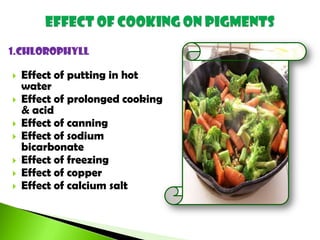
1.CHLOROPHYLL
 Effect of putting in hot
water
 Effect of prolonged cooking
& acid
 Effect of canning
 Effect of sodium
bicarbonate
 Effect of freezing
 Effect of copper
 Effect of calcium salt
Effect of heat & oxidation
Effect of cooking in fat
2.CAROTENOIDS
FLAVONOIDS
1.ANTHOCYANINS:
 Effect of pH
 Effect of metal
 Effect of method of cooking
 Effect of tap water
 Effect of pickling
2. BETALAINS
 Effect of pH
3.ANTHOXANTHINS
 Effect of pH
 Effect of metal
 Effect of cooking on sulphur containing vegetables
 Bitter compounds in vegetables
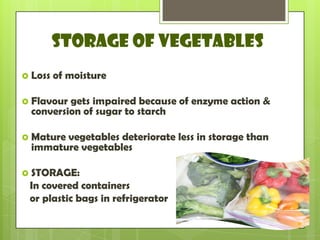
STORAGE OF VEGETABLES
 Loss of moisture
 Flavour gets impaired because of enzyme action &
conversion of sugar to starch
 Mature vegetables deteriorate less in storage than
immature vegetables
 STORAGE:
In covered containers
or plastic bags in refrigerator
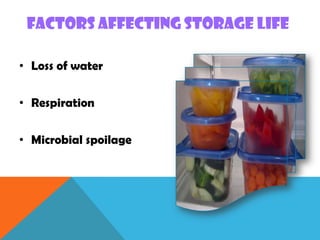
FACTORS AFFECTING STORAGE LIFE
• Loss of water
• Respiration
• Microbial spoilage
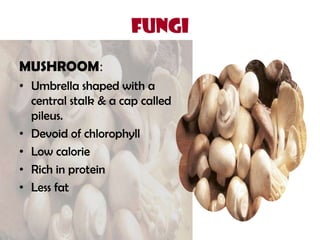
FUNGI
MUSHROOM:
• Umbrella shaped with a
central stalk & a cap called
pileus.
• Devoid of chlorophyll
• Low calorie
• Rich in protein
• Less fat
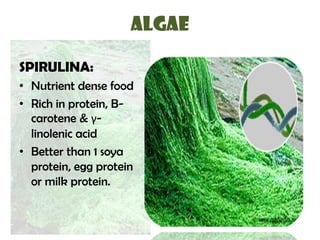
ALGAE
SPIRULINA:
• Nutrient dense food
• Rich in protein, B-
carotene & γ-
linolenic acid
• Better than 1 soya
protein, egg protein
or milk protein.
CASE STUDIES:
Study conducted by Sheetal Gupta, B.S.Gowri, A.Jyothi
Lakshmi, Jamuna Prakash
Journal of Food Science & Technology
September- October 2013
Vol 50, Issue 5
PP 918-925
1. RETENTION OF NUTRIENTS IN
GREEN LEAFY VEGETABLES ON
DEHYDRATION
To investigate the influence of dehydration on
nutrient composition of Amaranthus gangeticus,
Chenopodium album(bathua), Centella asiatica
(centella), Amaranth tricolor(tampala) &
Trigonella foenum graecum(fenugreek)
OBJECTIVE
The GLV were were steam blanched for 5 min &
dried in an oven at 60°C for 10-12hrs.
The fresh & dehydrated samples were analysed for
selected proximate constituents, vitamins,
minerals, antinutrients & dialyzable minerals
STUDY METHODOLOGY
Dehydration seems to have little effect on the
proximate constituents, vitamins, minerals,
antinutrient content of the GLV
Among the vitamins, retention of ascorbic acid was
1-14%, thiamin 22-71%, total carotene 49-73% & β-
carotene 20-69% of their initial content.
FINDINGS
Dialyzable iron & calcium in the fresh vegetables
ranged between 0.21-3.5mg & 15.36-81.33 mg/100g
respectively which reduced to 0.05-0.53mg & 6.94-
58.15mg/100g on dehydration.
Proximate principles were least affected
Calcium & total iron content decreased slightly
Dialysability of minerals decreased significantly
Among the vitamins, ascorbic acid, total & B-
carotene were lost significantly while thiamine was
retained moderately
Changes in the antinutritional factor was not
significant.
CONCLUSION
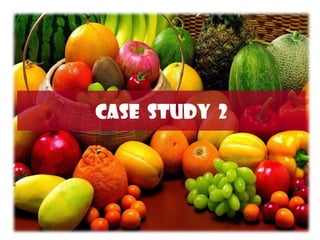
CASE STUDY 2
EVAPORATIVE COOLING SYSTEM FOR
STORAGE OF FRUITS & VEGETABLES
- A review
 Study conducted by: Amrat lal Basediya,
D.V.K.Samuel, Vimala Beera
 Journal of Food Science & Technology
 May- June 2013
 Vol.50, Issue 3
 PP 429-442
EVAPORATIVE COOLING SYSTEM
 Evaporative cooling is a well-known
system to be an efficient & economical
means for reducing the temperature &
increasing the relative humidity in an
enclosure & this this effect has been
extensively tried for increasing the shelf
life of horticultural produce in some
tropical & subtropical countries.
PRINCIPLE OF EVAPORATIVE
COOLING
 The wet-bulb temperature as
compared to air’s dry-bulb
temperature, is a measure of potential
for evaporative cooling.
 The greater the difference in the
temperature, the greater is the cooling
effect.
METHOD OF EVAPORATIVE
COOLING
Direct cooling system
Indirect evaporative cooling
Two stage system
Evaporative cooling system for short
duration:
(Scientific storage system)
ZERO ENERGY COOLING SYSTEM:
 Developed at IARI, New Delhi
 By Roy & Khurdiya (1986)
 Based on the principle of evaporative cooling
ADVANTAGE OF
EVAPORATIVE COOLED
STORAGE
 Most suitable for rural application
 Size can be fitted to the need
 Better marketablity
 Retain nutritive value
 Environment friendly
 Reduce energy use by 70%
 Extends shelf life (Reduces surrounding air
temperature & increases moisture content)
 Less expensive & easy to install, operate &
maintain.
DISADVANTAGE:
 Requires a constant water supply to wet
pad
 Space required outside home
 Water high in mineral leave mineral
deposit
 High humidity decreases the cooling
capability
 No dehumidification
CONCLUSION
 Approximately 23-35% of horticultural produce goes
waste due to improper post harvest operation &
storage
 Evaporative cooling system is well suited where
temperature is high, humidity low, water can be
spared & air movement available
 Zero energy cool chamber could be used for short
duration storage in hilly regions.
CONCLUSION
TEXT BOOKS:
1. Vaclavik,V.A., Christian,E.W., Essentials of
Food Science, Third Edition, Springer.
2. Srilaksmi, Food Science, Third Edition, 2003,
New Age International Publisher, New Delhi.
REFERENCE
JOURNALS
1. Gupta,S., Gowri,B.S., Lakshmi,A.J., Prakash,J.,
2013, Retention of nutrients in green leafy
vegetables on dehydration, Journal of Food
Science & Technology, Vol.50(5), PP 918-925
2. Basediya,A.L., Samuel,D.V.K., Beera,V., 2013,
Evaporative Cooling System for Storage of fruits
& vegetables, Journal of Food Science &
Technology, Vol.50(3), PP 429-442
Fruits & vegetables
Fruits & vegetables

Fruits & vegetables

  • 1.
    FRUITS & VEGETABLES SU P T A S A R K A R H H M / 2 0 1 3 / 1 0 M . S C F N - 1 S T Y R
  • 2.
    CONTENT: 1. STRUCTURE &COMPOSITION OF CELL TISSUE 2. CHEMICAL COMPOSITION OF PLANT MATERIAL 3. FRUITS 4. VEGETABLES 5. CASE STUDIES: I. Retention of nutrients in green leafy vegetables on dehydration II. Evaporative cooling system for storage of fruits & vegetables - a review
  • 3.
    STRUCTURE & COMPOSITIONOF CELL TISSUE  Fruits & vegetables are composed of both simple & complex cells  Simple tissue: -Dermal tissue -Parenchyma tissue  Complex tissue: -Vascular tissue (Xylem & Phloem) -Collenchyma tissue & -Sclerenchyma supporting tissue
  • 4.
  • 5.
    CHEMICAL COMPOSITION OF PLANTMATERIAL 1.Carbohydrate: (Simple & complex form) -Complex carbohydrate: • Starch(α-1,4) • Cellulose(β-1,4) • Hemicellulose • Pectic substances 2. Protein (<1%) 3. Fat (About 5%)
  • 6.
    4. Vitamins 5. Minerals 6.Water (80-90%) 7. Phytochemicals 8. Pigments -Chlorophyll (green pigment) -Carotenoids (yellow, red or orange) -Anthocyanin (red, blue or purple) -Anthoxanthin (white) Flavonoids
  • 7.
    9. Flavour compounds: •Allium • Brassica • Organic acids (Citric acid, malic acid or tartaric acid) Sulphur containing
  • 8.
    A plant’s turgorpressure is the pressure that water- filled vacuoles exert on the cytoplasm & the partially elastic cell wall. TURGOR PRESSURE
  • 9.
  • 10.
    FRUITS • A fruitis a part of a flowering plant that derives from specific tissues of the flower, one or more ovaries, and in some cases accessory tissues. • Fruits are the means by which these plants disseminate seeds.
  • 11.
    CLASSIFICATION 1. Berries 2. Citrusfruits 3. Drupes 4. Grapes 5. Melons 6. Pomes 7. Tropical & subtropical fruits
  • 12.
     Fruits arevery poor source of protein & fat. (Exception: Avocado)  Contain high amount of moisture  Good source of fibre  Not very good sources of calories (Exception: Banana)  Higher percentage of sugar
  • 13.
     Generally poorsource of iron (Exception is watermelon, Seethaphul)  Mangoes are excellent source of carotenes. Oranges are fairly good source of carotene.
  • 14.
     Citrus fruitsare good source of vitamin C.  If fruits are bruised, peeled, cooked or exposed to air, alkali or copper large amounts of vitamin may be oxidised.  Apples give fibre to the diet.
  • 15.
    Pigments Fruits contain differentpigments: 1. Chlorophyll 2. Carotenoids 3. Anthocyanins 4. Anthoxanthins
  • 16.
    Anthocyanins  Enzymes likeanthocyanase catalase reactions that result in the loss of colour of anthocyanins.  In addition to heat & oxygen various metallic ions can cause undesirable change in colour.  The metal iron precipitates anthocyanin. This reaction may cause ‘pin-holing’ of cans.
  • 17.
     Effect ofcanning or preserving: Colour deteriorate on storage.  Effect of sulphur dioxide: Antimicrobial preservative Potassium metabisulphite at high concentrations 1 – 1.5% causes total irreversible bleaching.
  • 18.
    Fruits: 70 to90% water Found in the vacuoles Soluble substances: sugar, salts, organic acids & water soluble pigments. Water
  • 19.
    • The frameworkof fruit is made of cellulose • Forms the wall of plant cell • Pectic substances are also found in cell walls & between cells. • Act as cementing substance. • Pectic substances: protopectin, pectinic acid, pectic acid. CELLULOSE & PECTIC SUBSTANCES
  • 20.
    • Change insolubility is influenced by heat. • Acid make structures more firm. • Alkaline disintegrate the fibre.
  • 21.
     Volatile compounds:Esters, aldehydes, acids, alcohols, ketones & ethers.  Sugars, tannins, acids & mineral salts also affect the flavour of fruits.
  • 22.
     Comprised ofcatechins, leuco-anthocyanins & hydroxy acids.  They are present in the tissues of those woody plants while absent in herbaceous plants.  Tannins affect the colour & flavour  High amount: skin & seeds
  • 23.
    EFFECTS OF POLYPHENOLSON FRUIT QUALITY: • Undesirable astringency in some fruits & desirable astringency in ciders & wines. • Brown discolouration due to oxidation . • Undesirable dark coloured complexes with iron due to sequestering action in canned food. • Leucoanthocyanins cause development of pink to pinkish brown colour.
  • 24.
    Bitterness in fruits: -Limoninoids(triterpenes) & -flavanone glycosides (flavonoids)  The precursor of limonin in intact citrus tissue combine with acidic pH of fruit  The principal bitter tasting flavonoid compound: naringin
  • 25.
    Post harvest changes& Storage  All synthesis of organic compounds halts after harvest but numerous physiological changes continue during storage.  Bulbs, roots, tubers & seeds become relatively dormant during storage whereas fleshy tissues undergo ripening after maturation & then continue to senescence.  Certain biochemical activities occur.
  • 26.
    • Respiration ratevaries with stage of maturity. • Based on the rate of respiration prior to senescence fruits are classified as: Climacteric & Non-climacteric fruits. • Non-climacteric fruits are best when ripened before harvesting.
  • 27.
    CLIMACTERIC FRUITS NON-CLIMACTERIC FRUITS Apple Apricot Banana Plum Papaya Mango Tomato Jackfruit Cherry Citrus fruits Figs Grapes Melons Pineapple Strawberry Classification of climacteric & non- climacteric fruits:
  • 28.
    • Cell wallcomponents undergo changes after harvest due to various enzymes • Pectin degrade due to pectinesterases & polygalacturonases. • Other enzymes: cellulase & hemicellulases.
  • 29.
    RIPENING OF FRUITS •It is genetically programmed highly coordinated physiological process • Changes occur due to enzymes: lipase, pectic enzymes, invertase, chlorophyllase & peroxidase • Breakdown of chlorophyll( colour changes from green -> yellow or orange red) • Softening of flesh ( protopectin -> pectin, & in over ripe fruits: pectin ->pectic acid)
  • 30.
    • There isdecrese in acidity, increase in sugar, increase in volatile substances & increase in essential oil • The optimum temperature is about 20°C & relative humidity about 90-95%
  • 31.
     Each fruitmust be stored at its own optimum temperature  Proper air circulation must be ensured  Commercial storage: Low temperature close to 0°C & relative humidity about 85% is preferred  Home refrigerator: Ventilated covered containers  Strong flavoured fruits can be stored in tight containers.
  • 32.
    ENZYMATIC BROWNING  Normallythe natural enzymatic compounds present in intact tissue do not come in contact with the enzyme phenol oxidases present in some tissues  Phenol oxidase enzyme act on polyphenols, oxidising them to orthoquinones  Orthoquinones rapidly polimerise to form brown pigments.  The optimum pH is between 5 to 7
  • 33.
    Schematic diagram ofenzymatic browning: Cut fruit containing catechins, tyrosine, chlorogenic acid , mono & dihydroxy phenol DOPA (Dihydroxy Phenyl Alanine) Orthoquinones Melanins polyphenolase polyphenolase polymerised O2 O2
  • 34.
    Prevention of enzymaticbrowning: • Either by inactivating the enzyme or cutting off the oxygen: • Temperature • Change in pH • Use of antioxidants • Prevention of contact with oxygen
  • 35.
    NON-ENZYMATIC BROWNING • Ascorbic acidis responsible for browning • Mixture of ascorbic acid & amino acid develop browning more rapidly.
  • 36.
  • 37.
    Botanical classification ofvegetables: CLASSIFICATION: GROUP EXAMPLES Roots Carrot, beet root, radish turnip, colocasia Tubers Potatoes, sweet potato , tapioca Bulb Garlic, onion, shallots Leaves Cabbage, lettuce, spinach Flowers Plantain flower, cauliflower, neem flower, brocoli Contd….
  • 38.
    GROUPS EXAMPLE Fruits Tomatoes,brinjal, lady’s finger, pumpkin, bottle gourd Legumes (pods & seeds) Peas , beans, bengal gram tender, red gram tender Stems Plantain stem, amaranth stem, celery stem Fungi Mushroom Algae Spirulina …Contd.
  • 39.
    Classification based onnutrition: 1. Green leafy vegetables 2. Roots & tubers 3. Other vegetables
  • 40.
     Most ofthe pigments occur in plastids  Some of the water soluble pigments are dissolved in the vacuoles  The chief pigments: -Fat soluble -Water soluble
  • 41.
    WATER INSOLUBLE PIGMENTS CHLOROPHYLL •Present in chloroplasts • 2 chlorophylls: -Chlorophyll-a: Intense blue green -Chlorophyll-b: Dull Yellow green • Occurs in the ratio: 3a:1b
  • 42.
    CAROTENOIDS • Groups ofyellow, orange, red & fat soluble pigments • They are present as α-carotene, β-carotene, γ-carotene, xanthophyll & cryptoxanthin • β-carotene is valuable in the synthesis of vitamin A
  • 43.
    WATER SOLUBLE PIGMENTS •Flavonoids: -Anthocyanin: Red to purple -Anthoxanthins: Colourless or white ANTHOCYANIN: • In the vacuoles • Anthocyanidins are anthocyanins without sugar in their structure • They are pelargonidin(red), cyanidin(reddish blue), delphinidin(blue).
  • 44.
  • 45.
    ORGANIC ACIDS  Formic,Succinic, Citric, Acetic, Malic, Fumaric, Tartaric & Benzoic acid  The concentration is lower in vegetables than fruits  Tomatoes & vegetables with concentration of acid have pH 4 - 4.6  Most vegetables have pH of about 5 – 5.6
  • 46.
    ENZYMES • Composed ofprotein • Destroyed by heat & chemicals • 2 types of enzymes: -Hydrolytic enzymes -Oxido Reductases Example: Papain, Anthocyanase, Peroxidases, Phenolases, Glycosidases
  • 47.
    FLAVOUR COMPOUNDS • Thenatural flavours of vegetables are due to mixture of aldehydes, alcohol, ketones, organic acids& sulphur compounds • Astringent taste is due to phenolic compounds & tannins. • Strong flavour due to sulphur containing compounds as in Allium & Cruciferae vegetables
  • 48.
    Flavour components insulphur containing vegetables Vegetables Precursor Reaction with treatment Final volatile compound Garlic Alliin S-2- propenyl (allyl) cysteine sulphoxide Cutting/ crushing results in allicin formation. This undergoes non- enzymatic decomposition to disulphide & thiosulphinate Disulphide further decomposes to a complex mixture of mono-sulphide & tri- sulphide –characteristic flavour Onion S-1-propenyl cysteine sulphoxide Cutting/ crushing results in formation of sulphenic acids which is unstable & undergoes rearrangement Thiopropanal-S-oxide- lachry matory factor Brassica family- cabbage, cauliflower S-methyl- cysteine sulphoxide & thioglucosides Cooking Dimethyl sulphides & isothiocyanates- give off-flavour
  • 49.
    CHANGES DURING COOKING 1.Water content 2. Carbohydrates (Cellulose & pectic substances) 3. Protein
  • 50.
    LOSS OF NUTRIENTSDURING COOKING • Mechanical losses • Solvent action of water • Oxidation & chemical decomposition
  • 51.
    1.CHLOROPHYLL  Effect ofputting in hot water  Effect of prolonged cooking & acid  Effect of canning  Effect of sodium bicarbonate  Effect of freezing  Effect of copper  Effect of calcium salt
  • 52.
    Effect of heat& oxidation Effect of cooking in fat 2.CAROTENOIDS
  • 53.
    FLAVONOIDS 1.ANTHOCYANINS:  Effect ofpH  Effect of metal  Effect of method of cooking  Effect of tap water  Effect of pickling
  • 54.
    2. BETALAINS  Effectof pH 3.ANTHOXANTHINS  Effect of pH  Effect of metal  Effect of cooking on sulphur containing vegetables  Bitter compounds in vegetables
  • 55.
    STORAGE OF VEGETABLES Loss of moisture  Flavour gets impaired because of enzyme action & conversion of sugar to starch  Mature vegetables deteriorate less in storage than immature vegetables  STORAGE: In covered containers or plastic bags in refrigerator
  • 56.
    FACTORS AFFECTING STORAGELIFE • Loss of water • Respiration • Microbial spoilage
  • 57.
    FUNGI MUSHROOM: • Umbrella shapedwith a central stalk & a cap called pileus. • Devoid of chlorophyll • Low calorie • Rich in protein • Less fat
  • 58.
    ALGAE SPIRULINA: • Nutrient densefood • Rich in protein, B- carotene & γ- linolenic acid • Better than 1 soya protein, egg protein or milk protein.
  • 59.
  • 60.
    Study conducted bySheetal Gupta, B.S.Gowri, A.Jyothi Lakshmi, Jamuna Prakash Journal of Food Science & Technology September- October 2013 Vol 50, Issue 5 PP 918-925 1. RETENTION OF NUTRIENTS IN GREEN LEAFY VEGETABLES ON DEHYDRATION
  • 61.
    To investigate theinfluence of dehydration on nutrient composition of Amaranthus gangeticus, Chenopodium album(bathua), Centella asiatica (centella), Amaranth tricolor(tampala) & Trigonella foenum graecum(fenugreek) OBJECTIVE
  • 62.
    The GLV werewere steam blanched for 5 min & dried in an oven at 60°C for 10-12hrs. The fresh & dehydrated samples were analysed for selected proximate constituents, vitamins, minerals, antinutrients & dialyzable minerals STUDY METHODOLOGY
  • 63.
    Dehydration seems tohave little effect on the proximate constituents, vitamins, minerals, antinutrient content of the GLV Among the vitamins, retention of ascorbic acid was 1-14%, thiamin 22-71%, total carotene 49-73% & β- carotene 20-69% of their initial content. FINDINGS
  • 64.
    Dialyzable iron &calcium in the fresh vegetables ranged between 0.21-3.5mg & 15.36-81.33 mg/100g respectively which reduced to 0.05-0.53mg & 6.94- 58.15mg/100g on dehydration.
  • 65.
    Proximate principles wereleast affected Calcium & total iron content decreased slightly Dialysability of minerals decreased significantly Among the vitamins, ascorbic acid, total & B- carotene were lost significantly while thiamine was retained moderately Changes in the antinutritional factor was not significant. CONCLUSION
  • 66.
  • 67.
    EVAPORATIVE COOLING SYSTEMFOR STORAGE OF FRUITS & VEGETABLES - A review  Study conducted by: Amrat lal Basediya, D.V.K.Samuel, Vimala Beera  Journal of Food Science & Technology  May- June 2013  Vol.50, Issue 3  PP 429-442
  • 68.
    EVAPORATIVE COOLING SYSTEM Evaporative cooling is a well-known system to be an efficient & economical means for reducing the temperature & increasing the relative humidity in an enclosure & this this effect has been extensively tried for increasing the shelf life of horticultural produce in some tropical & subtropical countries.
  • 69.
    PRINCIPLE OF EVAPORATIVE COOLING The wet-bulb temperature as compared to air’s dry-bulb temperature, is a measure of potential for evaporative cooling.  The greater the difference in the temperature, the greater is the cooling effect.
  • 70.
    METHOD OF EVAPORATIVE COOLING Directcooling system Indirect evaporative cooling Two stage system
  • 71.
    Evaporative cooling systemfor short duration: (Scientific storage system) ZERO ENERGY COOLING SYSTEM:  Developed at IARI, New Delhi  By Roy & Khurdiya (1986)  Based on the principle of evaporative cooling
  • 72.
    ADVANTAGE OF EVAPORATIVE COOLED STORAGE Most suitable for rural application  Size can be fitted to the need  Better marketablity  Retain nutritive value  Environment friendly  Reduce energy use by 70%  Extends shelf life (Reduces surrounding air temperature & increases moisture content)  Less expensive & easy to install, operate & maintain.
  • 73.
    DISADVANTAGE:  Requires aconstant water supply to wet pad  Space required outside home  Water high in mineral leave mineral deposit  High humidity decreases the cooling capability  No dehumidification
  • 74.
    CONCLUSION  Approximately 23-35%of horticultural produce goes waste due to improper post harvest operation & storage  Evaporative cooling system is well suited where temperature is high, humidity low, water can be spared & air movement available  Zero energy cool chamber could be used for short duration storage in hilly regions.
  • 75.
  • 76.
    TEXT BOOKS: 1. Vaclavik,V.A.,Christian,E.W., Essentials of Food Science, Third Edition, Springer. 2. Srilaksmi, Food Science, Third Edition, 2003, New Age International Publisher, New Delhi. REFERENCE
  • 77.
    JOURNALS 1. Gupta,S., Gowri,B.S.,Lakshmi,A.J., Prakash,J., 2013, Retention of nutrients in green leafy vegetables on dehydration, Journal of Food Science & Technology, Vol.50(5), PP 918-925 2. Basediya,A.L., Samuel,D.V.K., Beera,V., 2013, Evaporative Cooling System for Storage of fruits & vegetables, Journal of Food Science & Technology, Vol.50(3), PP 429-442