Vegetable processingVegetable processing
Presented By : Amirullah mokhles
Admission No: A 2015 30 073
PROCESSING OF FRESH CUTPROCESSING OF FRESH CUT
VEGETABLESVEGETABLES
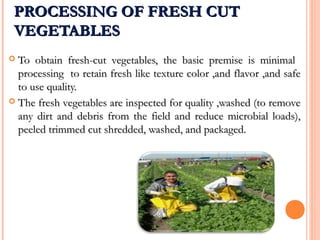
 To obtain fresh-cut vegetables, the basic premise is minimalTo obtain fresh-cut vegetables, the basic premise is minimal
processing to retain fresh like texture color ,and flavor ,and safeprocessing to retain fresh like texture color ,and flavor ,and safe
to use quality.to use quality.
 The fresh vegetables are inspected for quality ,washed (to removeThe fresh vegetables are inspected for quality ,washed (to remove
any dirt and debris from the field and reduce microbial loads),any dirt and debris from the field and reduce microbial loads),
peeled trimmed cut shredded, washed, and packaged.peeled trimmed cut shredded, washed, and packaged.
PROCESSING OF FRESH CUTPROCESSING OF FRESH CUT
VEGETABLESVEGETABLES
WASHINGWASHING
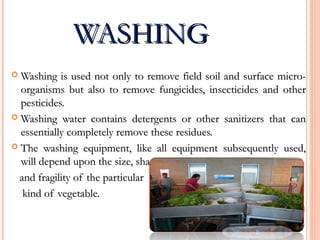
 Washing is used not only to remove field soil and surface micro-Washing is used not only to remove field soil and surface micro-
organisms but also to remove fungicides, insecticides and otherorganisms but also to remove fungicides, insecticides and other
pesticides.pesticides.
 Washing water contains detergents or other sanitizers that canWashing water contains detergents or other sanitizers that can
essentially completely remove these residues.essentially completely remove these residues.
 The washing equipment, like all equipment subsequently used,The washing equipment, like all equipment subsequently used,
will depend upon the size, shapewill depend upon the size, shape
and fragility of the particularand fragility of the particular
kind of vegetable.kind of vegetable.
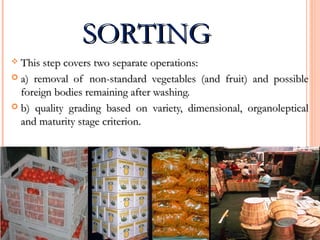
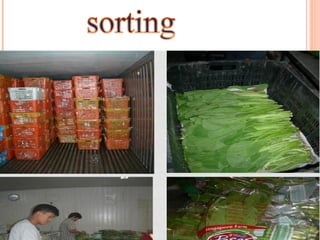
SORTINGSORTING
 This step covers two separate operations:This step covers two separate operations:
 a) removal of non-standard vegetables (and fruit) and possiblea) removal of non-standard vegetables (and fruit) and possible
foreign bodies remaining after washing.foreign bodies remaining after washing.
 b) quality grading based on variety, dimensional, organolepticalb) quality grading based on variety, dimensional, organoleptical
and maturity stage criterion.and maturity stage criterion.
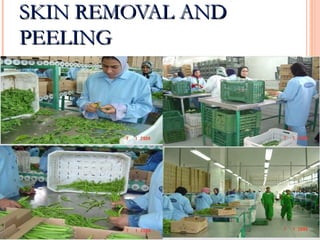
SKIN REMOVAL ANDSKIN REMOVAL AND
PEELINGPEELING
 Some vegetables require skin removal. This can be done inSome vegetables require skin removal. This can be done in
various ways.various ways.
 a) Mechanicala) Mechanical
 i. a machine with abrasion device (potatoes, root vegetables).i. a machine with abrasion device (potatoes, root vegetables).
 ii. equipment with knives ( potatoes, etc.).ii. equipment with knives ( potatoes, etc.).
 iii. equipment with rotating sieve drums (root vegetables).iii. equipment with rotating sieve drums (root vegetables).
SKIN REMOVAL ANDSKIN REMOVAL AND
PEELINGPEELING
CONT..…CONT..…
b) Chemicalb) Chemical
 Skins can be softened from the underlying tissues bySkins can be softened from the underlying tissues by
submerging vegetables in hot alkali solution. Lye may be used atsubmerging vegetables in hot alkali solution. Lye may be used at
a concentration of about 0.5-3%, at about 93° C (2000 F) for aa concentration of about 0.5-3%, at about 93° C (2000 F) for a
short time period (0.5-3min).short time period (0.5-3min).
c) Thermalc) Thermal
 Wet heat (steam). Other vegetables with thick skins such asWet heat (steam). Other vegetables with thick skins such as
beets, potatoes, carrots and sweet potatoes may be peeled withbeets, potatoes, carrots and sweet potatoes may be peeled with
steam under pressure (about 10 at) as they pass throughsteam under pressure (about 10 at) as they pass through
cylindrical vessels.cylindrical vessels.
BLANCHINGBLANCHING
 The special heat treatment to inactivate enzymes is known asThe special heat treatment to inactivate enzymes is known as
blanching.blanching.
 Blanching is not indiscriminate heating.Blanching is not indiscriminate heating.
 Too little is ineffective, and too much damages the vegetables byToo little is ineffective, and too much damages the vegetables by
excessive cooking, especially where the fresh character of theexcessive cooking, especially where the fresh character of the
vegetable is subsequently to be preserved by processing.vegetable is subsequently to be preserved by processing.
 Two of the more heat resistant enzymes important in vegetablesTwo of the more heat resistant enzymes important in vegetables
are catalase and peroxidase.are catalase and peroxidase.
VEGETABLE DRYING ANDVEGETABLE DRYING AND
DEHYDRATIONDEHYDRATION
 Technology for vegetable powder processingTechnology for vegetable powder processing
 This technology has been developed in recent years withThis technology has been developed in recent years with
applications mainly for potatoes (flour, flakes, granulated), carrotsapplications mainly for potatoes (flour, flakes, granulated), carrots
(powder) and red tomatoes (powder). In order to obtain these(powder) and red tomatoes (powder). In order to obtain these
finished products there are two processes:finished products there are two processes:
 a) drying of vegetables down to a final water content below 4%a) drying of vegetables down to a final water content below 4%
followed by grinding, sieving and packing of products.followed by grinding, sieving and packing of products.
 b) vegetables are transformed by boiling and sieving into puréesb) vegetables are transformed by boiling and sieving into purées
which are then dried on heated surfaces (under vacuumwhich are then dried on heated surfaces (under vacuum
preferably) or by spraying in hot air.preferably) or by spraying in hot air.
CONT..….CONT..….
 Dryers with plates under vacuum are equipped with plates
heated with hot water. Stainless steel plates containing the purée
to be dried are placed on them. Process conditions are at low
residual pressure (about 10-20 mm Hg) and a product
temperature of 50-70° C.
 Drum dryers have one or two drums heated with hot water or
steam as heating elements.
 Drying installations by spraying in hot air; the product is
introduced in equipment and sprayed by a special device inhot
air.
 Drying is instantaneous (1/50 s) and therefore can be carried
out at 130-15O° C.
CONT..….CONT..….
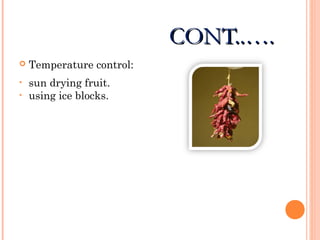
 Temperature control:
• sun drying fruit.
• using ice blocks.
PACKING AND STORAGE OF DRIEDPACKING AND STORAGE OF DRIED
AND POWDERED VEGETABLESAND POWDERED VEGETABLES
 Dried vegetables can suffer significant modifications thatDried vegetables can suffer significant modifications that
bring about their deterioration during storage.bring about their deterioration during storage.
 Technical solutions for maintaining a low dehydratedTechnical solutions for maintaining a low dehydrated
products moisture are:products moisture are:
 a) storage in stores with air relative humidity below 78%;a) storage in stores with air relative humidity below 78%;
 b) use packages that are water vapour proof. The mostb) use packages that are water vapour proof. The most
efficient packages are tin boxes or drums (mainly for longefficient packages are tin boxes or drums (mainly for long
term storage periods).term storage periods).
 The storage temperature should be below 25° C (andThe storage temperature should be below 25° C (and
preferablypreferably
15° C); lower temperatures (0-10° C) help maintain taste, colour15° C); lower temperatures (0-10° C) help maintain taste, colour
and water rehydration ratio and also, to some extent, vitaminand water rehydration ratio and also, to some extent, vitamin
POTATO CRISP AND CHIPPOTATO CRISP AND CHIP
PROCESSINGPROCESSING
 Most important steps involved in potato crisps processing are:Most important steps involved in potato crisps processing are:
1)1) Selecting, procuring and receiving potatoesSelecting, procuring and receiving potatoes
2)2) Storage of potato stock under optimum conditionsStorage of potato stock under optimum conditions
3)3) Peeling and trimming the tubersPeeling and trimming the tubers
4)4) SlicingSlicing
5)5) Frying in oilFrying in oil
6)6) Salting or applying flavored powdersSalting or applying flavored powders
7)7) PackagingPackaging
FREEZING OF VEGETABLESFREEZING OF VEGETABLES
 Freezing is a simple method of preservation that preserveFreezing is a simple method of preservation that preserve
vegetable over long period of time while maintaining manyvegetable over long period of time while maintaining many
of their fresh like qualities .of their fresh like qualities .
 . however . while freezing helps to preserve by retarding. however . while freezing helps to preserve by retarding
enzymatic reaction .enzymatic reaction .
 senescence and microbial growth ,it does not fully stop thesesenescence and microbial growth ,it does not fully stop these
reactions .reactions .
 the result can be the development of off odors off colorsthe result can be the development of off odors off colors
off –flavors ,changes in texture, and nutrient lossoff –flavors ,changes in texture, and nutrient loss
blanching ,which involves mild heating of products for shortblanching ,which involves mild heating of products for short
periods of time, is usually included as a prefreezing stepperiods of time, is usually included as a prefreezing step
VEGETABLE CANNINGVEGETABLE CANNING
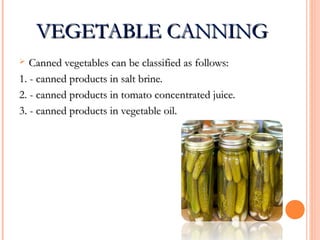
 Canned vegetables can be classified as follows:Canned vegetables can be classified as follows:
1. - canned products in salt brine.1. - canned products in salt brine.
2. - canned products in tomato concentrated juice.2. - canned products in tomato concentrated juice.
3. - canned products in vegetable oil.3. - canned products in vegetable oil.
CANNED VEGETABLES IN SALTCANNED VEGETABLES IN SALT
BRINEBRINE
The technological flow-sheet covers steps that are applied partly orThe technological flow-sheet covers steps that are applied partly or
completely according to orientative technical data for processingcompletely according to orientative technical data for processing
are:are:
1.1. Storage siloStorage silo
2.2. SortingSorting
3.3. WashingWashing
4.4. GradingGrading
5.5. CleaningCleaning
6.6. CuttingCutting
7.7. BlanchingBlanching
8.8. or steamingor steaming
9.9. CoolingCooling
10.10. Receptacle fillingReceptacle filling
CONT..….CONT..….
11)11) PreheatingPreheating
12)12) Hermetic sealingHermetic sealing
13)13) SterilisationSterilisation
14)14) CoolingCooling
15)15) LabellingLabelling
16)16) StorageStorage
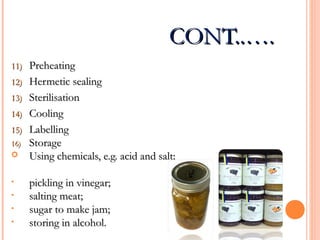
 Using chemicals, e.g. acid and salt:Using chemicals, e.g. acid and salt:
• pickling in vinegar;pickling in vinegar;
• salting meat;salting meat;
• sugar to make jam;sugar to make jam;
• storing in alcohol.storing in alcohol.
CANNED VEGETABLES INCANNED VEGETABLES IN
CONCENTRATED TOMATO JUICECONCENTRATED TOMATO JUICE
 General technological flow-sheet covers two types ofGeneral technological flow-sheet covers two types of
operations:operations:
 a) Preparation of vegetables is similar to the one described fora) Preparation of vegetables is similar to the one described for
canned vegetables in salt brine: sorting, washing, grading,canned vegetables in salt brine: sorting, washing, grading,
cutting, blanching and cooling, the exception is for spicescutting, blanching and cooling, the exception is for spices
which are not blanched.which are not blanched.
 b) Preparation of canned products covering: receptacles fillingb) Preparation of canned products covering: receptacles filling
with vegetables, adding concentrated.with vegetables, adding concentrated.
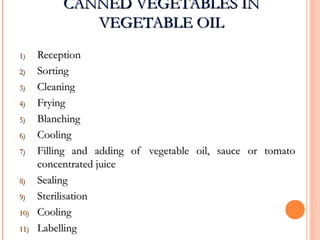
CANNED VEGETABLES INCANNED VEGETABLES IN
VEGETABLE OILVEGETABLE OIL
1)1) ReceptionReception
2)2) SortingSorting
3)3) CleaningCleaning
4)4) FryingFrying
5)5) BlanchingBlanching
6)6) CoolingCooling
7)7) Filling and adding of vegetable oil, sauce or tomatoFilling and adding of vegetable oil, sauce or tomato
concentrated juiceconcentrated juice
8)8) SealingSealing
9)9) SterilisationSterilisation
10)10) CoolingCooling
11)11) LabellingLabelling
Thank youThank you

Vegetable processing

  • 1.
    Vegetable processingVegetable processing PresentedBy : Amirullah mokhles Admission No: A 2015 30 073
  • 2.
    PROCESSING OF FRESHCUTPROCESSING OF FRESH CUT VEGETABLESVEGETABLES  To obtain fresh-cut vegetables, the basic premise is minimalTo obtain fresh-cut vegetables, the basic premise is minimal processing to retain fresh like texture color ,and flavor ,and safeprocessing to retain fresh like texture color ,and flavor ,and safe to use quality.to use quality.  The fresh vegetables are inspected for quality ,washed (to removeThe fresh vegetables are inspected for quality ,washed (to remove any dirt and debris from the field and reduce microbial loads),any dirt and debris from the field and reduce microbial loads), peeled trimmed cut shredded, washed, and packaged.peeled trimmed cut shredded, washed, and packaged.
  • 3.
    PROCESSING OF FRESHCUTPROCESSING OF FRESH CUT VEGETABLESVEGETABLES
  • 4.
    WASHINGWASHING  Washing isused not only to remove field soil and surface micro-Washing is used not only to remove field soil and surface micro- organisms but also to remove fungicides, insecticides and otherorganisms but also to remove fungicides, insecticides and other pesticides.pesticides.  Washing water contains detergents or other sanitizers that canWashing water contains detergents or other sanitizers that can essentially completely remove these residues.essentially completely remove these residues.  The washing equipment, like all equipment subsequently used,The washing equipment, like all equipment subsequently used, will depend upon the size, shapewill depend upon the size, shape and fragility of the particularand fragility of the particular kind of vegetable.kind of vegetable.
  • 5.
    SORTINGSORTING  This stepcovers two separate operations:This step covers two separate operations:  a) removal of non-standard vegetables (and fruit) and possiblea) removal of non-standard vegetables (and fruit) and possible foreign bodies remaining after washing.foreign bodies remaining after washing.  b) quality grading based on variety, dimensional, organolepticalb) quality grading based on variety, dimensional, organoleptical and maturity stage criterion.and maturity stage criterion.
  • 7.
    SKIN REMOVAL ANDSKINREMOVAL AND PEELINGPEELING  Some vegetables require skin removal. This can be done inSome vegetables require skin removal. This can be done in various ways.various ways.  a) Mechanicala) Mechanical  i. a machine with abrasion device (potatoes, root vegetables).i. a machine with abrasion device (potatoes, root vegetables).  ii. equipment with knives ( potatoes, etc.).ii. equipment with knives ( potatoes, etc.).  iii. equipment with rotating sieve drums (root vegetables).iii. equipment with rotating sieve drums (root vegetables).
  • 8.
    SKIN REMOVAL ANDSKINREMOVAL AND PEELINGPEELING
  • 9.
    CONT..…CONT..… b) Chemicalb) Chemical Skins can be softened from the underlying tissues bySkins can be softened from the underlying tissues by submerging vegetables in hot alkali solution. Lye may be used atsubmerging vegetables in hot alkali solution. Lye may be used at a concentration of about 0.5-3%, at about 93° C (2000 F) for aa concentration of about 0.5-3%, at about 93° C (2000 F) for a short time period (0.5-3min).short time period (0.5-3min). c) Thermalc) Thermal  Wet heat (steam). Other vegetables with thick skins such asWet heat (steam). Other vegetables with thick skins such as beets, potatoes, carrots and sweet potatoes may be peeled withbeets, potatoes, carrots and sweet potatoes may be peeled with steam under pressure (about 10 at) as they pass throughsteam under pressure (about 10 at) as they pass through cylindrical vessels.cylindrical vessels.
  • 10.
    BLANCHINGBLANCHING  The specialheat treatment to inactivate enzymes is known asThe special heat treatment to inactivate enzymes is known as blanching.blanching.  Blanching is not indiscriminate heating.Blanching is not indiscriminate heating.  Too little is ineffective, and too much damages the vegetables byToo little is ineffective, and too much damages the vegetables by excessive cooking, especially where the fresh character of theexcessive cooking, especially where the fresh character of the vegetable is subsequently to be preserved by processing.vegetable is subsequently to be preserved by processing.  Two of the more heat resistant enzymes important in vegetablesTwo of the more heat resistant enzymes important in vegetables are catalase and peroxidase.are catalase and peroxidase.
  • 11.
    VEGETABLE DRYING ANDVEGETABLEDRYING AND DEHYDRATIONDEHYDRATION  Technology for vegetable powder processingTechnology for vegetable powder processing  This technology has been developed in recent years withThis technology has been developed in recent years with applications mainly for potatoes (flour, flakes, granulated), carrotsapplications mainly for potatoes (flour, flakes, granulated), carrots (powder) and red tomatoes (powder). In order to obtain these(powder) and red tomatoes (powder). In order to obtain these finished products there are two processes:finished products there are two processes:  a) drying of vegetables down to a final water content below 4%a) drying of vegetables down to a final water content below 4% followed by grinding, sieving and packing of products.followed by grinding, sieving and packing of products.  b) vegetables are transformed by boiling and sieving into puréesb) vegetables are transformed by boiling and sieving into purées which are then dried on heated surfaces (under vacuumwhich are then dried on heated surfaces (under vacuum preferably) or by spraying in hot air.preferably) or by spraying in hot air.
  • 12.
    CONT..….CONT..….  Dryers withplates under vacuum are equipped with plates heated with hot water. Stainless steel plates containing the purée to be dried are placed on them. Process conditions are at low residual pressure (about 10-20 mm Hg) and a product temperature of 50-70° C.  Drum dryers have one or two drums heated with hot water or steam as heating elements.  Drying installations by spraying in hot air; the product is introduced in equipment and sprayed by a special device inhot air.  Drying is instantaneous (1/50 s) and therefore can be carried out at 130-15O° C.
  • 13.
    CONT..….CONT..….  Temperature control: •sun drying fruit. • using ice blocks.
  • 14.
    PACKING AND STORAGEOF DRIEDPACKING AND STORAGE OF DRIED AND POWDERED VEGETABLESAND POWDERED VEGETABLES  Dried vegetables can suffer significant modifications thatDried vegetables can suffer significant modifications that bring about their deterioration during storage.bring about their deterioration during storage.  Technical solutions for maintaining a low dehydratedTechnical solutions for maintaining a low dehydrated products moisture are:products moisture are:  a) storage in stores with air relative humidity below 78%;a) storage in stores with air relative humidity below 78%;  b) use packages that are water vapour proof. The mostb) use packages that are water vapour proof. The most efficient packages are tin boxes or drums (mainly for longefficient packages are tin boxes or drums (mainly for long term storage periods).term storage periods).  The storage temperature should be below 25° C (andThe storage temperature should be below 25° C (and preferablypreferably 15° C); lower temperatures (0-10° C) help maintain taste, colour15° C); lower temperatures (0-10° C) help maintain taste, colour and water rehydration ratio and also, to some extent, vitaminand water rehydration ratio and also, to some extent, vitamin
  • 15.
    POTATO CRISP ANDCHIPPOTATO CRISP AND CHIP PROCESSINGPROCESSING  Most important steps involved in potato crisps processing are:Most important steps involved in potato crisps processing are: 1)1) Selecting, procuring and receiving potatoesSelecting, procuring and receiving potatoes 2)2) Storage of potato stock under optimum conditionsStorage of potato stock under optimum conditions 3)3) Peeling and trimming the tubersPeeling and trimming the tubers 4)4) SlicingSlicing 5)5) Frying in oilFrying in oil 6)6) Salting or applying flavored powdersSalting or applying flavored powders 7)7) PackagingPackaging
  • 16.
    FREEZING OF VEGETABLESFREEZINGOF VEGETABLES  Freezing is a simple method of preservation that preserveFreezing is a simple method of preservation that preserve vegetable over long period of time while maintaining manyvegetable over long period of time while maintaining many of their fresh like qualities .of their fresh like qualities .  . however . while freezing helps to preserve by retarding. however . while freezing helps to preserve by retarding enzymatic reaction .enzymatic reaction .  senescence and microbial growth ,it does not fully stop thesesenescence and microbial growth ,it does not fully stop these reactions .reactions .  the result can be the development of off odors off colorsthe result can be the development of off odors off colors off –flavors ,changes in texture, and nutrient lossoff –flavors ,changes in texture, and nutrient loss blanching ,which involves mild heating of products for shortblanching ,which involves mild heating of products for short periods of time, is usually included as a prefreezing stepperiods of time, is usually included as a prefreezing step
  • 17.
    VEGETABLE CANNINGVEGETABLE CANNING Canned vegetables can be classified as follows:Canned vegetables can be classified as follows: 1. - canned products in salt brine.1. - canned products in salt brine. 2. - canned products in tomato concentrated juice.2. - canned products in tomato concentrated juice. 3. - canned products in vegetable oil.3. - canned products in vegetable oil.
  • 18.
    CANNED VEGETABLES INSALTCANNED VEGETABLES IN SALT BRINEBRINE The technological flow-sheet covers steps that are applied partly orThe technological flow-sheet covers steps that are applied partly or completely according to orientative technical data for processingcompletely according to orientative technical data for processing are:are: 1.1. Storage siloStorage silo 2.2. SortingSorting 3.3. WashingWashing 4.4. GradingGrading 5.5. CleaningCleaning 6.6. CuttingCutting 7.7. BlanchingBlanching 8.8. or steamingor steaming 9.9. CoolingCooling 10.10. Receptacle fillingReceptacle filling
  • 19.
    CONT..….CONT..…. 11)11) PreheatingPreheating 12)12) HermeticsealingHermetic sealing 13)13) SterilisationSterilisation 14)14) CoolingCooling 15)15) LabellingLabelling 16)16) StorageStorage  Using chemicals, e.g. acid and salt:Using chemicals, e.g. acid and salt: • pickling in vinegar;pickling in vinegar; • salting meat;salting meat; • sugar to make jam;sugar to make jam; • storing in alcohol.storing in alcohol.
  • 20.
    CANNED VEGETABLES INCANNEDVEGETABLES IN CONCENTRATED TOMATO JUICECONCENTRATED TOMATO JUICE  General technological flow-sheet covers two types ofGeneral technological flow-sheet covers two types of operations:operations:  a) Preparation of vegetables is similar to the one described fora) Preparation of vegetables is similar to the one described for canned vegetables in salt brine: sorting, washing, grading,canned vegetables in salt brine: sorting, washing, grading, cutting, blanching and cooling, the exception is for spicescutting, blanching and cooling, the exception is for spices which are not blanched.which are not blanched.  b) Preparation of canned products covering: receptacles fillingb) Preparation of canned products covering: receptacles filling with vegetables, adding concentrated.with vegetables, adding concentrated.
  • 21.
    CANNED VEGETABLES INCANNEDVEGETABLES IN VEGETABLE OILVEGETABLE OIL 1)1) ReceptionReception 2)2) SortingSorting 3)3) CleaningCleaning 4)4) FryingFrying 5)5) BlanchingBlanching 6)6) CoolingCooling 7)7) Filling and adding of vegetable oil, sauce or tomatoFilling and adding of vegetable oil, sauce or tomato concentrated juiceconcentrated juice 8)8) SealingSealing 9)9) SterilisationSterilisation 10)10) CoolingCooling 11)11) LabellingLabelling
  • 22.