LEARNING ABOUT NUTRITION  By Dawn Schaeffer
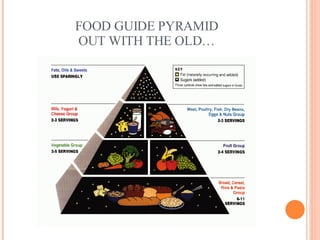
FOOD GUIDE PYRAMID OUT WITH THE OLD…
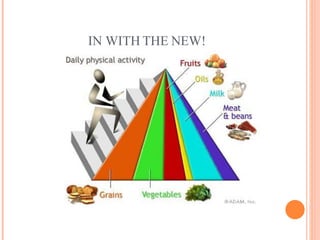
IN WITH THE NEW!
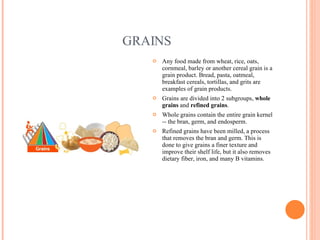
GRAINS Any food made from wheat, rice, oats, cornmeal, barley or another cereal grain is a grain product. Bread, pasta, oatmeal, breakfast cereals, tortillas, and grits are examples of grain products.  Grains are divided into 2 subgroups,  whole grains  and  refined grains .  Whole grains contain the entire grain kernel -- the bran, germ, and endosperm. Refined grains have been milled, a process that removes the bran and germ. This is done to give grains a finer texture and improve their shelf life, but it also removes dietary fiber, iron, and many B vitamins.
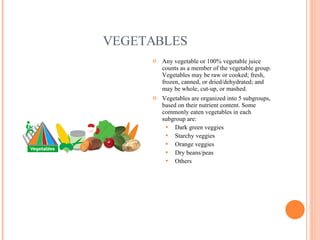
VEGETABLES  Any vegetable or 100% vegetable juice counts as a member of the vegetable group. Vegetables may be raw or cooked; fresh, frozen, canned, or dried/dehydrated; and may be whole, cut-up, or mashed. Vegetables are organized into 5 subgroups, based on their nutrient content. Some commonly eaten vegetables in each subgroup are:  Dark green veggies Starchy veggies  Orange veggies Dry beans/peas Others
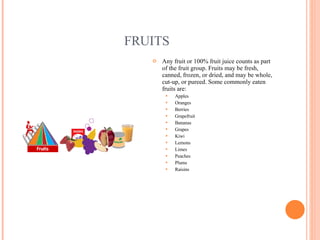
FRUITS Any fruit or 100% fruit juice counts as part of the fruit group. Fruits may be fresh, canned, frozen, or dried, and may be whole, cut-up, or pureed. Some commonly eaten fruits are:  Apples Oranges Berries Grapefruit Bananas Grapes Kiwi Lemons Limes Peaches Plums Raisins
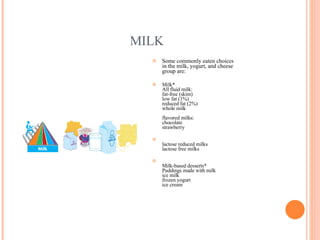
MILK Some commonly eaten choices in the milk, yogurt, and cheese group are:  Milk* All fluid milk: fat-free (skim) low fat (1%) reduced fat (2%) whole milk flavored milks: chocolate strawberry lactose reduced milks lactose free milks Milk-based desserts* Puddings made with milk ice milk frozen yogurt ice cream
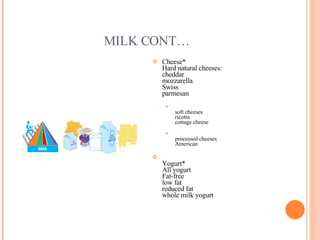
MILK CONT… Cheese* Hard natural cheeses: cheddar mozzarella Swiss parmesan soft cheeses ricotta cottage cheese processed cheeses American Yogurt* All yogurt Fat-free low fat reduced fat whole milk yogurt
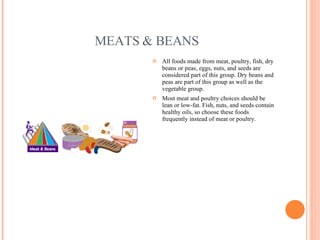
MEATS & BEANS All foods made from meat, poultry, fish, dry beans or peas, eggs, nuts, and seeds are considered part of this group. Dry beans and peas are part of this group as well as the vegetable group. Most meat and poultry choices should be lean or low-fat. Fish, nuts, and seeds contain healthy oils, so choose these foods frequently instead of meat or poultry.
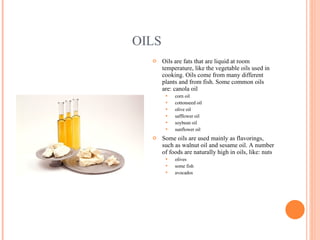
OILS Oils are fats that are liquid at room temperature, like the vegetable oils used in cooking. Oils come from many different plants and from fish. Some common oils are: canola oil  corn oil  cottonseed oil  olive oil  safflower oil  soybean oil  sunflower oil  Some oils are used mainly as flavorings, such as walnut oil and sesame oil. A number of foods are naturally high in oils, like: nuts  olives  some fish  avocados
PHYSICAL ACTIVITY ALONG WITH NUTRITION What is physical activity? Physical activity simply means movement of the body that uses energy. Walking, gardening, briskly pushing a baby stroller, climbing the stairs, playing soccer, or dancing the night away are all good examples of being active. For health benefits, physical activity should be  moderate  or  vigorous  and add up to at least 30 minutes a day. Moderate physical activities include: Walking briskly (about 3 ½ miles per hour)  Hiking  Gardening/yard work  Dancing  Golf (walking and carrying clubs)  Bicycling (less than 10 miles per hour)  Weight training (general light workout)  Vigorous physical activities include: Running/jogging (5 miles per hour)  Bicycling (more than 10 miles per hour)  Swimming (freestyle laps)  Aerobics  Walking very fast (4 ½ miles per hour)  Heavy yard work, such as chopping wood  Weight lifting (vigorous effort)  Basketball (competitive)
PYRAMID VIDEO!
THANK YOU!

Nutrition

  • 1.
    LEARNING ABOUT NUTRITION By Dawn Schaeffer
  • 2.
    FOOD GUIDE PYRAMIDOUT WITH THE OLD…
  • 3.
  • 4.
    GRAINS Any foodmade from wheat, rice, oats, cornmeal, barley or another cereal grain is a grain product. Bread, pasta, oatmeal, breakfast cereals, tortillas, and grits are examples of grain products. Grains are divided into 2 subgroups, whole grains and refined grains . Whole grains contain the entire grain kernel -- the bran, germ, and endosperm. Refined grains have been milled, a process that removes the bran and germ. This is done to give grains a finer texture and improve their shelf life, but it also removes dietary fiber, iron, and many B vitamins.
  • 5.
    VEGETABLES Anyvegetable or 100% vegetable juice counts as a member of the vegetable group. Vegetables may be raw or cooked; fresh, frozen, canned, or dried/dehydrated; and may be whole, cut-up, or mashed. Vegetables are organized into 5 subgroups, based on their nutrient content. Some commonly eaten vegetables in each subgroup are: Dark green veggies Starchy veggies Orange veggies Dry beans/peas Others
  • 6.
    FRUITS Any fruitor 100% fruit juice counts as part of the fruit group. Fruits may be fresh, canned, frozen, or dried, and may be whole, cut-up, or pureed. Some commonly eaten fruits are: Apples Oranges Berries Grapefruit Bananas Grapes Kiwi Lemons Limes Peaches Plums Raisins
  • 7.
    MILK Some commonlyeaten choices in the milk, yogurt, and cheese group are: Milk* All fluid milk: fat-free (skim) low fat (1%) reduced fat (2%) whole milk flavored milks: chocolate strawberry lactose reduced milks lactose free milks Milk-based desserts* Puddings made with milk ice milk frozen yogurt ice cream
  • 8.
    MILK CONT… Cheese*Hard natural cheeses: cheddar mozzarella Swiss parmesan soft cheeses ricotta cottage cheese processed cheeses American Yogurt* All yogurt Fat-free low fat reduced fat whole milk yogurt
  • 9.
    MEATS & BEANSAll foods made from meat, poultry, fish, dry beans or peas, eggs, nuts, and seeds are considered part of this group. Dry beans and peas are part of this group as well as the vegetable group. Most meat and poultry choices should be lean or low-fat. Fish, nuts, and seeds contain healthy oils, so choose these foods frequently instead of meat or poultry.
  • 10.
    OILS Oils arefats that are liquid at room temperature, like the vegetable oils used in cooking. Oils come from many different plants and from fish. Some common oils are: canola oil corn oil cottonseed oil olive oil safflower oil soybean oil sunflower oil Some oils are used mainly as flavorings, such as walnut oil and sesame oil. A number of foods are naturally high in oils, like: nuts olives some fish avocados
  • 11.
    PHYSICAL ACTIVITY ALONGWITH NUTRITION What is physical activity? Physical activity simply means movement of the body that uses energy. Walking, gardening, briskly pushing a baby stroller, climbing the stairs, playing soccer, or dancing the night away are all good examples of being active. For health benefits, physical activity should be moderate or vigorous and add up to at least 30 minutes a day. Moderate physical activities include: Walking briskly (about 3 ½ miles per hour) Hiking Gardening/yard work Dancing Golf (walking and carrying clubs) Bicycling (less than 10 miles per hour) Weight training (general light workout) Vigorous physical activities include: Running/jogging (5 miles per hour) Bicycling (more than 10 miles per hour) Swimming (freestyle laps) Aerobics Walking very fast (4 ½ miles per hour) Heavy yard work, such as chopping wood Weight lifting (vigorous effort) Basketball (competitive)
  • 12.
  • 13.