Fiber Optic Cables | Group 3 
Fiber Optic Cables 
Topics Covered: 
Introduction to Optical Fiber 
Classification of FOC based on modes: 
Single Mode 
Multi Mode 
Linearly Polarized Model 
Fiber Optic Cables | Group 3
Fiber Optic Cables | Group 3 
Optical Fiber Construction 
Fiber Optic Cables | Group 3
Fiber Optic Cables | Group 3 
Optical Fiber Construction 
Fiber Optic Cables | Group 3 
 
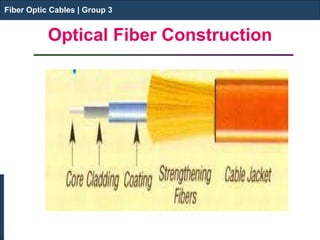
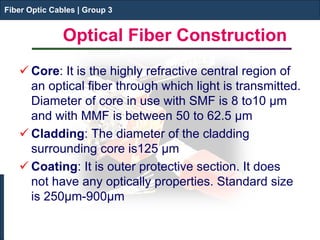
Core: It is the highly refractive central region of an optical fiber through which light is transmitted. Diameter of core in use with SMF is 8 to10 μm and with MMF is between 50 to 62.5 μm 
 
Cladding: The diameter of the cladding surrounding core is125 μm 
 
Coating: It is outer protective section. It does not have any optically properties. Standard size is 250μm-900μm
Fiber Optic Cables | Group 3 
Total Internal Reflection 
 
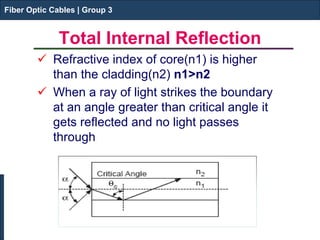
Refractive index of core(n1) is higher than the cladding(n2) n1>n2 
 
When a ray of light strikes the boundary at an angle greater than critical angle it gets reflected and no light passes through 
Fiber Optic Cables | Group 3
Fiber Optic Cables | Group 3 
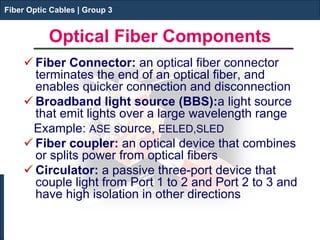
Optical Fiber Components 
 
Fiber Connector: an optical fiber connector terminates the end of an optical fiber, and enables quicker connection and disconnection 
 
Broadband light source (BBS):a light source that emit lights over a large wavelength range 
Example: ASE source, EELED,SLED 
 
Fiber coupler: an optical device that combines or splits power from optical fibers 
 
Circulator: a passive three-port device that couple light from Port 1 to 2 and Port 2 to 3 and have high isolation in other directions 
Fiber Optic Cables | Group 3
Fiber Optic Cables | Group 3 
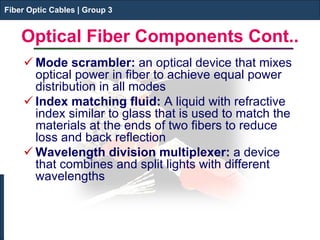
Optical Fiber Components Cont.. 
 
Mode scrambler: an optical device that mixes optical power in fiber to achieve equal power distribution in all modes 
 
Index matching fluid: A liquid with refractive index similar to glass that is used to match the materials at the ends of two fibers to reduce loss and back reflection 
 
Wavelength division multiplexer: a device that combines and split lights with different wavelengths 
Fiber Optic Cables | Group 3
Fiber Optic Cables | Group 3 
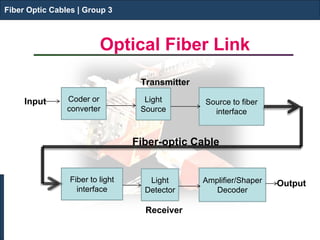
Optical Fiber Link 
Fiber Optic Cables | Group 3 
Transmitter 
Input 
Fiber-optic Cable 
Output 
Receiver 
Coder or 
converter 
Light 
Source 
Source to fiber 
interface 
Amplifier/Shaper 
Decoder 
Fiber to light 
interface 
Light 
Detector
Fiber Optic Cables | Group 3 
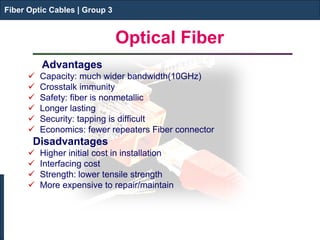
Optical Fiber 
Advantages 
 
Capacity: much wider bandwidth(10GHz) 
 
Crosstalk immunity 
 
Safety: fiber is nonmetallic 
 
Longer lasting 
 
Security: tapping is difficult 
 
Economics: fewer repeaters Fiber connector 
Disadvantages 
 
Higher initial cost in installation 
 
Interfacing cost 
 
Strength: lower tensile strength 
 
More expensive to repair/maintain 
Fiber Optic Cables | Group 3
Fiber Optic Cables | Group 3 
Single Mode Fibers 
 
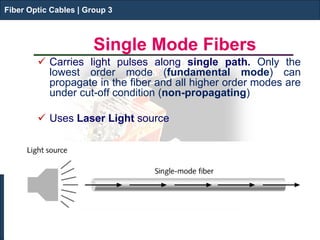
Carries light pulses along single path. Only the lowest order mode (fundamental mode) can propagate in the fiber and all higher order modes are under cut-off condition (non-propagating) 
 
Uses Laser Light source 
Fiber Optic Cables | Group 3
Fiber Optic Cables | Group 3 
Single Mode Fibers 
Fiber Optic Cables | Group 3 
 
Advantages 
 
Less dispersion 
 
Less degradation 
 
Large information capacity 
 
Core diameter is about 10 μm 
 
Difference between the RI of core and cladding is small 
Drawbacks 
Expensive to produce 
Joining two fibers is difficult 
Launching of light into single mode is difficult
Fiber Optic Cables | Group 3 
Propagation Modes of Single Mode Step Index Fibers 
 
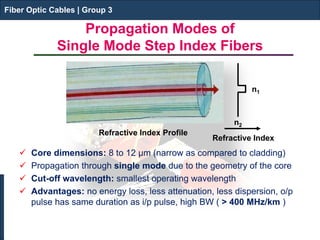
Core dimensions: 8 to 12 μm (narrow as compared to cladding) 
 
Propagation through single mode due to the geometry of the core 
 
Cut-off wavelength: smallest operating wavelength 
 
Advantages: no energy loss, less attenuation, less dispersion, o/p pulse has same duration as i/p pulse, high BW ( > 400 MHz/km ) 
Fiber Optic Cables | Group 3 
Refractive Index 
Refractive Index Profile 
n1 
n2
Fiber Optic Cables | Group 3 
Dispersion Modified Single Mode Fibers 
 
During propagation, light ray is subjected to many losses due to: 
 
splicing 
 
micro-bending 
 
losses in connectors 
 
losses due to fiber misalignment 
 
losses due to NA mismatch 
 
Dispersion during propagation causes broadening leading to Inter Symbol Interference that limits Information Carrying Capacity 
 
In single mode fibers, intramodal dispersion occurs, caused by material and waveguide dispersion 
 
Thus, special Dispersion Modified Single Mode Fibers are used as waveguide dispersion depends upon FOC design 
Fiber Optic Cables | Group 3
Fiber Optic Cables | Group 3 
Matched Clad & Depressed Clad 
Fiber Optic Cables | Group 3 
 
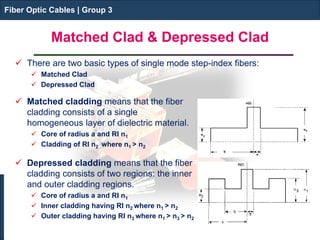
There are two basic types of single mode step-index fibers: 
 
Matched Clad 
 
Depressed Clad 
 
Matched cladding means that the fiber cladding consists of a single homogeneous layer of dielectric material. 
 
Core of radius a and RI n1 
 
Cladding of RI n2 where n1 > n2 
Depressed cladding means that the fiber cladding consists of two regions: the inner and outer cladding regions. 
Core of radius a and RI n1 
Inner cladding having RI n2 where n1 > n2 
Outer cladding having RI n3 where n1 > n3 > n2
Fiber Optic Cables | Group 3 
Dispersion Shifted & Dispersion Flattened Single Mode Fibers 
Dispersion Shifted Fibers 
 
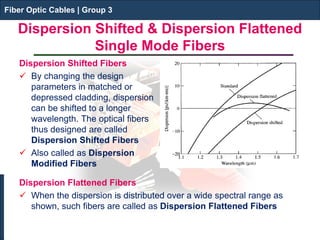
By changing the design parameters in matched or depressed cladding, dispersion can be shifted to a longer wavelength. The optical fibers thus designed are called Dispersion Shifted Fibers 
 
Also called as Dispersion Modified Fibers 
Fiber Optic Cables | Group 3 
Dispersion Flattened Fibers 
 
When the dispersion is distributed over a wide spectral range as shown, such fibers are called as Dispersion Flattened Fibers
Fiber Optic Cables | Group 3 
Multi-mode Optical Fiber 
 
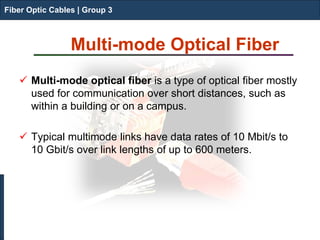
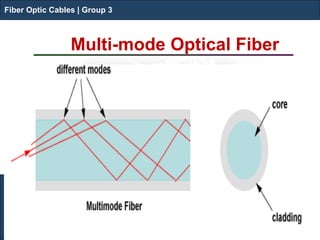
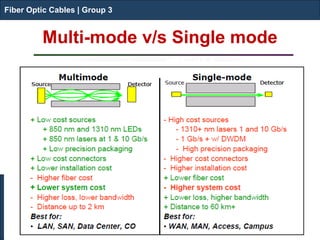
Multi-mode optical fiber is a type of optical fiber mostly used for communication over short distances, such as within a building or on a campus. 
Typical multimode links have data rates of 10 Mbit/s to 10 Gbit/s over link lengths of up to 600 meters. 
Fiber Optic Cables | Group 3
Fiber Optic Cables | Group 3 
About Multi-Mode Fiber 
Fiber Optic Cables | Group 3 
 
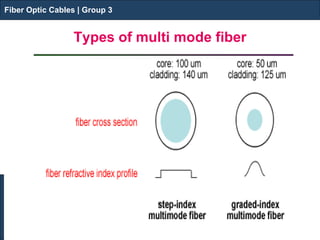
Multi-mode fibers are described by their core and cladding diameters. example: 62.5/125 μm multi-mode fiber. 
 
The two types of multi-mode optical fibers are: 
 
Step index multi-mode optical fibers 
 
Graded index multi-mode optical fibers 
The transition between the core and cladding can be sharp, which is called a step-index profile, or a gradual transition, which is called a graded-index profile.
Fiber Optic Cables | Group 3 
Multi-mode Optical Fiber 
Fiber Optic Cables | Group 3
Fiber Optic Cables | Group 3 
Types of multi mode fiber 
Fiber Optic Cables | Group 3
Fiber Optic Cables | Group 3 
Step Index Fiber 
 
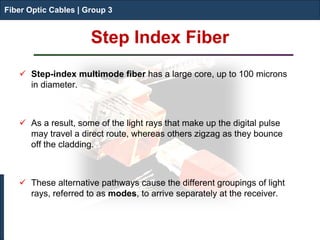
Step-index multimode fiber has a large core, up to 100 microns in diameter. 
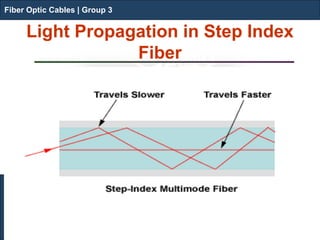
As a result, some of the light rays that make up the digital pulse may travel a direct route, whereas others zigzag as they bounce off the cladding. 
These alternative pathways cause the different groupings of light rays, referred to as modes, to arrive separately at the receiver. 
Fiber Optic Cables | Group 3
Fiber Optic Cables | Group 3 
Step Index Fiber 
Fiber Optic Cables | Group 3 
 
The pulse begins to spread out, thus losing its well-defined shape. 
 
The need to leave spacing between pulses to prevent overlapping limits bandwidth that is, the amount of information that can be sent. 
Consequently, this type of fiber is best suited for transmission over short distances, in an endoscope, for instance.
Fiber Optic Cables | Group 3 
Light Propagation in Step Index Fiber 
Fiber Optic Cables | Group 3
Fiber Optic Cables | Group 3 
Modal Dispersion 
Fiber Optic Cables | Group 3 
 
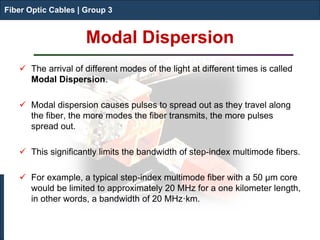
The arrival of different modes of the light at different times is called Modal Dispersion. 
 
Modal dispersion causes pulses to spread out as they travel along the fiber, the more modes the fiber transmits, the more pulses spread out. 
 
This significantly limits the bandwidth of step-index multimode fibers. 
 
For example, a typical step-index multimode fiber with a 50 μm core would be limited to approximately 20 MHz for a one kilometer length, in other words, a bandwidth of 20 MHz·km.
Fiber Optic Cables | Group 3 
Graded-Index Multimode Fibers 
Fiber Optic Cables | Group 3 
 
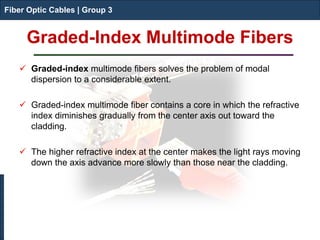
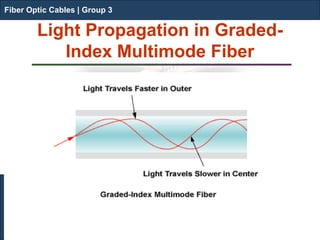
Graded-index multimode fibers solves the problem of modal dispersion to a considerable extent. 
 
Graded-index multimode fiber contains a core in which the refractive index diminishes gradually from the center axis out toward the cladding. 
 
The higher refractive index at the center makes the light rays moving down the axis advance more slowly than those near the cladding.
Fiber Optic Cables | Group 3 
Graded-Index Multimode Fibers 
Fiber Optic Cables | Group 3 
 
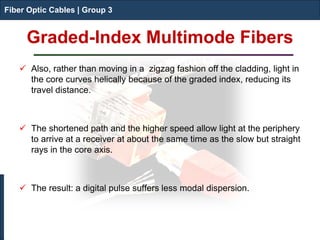
Also, rather than moving in a zigzag fashion off the cladding, light in the core curves helically because of the graded index, reducing its travel distance. 
 
The shortened path and the higher speed allow light at the periphery to arrive at a receiver at about the same time as the slow but straight rays in the core axis. 
 
The result: a digital pulse suffers less modal dispersion.
Fiber Optic Cables | Group 3 
Light Propagation in Graded- Index Multimode Fiber 
Fiber Optic Cables | Group 3
Fiber Optic Cables | Group 3 
Multi-mode v/s Single mode 
Fiber Optic Cables | Group 3
Fiber Optic Cables | Group 3 
Advantages of Multi-mode Fiber 
Fiber Optic Cables | Group 3 
 
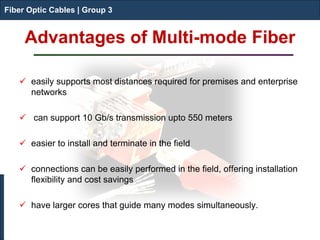
easily supports most distances required for premises and enterprise networks 
 
can support 10 Gb/s transmission upto 550 meters 
easier to install and terminate in the field 
connections can be easily performed in the field, offering installation flexibility and cost savings 
have larger cores that guide many modes simultaneously.
Fiber Optic Cables | Group 3 
Applications 
 
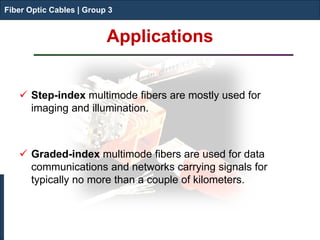
Step-index multimode fibers are mostly used for imaging and illumination. 
Graded-index multimode fibers are used for data communications and networks carrying signals for typically no more than a couple of kilometers. 
Fiber Optic Cables | Group 3
Fiber Optic Cables | Group 3 
Polarization and its types 
The orientation of the electric field vector at a fixed point in space is defined as polarization of a EM wave 
Types of polarization: 
 
Elliptical Polarization 
 
Circular Polarization 
 
Linear Polarization 
Fiber Optic Cables | Group 3
Fiber Optic Cables | Group 3 
Polarization (contd.) 
 
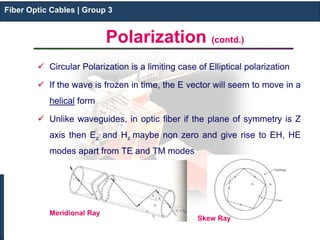
Circular Polarization is a limiting case of Elliptical polarization 
 
If the wave is frozen in time, the E vector will seem to move in a helical form 
 
Unlike waveguides, in optic fiber if the plane of symmetry is Z axis then Ez and Hz maybe non zero and give rise to EH, HE modes apart from TE and TM modes 
Fiber Optic Cables | Group 3 
Meridional Ray 
Skew Ray
Fiber Optic Cables | Group 3 
Linearly Polarized Modes 
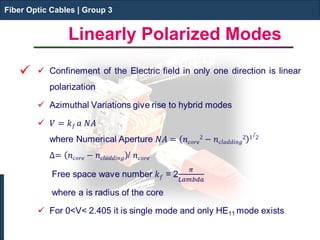
 
Fiber Optic Cables | Group 3
Fiber Optic Cables | Group 3 
Linearly Polarized modes (contd.) 
Fiber Optic Cables | Group 3 
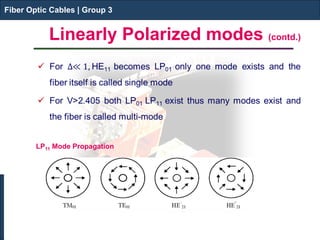
LP11 Mode Propagation
Fiber Optic Cables | Group 3 
Mathematical Derivation 
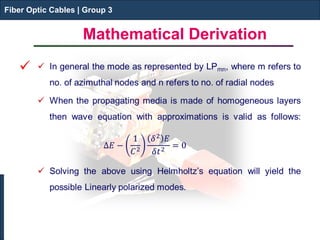
 
Fiber Optic Cables | Group 3
Fiber Optic Cables | Group 3 
 
Fiber Optic Cables | Group 3 
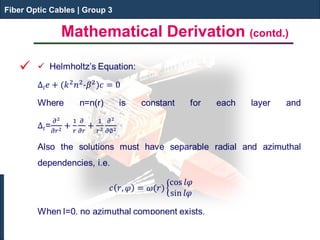
Mathematical Derivation (contd.)
Fiber Optic Cables | Group 3 
Summary 
 
The classification of modes depends on light intensity distribution rather than electric field pattern 
 
LP modes are valid only for n1-n2<<1 i.e. weak guiding approximation 
 
A single LP mode may have various exact modes 
 
Different exact modes can be obtained by assuming different direction of polarization 
 
Lastly, LP modes are important in analyzing the characteristic of optic fiber 
Fiber Optic Cables | Group 3
Fiber Optic Cables | Group 3 
Thank You 
Fiber Optic Cables | Group 3

Optical Fiber Cables :- An Introduction

  • 1.
    Fiber Optic Cables| Group 3 Fiber Optic Cables Topics Covered: Introduction to Optical Fiber Classification of FOC based on modes: Single Mode Multi Mode Linearly Polarized Model Fiber Optic Cables | Group 3
  • 2.
    Fiber Optic Cables| Group 3 Optical Fiber Construction Fiber Optic Cables | Group 3
  • 3.
    Fiber Optic Cables| Group 3 Optical Fiber Construction Fiber Optic Cables | Group 3  Core: It is the highly refractive central region of an optical fiber through which light is transmitted. Diameter of core in use with SMF is 8 to10 μm and with MMF is between 50 to 62.5 μm  Cladding: The diameter of the cladding surrounding core is125 μm  Coating: It is outer protective section. It does not have any optically properties. Standard size is 250μm-900μm
  • 4.
    Fiber Optic Cables| Group 3 Total Internal Reflection  Refractive index of core(n1) is higher than the cladding(n2) n1>n2  When a ray of light strikes the boundary at an angle greater than critical angle it gets reflected and no light passes through Fiber Optic Cables | Group 3
  • 5.
    Fiber Optic Cables| Group 3 Optical Fiber Components  Fiber Connector: an optical fiber connector terminates the end of an optical fiber, and enables quicker connection and disconnection  Broadband light source (BBS):a light source that emit lights over a large wavelength range Example: ASE source, EELED,SLED  Fiber coupler: an optical device that combines or splits power from optical fibers  Circulator: a passive three-port device that couple light from Port 1 to 2 and Port 2 to 3 and have high isolation in other directions Fiber Optic Cables | Group 3
  • 6.
    Fiber Optic Cables| Group 3 Optical Fiber Components Cont..  Mode scrambler: an optical device that mixes optical power in fiber to achieve equal power distribution in all modes  Index matching fluid: A liquid with refractive index similar to glass that is used to match the materials at the ends of two fibers to reduce loss and back reflection  Wavelength division multiplexer: a device that combines and split lights with different wavelengths Fiber Optic Cables | Group 3
  • 7.
    Fiber Optic Cables| Group 3 Optical Fiber Link Fiber Optic Cables | Group 3 Transmitter Input Fiber-optic Cable Output Receiver Coder or converter Light Source Source to fiber interface Amplifier/Shaper Decoder Fiber to light interface Light Detector
  • 8.
    Fiber Optic Cables| Group 3 Optical Fiber Advantages  Capacity: much wider bandwidth(10GHz)  Crosstalk immunity  Safety: fiber is nonmetallic  Longer lasting  Security: tapping is difficult  Economics: fewer repeaters Fiber connector Disadvantages  Higher initial cost in installation  Interfacing cost  Strength: lower tensile strength  More expensive to repair/maintain Fiber Optic Cables | Group 3
  • 9.
    Fiber Optic Cables| Group 3 Single Mode Fibers  Carries light pulses along single path. Only the lowest order mode (fundamental mode) can propagate in the fiber and all higher order modes are under cut-off condition (non-propagating)  Uses Laser Light source Fiber Optic Cables | Group 3
  • 10.
    Fiber Optic Cables| Group 3 Single Mode Fibers Fiber Optic Cables | Group 3  Advantages  Less dispersion  Less degradation  Large information capacity  Core diameter is about 10 μm  Difference between the RI of core and cladding is small Drawbacks Expensive to produce Joining two fibers is difficult Launching of light into single mode is difficult
  • 11.
    Fiber Optic Cables| Group 3 Propagation Modes of Single Mode Step Index Fibers  Core dimensions: 8 to 12 μm (narrow as compared to cladding)  Propagation through single mode due to the geometry of the core  Cut-off wavelength: smallest operating wavelength  Advantages: no energy loss, less attenuation, less dispersion, o/p pulse has same duration as i/p pulse, high BW ( > 400 MHz/km ) Fiber Optic Cables | Group 3 Refractive Index Refractive Index Profile n1 n2
  • 12.
    Fiber Optic Cables| Group 3 Dispersion Modified Single Mode Fibers  During propagation, light ray is subjected to many losses due to:  splicing  micro-bending  losses in connectors  losses due to fiber misalignment  losses due to NA mismatch  Dispersion during propagation causes broadening leading to Inter Symbol Interference that limits Information Carrying Capacity  In single mode fibers, intramodal dispersion occurs, caused by material and waveguide dispersion  Thus, special Dispersion Modified Single Mode Fibers are used as waveguide dispersion depends upon FOC design Fiber Optic Cables | Group 3
  • 13.
    Fiber Optic Cables| Group 3 Matched Clad & Depressed Clad Fiber Optic Cables | Group 3  There are two basic types of single mode step-index fibers:  Matched Clad  Depressed Clad  Matched cladding means that the fiber cladding consists of a single homogeneous layer of dielectric material.  Core of radius a and RI n1  Cladding of RI n2 where n1 > n2 Depressed cladding means that the fiber cladding consists of two regions: the inner and outer cladding regions. Core of radius a and RI n1 Inner cladding having RI n2 where n1 > n2 Outer cladding having RI n3 where n1 > n3 > n2
  • 14.
    Fiber Optic Cables| Group 3 Dispersion Shifted & Dispersion Flattened Single Mode Fibers Dispersion Shifted Fibers  By changing the design parameters in matched or depressed cladding, dispersion can be shifted to a longer wavelength. The optical fibers thus designed are called Dispersion Shifted Fibers  Also called as Dispersion Modified Fibers Fiber Optic Cables | Group 3 Dispersion Flattened Fibers  When the dispersion is distributed over a wide spectral range as shown, such fibers are called as Dispersion Flattened Fibers
  • 15.
    Fiber Optic Cables| Group 3 Multi-mode Optical Fiber  Multi-mode optical fiber is a type of optical fiber mostly used for communication over short distances, such as within a building or on a campus. Typical multimode links have data rates of 10 Mbit/s to 10 Gbit/s over link lengths of up to 600 meters. Fiber Optic Cables | Group 3
  • 16.
    Fiber Optic Cables| Group 3 About Multi-Mode Fiber Fiber Optic Cables | Group 3  Multi-mode fibers are described by their core and cladding diameters. example: 62.5/125 μm multi-mode fiber.  The two types of multi-mode optical fibers are:  Step index multi-mode optical fibers  Graded index multi-mode optical fibers The transition between the core and cladding can be sharp, which is called a step-index profile, or a gradual transition, which is called a graded-index profile.
  • 17.
    Fiber Optic Cables| Group 3 Multi-mode Optical Fiber Fiber Optic Cables | Group 3
  • 18.
    Fiber Optic Cables| Group 3 Types of multi mode fiber Fiber Optic Cables | Group 3
  • 19.
    Fiber Optic Cables| Group 3 Step Index Fiber  Step-index multimode fiber has a large core, up to 100 microns in diameter. As a result, some of the light rays that make up the digital pulse may travel a direct route, whereas others zigzag as they bounce off the cladding. These alternative pathways cause the different groupings of light rays, referred to as modes, to arrive separately at the receiver. Fiber Optic Cables | Group 3
  • 20.
    Fiber Optic Cables| Group 3 Step Index Fiber Fiber Optic Cables | Group 3  The pulse begins to spread out, thus losing its well-defined shape.  The need to leave spacing between pulses to prevent overlapping limits bandwidth that is, the amount of information that can be sent. Consequently, this type of fiber is best suited for transmission over short distances, in an endoscope, for instance.
  • 21.
    Fiber Optic Cables| Group 3 Light Propagation in Step Index Fiber Fiber Optic Cables | Group 3
  • 22.
    Fiber Optic Cables| Group 3 Modal Dispersion Fiber Optic Cables | Group 3  The arrival of different modes of the light at different times is called Modal Dispersion.  Modal dispersion causes pulses to spread out as they travel along the fiber, the more modes the fiber transmits, the more pulses spread out.  This significantly limits the bandwidth of step-index multimode fibers.  For example, a typical step-index multimode fiber with a 50 μm core would be limited to approximately 20 MHz for a one kilometer length, in other words, a bandwidth of 20 MHz·km.
  • 23.
    Fiber Optic Cables| Group 3 Graded-Index Multimode Fibers Fiber Optic Cables | Group 3  Graded-index multimode fibers solves the problem of modal dispersion to a considerable extent.  Graded-index multimode fiber contains a core in which the refractive index diminishes gradually from the center axis out toward the cladding.  The higher refractive index at the center makes the light rays moving down the axis advance more slowly than those near the cladding.
  • 24.
    Fiber Optic Cables| Group 3 Graded-Index Multimode Fibers Fiber Optic Cables | Group 3  Also, rather than moving in a zigzag fashion off the cladding, light in the core curves helically because of the graded index, reducing its travel distance.  The shortened path and the higher speed allow light at the periphery to arrive at a receiver at about the same time as the slow but straight rays in the core axis.  The result: a digital pulse suffers less modal dispersion.
  • 25.
    Fiber Optic Cables| Group 3 Light Propagation in Graded- Index Multimode Fiber Fiber Optic Cables | Group 3
  • 26.
    Fiber Optic Cables| Group 3 Multi-mode v/s Single mode Fiber Optic Cables | Group 3
  • 27.
    Fiber Optic Cables| Group 3 Advantages of Multi-mode Fiber Fiber Optic Cables | Group 3  easily supports most distances required for premises and enterprise networks  can support 10 Gb/s transmission upto 550 meters easier to install and terminate in the field connections can be easily performed in the field, offering installation flexibility and cost savings have larger cores that guide many modes simultaneously.
  • 28.
    Fiber Optic Cables| Group 3 Applications  Step-index multimode fibers are mostly used for imaging and illumination. Graded-index multimode fibers are used for data communications and networks carrying signals for typically no more than a couple of kilometers. Fiber Optic Cables | Group 3
  • 29.
    Fiber Optic Cables| Group 3 Polarization and its types The orientation of the electric field vector at a fixed point in space is defined as polarization of a EM wave Types of polarization:  Elliptical Polarization  Circular Polarization  Linear Polarization Fiber Optic Cables | Group 3
  • 30.
    Fiber Optic Cables| Group 3 Polarization (contd.)  Circular Polarization is a limiting case of Elliptical polarization  If the wave is frozen in time, the E vector will seem to move in a helical form  Unlike waveguides, in optic fiber if the plane of symmetry is Z axis then Ez and Hz maybe non zero and give rise to EH, HE modes apart from TE and TM modes Fiber Optic Cables | Group 3 Meridional Ray Skew Ray
  • 31.
    Fiber Optic Cables| Group 3 Linearly Polarized Modes  Fiber Optic Cables | Group 3
  • 32.
    Fiber Optic Cables| Group 3 Linearly Polarized modes (contd.) Fiber Optic Cables | Group 3 LP11 Mode Propagation
  • 33.
    Fiber Optic Cables| Group 3 Mathematical Derivation  Fiber Optic Cables | Group 3
  • 34.
    Fiber Optic Cables| Group 3  Fiber Optic Cables | Group 3 Mathematical Derivation (contd.)
  • 35.
    Fiber Optic Cables| Group 3 Summary  The classification of modes depends on light intensity distribution rather than electric field pattern  LP modes are valid only for n1-n2<<1 i.e. weak guiding approximation  A single LP mode may have various exact modes  Different exact modes can be obtained by assuming different direction of polarization  Lastly, LP modes are important in analyzing the characteristic of optic fiber Fiber Optic Cables | Group 3
  • 36.
    Fiber Optic Cables| Group 3 Thank You Fiber Optic Cables | Group 3