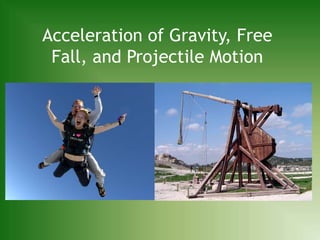
Acceleration of Gravity, Free Fall, and Projectile Motion
Acceleration of GravityThe acceleration of gravity near the earth’s surface is 9.8 m/s2 for ALL objects.This means that objects will accelerate at a rate of 9.8 m/s every second when in free fall.EquationV = g x tGalileo dropped a cannon ball and musket shell and found they landed at the same time
Example ProblemExample Problem: If an object is dropped from a building, how fast will it be going if it falls for 4 seconds?V  =  g x tV  =  (9.8 m/s2)  x  (4 seconds) = 39.2 m/s (which is about 100 mph)
Example #2You want to know how high above the ground you are, so you drop a rock off a tall bridge.Distance = ½gt2You count and see it takes 7.3 seconds to hit the river.
Example #2You want to know how high above the ground you are, so you drop a rock off a tall bridge.Distance = ½gt2You count and see it takes 7.3 seconds to hit the river.Thus d = ½ * (9.8 m/sec2) * (7.3sec)2D = 267 meters or 876 feet tall
Free FallFree FallWhen something falls through the air it is experiencing free fall (meaning it accelerates at a rate of 9.8m/s2).Terminal VelocityThe velocity reached when the force of friction (air resistance) becomes equal to the force of gravity pulling down.Diagram102,000 feet614 mphThe force of air resistance going up equals the force of gravity going downFairF gravityTerminal velocity helps flying squirrels jump from tree to tree
Two primary factors affect Terminal Velocity.Area (how much air is caught under it)Mass (how much air can be pushed out of the way).Heavier objects increase TV while wider objects decrease it.
Terminal Velocities Compared134 mph200 mph20 mph204 mph74 mph20 mph2 mph
Projectile MotionObjects thrown through the air are called projectiles.As an object goes up it slows at a rate of 9.8 m/s2, and as the object comes down it speeds up at a rate of 9.8 m/s2.Projectiles have a vertical dimension and a horizontal dimension to their movement.The horizontal velocity of the object is constant due to no forces acting horizontally.The vertical velocity of the object is changing due to the force of gravity acting on it.
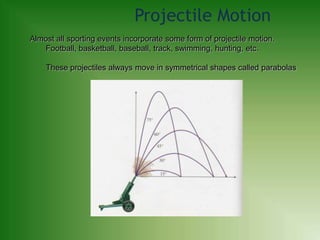
Projectile MotionAlmost all sporting events incorporate some form of projectile motion.Football, basketball, baseball, track, swimming, hunting, etc.These projectiles always move in symmetrical shapes called parabolas
Parabolic Paths
Definitions:MASS:  The amount of matter in an objectWEIGHT:  Depends on the force of gravity on that object.
Formula’sFormulaF = m x a			W = m x gUnitsForce or Weight = Newtons (N)Mass = kgAcceleration or g – m/sec/sec or m/sec2A force is present when an object is accelerating!Weight is a force due to the acceleration of gravity!The force and weight formula’s are very similar because they are both forces due to an acceleration!!!
Comparing the Earth v. the MoonEarth v. MoonMass on earth = mass on the moonThis is because you have the same amount of matter on earth as you do on the moon (assuming that you do not stop to go to the bathroom or to eat while traveling to the moon)Weight on earth is > Weight on the moonThis is due to the earth being more massive and having a greater gravitational pull on you than the moon.Jumping on the moon with a 300 lb space suit. You try that at home!Heavy-g’s while the plane accelerates. G-forces can crush blood vessels and cause blackoutsWith no gravity, there is no weight

Unit 22 - Projectile Motion, Weight, And Mass

  • 1.
    Acceleration of Gravity,Free Fall, and Projectile Motion
  • 2.
    Acceleration of GravityTheacceleration of gravity near the earth’s surface is 9.8 m/s2 for ALL objects.This means that objects will accelerate at a rate of 9.8 m/s every second when in free fall.EquationV = g x tGalileo dropped a cannon ball and musket shell and found they landed at the same time
  • 3.
    Example ProblemExample Problem:If an object is dropped from a building, how fast will it be going if it falls for 4 seconds?V = g x tV = (9.8 m/s2) x (4 seconds) = 39.2 m/s (which is about 100 mph)
  • 4.
    Example #2You wantto know how high above the ground you are, so you drop a rock off a tall bridge.Distance = ½gt2You count and see it takes 7.3 seconds to hit the river.
  • 5.
    Example #2You wantto know how high above the ground you are, so you drop a rock off a tall bridge.Distance = ½gt2You count and see it takes 7.3 seconds to hit the river.Thus d = ½ * (9.8 m/sec2) * (7.3sec)2D = 267 meters or 876 feet tall
  • 6.
    Free FallFree FallWhensomething falls through the air it is experiencing free fall (meaning it accelerates at a rate of 9.8m/s2).Terminal VelocityThe velocity reached when the force of friction (air resistance) becomes equal to the force of gravity pulling down.Diagram102,000 feet614 mphThe force of air resistance going up equals the force of gravity going downFairF gravityTerminal velocity helps flying squirrels jump from tree to tree
  • 7.
    Two primary factorsaffect Terminal Velocity.Area (how much air is caught under it)Mass (how much air can be pushed out of the way).Heavier objects increase TV while wider objects decrease it.
  • 8.
    Terminal Velocities Compared134mph200 mph20 mph204 mph74 mph20 mph2 mph
  • 9.
    Projectile MotionObjects thrownthrough the air are called projectiles.As an object goes up it slows at a rate of 9.8 m/s2, and as the object comes down it speeds up at a rate of 9.8 m/s2.Projectiles have a vertical dimension and a horizontal dimension to their movement.The horizontal velocity of the object is constant due to no forces acting horizontally.The vertical velocity of the object is changing due to the force of gravity acting on it.
  • 10.
    Projectile MotionAlmost allsporting events incorporate some form of projectile motion.Football, basketball, baseball, track, swimming, hunting, etc.These projectiles always move in symmetrical shapes called parabolas
  • 11.
  • 12.
    Definitions:MASS: Theamount of matter in an objectWEIGHT: Depends on the force of gravity on that object.
  • 13.
    Formula’sFormulaF = mx a W = m x gUnitsForce or Weight = Newtons (N)Mass = kgAcceleration or g – m/sec/sec or m/sec2A force is present when an object is accelerating!Weight is a force due to the acceleration of gravity!The force and weight formula’s are very similar because they are both forces due to an acceleration!!!
  • 14.
    Comparing the Earthv. the MoonEarth v. MoonMass on earth = mass on the moonThis is because you have the same amount of matter on earth as you do on the moon (assuming that you do not stop to go to the bathroom or to eat while traveling to the moon)Weight on earth is > Weight on the moonThis is due to the earth being more massive and having a greater gravitational pull on you than the moon.Jumping on the moon with a 300 lb space suit. You try that at home!Heavy-g’s while the plane accelerates. G-forces can crush blood vessels and cause blackoutsWith no gravity, there is no weight