February 17, 2020
Rotational Motion
 Angular Position and Radians
 Angular Velocity
 Angular Acceleration
 Rigid Object under Constant
Angular Acceleration
 Angular and Translational
Quantities
 Rotational Kinetic Energy
 Moments of Inertia
February 17, 2020
Angle and Radian
 What is the circumference S ?
 q can be defined as the arc
length s along a circle divided
by the radius r:
 q is a pure number, but
commonly is given the artificial
unit, radian (“rad”)
r
qs
r
q 
rs )2( 
r
s
2
s
 Whenever using rotational equations, you must use angles
expressed in radians
February 17, 2020
Conversions
 Comparing degrees and radians
 Converting from degrees to radians
 Converting from radians to degrees

180)( rad
360
1 57.3
2
rad


  
   
180
rad degrees

q q


360)(2 rad
)(
180
)(deg radrees q

q


February 17, 2020
Rigid Object
 A rigid object is one that is nondeformable
 The relative locations of all particles making
up the object remain constant
 All real objects are deformable to some
extent, but the rigid object model is very
useful in many situations where the
deformation is negligible
 This simplification allows analysis of the
motion of an extended object
February 17, 2020
Recall: 1-Dimensional Position x
 What is motion? Change of position over time.
 How can we represent position along a straight line?
 Position definition:
 Defines a starting point: origin (x = 0), x relative to origin
 Direction: positive (right or up), negative (left or down)
 It depends on time: t = 0 (start clock), x(t=0) does not have
to be zero.
 Position has units of [Length]: meters.
x = + 2.5 m
x = - 3 m
February 17, 2020
Angular Position
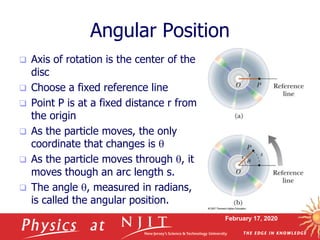
 Axis of rotation is the center of the
disc
 Choose a fixed reference line
 Point P is at a fixed distance r from
the origin
 As the particle moves, the only
coordinate that changes is q
 As the particle moves through q, it
moves though an arc length s.
 The angle q, measured in radians,
is called the angular position.
February 17, 2020
Recall: Displacement
 Displacement is a change of position in time.
 Displacement:
 f stands for final and i stands for initial.
 It is a vector quantity.
 It has both magnitude and direction: + or - sign
 It has units of [length]: meters.
)()( iiff txtxx 
x1 (t1) = + 2.5 m
x2 (t2) = - 2.0 m
Δx = -2.0 m - 2.5 m = -4.5 m
x1 (t1) = - 3.0 m
x2 (t2) = + 1.0 m
Δx = +1.0 m + 3.0 m = +4.0 m
February 17, 2020
Angular Displacement
 The angular displacement
is defined as the angle
the object rotates
through during some time
interval
 SI unit: radian (rad)
 This is the angle that the
reference line of length r
sweeps out
f iq q q  
February 17, 2020
Recall: Velocity
 Velocity is the rate of change of position.
 Velocity is a vector quantity.
 Velocity has both magnitude and direction.
 Velocity has a unit of [length/time]: meter/second.
 Definition:
 Average velocity
 Average speed
 Instantaneous
velocity
avg
total distance
s
t


0
lim
t
x dx
v
t dt 

 

t
xx
t
x
v
if
avg






February 17, 2020
Average and Instantaneous
Angular Speed
 The average angular speed, ωavg, of a rotating rigid
object is the ratio of the angular displacement to the
time interval
 The instantaneous angular speed is defined as the limit
of the average speed as the time interval approaches
zero
 SI unit: radian per second (rad/s)
 Angular speed positive if rotating in counterclockwise
 Angular speed will be negative if rotating in clockwise
f i
avg
f it t t
q q q

 
 
 
lim
0t
d
t dt
q q
  

 

February 17, 2020
Recall: Average Acceleration
 Changing velocity (non-uniform) means an
acceleration is present.
 Acceleration is the rate of change of velocity.
 Acceleration is a vector quantity.
 Acceleration has both magnitude and direction.
 Acceleration has a unit of [length/time2]: m/s2.
 Definition:
 Average acceleration
 Instantaneous acceleration
if
if
avg
tt
vv
t
v
a






2
2
0
lim dt
vd
dt
dx
dt
d
dt
dv
t
v
a
t





February 17, 2020
Average Angular Acceleration
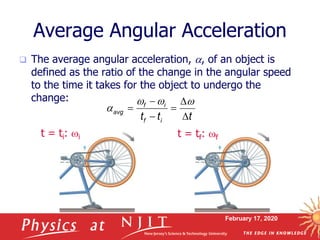
 The average angular acceleration, a, of an object is
defined as the ratio of the change in the angular speed
to the time it takes for the object to undergo the
change:
f i
avg
f it t t
  
a
 
 
 
t = ti: i t = tf: f
February 17, 2020
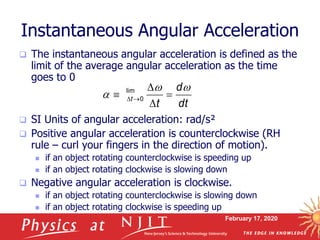
Instantaneous Angular Acceleration
 The instantaneous angular acceleration is defined as the
limit of the average angular acceleration as the time
goes to 0
 SI Units of angular acceleration: rad/s²
 Positive angular acceleration is counterclockwise (RH
rule – curl your fingers in the direction of motion).
 if an object rotating counterclockwise is speeding up
 if an object rotating clockwise is slowing down
 Negative angular acceleration is clockwise.
 if an object rotating counterclockwise is slowing down
 if an object rotating clockwise is speeding up
lim
0t
d
t dt
 
a  

 

February 17, 2020
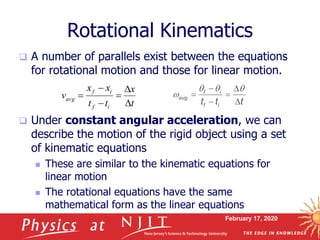
Rotational Kinematics
 A number of parallels exist between the equations
for rotational motion and those for linear motion.
 Under constant angular acceleration, we can
describe the motion of the rigid object using a set
of kinematic equations
 These are similar to the kinematic equations for
linear motion
 The rotational equations have the same
mathematical form as the linear equations
t
x
tt
xx
v
if
if
avg





 f i
avg
f it t t
q q q

 
 
 
Analogy with Linear Kinematics
 Start with angular acceleration:
 Integrate once:
 Integrate again:
 Just substitute symbols, and all of the old
equations apply:
February 17, 2020
d
dt

a 
f idt t a  a  
  21
2f i i it dt t tq  a q  a    
21
2f i ix x vt at  
f iv v at 
x
v
a
q

a



February 17, 2020
Comparison Between Rotational
and Linear Equations
February 17, 2020
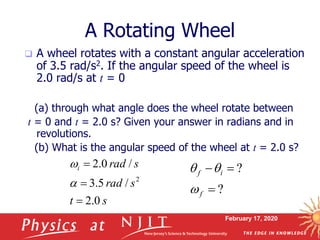
A Rotating Wheel
st
srad
sradi
0.2
/5.3
/0.2
2



a

 A wheel rotates with a constant angular acceleration
of 3.5 rad/s2. If the angular speed of the wheel is
2.0 rad/s at t = 0
(a) through what angle does the wheel rotate between
t = 0 and t = 2.0 s? Given your answer in radians and in
revolutions.
(b) What is the angular speed of the wheel at t = 2.0 s?
?
?


f
if

qq
February 17, 2020
Hints for Problem-Solving
 Similar to the techniques used in linear motion
problems
 With constant angular acceleration, the techniques
are much like those with constant linear acceleration
 There are some differences to keep in mind
 For rotational motion, define a rotational axis
 The choice is arbitrary
 Once you make the choice, it must be maintained
 In some problems, the physical situation may suggest a
natural axis
 The object keeps returning to its original orientation,
so you can find the number of revolutions made by
the body
February 17, 2020
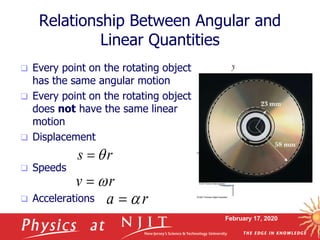
Relationship Between Angular and
Linear Quantities
 Every point on the rotating object
has the same angular motion
 Every point on the rotating object
does not have the same linear
motion
 Displacement
 Speeds
 Accelerations
s rq
v r
a ra
February 17, 2020
Speed Comparison
 The linear velocity is always
tangent to the circular path
 Called the tangential velocity
 The magnitude is defined by
the tangential speed
t
s
rtr
s
t 






 1q
r
s
q
 rvor
r
v

February 17, 2020
Acceleration Comparison
 The tangential
acceleration is the
derivative of the
tangential velocity
a

r
t
r
t
v






 rv
arat 
February 17, 2020
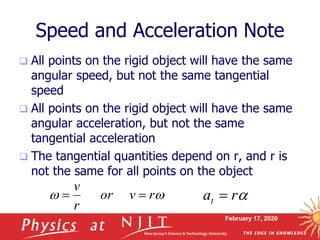
Speed and Acceleration Note
 All points on the rigid object will have the same
angular speed, but not the same tangential
speed
 All points on the rigid object will have the same
angular acceleration, but not the same
tangential acceleration
 The tangential quantities depend on r, and r is
not the same for all points on the object
 rvor
r
v
 arat 
February 17, 2020
Centripetal Acceleration
 An object traveling in a circle,
even though it moves with a
constant speed, will have an
acceleration
 Therefore, each point on a
rotating rigid object will
experience a centripetal
acceleration
2
22
)(


r
r
r
r
v
ar 
February 17, 2020
Resultant Acceleration
 The tangential component of
the acceleration is due to
changing speed
 The centripetal component of
the acceleration is due to
changing direction
 Total acceleration can be
found from these components
2 2 2 2 2 4 2 4
t ra a a r r ra  a      
February 17, 2020
Rotational Kinetic Energy
 An object rotating about z axis with
an angular speed, ω, has rotational
kinetic energy
 Each particle has a kinetic energy of
Ki = ½ mivi
2
 Since the tangential velocity
depends on the distance, r, from
the axis of rotation, we can
substitute
vi = ri => Ki = ½ mi2ri
2
February 17, 2020
Rotational Kinetic Energy, cont’d
 The total rotational kinetic energy of the rigid
object is the sum of the energies of all its
particles
 Where I is called the moment of inertia
2 2
2 2 2
1
2
1 1
2 2
R i i i
i i
R i i
i
K K m r
K m r I

 
 
 
  
 
 

February 17, 2020
Rotational Kinetic Energy, cont’d
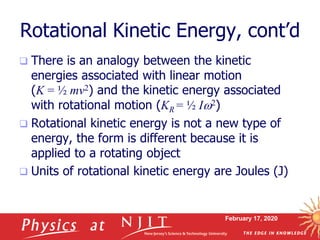
 There is an analogy between the kinetic
energies associated with linear motion
(K = ½ mv2) and the kinetic energy associated
with rotational motion (KR = ½ I2)
 Rotational kinetic energy is not a new type of
energy, the form is different because it is
applied to a rotating object
 Units of rotational kinetic energy are Joules (J)
February 17, 2020
Moment of Inertia of Point Mass
 For a single particle, the definition of moment
of inertia is
 m is the mass of the single particle
 r is the rotational radius
 SI units of moment of inertia are kg.m2
 Moment of inertia and mass of an object are
different quantities
 It depends on both the quantity of matter and
its distribution (through the r2 term)
2
mrI 
February 17, 2020
Moment of Inertia of Point Mass
 For a composite particle, the definition of moment of
inertia is
 mi is the mass of the ith single particle
 ri is the rotational radius of ith particle
 SI units of moment of inertia are kg.m2
 Consider an unusual baton made up of four sphere
fastened to the ends of very light rods
 Find I about an axis perpendicular to the page and
passing through the point O where the rods cross
...
2
44
2
33
2
22
2
11
2
 rmrmrmrmrmI ii
2222222
22 mbMaMambMambrmI ii 
February 17, 2020
The Baton Twirler
 Consider an unusual baton made
up of four sphere fastened to the
ends of very light rods. Each rod is
1.0m long (a = b = 1.0 m). M = 0.3
kg and m = 0.2 kg.
 (a) Find I about an axis
perpendicular to the page and
passing through the point where
the rods cross. Find KR if angular
speed is 
 (b) The majorette tries spinning
her strange baton about the axis y,
calculate I of the baton about this
axis and KR if angular speed is 
February 17, 2020
Moment of Inertia of Extended Objects
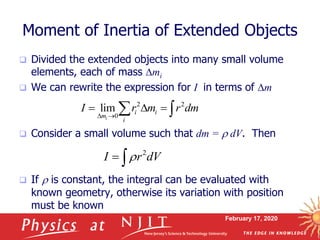
 Divided the extended objects into many small volume
elements, each of mass mi
 We can rewrite the expression for I in terms of m
 Consider a small volume such that dm = r dV. Then
 If r is constant, the integral can be evaluated with
known geometry, otherwise its variation with position
must be known
2 2
0
lim
i
i i
m
i
I r m r dm
 
   
2
I r dVr 
Densities
 You know the density (volume density) as
mass/unit volume
 r = M/V = dm/dV => dm = rdV
 We can define other densities such as surface
density (mass/unit area)
 s = M/A = dm/dA => dm = sdV
 Or linear density (mass/unit length)
 l = M/L = dm/dx => dm = ldV
February 17, 2020
February 17, 2020
Moment of Inertia
of a Uniform Rigid Rod
 The shaded area has
a mass
 dm = l dx
 Then the moment of
inertia is
/2
2 2
/2
21
12
L
y L
M
I r dm x dx
L
I ML

 

 
February 17, 2020
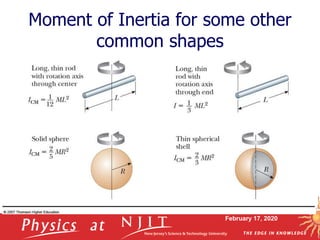
Moment of Inertia for some other
common shapes
February 17, 2020
February 17, 2020
Parallel-Axis Theorem
 In the previous examples, the axis of
rotation coincides with the axis of
symmetry of the object
 For an arbitrary axis, the parallel-axis
theorem often simplifies calculations
 The theorem states
I = ICM + MD 2
 I is about any axis parallel to the axis through
the center of mass of the object
 ICM is about the axis through the center of
mass
 D is the distance from the center of mass axis
to the arbitrary axis
D
February 17, 2020
Moment of Inertia
of a Uniform Rigid Rod
 The moment of inertia
about y is
 The moment of inertia
about y’ is
/2
2 2
/2
21
12
L
y L
M
I r dm x dx
L
I ML

 

 
2222
'
3
1
)
2
(
12
1
ML
L
MMLMDII CMy 

3.5) 12 rotational-motion-ii

  • 1.
    February 17, 2020 RotationalMotion  Angular Position and Radians  Angular Velocity  Angular Acceleration  Rigid Object under Constant Angular Acceleration  Angular and Translational Quantities  Rotational Kinetic Energy  Moments of Inertia
  • 2.
    February 17, 2020 Angleand Radian  What is the circumference S ?  q can be defined as the arc length s along a circle divided by the radius r:  q is a pure number, but commonly is given the artificial unit, radian (“rad”) r qs r q  rs )2(  r s 2 s  Whenever using rotational equations, you must use angles expressed in radians
  • 3.
    February 17, 2020 Conversions Comparing degrees and radians  Converting from degrees to radians  Converting from radians to degrees  180)( rad 360 1 57.3 2 rad          180 rad degrees  q q   360)(2 rad )( 180 )(deg radrees q  q  
  • 4.
    February 17, 2020 RigidObject  A rigid object is one that is nondeformable  The relative locations of all particles making up the object remain constant  All real objects are deformable to some extent, but the rigid object model is very useful in many situations where the deformation is negligible  This simplification allows analysis of the motion of an extended object
  • 5.
    February 17, 2020 Recall:1-Dimensional Position x  What is motion? Change of position over time.  How can we represent position along a straight line?  Position definition:  Defines a starting point: origin (x = 0), x relative to origin  Direction: positive (right or up), negative (left or down)  It depends on time: t = 0 (start clock), x(t=0) does not have to be zero.  Position has units of [Length]: meters. x = + 2.5 m x = - 3 m
  • 6.
    February 17, 2020 AngularPosition  Axis of rotation is the center of the disc  Choose a fixed reference line  Point P is at a fixed distance r from the origin  As the particle moves, the only coordinate that changes is q  As the particle moves through q, it moves though an arc length s.  The angle q, measured in radians, is called the angular position.
  • 7.
    February 17, 2020 Recall:Displacement  Displacement is a change of position in time.  Displacement:  f stands for final and i stands for initial.  It is a vector quantity.  It has both magnitude and direction: + or - sign  It has units of [length]: meters. )()( iiff txtxx  x1 (t1) = + 2.5 m x2 (t2) = - 2.0 m Δx = -2.0 m - 2.5 m = -4.5 m x1 (t1) = - 3.0 m x2 (t2) = + 1.0 m Δx = +1.0 m + 3.0 m = +4.0 m
  • 8.
    February 17, 2020 AngularDisplacement  The angular displacement is defined as the angle the object rotates through during some time interval  SI unit: radian (rad)  This is the angle that the reference line of length r sweeps out f iq q q  
  • 9.
    February 17, 2020 Recall:Velocity  Velocity is the rate of change of position.  Velocity is a vector quantity.  Velocity has both magnitude and direction.  Velocity has a unit of [length/time]: meter/second.  Definition:  Average velocity  Average speed  Instantaneous velocity avg total distance s t   0 lim t x dx v t dt      t xx t x v if avg      
  • 10.
    February 17, 2020 Averageand Instantaneous Angular Speed  The average angular speed, ωavg, of a rotating rigid object is the ratio of the angular displacement to the time interval  The instantaneous angular speed is defined as the limit of the average speed as the time interval approaches zero  SI unit: radian per second (rad/s)  Angular speed positive if rotating in counterclockwise  Angular speed will be negative if rotating in clockwise f i avg f it t t q q q        lim 0t d t dt q q       
  • 11.
    February 17, 2020 Recall:Average Acceleration  Changing velocity (non-uniform) means an acceleration is present.  Acceleration is the rate of change of velocity.  Acceleration is a vector quantity.  Acceleration has both magnitude and direction.  Acceleration has a unit of [length/time2]: m/s2.  Definition:  Average acceleration  Instantaneous acceleration if if avg tt vv t v a       2 2 0 lim dt vd dt dx dt d dt dv t v a t     
  • 12.
    February 17, 2020 AverageAngular Acceleration  The average angular acceleration, a, of an object is defined as the ratio of the change in the angular speed to the time it takes for the object to undergo the change: f i avg f it t t    a       t = ti: i t = tf: f
  • 13.
    February 17, 2020 InstantaneousAngular Acceleration  The instantaneous angular acceleration is defined as the limit of the average angular acceleration as the time goes to 0  SI Units of angular acceleration: rad/s²  Positive angular acceleration is counterclockwise (RH rule – curl your fingers in the direction of motion).  if an object rotating counterclockwise is speeding up  if an object rotating clockwise is slowing down  Negative angular acceleration is clockwise.  if an object rotating counterclockwise is slowing down  if an object rotating clockwise is speeding up lim 0t d t dt   a      
  • 14.
    February 17, 2020 RotationalKinematics  A number of parallels exist between the equations for rotational motion and those for linear motion.  Under constant angular acceleration, we can describe the motion of the rigid object using a set of kinematic equations  These are similar to the kinematic equations for linear motion  The rotational equations have the same mathematical form as the linear equations t x tt xx v if if avg       f i avg f it t t q q q       
  • 15.
    Analogy with LinearKinematics  Start with angular acceleration:  Integrate once:  Integrate again:  Just substitute symbols, and all of the old equations apply: February 17, 2020 d dt  a  f idt t a  a     21 2f i i it dt t tq  a q  a     21 2f i ix x vt at   f iv v at  x v a q  a   
  • 16.
    February 17, 2020 ComparisonBetween Rotational and Linear Equations
  • 17.
    February 17, 2020 ARotating Wheel st srad sradi 0.2 /5.3 /0.2 2    a   A wheel rotates with a constant angular acceleration of 3.5 rad/s2. If the angular speed of the wheel is 2.0 rad/s at t = 0 (a) through what angle does the wheel rotate between t = 0 and t = 2.0 s? Given your answer in radians and in revolutions. (b) What is the angular speed of the wheel at t = 2.0 s? ? ?   f if  qq
  • 18.
    February 17, 2020 Hintsfor Problem-Solving  Similar to the techniques used in linear motion problems  With constant angular acceleration, the techniques are much like those with constant linear acceleration  There are some differences to keep in mind  For rotational motion, define a rotational axis  The choice is arbitrary  Once you make the choice, it must be maintained  In some problems, the physical situation may suggest a natural axis  The object keeps returning to its original orientation, so you can find the number of revolutions made by the body
  • 19.
    February 17, 2020 RelationshipBetween Angular and Linear Quantities  Every point on the rotating object has the same angular motion  Every point on the rotating object does not have the same linear motion  Displacement  Speeds  Accelerations s rq v r a ra
  • 20.
    February 17, 2020 SpeedComparison  The linear velocity is always tangent to the circular path  Called the tangential velocity  The magnitude is defined by the tangential speed t s rtr s t         1q r s q  rvor r v 
  • 21.
    February 17, 2020 AccelerationComparison  The tangential acceleration is the derivative of the tangential velocity a  r t r t v        rv arat 
  • 22.
    February 17, 2020 Speedand Acceleration Note  All points on the rigid object will have the same angular speed, but not the same tangential speed  All points on the rigid object will have the same angular acceleration, but not the same tangential acceleration  The tangential quantities depend on r, and r is not the same for all points on the object  rvor r v  arat 
  • 23.
    February 17, 2020 CentripetalAcceleration  An object traveling in a circle, even though it moves with a constant speed, will have an acceleration  Therefore, each point on a rotating rigid object will experience a centripetal acceleration 2 22 )(   r r r r v ar 
  • 24.
    February 17, 2020 ResultantAcceleration  The tangential component of the acceleration is due to changing speed  The centripetal component of the acceleration is due to changing direction  Total acceleration can be found from these components 2 2 2 2 2 4 2 4 t ra a a r r ra  a      
  • 25.
    February 17, 2020 RotationalKinetic Energy  An object rotating about z axis with an angular speed, ω, has rotational kinetic energy  Each particle has a kinetic energy of Ki = ½ mivi 2  Since the tangential velocity depends on the distance, r, from the axis of rotation, we can substitute vi = ri => Ki = ½ mi2ri 2
  • 26.
    February 17, 2020 RotationalKinetic Energy, cont’d  The total rotational kinetic energy of the rigid object is the sum of the energies of all its particles  Where I is called the moment of inertia 2 2 2 2 2 1 2 1 1 2 2 R i i i i i R i i i K K m r K m r I               
  • 27.
    February 17, 2020 RotationalKinetic Energy, cont’d  There is an analogy between the kinetic energies associated with linear motion (K = ½ mv2) and the kinetic energy associated with rotational motion (KR = ½ I2)  Rotational kinetic energy is not a new type of energy, the form is different because it is applied to a rotating object  Units of rotational kinetic energy are Joules (J)
  • 28.
    February 17, 2020 Momentof Inertia of Point Mass  For a single particle, the definition of moment of inertia is  m is the mass of the single particle  r is the rotational radius  SI units of moment of inertia are kg.m2  Moment of inertia and mass of an object are different quantities  It depends on both the quantity of matter and its distribution (through the r2 term) 2 mrI 
  • 29.
    February 17, 2020 Momentof Inertia of Point Mass  For a composite particle, the definition of moment of inertia is  mi is the mass of the ith single particle  ri is the rotational radius of ith particle  SI units of moment of inertia are kg.m2  Consider an unusual baton made up of four sphere fastened to the ends of very light rods  Find I about an axis perpendicular to the page and passing through the point O where the rods cross ... 2 44 2 33 2 22 2 11 2  rmrmrmrmrmI ii 2222222 22 mbMaMambMambrmI ii 
  • 30.
    February 17, 2020 TheBaton Twirler  Consider an unusual baton made up of four sphere fastened to the ends of very light rods. Each rod is 1.0m long (a = b = 1.0 m). M = 0.3 kg and m = 0.2 kg.  (a) Find I about an axis perpendicular to the page and passing through the point where the rods cross. Find KR if angular speed is   (b) The majorette tries spinning her strange baton about the axis y, calculate I of the baton about this axis and KR if angular speed is 
  • 31.
    February 17, 2020 Momentof Inertia of Extended Objects  Divided the extended objects into many small volume elements, each of mass mi  We can rewrite the expression for I in terms of m  Consider a small volume such that dm = r dV. Then  If r is constant, the integral can be evaluated with known geometry, otherwise its variation with position must be known 2 2 0 lim i i i m i I r m r dm       2 I r dVr 
  • 32.
    Densities  You knowthe density (volume density) as mass/unit volume  r = M/V = dm/dV => dm = rdV  We can define other densities such as surface density (mass/unit area)  s = M/A = dm/dA => dm = sdV  Or linear density (mass/unit length)  l = M/L = dm/dx => dm = ldV February 17, 2020
  • 33.
    February 17, 2020 Momentof Inertia of a Uniform Rigid Rod  The shaded area has a mass  dm = l dx  Then the moment of inertia is /2 2 2 /2 21 12 L y L M I r dm x dx L I ML      
  • 34.
    February 17, 2020 Momentof Inertia for some other common shapes
  • 35.
  • 36.
    February 17, 2020 Parallel-AxisTheorem  In the previous examples, the axis of rotation coincides with the axis of symmetry of the object  For an arbitrary axis, the parallel-axis theorem often simplifies calculations  The theorem states I = ICM + MD 2  I is about any axis parallel to the axis through the center of mass of the object  ICM is about the axis through the center of mass  D is the distance from the center of mass axis to the arbitrary axis D
  • 37.
    February 17, 2020 Momentof Inertia of a Uniform Rigid Rod  The moment of inertia about y is  The moment of inertia about y’ is /2 2 2 /2 21 12 L y L M I r dm x dx L I ML       2222 ' 3 1 ) 2 ( 12 1 ML L MMLMDII CMy 