Uniform Circular Motion By  Yatendra Kumar
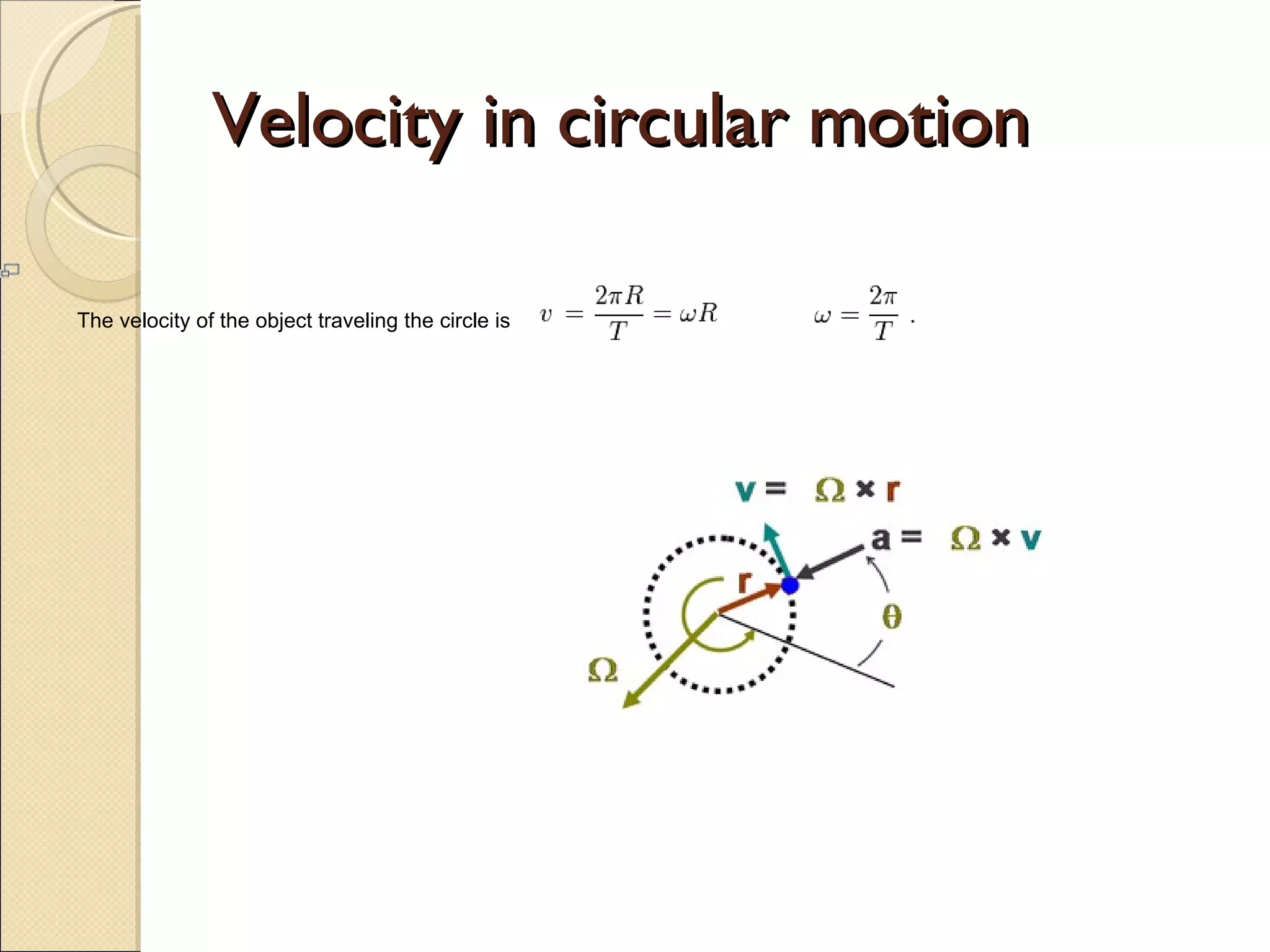
Velocity in circular motion The velocity of the object traveling the circle is
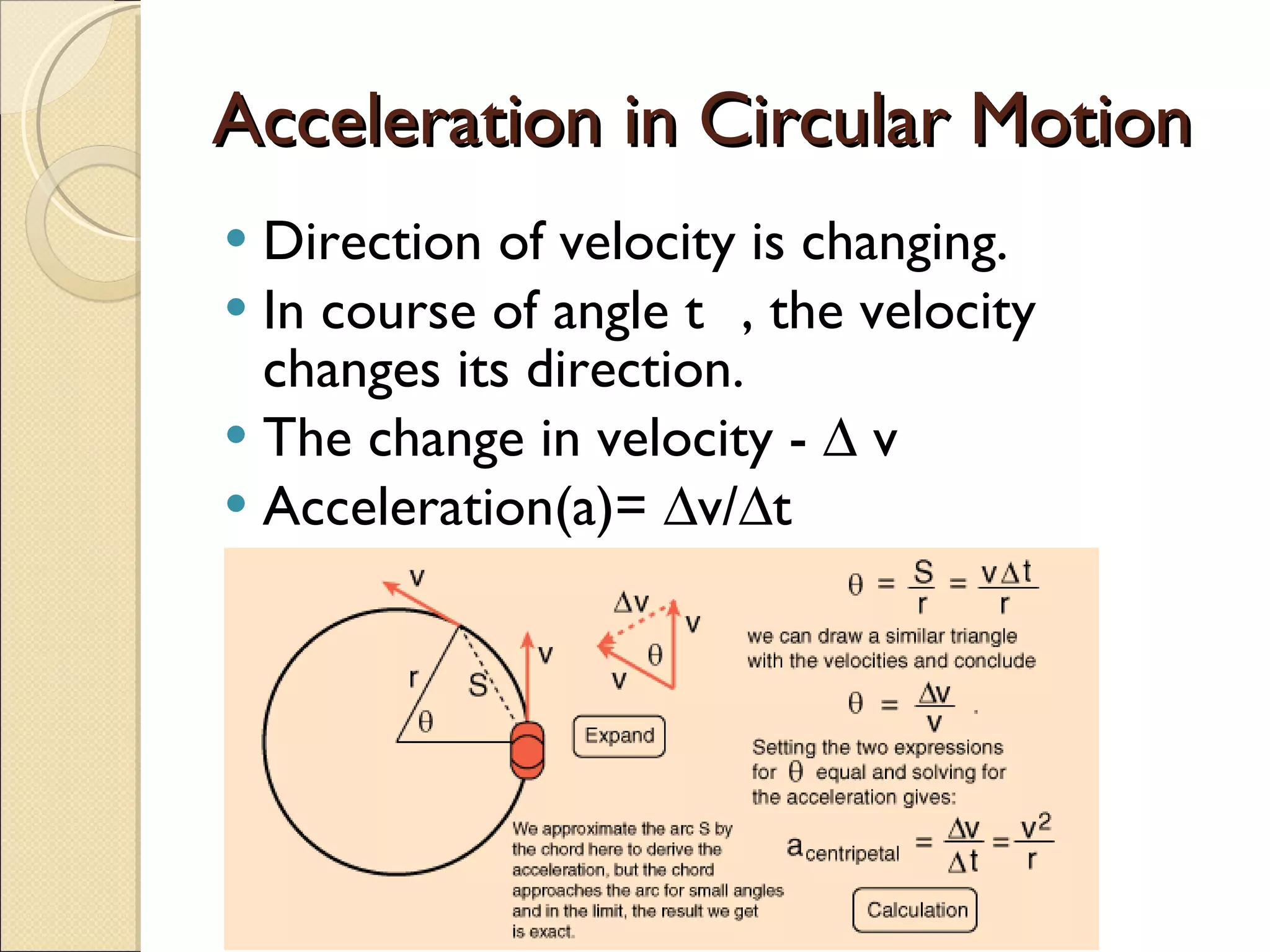
Acceleration in Circular Motion Direction of velocity is changing. In course of angle 𝛩, the velocity changes its direction. The change in velocity - ∆ v Acceleration(a)= ∆v/∆t ∆ v= v 𝛩 a= v 𝛩/ ∆t 𝛩 =s/ r=v ∆t/r a=v ²/r
Acceleration is towards centre Change in velocity ∆ v is towards centre Acceleration is towards centre This acceleration is necessary for circular motion. This is produced by the force acting towards centre
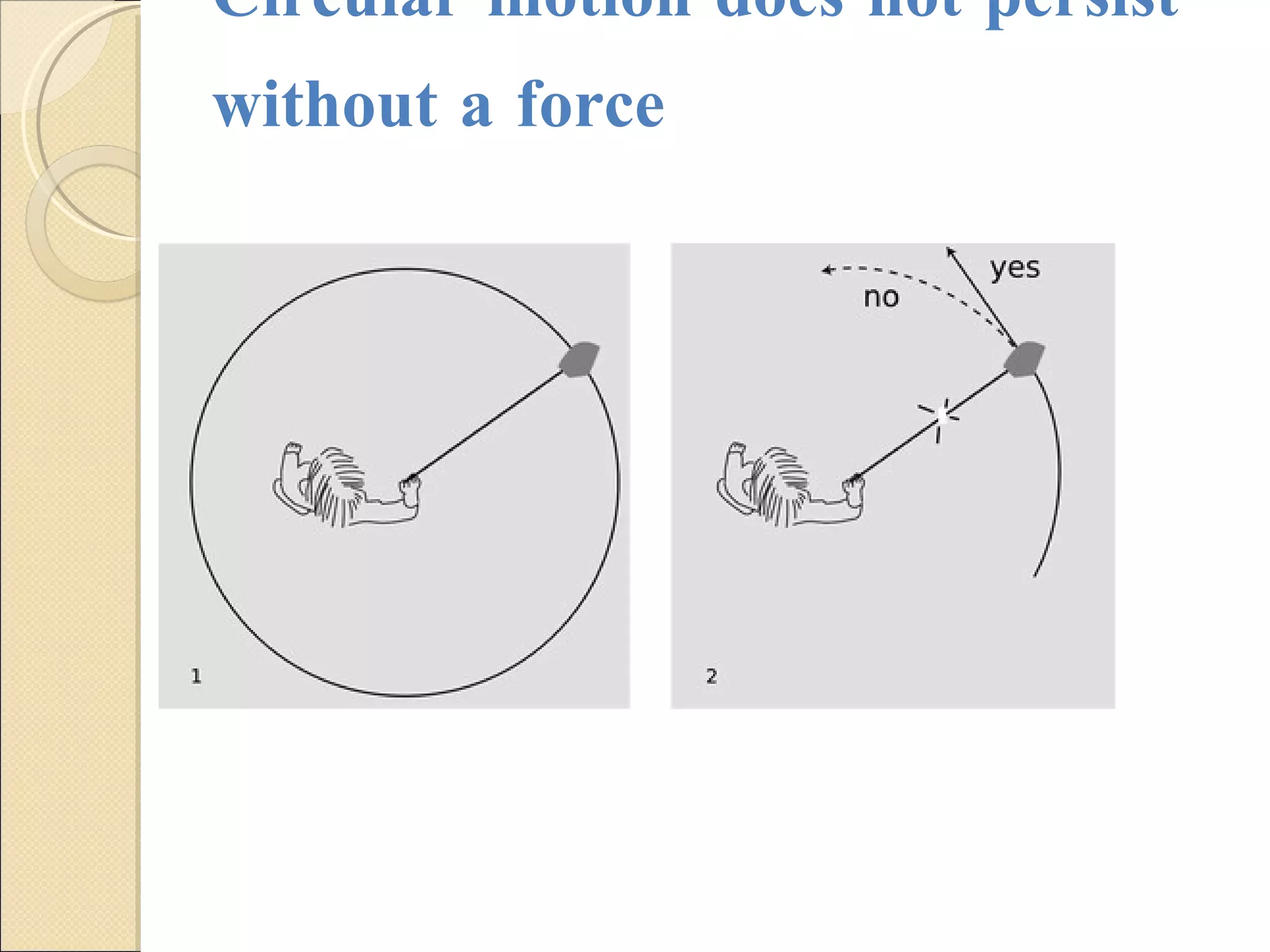
Circular motion does not persist without a force
Uniform and nonuniform circular motion Circular motion always involves a change in the direction of the velocity vector. When only direction changes but the magnitude is constant, the motion is called uniform. If the magnitude of the velocity also changes , the motion is  nonuniform
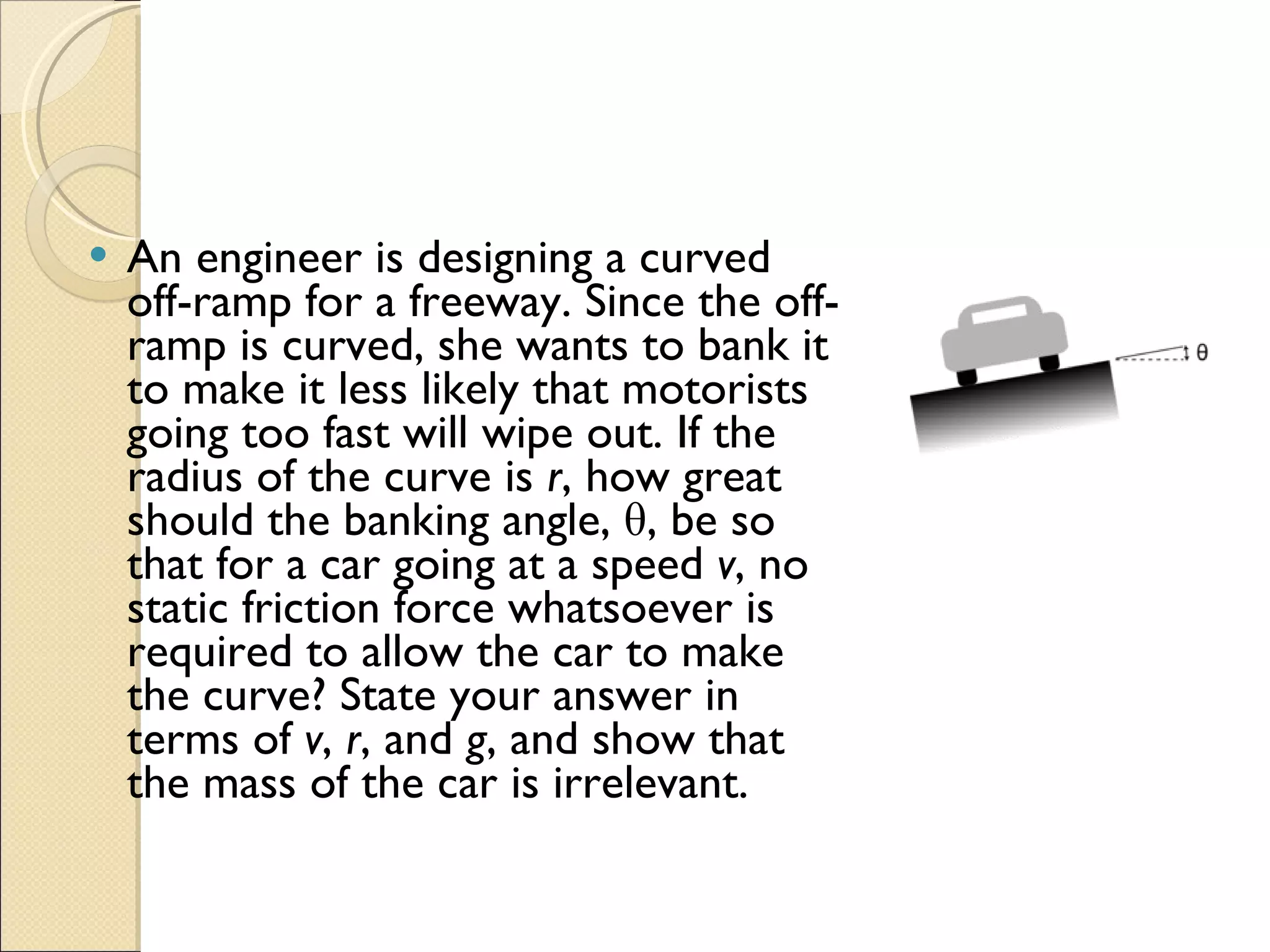
An engineer is designing a curved off-ramp for a freeway. Since the off-ramp is curved, she wants to bank it to make it less likely that motorists going too fast will wipe out. If the radius of the curve is  r , how great should the banking angle, θ, be so that for a car going at a speed  v , no static friction force whatsoever is required to allow the car to make the curve? State your answer in terms of  v ,  r , and  g , and show that the mass of the car is irrelevant.
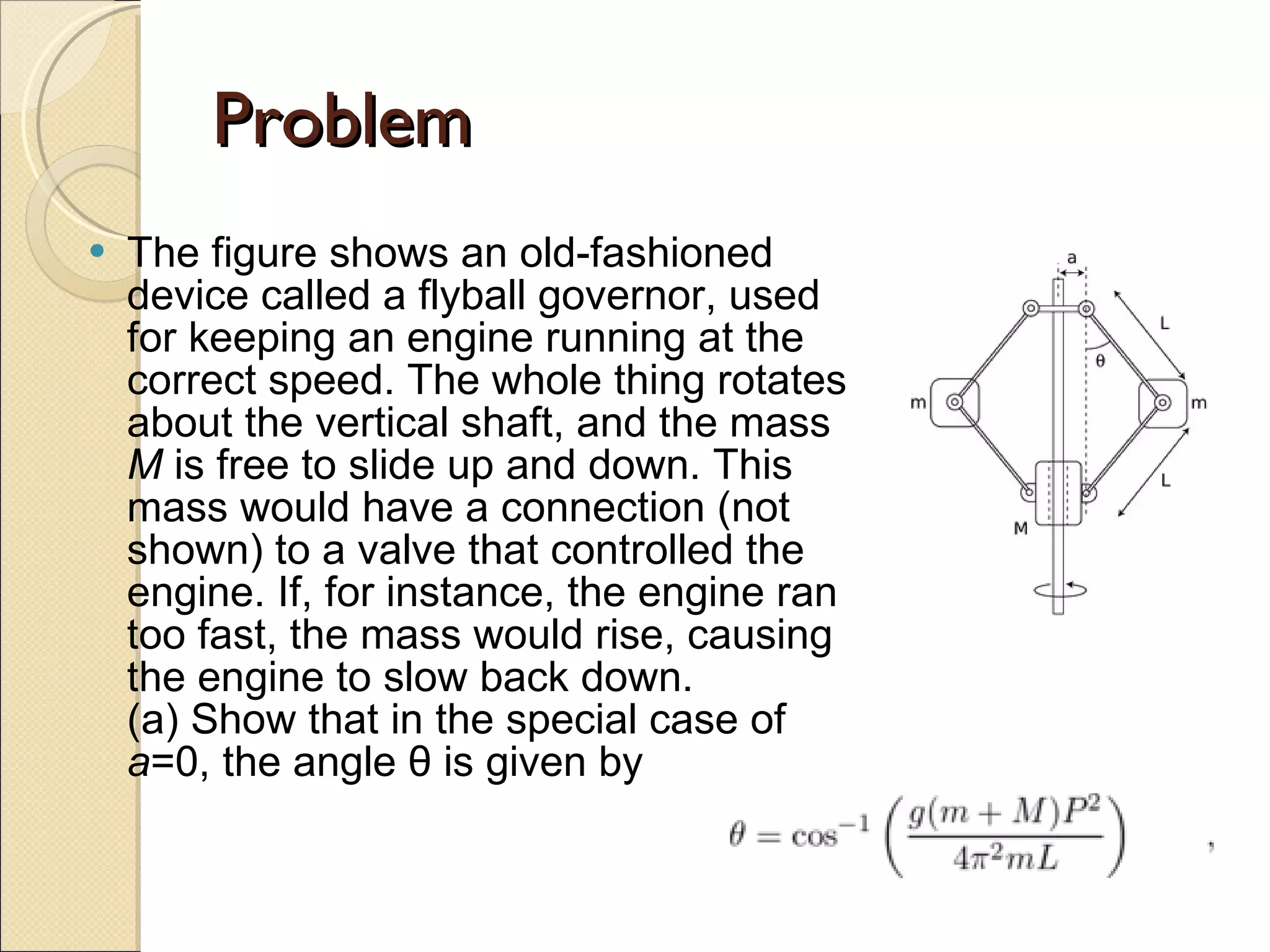
Problem The figure shows an old-fashioned device called a flyball governor, used for keeping an engine running at the correct speed. The whole thing rotates about the vertical shaft, and the mass  M  is free to slide up and down. This mass would have a connection (not shown) to a valve that controlled the engine. If, for instance, the engine ran too fast, the mass would rise, causing the engine to slow back down. (a) Show that in the special case of  a =0, the angle θ is given by
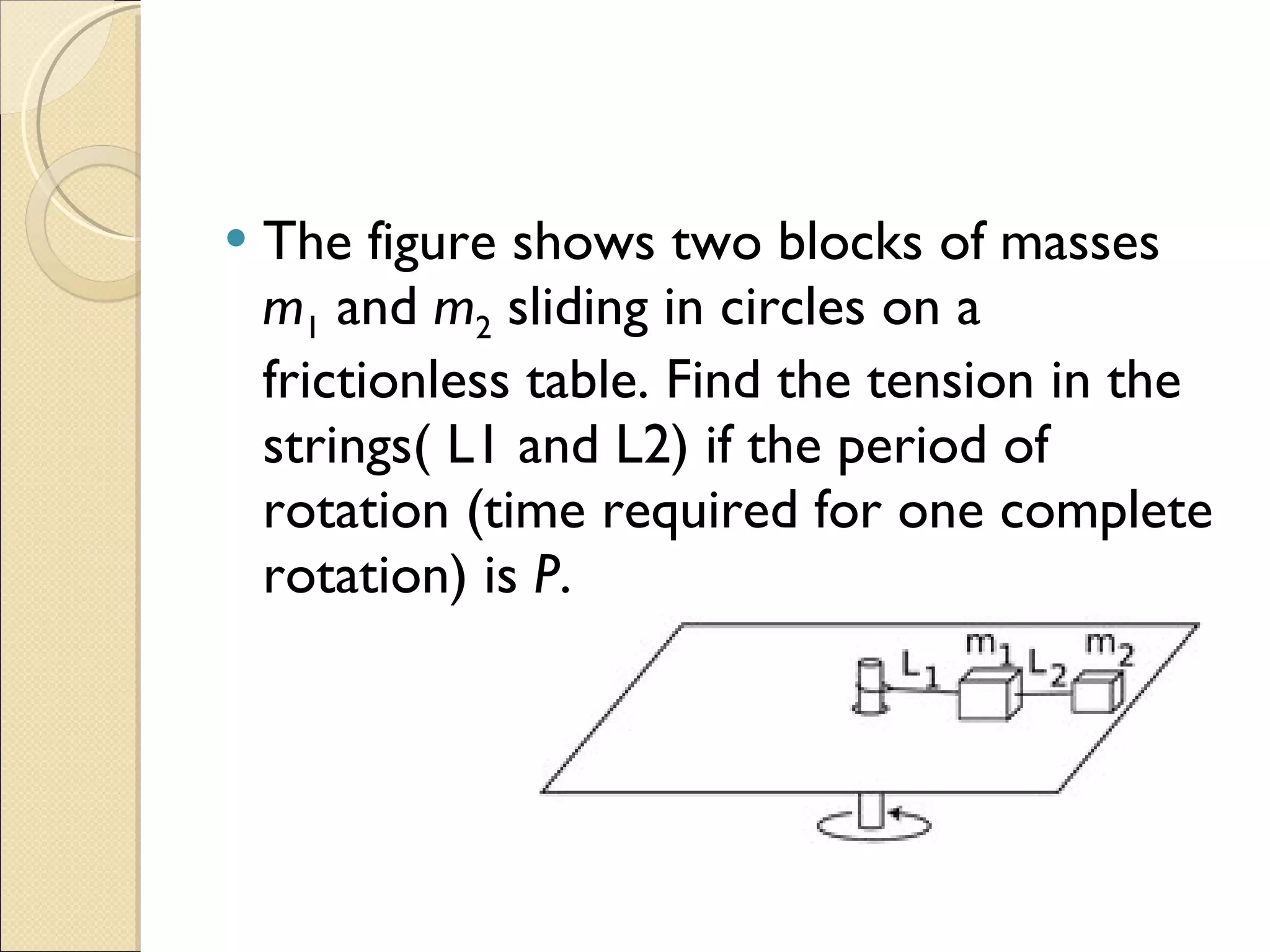
The figure shows two blocks of masses  m 1  and  m 2  sliding in circles on a frictionless table. Find the tension in the strings( L1 and L2) if the period of rotation (time required for one complete rotation) is  P .
Source- http://hyperphysics.phy-astr.gsu.edu/hbase/circ.html http://en.wikipedia.org/wiki/Circular_motion http://www.lightandmatter.com/html_books/1np/ch09/ch09.html

Circular Motion

  • 1.
    Uniform Circular MotionBy Yatendra Kumar
  • 2.
    Velocity in circularmotion The velocity of the object traveling the circle is
  • 3.
    Acceleration in CircularMotion Direction of velocity is changing. In course of angle 𝛩, the velocity changes its direction. The change in velocity - ∆ v Acceleration(a)= ∆v/∆t ∆ v= v 𝛩 a= v 𝛩/ ∆t 𝛩 =s/ r=v ∆t/r a=v ²/r
  • 4.
    Acceleration is towardscentre Change in velocity ∆ v is towards centre Acceleration is towards centre This acceleration is necessary for circular motion. This is produced by the force acting towards centre
  • 5.
    Circular motion doesnot persist without a force
  • 6.
    Uniform and nonuniformcircular motion Circular motion always involves a change in the direction of the velocity vector. When only direction changes but the magnitude is constant, the motion is called uniform. If the magnitude of the velocity also changes , the motion is nonuniform
  • 7.
    An engineer isdesigning a curved off-ramp for a freeway. Since the off-ramp is curved, she wants to bank it to make it less likely that motorists going too fast will wipe out. If the radius of the curve is r , how great should the banking angle, θ, be so that for a car going at a speed v , no static friction force whatsoever is required to allow the car to make the curve? State your answer in terms of v , r , and g , and show that the mass of the car is irrelevant.
  • 8.
    Problem The figureshows an old-fashioned device called a flyball governor, used for keeping an engine running at the correct speed. The whole thing rotates about the vertical shaft, and the mass M is free to slide up and down. This mass would have a connection (not shown) to a valve that controlled the engine. If, for instance, the engine ran too fast, the mass would rise, causing the engine to slow back down. (a) Show that in the special case of a =0, the angle θ is given by
  • 9.
    The figure showstwo blocks of masses m 1 and m 2 sliding in circles on a frictionless table. Find the tension in the strings( L1 and L2) if the period of rotation (time required for one complete rotation) is P .
  • 10.