Electrons Unleashed:
A Journey Through
Classical Free
Electron Theory
Introduction
What is classical free electron theory?
The Drude Model
Electron Scattering
Electrical Conductivity
Limitations of Classical Free Electron
Theory
Quantum Mechanics
The Sommerfeld Model
Applications of Classical Free
Electron Theory
Conclusion
Introduction
Welcome to the world of classical free electron theory! At its core, this
theory explains how electrons move through materials and interact with
each other. It is a fundamental concept in the ïŹeld of condensed matter
physics, with applications ranging from electronics to materials science.
In this presentation, we will explore the basic principles of classical free
electron theory, its limitations, and its practical applications. We will also
delve into related topics such as quantum mechanics and the
Sommerfeld model. So buckle up and get ready for a journey through the
fascinating world of electrons!
What is classical free electron theory?
Classical free electron theory is a fundamental concept in the ïŹeld of
condensed matter physics. At its core, it describes the behavior of
electrons in a solid material as if they were free particles moving in a
vacuum. This simpliïŹcation allows for a more straightforward
understanding of the electrical and thermal properties of materials. The
basic principles of classical free electron theory are rooted in the laws of
classical mechanics. Electrons are treated as point particles that move
freely through a lattice of positively charged ions. The motion of these
electrons is governed by the forces acting upon them, including electric
ïŹelds and collisions with other particles.
The Drude Model
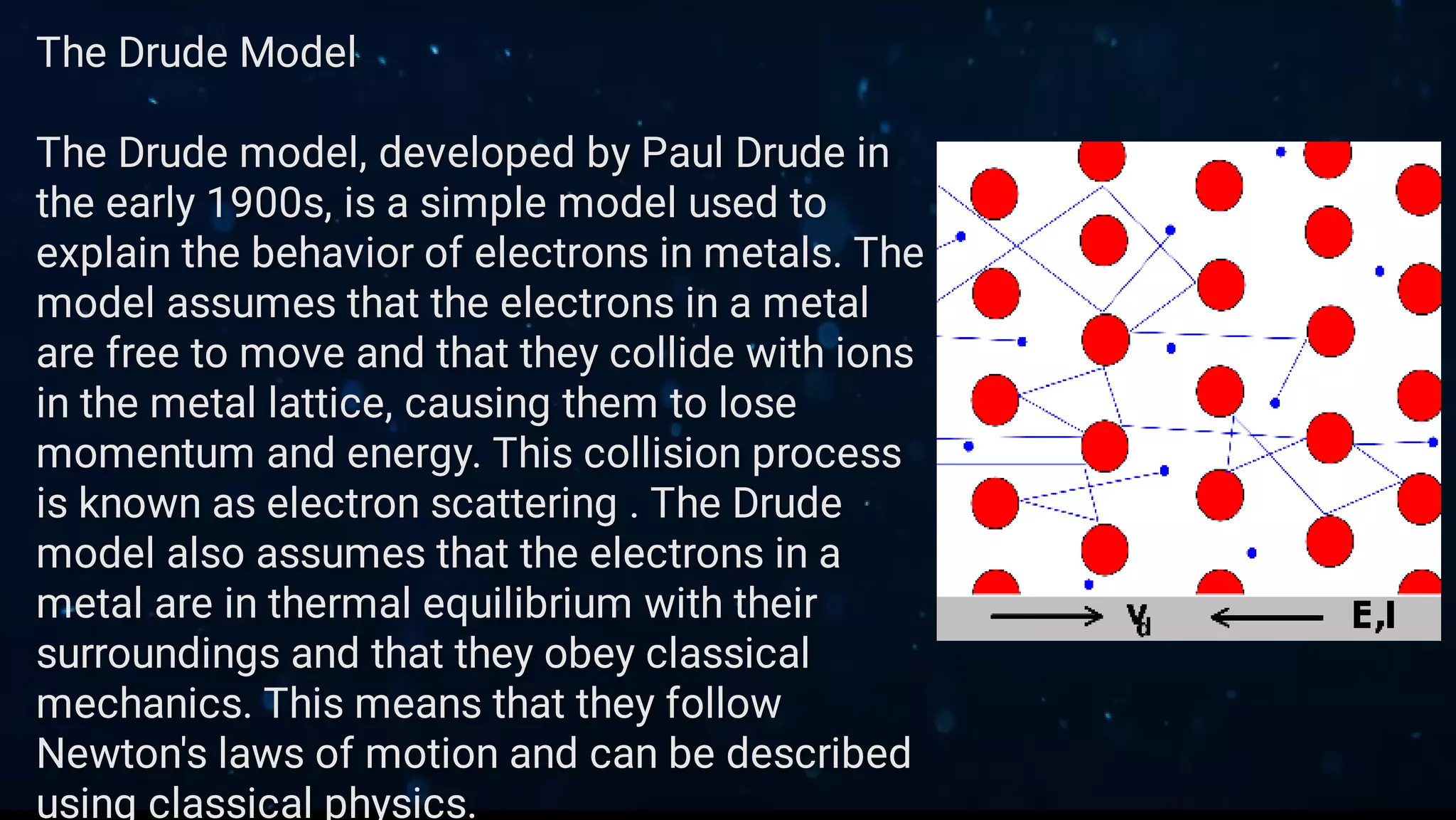
The Drude model, developed by Paul Drude in
the early 1900s, is a simple model used to
explain the behavior of electrons in metals. The
model assumes that the electrons in a metal
are free to move and that they collide with ions
in the metal lattice, causing them to lose
momentum and energy. This collision process
is known as electron scattering . The Drude
model also assumes that the electrons in a
metal are in thermal equilibrium with their
surroundings and that they obey classical
mechanics. This means that they follow
Newton's laws of motion and can be described
using classical physics.
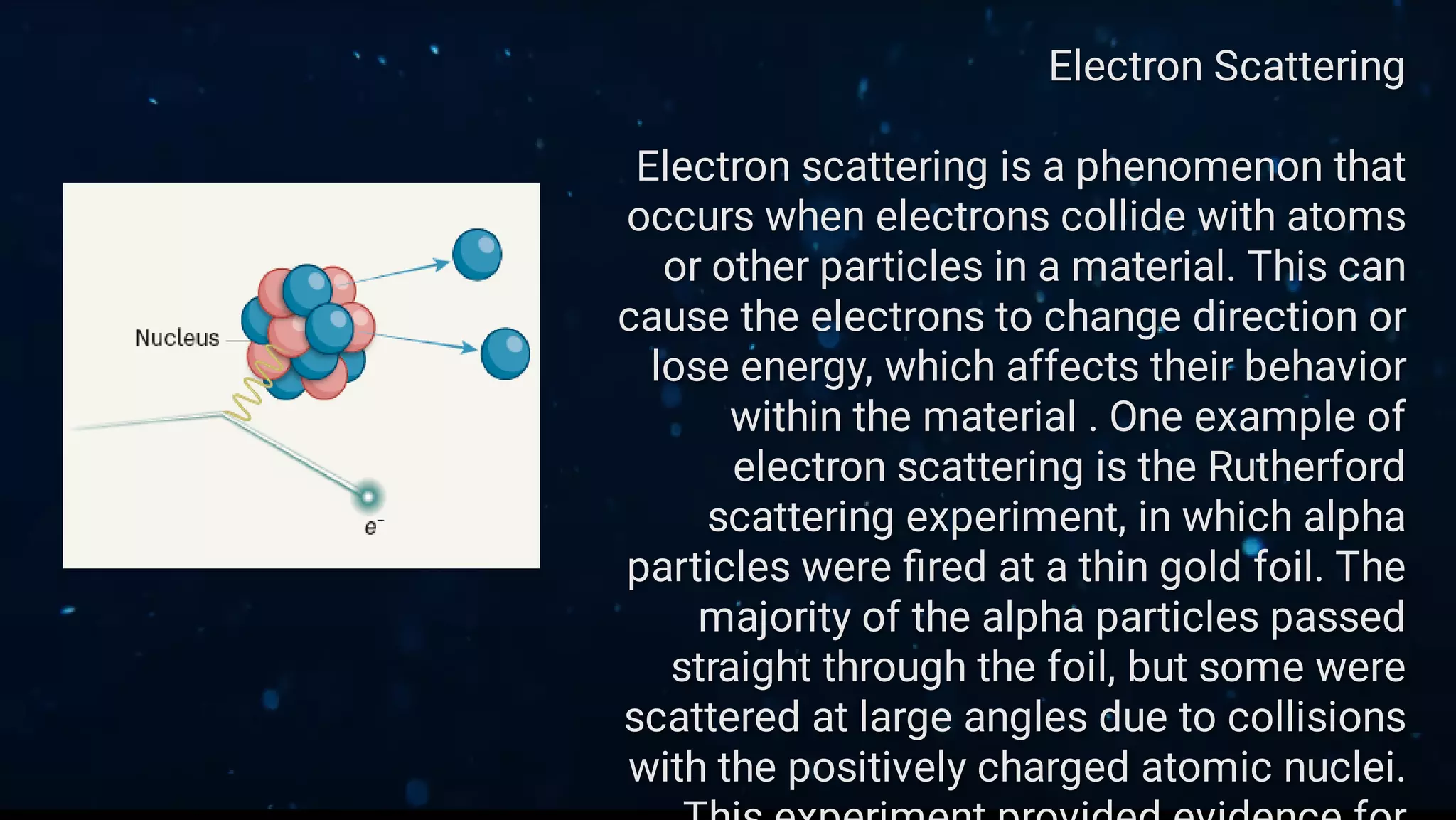
Electron Scattering
Electron scattering is a phenomenon that
occurs when electrons collide with atoms
or other particles in a material. This can
cause the electrons to change direction or
lose energy, which affects their behavior
within the material . One example of
electron scattering is the Rutherford
scattering experiment, in which alpha
particles were ïŹred at a thin gold foil. The
majority of the alpha particles passed
straight through the foil, but some were
scattered at large angles due to collisions
with the positively charged atomic nuclei.
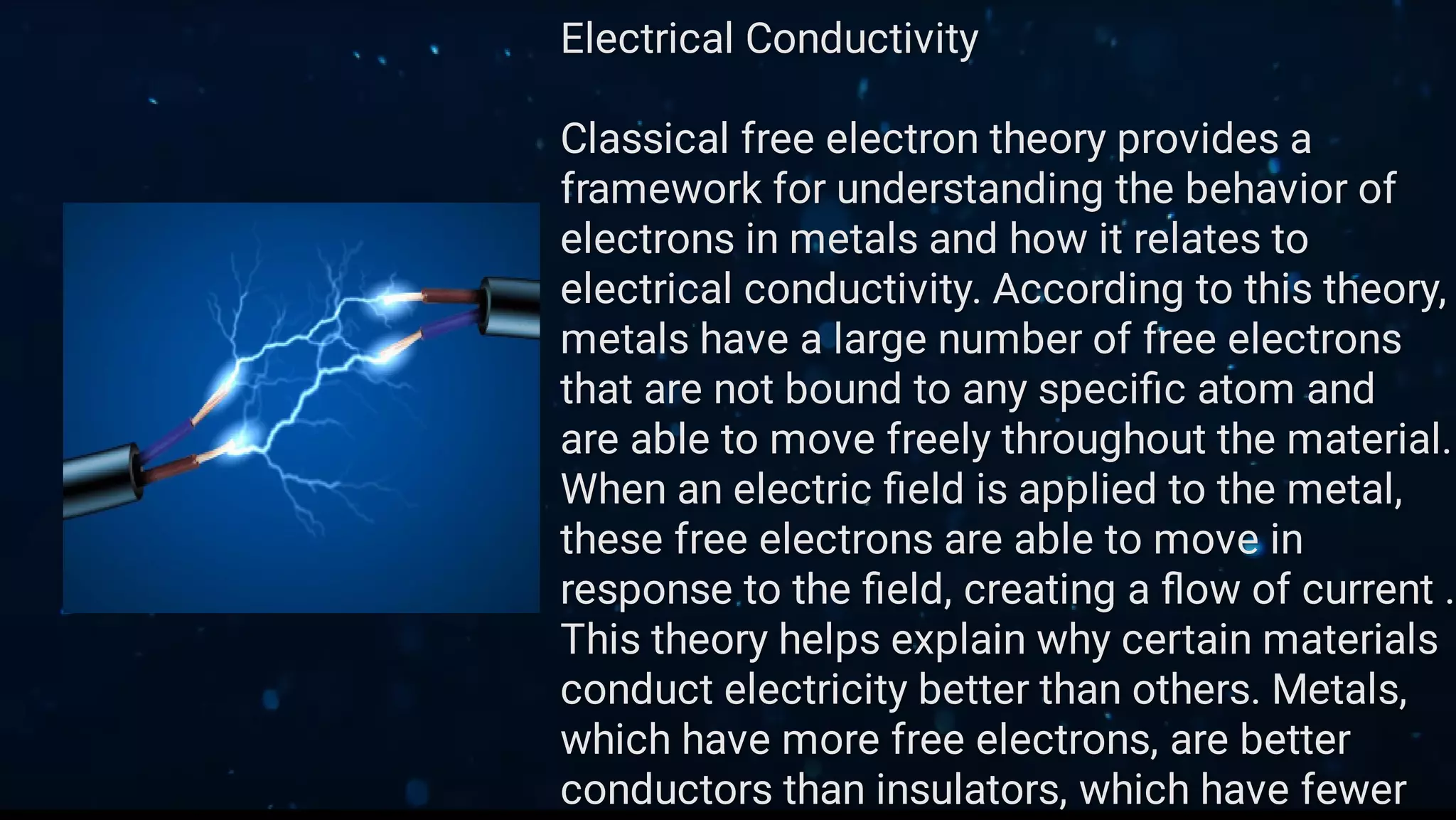
Electrical Conductivity
Classical free electron theory provides a
framework for understanding the behavior of
electrons in metals and how it relates to
electrical conductivity. According to this theory,
metals have a large number of free electrons
that are not bound to any speciïŹc atom and
are able to move freely throughout the material.
When an electric ïŹeld is applied to the metal,
these free electrons are able to move in
response to the ïŹeld, creating a ïŹ‚ow of current .
This theory helps explain why certain materials
conduct electricity better than others. Metals,
which have more free electrons, are better
conductors than insulators, which have fewer
Limitations of Classical Free Electron Theory
Classical free electron theory is a powerful tool for understanding the
behavior of electrons in metals, but it has its limitations. One major
limitation is its inability to explain certain phenomena, such as the Hall
effect and superconductivity. The Hall effect occurs when a magnetic ïŹeld
is applied perpendicular to the ïŹ‚ow of current in a conductor, causing a
voltage to be generated across the width of the conductor.
Superconductivity is the phenomenon where a material loses all electrical
resistance at very low temperatures . While classical free electron theory
can explain many aspects of electrical conductivity in metals, it falls short
in explaining these more complex phenomena. This is where quantum
mechanics comes into play, providing a more accurate and complete
picture of electron behavior.
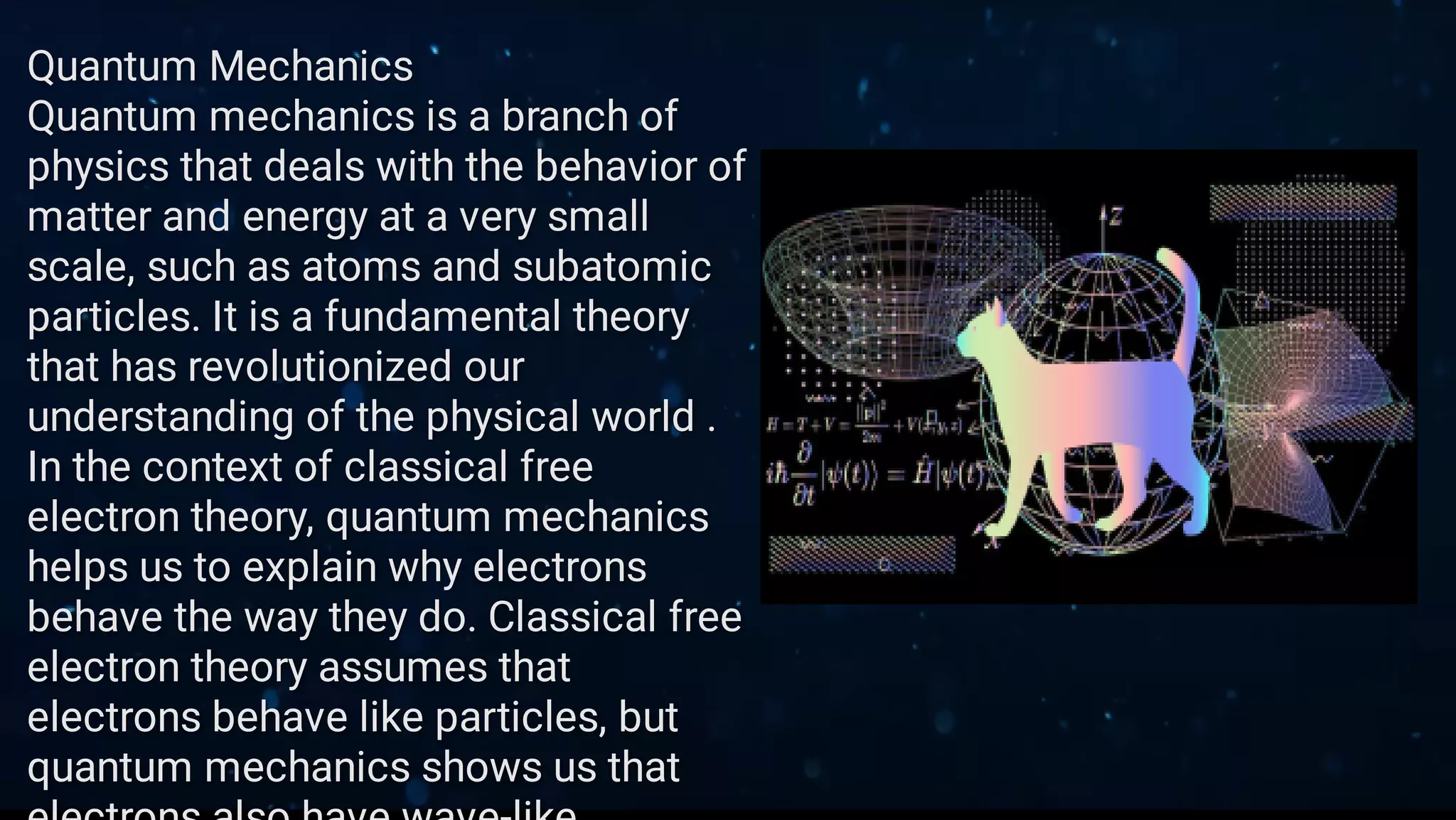
Quantum Mechanics
Quantum mechanics is a branch of
physics that deals with the behavior of
matter and energy at a very small
scale, such as atoms and subatomic
particles. It is a fundamental theory
that has revolutionized our
understanding of the physical world .
In the context of classical free
electron theory, quantum mechanics
helps us to explain why electrons
behave the way they do. Classical free
electron theory assumes that
electrons behave like particles, but
quantum mechanics shows us that
The Sommerfeld Model
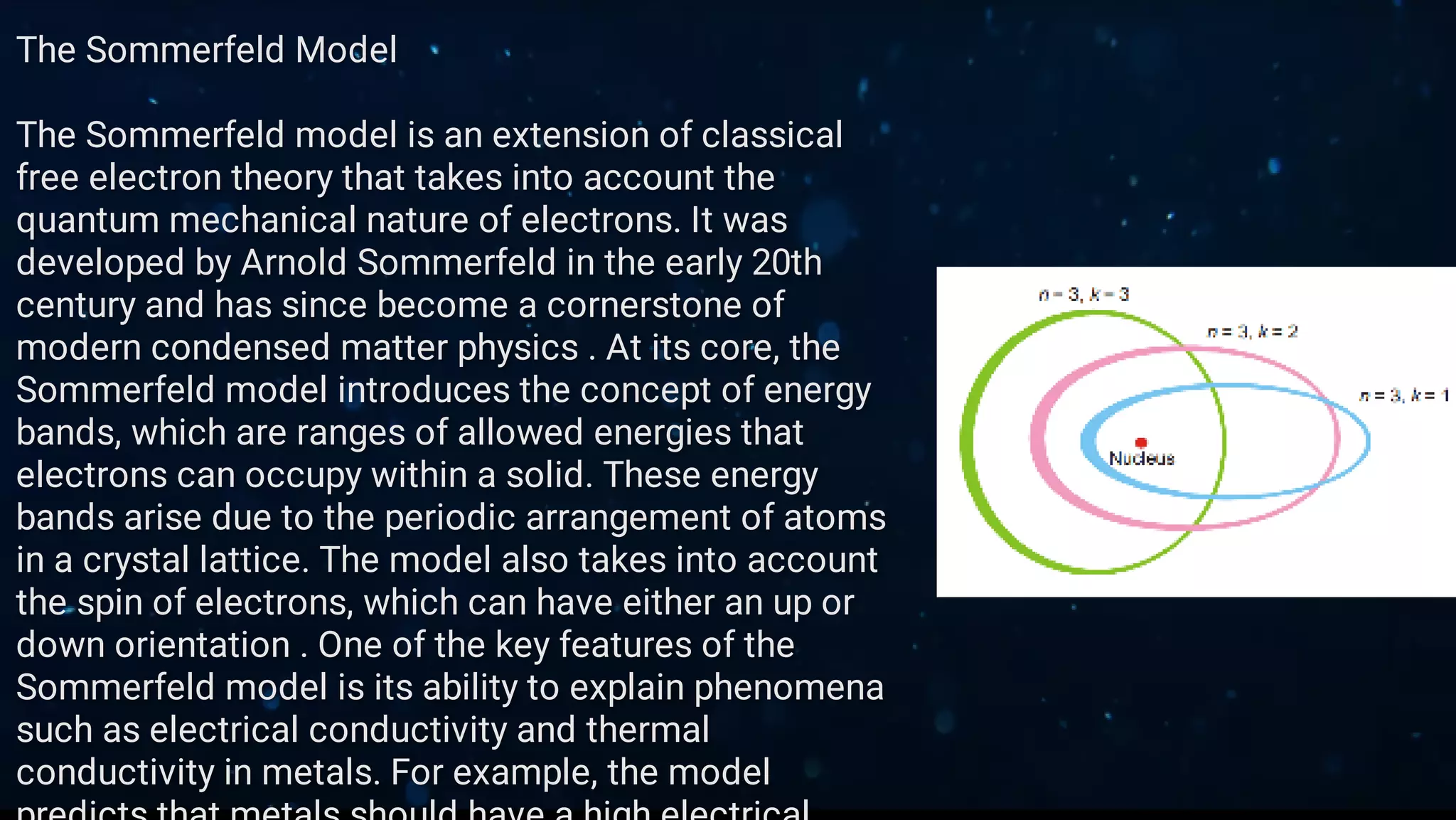
The Sommerfeld model is an extension of classical
free electron theory that takes into account the
quantum mechanical nature of electrons. It was
developed by Arnold Sommerfeld in the early 20th
century and has since become a cornerstone of
modern condensed matter physics . At its core, the
Sommerfeld model introduces the concept of energy
bands, which are ranges of allowed energies that
electrons can occupy within a solid. These energy
bands arise due to the periodic arrangement of atoms
in a crystal lattice. The model also takes into account
the spin of electrons, which can have either an up or
down orientation . One of the key features of the
Sommerfeld model is its ability to explain phenomena
such as electrical conductivity and thermal
conductivity in metals. For example, the model
Applications of Classical Free Electron Theory
Classical free electron theory has numerous practical applications,
particularly in the ïŹeld of materials science. One key application is in the
study of metals and their behavior under different conditions. By
understanding the principles of classical free electron theory, researchers
can predict how metals will behave in various environments and design new
alloys with speciïŹc properties . Another important application of classical
free electron theory is in the development of semiconductors. By
manipulating the behavior of electrons in materials, scientists can create
new materials with unique electrical properties that are essential for modern
electronics. This has led to the development of transistors, integrated
circuits, and other electronic devices that have revolutionized our world.
Conclusion
In conclusion, classical free electron theory
is a fundamental concept in the ïŹeld of
materials science and solid-state physics. It
provides a framework for understanding the
behavior of electrons in metals and other
conductive materials, and has practical
applications in areas such as electronics and
energy generation . While classical free
electron theory has its limitations,
particularly in explaining certain phenomena
at the atomic scale, it remains an important
tool for scientists and engineers working in a
variety of ïŹelds. By building upon this
foundation with quantum mechanics and
Thank you!!!!!

free electron theory.pdf

  • 1.
    Electrons Unleashed: A JourneyThrough Classical Free Electron Theory
  • 2.
    Introduction What is classicalfree electron theory? The Drude Model Electron Scattering Electrical Conductivity Limitations of Classical Free Electron Theory Quantum Mechanics The Sommerfeld Model Applications of Classical Free Electron Theory Conclusion
  • 3.
    Introduction Welcome to theworld of classical free electron theory! At its core, this theory explains how electrons move through materials and interact with each other. It is a fundamental concept in the ïŹeld of condensed matter physics, with applications ranging from electronics to materials science. In this presentation, we will explore the basic principles of classical free electron theory, its limitations, and its practical applications. We will also delve into related topics such as quantum mechanics and the Sommerfeld model. So buckle up and get ready for a journey through the fascinating world of electrons!
  • 4.
    What is classicalfree electron theory? Classical free electron theory is a fundamental concept in the ïŹeld of condensed matter physics. At its core, it describes the behavior of electrons in a solid material as if they were free particles moving in a vacuum. This simpliïŹcation allows for a more straightforward understanding of the electrical and thermal properties of materials. The basic principles of classical free electron theory are rooted in the laws of classical mechanics. Electrons are treated as point particles that move freely through a lattice of positively charged ions. The motion of these electrons is governed by the forces acting upon them, including electric ïŹelds and collisions with other particles.
  • 5.
    The Drude Model TheDrude model, developed by Paul Drude in the early 1900s, is a simple model used to explain the behavior of electrons in metals. The model assumes that the electrons in a metal are free to move and that they collide with ions in the metal lattice, causing them to lose momentum and energy. This collision process is known as electron scattering . The Drude model also assumes that the electrons in a metal are in thermal equilibrium with their surroundings and that they obey classical mechanics. This means that they follow Newton's laws of motion and can be described using classical physics.
  • 6.
    Electron Scattering Electron scatteringis a phenomenon that occurs when electrons collide with atoms or other particles in a material. This can cause the electrons to change direction or lose energy, which affects their behavior within the material . One example of electron scattering is the Rutherford scattering experiment, in which alpha particles were ïŹred at a thin gold foil. The majority of the alpha particles passed straight through the foil, but some were scattered at large angles due to collisions with the positively charged atomic nuclei.
  • 7.
    Electrical Conductivity Classical freeelectron theory provides a framework for understanding the behavior of electrons in metals and how it relates to electrical conductivity. According to this theory, metals have a large number of free electrons that are not bound to any speciïŹc atom and are able to move freely throughout the material. When an electric ïŹeld is applied to the metal, these free electrons are able to move in response to the ïŹeld, creating a ïŹ‚ow of current . This theory helps explain why certain materials conduct electricity better than others. Metals, which have more free electrons, are better conductors than insulators, which have fewer
  • 8.
    Limitations of ClassicalFree Electron Theory Classical free electron theory is a powerful tool for understanding the behavior of electrons in metals, but it has its limitations. One major limitation is its inability to explain certain phenomena, such as the Hall effect and superconductivity. The Hall effect occurs when a magnetic ïŹeld is applied perpendicular to the ïŹ‚ow of current in a conductor, causing a voltage to be generated across the width of the conductor. Superconductivity is the phenomenon where a material loses all electrical resistance at very low temperatures . While classical free electron theory can explain many aspects of electrical conductivity in metals, it falls short in explaining these more complex phenomena. This is where quantum mechanics comes into play, providing a more accurate and complete picture of electron behavior.
  • 9.
    Quantum Mechanics Quantum mechanicsis a branch of physics that deals with the behavior of matter and energy at a very small scale, such as atoms and subatomic particles. It is a fundamental theory that has revolutionized our understanding of the physical world . In the context of classical free electron theory, quantum mechanics helps us to explain why electrons behave the way they do. Classical free electron theory assumes that electrons behave like particles, but quantum mechanics shows us that
  • 10.
    The Sommerfeld Model TheSommerfeld model is an extension of classical free electron theory that takes into account the quantum mechanical nature of electrons. It was developed by Arnold Sommerfeld in the early 20th century and has since become a cornerstone of modern condensed matter physics . At its core, the Sommerfeld model introduces the concept of energy bands, which are ranges of allowed energies that electrons can occupy within a solid. These energy bands arise due to the periodic arrangement of atoms in a crystal lattice. The model also takes into account the spin of electrons, which can have either an up or down orientation . One of the key features of the Sommerfeld model is its ability to explain phenomena such as electrical conductivity and thermal conductivity in metals. For example, the model
  • 11.
    Applications of ClassicalFree Electron Theory Classical free electron theory has numerous practical applications, particularly in the ïŹeld of materials science. One key application is in the study of metals and their behavior under different conditions. By understanding the principles of classical free electron theory, researchers can predict how metals will behave in various environments and design new alloys with speciïŹc properties . Another important application of classical free electron theory is in the development of semiconductors. By manipulating the behavior of electrons in materials, scientists can create new materials with unique electrical properties that are essential for modern electronics. This has led to the development of transistors, integrated circuits, and other electronic devices that have revolutionized our world.
  • 12.
    Conclusion In conclusion, classicalfree electron theory is a fundamental concept in the ïŹeld of materials science and solid-state physics. It provides a framework for understanding the behavior of electrons in metals and other conductive materials, and has practical applications in areas such as electronics and energy generation . While classical free electron theory has its limitations, particularly in explaining certain phenomena at the atomic scale, it remains an important tool for scientists and engineers working in a variety of ïŹelds. By building upon this foundation with quantum mechanics and
  • 13.