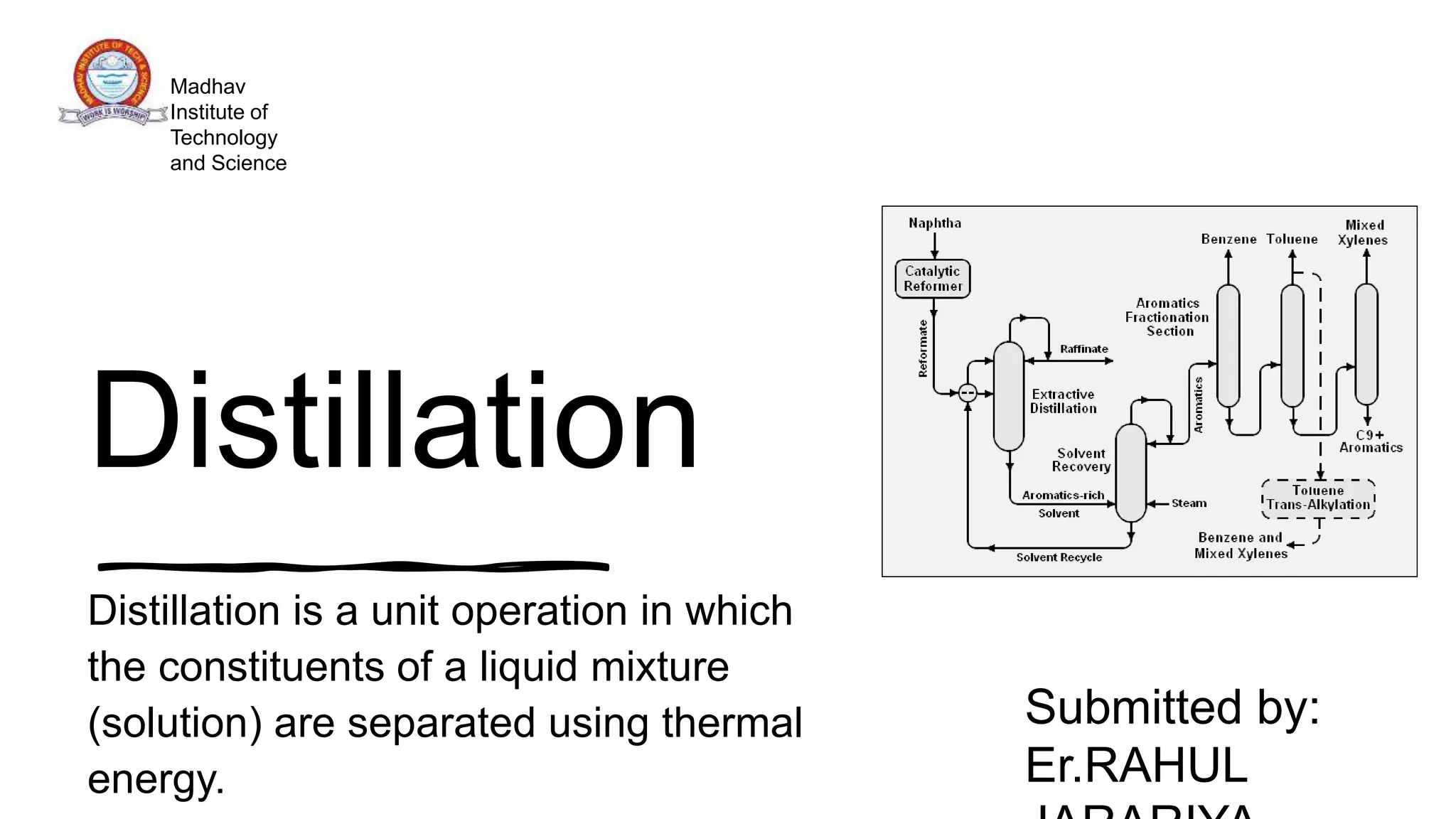
Distillation
Distillation is a unit operation in which
the constituents of a liquid mixture
(solution) are separated using thermal
energy.
Madhav
Institute of
Technology
and Science
Submitted by:
Er.RAHUL
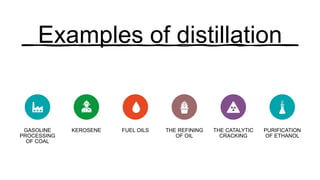
Examples of distillation
GASOLINE
PROCESSING
OF COAL
KEROSENE FUEL OILS THE REFINING
OF OIL
THE CATALYTIC
CRACKING
PURIFICATION
OF ETHANOL
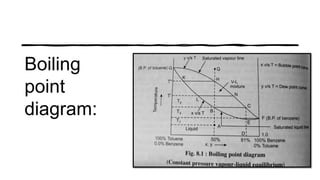
Boiling
point
diagram:
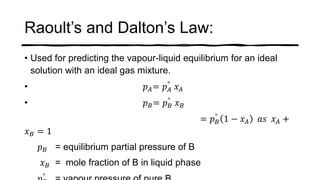
Raoult’s and Dalton’s Law:
• Used for predicting the vapour-liquid equilibrium for an ideal
solution with an ideal gas mixture.
• 𝑝 𝐴= 𝑝 𝐴
°
𝑥 𝐴
• 𝑝 𝐵= 𝑝 𝐵
°
𝑥 𝐵
= 𝑝 𝐵
°
1 − 𝑥 𝐴 𝑎𝑠 𝑥 𝐴 +
𝑥 𝐵 = 1
𝑝 𝐵 = equilibrium partial pressure of B
𝑥 𝐵 = mole fraction of B in liquid phase
°
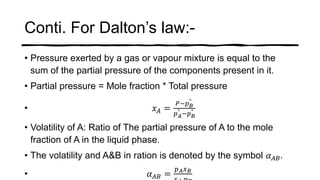
Conti. For Dalton’s law:-
• Pressure exerted by a gas or vapour mixture is equal to the
sum of the partial pressure of the components present in it.
• Partial pressure = Mole fraction * Total pressure
• 𝑥 𝐴 =
𝑃−𝑝 𝐵
°
𝑝 𝐴
° −𝑝 𝐵
°
• Volatility of A: Ratio of The partial pressure of A to the mole
fraction of A in the liquid phase.
• The volatility and A&B in ration is denoted by the symbol 𝛼 𝐴𝐵.
• 𝛼 𝐴𝐵 =
𝑝 𝐴 𝑥 𝐵
Cont.:-
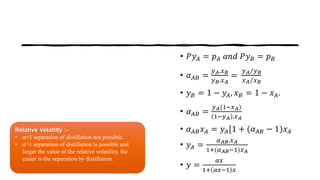
• 𝑃𝑦 𝐴 = 𝑝 𝐴 𝑎𝑛𝑑 𝑃𝑦 𝐵 = 𝑝 𝐵
• 𝛼 𝐴𝐵 =
𝑦 𝐴.𝑥 𝐵
𝑦 𝐵.𝑥 𝐴
=
𝑦 𝐴 𝑦 𝐵
𝑥 𝐴 𝑥 𝐵
• 𝑦 𝐵 = 1 − 𝑦 𝐴, 𝑥 𝐵 = 1 − 𝑥 𝐴.
• 𝛼 𝐴𝐵 =
𝑦 𝐴(1−𝑥 𝐴)
1−𝑦 𝐴 .𝑥 𝐴
• 𝛼 𝐴𝐵 𝑥 𝐴 = 𝑦 𝐴[1 + (𝛼 𝐴𝐵 − 1)𝑥 𝐴
• 𝑦 𝐴 =
𝛼 𝐴𝐵.𝑥 𝐴
1+(𝛼 𝐴𝐵−1)𝑥 𝐴
• 𝑦 =
𝛼𝑥
1+ 𝛼𝑥−1 𝑥
Relative Volatilty :-
• α=1 separation of distillation not possible.
• α>1 separation of distillation is possible and
larger the value of the relative volatility, the
easier is the separation by distillation.
Methods of Distillation:
• Differential or Simple distillation.
• Flash or equilibrium distillation.
• Rectification or fractionation.
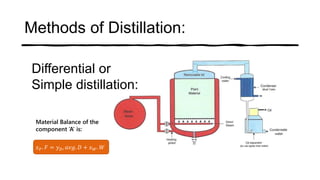
Differential or
Simple distillation:
Material Balance of the
component ‘A’ is:
𝑥 𝐹. 𝐹 = 𝑦 𝐷, 𝑎𝑣𝑔. 𝐷 + 𝑥 𝑊. 𝑊
Cont.:-
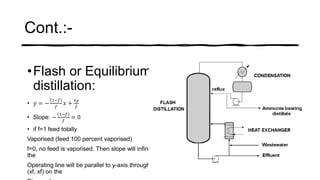
•Flash or Equilibrium
distillation:
• 𝑦 = −
1−𝑓
𝑓
𝑥 +
𝑥 𝐹
𝑓
• Slope: −
1−𝑓
𝑓
= 0
• if f=1 feed totally
Vaporised (feed 100 percent vaporised)
f=0, no feed is vaporised. Then slope will infinite. And
the
Operating line will be parallel to y-axis through a point
(xf, xf) on the
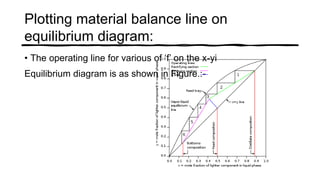
Plotting material balance line on
equilibrium diagram:
• The operating line for various of ‘f’ on the x-yi
Equilibrium diagram is as shown in Figure.:-
Rectification –Binary systems
• It is possible to get almost pure product by this method.
• The enrichment of the vapor stream as its passes through the
column in contact with reflux is termed as Rectification.
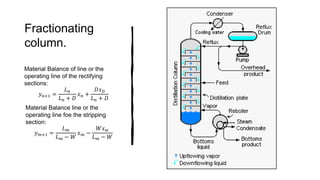
Fractionating column:
The fractionating column or fractionator consist of :
• A cylindrical shell divided into sections by a series of perforated
trays.
• A reboiler and A condenser
• This column divided into two sections – rectifying and stripping
Fractionating
column.
Material Balance of line or the
operating line of the rectifying
sections:
𝑦 𝑛+1 =
𝐿 𝑛
𝐿 𝑛 + 𝐷
𝑥 𝑛 +
𝐷𝑥 𝐷
𝐿 𝑛 + 𝐷
Material Balance line or the
operating line foe the stripping
section:
𝑦 𝑚+1 =
𝐿 𝑚
𝐿 𝑚 − 𝑊
𝑥 𝑚 −
𝑊𝑥 𝑤
𝐿 𝑚 − 𝑊
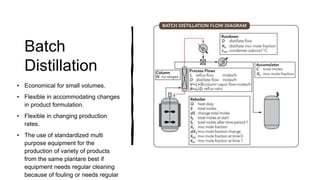
Batch
Distillation
• Economical for small volumes.
• Flexible in accommodating changes
in product formulation.
• Flexible in changing production
rates.
• The use of standardized multi
purpose equipment for the
production of variety of products
from the same plantare best if
equipment needs regular cleaning
because of fouling or needs regular
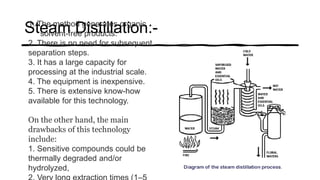
Steam Distillation:-1. The method generates organic
solvent-free products.
2. There is no need for subsequent
separation steps.
3. It has a large capacity for
processing at the industrial scale.
4. The equipment is inexpensive.
5. There is extensive know-how
available for this technology.
On the other hand, the main
drawbacks of this technology
include:
1. Sensitive compounds could be
thermally degraded and/or
hydrolyzed,
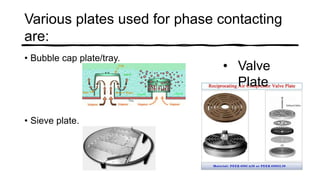
Various plates used for phase contacting
are:
• Bubble cap plate/tray.
• Sieve plate.
• Valve
Plate

Distillation

  • 1.
    Distillation Distillation is aunit operation in which the constituents of a liquid mixture (solution) are separated using thermal energy. Madhav Institute of Technology and Science Submitted by: Er.RAHUL
  • 2.
    Examples of distillation GASOLINE PROCESSING OFCOAL KEROSENE FUEL OILS THE REFINING OF OIL THE CATALYTIC CRACKING PURIFICATION OF ETHANOL
  • 3.
  • 4.
    Raoult’s and Dalton’sLaw: • Used for predicting the vapour-liquid equilibrium for an ideal solution with an ideal gas mixture. • 𝑝 𝐴= 𝑝 𝐴 ° 𝑥 𝐴 • 𝑝 𝐵= 𝑝 𝐵 ° 𝑥 𝐵 = 𝑝 𝐵 ° 1 − 𝑥 𝐴 𝑎𝑠 𝑥 𝐴 + 𝑥 𝐵 = 1 𝑝 𝐵 = equilibrium partial pressure of B 𝑥 𝐵 = mole fraction of B in liquid phase °
  • 5.
    Conti. For Dalton’slaw:- • Pressure exerted by a gas or vapour mixture is equal to the sum of the partial pressure of the components present in it. • Partial pressure = Mole fraction * Total pressure • 𝑥 𝐴 = 𝑃−𝑝 𝐵 ° 𝑝 𝐴 ° −𝑝 𝐵 ° • Volatility of A: Ratio of The partial pressure of A to the mole fraction of A in the liquid phase. • The volatility and A&B in ration is denoted by the symbol 𝛼 𝐴𝐵. • 𝛼 𝐴𝐵 = 𝑝 𝐴 𝑥 𝐵
  • 6.
    Cont.:- • 𝑃𝑦 𝐴= 𝑝 𝐴 𝑎𝑛𝑑 𝑃𝑦 𝐵 = 𝑝 𝐵 • 𝛼 𝐴𝐵 = 𝑦 𝐴.𝑥 𝐵 𝑦 𝐵.𝑥 𝐴 = 𝑦 𝐴 𝑦 𝐵 𝑥 𝐴 𝑥 𝐵 • 𝑦 𝐵 = 1 − 𝑦 𝐴, 𝑥 𝐵 = 1 − 𝑥 𝐴. • 𝛼 𝐴𝐵 = 𝑦 𝐴(1−𝑥 𝐴) 1−𝑦 𝐴 .𝑥 𝐴 • 𝛼 𝐴𝐵 𝑥 𝐴 = 𝑦 𝐴[1 + (𝛼 𝐴𝐵 − 1)𝑥 𝐴 • 𝑦 𝐴 = 𝛼 𝐴𝐵.𝑥 𝐴 1+(𝛼 𝐴𝐵−1)𝑥 𝐴 • 𝑦 = 𝛼𝑥 1+ 𝛼𝑥−1 𝑥 Relative Volatilty :- • α=1 separation of distillation not possible. • α>1 separation of distillation is possible and larger the value of the relative volatility, the easier is the separation by distillation.
  • 7.
    Methods of Distillation: •Differential or Simple distillation. • Flash or equilibrium distillation. • Rectification or fractionation. Differential or Simple distillation: Material Balance of the component ‘A’ is: 𝑥 𝐹. 𝐹 = 𝑦 𝐷, 𝑎𝑣𝑔. 𝐷 + 𝑥 𝑊. 𝑊
  • 8.
    Cont.:- •Flash or Equilibrium distillation: •𝑦 = − 1−𝑓 𝑓 𝑥 + 𝑥 𝐹 𝑓 • Slope: − 1−𝑓 𝑓 = 0 • if f=1 feed totally Vaporised (feed 100 percent vaporised) f=0, no feed is vaporised. Then slope will infinite. And the Operating line will be parallel to y-axis through a point (xf, xf) on the
  • 9.
    Plotting material balanceline on equilibrium diagram: • The operating line for various of ‘f’ on the x-yi Equilibrium diagram is as shown in Figure.:-
  • 10.
    Rectification –Binary systems •It is possible to get almost pure product by this method. • The enrichment of the vapor stream as its passes through the column in contact with reflux is termed as Rectification. Fractionating column: The fractionating column or fractionator consist of : • A cylindrical shell divided into sections by a series of perforated trays. • A reboiler and A condenser • This column divided into two sections – rectifying and stripping
  • 11.
    Fractionating column. Material Balance ofline or the operating line of the rectifying sections: 𝑦 𝑛+1 = 𝐿 𝑛 𝐿 𝑛 + 𝐷 𝑥 𝑛 + 𝐷𝑥 𝐷 𝐿 𝑛 + 𝐷 Material Balance line or the operating line foe the stripping section: 𝑦 𝑚+1 = 𝐿 𝑚 𝐿 𝑚 − 𝑊 𝑥 𝑚 − 𝑊𝑥 𝑤 𝐿 𝑚 − 𝑊
  • 12.
    Batch Distillation • Economical forsmall volumes. • Flexible in accommodating changes in product formulation. • Flexible in changing production rates. • The use of standardized multi purpose equipment for the production of variety of products from the same plantare best if equipment needs regular cleaning because of fouling or needs regular
  • 13.
    Steam Distillation:-1. Themethod generates organic solvent-free products. 2. There is no need for subsequent separation steps. 3. It has a large capacity for processing at the industrial scale. 4. The equipment is inexpensive. 5. There is extensive know-how available for this technology. On the other hand, the main drawbacks of this technology include: 1. Sensitive compounds could be thermally degraded and/or hydrolyzed,
  • 14.
    Various plates usedfor phase contacting are: • Bubble cap plate/tray. • Sieve plate. • Valve Plate